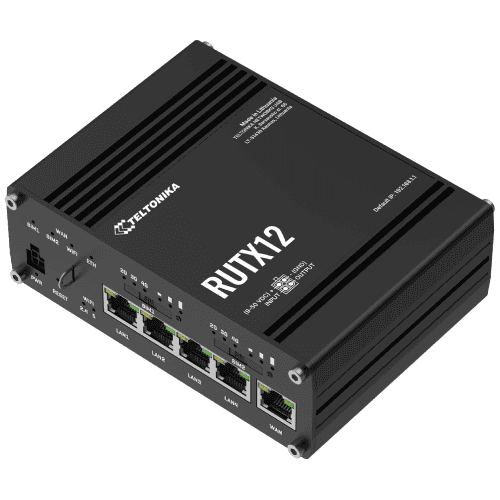
The RUTX12 is the right choice when a single cellular path carries too much risk. Two independent LTE modems, both active simultaneously, running on separate networks. It is not the cheapest way to get a router on a site – but for any IIoT deployment where connectivity loss has operational consequences, the dual-modem architecture changes the reliability equation in a way no single-modem router can match.
BESS, remote substations, DNP3 SCADA, high-availability industrial sites
Cost-sensitive rollouts where failover-only is acceptable
RUTX11 for single-modem dual-SIM failover at lower cost
Where the RUTX12 sits in the Teltonika lineup
The RUTX series sits above the RUT entry range and below the RUTM high-end and 5G range. Within the RUTX family, the RUTX12 is the only model with two independent LTE modems. Every other router in the Teltonika 4G range – including the RUTX11, the RUT series, and most RUTM models – has a single modem with one or two SIM slots. The RUTX12 is a different category of hardware, not just a higher-spec version of the same thing.
| Model | Modems | SIM slots | Simultaneous dual-path | Bondix | Cat |
|---|---|---|---|---|---|
| RUT200 | 1 | 1 | No | No | 4 |
| RUTX11 | 1 | 2 | No | No | 6 |
| RUTX12 | 2 | 2 | Yes | Yes | 6 |
| RUTM52 | 1 | 2 | No | No | 12 |
Dual modem versus dual SIM – why it matters
Most industrial routers described as “dual SIM” have a single modem. One SIM is active; the other waits. When the primary network fails, the router switches to the standby SIM. This is failover, and it works – but it is a recovery mechanism, not a prevention mechanism. There is a gap between failure and recovery. For many IIoT applications, that gap is acceptable.
The RUTX12 works differently. Both modems run simultaneously. Each has its own SIM on its own network path. The router load-balances across both by default. If one path drops, the other is already carrying traffic – there is no switchover delay because there is nothing to switch over to. The backup path is the primary path.
- One active path at a time
- SIM2 idles until needed
- Switchover on failure (15-30 sec)
- MNO diversity possible
- No load balancing
- Both paths active simultaneously
- Both SIMs connected at all times
- No switchover gap
- MNO diversity on both paths
- Load balancing + Bondix support
Reliability in IIoT – where the RUTX12 earns its cost
For most office or light commercial deployments, SIM failover is sufficient. A 30-second gap in connectivity is an inconvenience. For IIoT – remote monitoring, SCADA telemetry, DNP3 over cellular, smart metering backhaul – a 30-second loss of comms can mean missed data, alarm suppression, or a control system flagging a comms fault that requires manual investigation.
The dual-modem architecture removes that exposure. Combined with the RUTX12’s native support for DNP3 (station and outstation over TCP), Modbus TCP/USB, and OPC UA, and a built-in GNSS receiver for GPS time synchronisation, it covers the connectivity and timing requirements of most utility and industrial SCADA deployments from a single device.
The 9 to 50 VDC input range means it runs directly from a substation DC bus or a UPS output without a separate power converter. Add a 4 to 6 hour UPS on the power input and you have a connection that survives both MNO outages and site power failures simultaneously.
BESS deployment fit
Battery Energy Storage Systems are one of the strongest fits for the RUTX12. A utility-scale BESS site typically needs:
- Continuous DNP3 SCADA connectivity to the control centre (TCP port 20000)
- GPS timestamping for IEC 61850 event records
- MNO diversity to satisfy grid operator resilience requirements
- Wide DC input to power from the site UPS directly
- Remote monitoring and alerting via RMS when either cellular path degrades
The RUTX12 covers all five from a single unit. Place SIM1 on a private APN for the SCADA path and SIM2 on a separate MNO as the always-on backup. Both are active. Neither is waiting.
What to consider before specifying it
The RUTX12 is LTE Cat 6 on both modems – not 5G. For sites where 5G throughput is required, the RUTM series with 5G capability is the relevant range. The RUTX12 also has IP30 ingress protection, which means it needs to go inside an enclosure on any outdoor or exposed installation. It is not a sealed outdoor unit.
Bondix bonded 4G is a useful capability but it requires a separate Bondix subscription and a Bondix server endpoint. If you only need resilience and not aggregated throughput, you do not need Bondix – standard load balancing and hot swap failover are built in without any additional service.
Available from The Router Store with next-working-day delivery. UK-based technical support.


