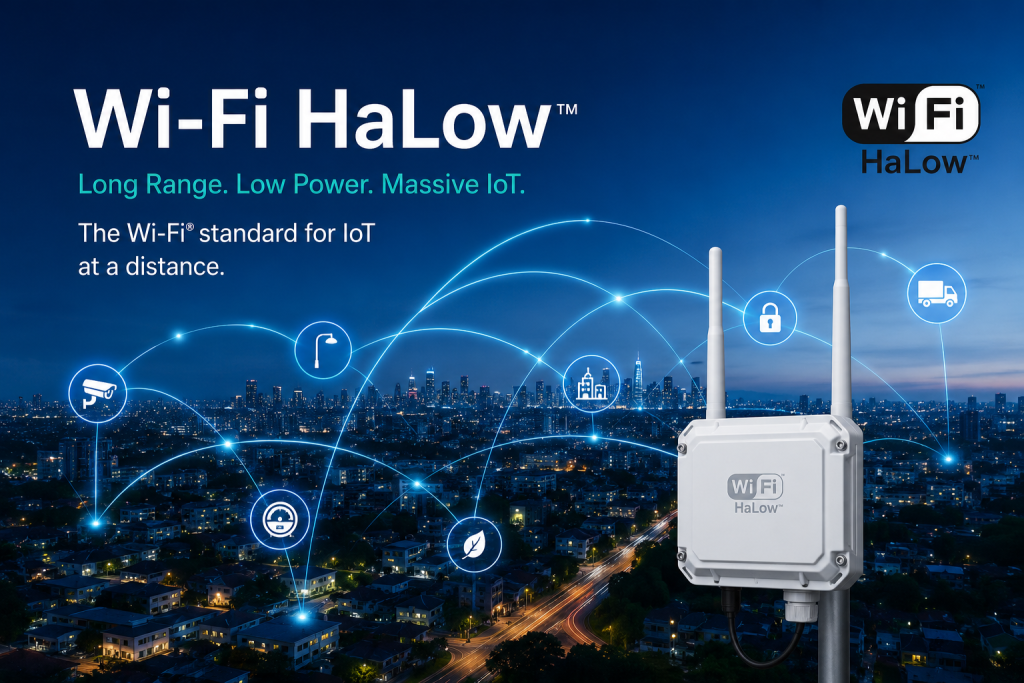
What is Wi-Fi HaLow?
Wi-Fi HaLow is long-range, low-power Wi-Fi built for the Internet of Things. It runs in sub-1 GHz spectrum, reaches far further than the Wi-Fi in your router, and can run sensors for years on a battery. Here is how it works, and what it really delivers in the UK.
Wi-Fi has a range problem. The 2.4 GHz and 5 GHz bands that carry your laptop and phone are excellent at moving large amounts of data across a room. They are poor at crossing a farmyard, penetrating a concrete plant room, or keeping a battery sensor alive for five years.
Wi-Fi HaLow is the answer to that. It is the Wi-Fi Alliance brand name for IEEE 802.11ah, a version of Wi-Fi that moved down into sub-1 GHz spectrum to trade raw speed for reach, penetration and battery life. The name is a play on “halo”, suggesting a wide ring of coverage around a single access point.
The standard was published in 2017, but the ecosystem took years to arrive. Certified silicon and buyable hardware have only become a practical proposition recently, which is why HaLow is suddenly appearing in conversations where LoRaWAN or Zigbee used to be the default answer.
Wi-Fi HaLow at a glance
| Property | Wi-Fi HaLow (802.11ah) |
|---|---|
| Standard | IEEE 802.11ah, published 2017 |
| Spectrum | Sub-1 GHz licence-exempt. 902 to 928 MHz in the US, 863 to 868 MHz in the UK and EU |
| Channel widths | 1, 2, 4, 8 and 16 MHz. UK and EU IoT use is effectively 1 MHz and 2 MHz |
| Data rates | Roughly 150 kbps to tens of Mbps, depending on channel width and conditions |
| Range | Marketed at up to 1 km and beyond. Real UK figures are considerably lower, see below |
| Devices per access point | Up to 8,191 in the standard |
| Power saving | Target Wake Time and Restricted Access Window, enabling multi-year battery life |
| Security | WPA3 |
| Networking | Native IP. Devices behave like ordinary Wi-Fi clients |
Why sub-1 GHz changes everything
The physics is simple. Lower frequency signals travel further for a given transmit power and pass through obstructions more effectively. A 900 MHz signal loses less energy crossing a brick wall, a metal rack or a stand of trees than a 2.4 GHz signal does, and far less than a 5 GHz one.
HaLow takes the familiar 802.11a/g OFDM design and downsamples it to run on channels as narrow as 1 MHz. Narrow channels concentrate the transmit power into less bandwidth, which raises the signal to noise ratio at the receiver. That is what buys the range. The trade is throughput: a 1 MHz channel carries around a hundred kilobits per second at the lower modulation rates.
Widen the channel and the data rate climbs. Sixteen megahertz channels with multiple spatial streams can push tens of megabits per second, which is enough for video. But wide channels need spectrum, and spectrum is exactly what the UK does not have much of in this band.
The UK reality check. Almost every article about Wi-Fi HaLow quotes American figures: 3 km of range, 8,191 devices, 86 Mbps, no duty cycle restrictions. Those come from the US 902 to 928 MHz allocation, which offers 26 MHz of spectrum and generous power limits.
The UK and Europe use 863 to 868 MHz. That is five megahertz of shared, congested spectrum, capped at 25 mW e.r.p (about 14 dBm) under Ofcom’s IR 2030, with duty cycle limits that vary by sub-band. You get a handful of 1 MHz or 2 MHz channels, far lower transmit power, and a legal obligation to keep off the air most of the time.
The consequence is that UK range, throughput and practical device counts are all materially below the headline numbers. HaLow still works well here, and it still beats ordinary Wi-Fi for reach by a wide margin. But anyone specifying a UK deployment from a US datasheet will be disappointed.
How the power saving works
Range is only half the story. The reason HaLow is credible for battery sensors is a pair of mechanisms borrowed and extended from the wider Wi-Fi family.
Target Wake Time (TWT) lets an access point and a device agree, in advance, exactly when the device will wake up and listen. Between those moments the radio is genuinely off, not idling. A sensor that reports once an hour spends the other fifty-nine minutes drawing microamps.
Restricted Access Window (RAW) divides devices into groups and gives each group its own slot to transmit. In a network with thousands of nodes, this prevents the collision storm that would otherwise occur when everything tries to talk at once. It is the mechanism that makes the very large device counts plausible rather than theoretical.
Together these allow coin-cell and multi-year battery designs. Newracom’s NRC5294, for example, is targeted specifically at coin-cell operation.
How Wi-Fi HaLow compares
HaLow sits in an awkward and interesting gap. It has far more bandwidth than the LPWAN technologies and far more range than the mesh protocols.
| Wi-Fi HaLow | LoRaWAN | Zigbee / Thread | Wi-Fi 6 | |
|---|---|---|---|---|
| Band | Sub-1 GHz | Sub-1 GHz | 2.4 GHz | 2.4 / 5 / 6 GHz |
| Typical data rate | Hundreds of kbps to tens of Mbps | 0.3 to 50 kbps | 250 kbps | Hundreds of Mbps to Gbps |
| Range | Long | Very long | Short, extended by mesh | Short |
| Battery life | Years | Years to a decade | Months to years | Hours to days |
| Carries IP natively | Yes | No | Thread yes, Zigbee no | Yes |
| Can carry video | Yes, with headroom | No | No | Yes |
| Recurring cost | None | None, or network operator fee | None | None |
The distinction that matters most is the IP one. A HaLow device is an ordinary IP client. It gets an address, it speaks TCP and UDP, it works with existing tooling. A LoRaWAN device does not. It hands short payloads to a network server that must decode and forward them. If your application wants to stream a camera, run a firmware update over the air, or expose a REST endpoint on a remote sensor, HaLow can do it and LoRaWAN cannot.
What HaLow gives up is ultimate reach and ultimate battery frugality. LoRaWAN will still go further on less energy for a tiny payload.
A common misconception. You cannot connect a Wi-Fi HaLow device to a normal Wi-Fi router. HaLow operates in a different frequency band entirely, so it requires its own access point. In practice a HaLow AP bridges into the existing network over Ethernet or standard Wi-Fi, and HaLow becomes a long-range extension of the network rather than a replacement for it.
The silicon and the hardware
Three names dominate the chipset conversation.
Morse Micro is the highest-profile player. Its MM6108 was the first widely adopted single-chip HaLow SoC, integrating radio, PHY and MAC. The newer MM8108 raises the ceiling substantially, supporting 256QAM for throughput up to 43 Mbps and a 26 dBm internal power amplifier.
Newracom shipped the first 802.11ah SoC, the NRC7292, and has since added the NRC7394 and the coin-cell focused NRC5294. It also produces the NRC4792 for TV white space and lower UHF bands.
Silex Technology builds modules and access points on top of that silicon, including the SX-NEWAH module and the AP-100AH and AP-150AH access points. AsiaRF, Teledatics and others fill out the module market.
On the hardware side, the arrival of ready-made gateways is what has shifted HaLow from a chipset story to a deployable one. Morse Micro’s HaLowLink 2, an all-in-one router, access point and extender built on the MM8108 and running OpenWrt, became generally available in early 2026 at around 129 US dollars, with region-specific variants for the UK, Europe and Japan alongside the US and Australia. Its predecessor sold for 99 dollars. At that price a pair of units is an affordable way to characterise a real site before committing to a design.
Where it fits
The applications that suit HaLow share a shape: many devices, spread across a site that is too large for ordinary Wi-Fi, moving more data than LoRaWAN can carry, without a cellular subscription per node.
Security and CCTV. This is arguably the strongest case. Battery-powered cameras at the edge of a site, well beyond conventional Wi-Fi, with enough bandwidth for a usable video stream. No other low-power technology can do this.
Agriculture and land management. Soil, weather, tank level and livestock sensors distributed across fields, backhauled to a single access point on a barn roof.
Industrial and warehouse monitoring. Vibration and condition monitoring on rotating equipment, where changing a battery is expensive and metal racking destroys 2.4 GHz coverage.
Smart buildings and campuses. Access control, occupancy and environmental sensing across multiple floors from far fewer access points than Wi-Fi would need.
Utilities and metering. Advanced metering infrastructure, where sub-GHz penetration into basements and meter cupboards is the entire problem.
Smart home. HaLow works alongside Matter, extending reach to garages, sheds, gates and garden sensors that sit outside the house Wi-Fi footprint.
Should you use it? Ask three questions. Do you need more than a few tens of kilobits per second per device? Do you need range beyond what ordinary Wi-Fi gives, but across a site you own rather than a whole region? Do you want to avoid a per-device cellular subscription?
Three yeses point firmly at Wi-Fi HaLow. If the answer to the first is no, LoRaWAN is cheaper and reaches further. If your devices are mobile or scattered across the country, cellular IoT is the right tool. If everything is within a hundred metres of a router, ordinary Wi-Fi already works.
The verdict
Wi-Fi HaLow spent a long time as a standard in search of an ecosystem. That has changed. Certified silicon exists from multiple vendors, gateways are available at hobbyist prices, and the throughput on the latest chipsets is high enough to make video and firmware updates practical over a kilometre-class link.
The caution is regional. The technology was designed for, and is marketed on, the roomy American sub-GHz allocation. UK and European deployments live in a narrower, more crowded band under tighter power and duty cycle rules. HaLow remains genuinely useful here, but the numbers on the box are not the numbers you will measure. Plan a survey, not a spreadsheet.
Wi-Fi HaLow and Wi-Fi Certified HaLow are trademarks of the Wi-Fi Alliance. Chipset specifications, product availability and pricing change frequently. Verify against vendor documentation before designing. UK spectrum figures should be checked against the current Ofcom IR 2030 before deployment.