

Summary: This article explains why Teltonika Networks is moving beyond routers into edge computing, what the new RUTC41 router-plus-compute platform does differently, and what it means for UK industrial IoT deployments that need local data processing without a separate industrial PC.
For years, Teltonika Networks built its name on rock-solid industrial connectivity: 4G and 5G routers that simply work, day in and day out, across factories, utilities, agriculture, retail, EV charging, rail, and just about every vertical that relies on remote connections. The brand earned its reputation by being predictable in the best possible way. Turn it on, configure it, plug it in, walk away. Job done.
But the industry is changing. The days of using a router solely as a bridge to the internet are fading. The modern IoT landscape expects more: more processing at the edge, more autonomy, more security, fewer external components, and less reliance on fragile cloud round-trips for decision-making. Instead of sending everything upstream, businesses want devices that can act on data where it’s created.
This is where Teltonika’s shift into edge computing becomes genuinely interesting. The company hasn’t just added a bit of extra RAM or thrown in a faster CPU for the sake of it. They’ve begun transforming the router from a networking node into a proper edge appliance — something capable of running logic, storing data, hosting applications, and driving automation without needing a separate industrial PC, gateway, or controller.
The clearest example of this new direction is the Teltonika RUTC41.
From Router to Edge Device: What the RUTC41 Represents
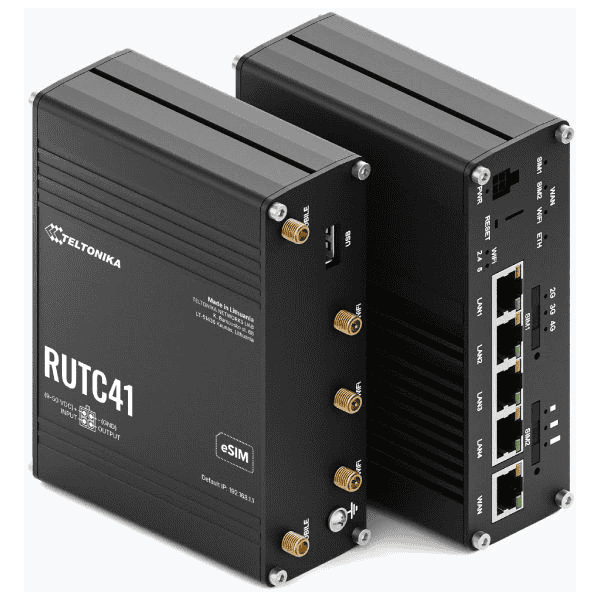
If you look at older industrial routers, even the ones considered “high performance” only a couple of years ago, the common pattern is clear: small CPU, tiny flash, limited RAM, and firmware aimed purely at routing and VPN. That was fine when IoT deployments were cloud-first. But today’s deployments ask more from every onsite device.
The RUTC41 represents Teltonika’s break from the old mold.
It doesn’t just connect things — it runs things.
Real Edge Processing Power
With a dual-core 1.3 GHz ARM Cortex-A53 processor and a full 1 GB DDR4 RAM, the RUTC41 looks far more like a compact industrial computer than a traditional LTE router. Paired with 8 GB of eMMC flash, this hardware foundation finally gives integrators room to run real applications, not just scripts.
Whether that’s protocol converters, lightweight analytics, local dashboards, buffering systems for intermittent connectivity, or integration logic between legacy kit and modern cloud platforms, the hardware has enough headroom for meaningful workloads.
Docker on a Teltonika Router — And It Works
Teltonika has supported various forms of SDK and scripting for years, but Docker is the moment the penny drops: they’re serious about edge.
The RUTC41 brings native Docker support, letting engineers deploy containerised applications the same way they would on a small Linux server or gateway. Want to run Node-RED? A Python service? A local MQTT pipeline? A bespoke industry microservice? You can drop it straight into the router.
That instantly removes a layer of hardware from many installations. No need for a Raspberry Pi sitting next to the router. No need for a DIN-rail industrial PC. No need for extra power supplies or isolation.
For small-to-mid-scale deployments, this is a genuine cost-cutter.
Modern Wireless and Fully-Fledged Connectivity
Edge computing is worthless without proper connectivity around it. The RUTC41 keeps the networking foundation Teltonika is known for, including:
- 4G LTE Cat 4 for stable mobile WAN
- Dual SIM + eSIM for multi-profile redundancy
- Wi-Fi 6 with MU-MIMO, suitable for client networks and local mesh
- 5× Gigabit Ethernet for clean wired distribution
- Full RutOS stack with every routing, firewall and VPN feature you’d expect
- Industrial protocol support for Modbus, BACnet, OPC UA, DNP3, MQTT and more
- Full compatibility with RMS for remote management
This isn’t a router pretending to be a gateway. It’s a router that actually is one.
Why Edge Computing Matters in Industrial IoT
A lot of the conversation around edge computing gets lost in buzzwords, especially when vendors try to break into IoT from outside the industrial world. But Teltonika’s take is far more grounded, and more aligned to the real problems integrators face every day.
Here are the challenges they’re clearly designing for.
1. Reducing Cloud Round-Trips
Sending every sensor reading or event to the cloud adds latency, cost, and a dependency chain that’s fragile by design. Edge processing allows:
- local filtering of noise
- handling alarms immediately
- reducing uplink bandwidth
- pushing only actionable or compressed data to the cloud
With Docker and increased RAM/flash, the RUTC41 becomes a site-level processing node.
2. Replacing Boxes on the Wall
Every extra component comes with wiring, power load, failure points, installation time, and maintenance risk. If the router can take over the job of a protocol converter or small gateway, the system becomes:
- cheaper
- more robust
- easier to deploy
- easier to remote-manage
One box. One power input. One RMS session.
3. Operating During Outages
Utility sites, remote cabins, pumping stations, portable plant, EV chargers — none of them enjoy perfect connectivity. Local logic running on the RUTC41 can keep equipment behaving correctly when the cloud isn’t reachable.
4. Site Security and Data Sovereignty
The more data you keep onsite, the less you have to push over public networks. For certain industries, that matters.
With RutOS, the router already handles VPN, VLAN segmentation, firewalling and certificate management. Add edge compute, and it becomes the security boundary and the automation brain in one.
Where Teltonika Is Heading Next
The RUTC41 is just the start of where Teltonika clearly intends to go.
If you look at the broader product lineup and the way the newer models are being positioned, the trajectory is obvious: routers that behave like edge servers, and gateways that behave like compact industrial controllers.
Expect more:
- higher-performance CPUs
- expanded RAM and flash
- deeper Docker integration
- official container templates for industrial protocols
- more specialised models tuned for verticals
- integration with Teltonika’s switches and future 5G edge products
- tighter RMS automation for fleet-wide edge-compute deployments
And as 5G SA matures, Teltonika will likely combine edge compute with true low-latency 5G network slicing for critical operations.
This will push Teltonika into direct competition not just with router vendors but with industrial PC makers, automation gateways, and even certain PLC edge-modules. The difference is that Teltonika knows how to build things at scale, at a price that doesn’t make integrators wince.
Where the RUTC41 Fits in the Real World
Here are the deployments already benefitting from this type of device:
Smart Utilities
Water, gas and power operators gain a single device that can connect legacy meters, convert protocols, run local decision trees, and maintain uptime even when remote links drop.
Manufacturing
Factories can deploy local analysis or routing logic without installing racks of compute. Think line monitoring, machine data collection, predictive triggers, and edge filtering.
Retail & Hospitality
Instead of a router plus an on-site mini PC for dashboards or payment services, the RUTC41 can host everything in a secured container.
Renewables
Solar and wind installations often run in low-connectivity environments. Localised processing keeps control logic steady without cloud dependency.
Transport
Edge analytics for fleet operations, telematics preprocessing, local data preparation before uplink — all possible within the router itself.
Temporary/portable plant
Construction cabins, portable pumps, mobile CCTV systems — removing secondary hardware cuts deployment time.
The Bigger Picture: The Router Is Becoming the Edge
The industrial IoT world has been edging towards this convergence for the past decade. The router has always been the anchor of every remote site. It’s already connected to everything and trusted to stay alive. Enhancing it with compute capability is a natural evolution.
What Teltonika is doing with the RUTC41—and what will follow—is simply formalising what integrators have been asking for:
A device that offers connectivity, security, compute, and industrial protocol support in one rugged box.
The RUTC41 doesn’t just hint at this future. It lands firmly in it. And if Teltonika follows through on this direction with stronger hardware and deeper container integration across upcoming models, they’ll end up setting the pace for the next generation of IoT infrastructure.
Related reading