
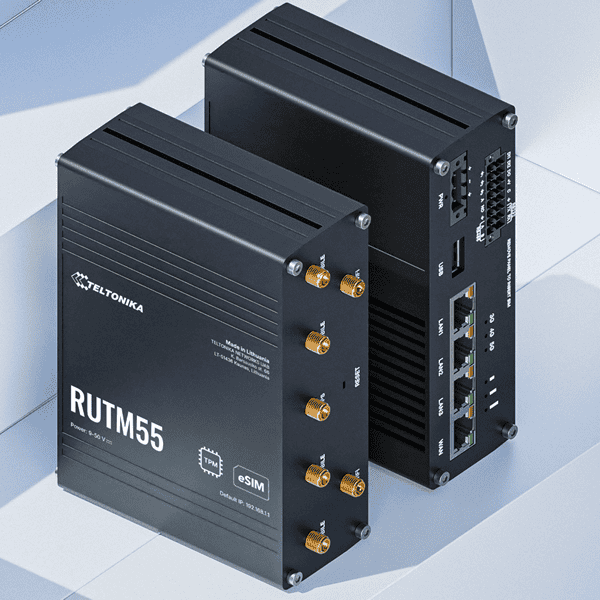
The Teltonika RUTM55 is a 5G industrial router built for businesses that don’t just need connectivity, but need it across both new and old infrastructure. It’s a bridge between legacy machines and the latest cellular networks, and that makes it a very relevant bit of kit for today’s factories, utilities, and remote operations.
Most companies in manufacturing or industrial automation don’t have the luxury of ripping out old systems and starting again. The cost and downtime are prohibitive. Instead, they need to find ways of connecting PLCs, sensors, controllers, and other devices that may still rely on serial interfaces, while simultaneously preparing for high-bandwidth, low-latency applications that 5G promises. The RUTM55 is one of the few routers that can genuinely tick both boxes.

Build and Hardware
The RUTM55 is built like other Teltonika industrial routers: compact, metal-cased, DIN-rail or wall mountable, and rugged enough to handle hostile environments. It’s rated to operate from −40°C up to +75°C, meaning it can be installed in plant rooms, outdoor cabinets, or inside hot factories without additional cooling.
Power flexibility is also there. With a wide DC input range, it integrates easily with industrial panels, backup power systems, or vehicle power supplies. That’s important when you’re rolling these out across multiple sites and don’t want power conversion to become another headache.
In terms of physical ports, the RUTM55 offers:
- Four Gigabit Ethernet ports for LAN and WAN.
- Dual SIM slots plus an embedded eSIM with support for multiple profiles.
- RS232 and RS485 serial interfaces for legacy equipment.
- Digital I/O for monitoring or triggering external systems.
- Dual-band WiFi 5 for local wireless coverage.
- GNSS support for positioning and timing applications.
This combination makes it highly versatile. It’s not just a 5G internet uplink; it’s a hub for converging old and new equipment into a single manageable platform.
Connectivity and Throughput
On paper, the RUTM55 supports download speeds up to around 3.4 Gbps on 5G. In practice, you’ll rarely see those numbers outside lab conditions, but that’s not the point. What matters is that the modem has enough capability to handle high-demand applications, whether that’s real-time video from production lines, large data dumps from SCADA systems, or multiple VPN tunnels feeding telemetry back to HQ.
The real value is in the failover and redundancy. With two physical SIM slots and an eSIM capable of storing several operator profiles, you can build in a level of resilience that minimises downtime. In a typical setup, you could run a primary 5G SIM from one operator, a backup 4G SIM from another, and then keep the eSIM for roaming coverage in case both local operators fail. The router handles automatic switching between them without user intervention.
For wired fallback, you can assign one of the Ethernet ports as a WAN input, meaning you could connect a secondary broadband, satellite, or even another router as backup. In industries where downtime costs thousands per hour, this level of redundancy is not a luxury, it’s a necessity.
Legacy Integration
Where the RUTM55 really sets itself apart is with its handling of legacy devices. Many factories and industrial sites are full of equipment that still communicates over RS232 or RS485. These devices often control critical processes and can’t simply be retired. Normally, you’d need a dedicated gateway or protocol converter to bring them onto IP networks.
With the RUTM55, those serial ports are native. That means you can plug in a legacy device directly and pass its data over 5G, 4G, or Ethernet without extra hardware. The router supports industrial protocols such as Modbus, making integration straightforward.
For businesses managing hundreds of legacy assets, this cuts complexity and cost. Instead of deploying both a gateway and a router, you roll out one device that does both jobs.
Software and Management
The router runs on RutOS, Teltonika’s own hardened version of OpenWRT. This provides a huge feature set, including:
- VPN support: OpenVPN, IPsec, WireGuard, and others.
- Firewall with advanced filtering and VLAN support.
- Industrial protocol support for Modbus TCP/RTU.
- SNMP, MQTT, and scripting for integration with monitoring systems.
- Automatic firmware and security updates.
For organisations managing fleets of routers, Teltonika’s Remote Management System (RMS) is a key advantage. RMS allows you to configure, update, and monitor devices remotely, reducing site visits and engineer call-outs. You can even access connected devices behind the router securely, which is a lifesaver for troubleshooting industrial controllers without being on-site.
Security is built into the system with multiple VPN types, secure boot, and ongoing firmware updates. In a world where cyberattacks on industrial infrastructure are rising, this isn’t optional.
Use Case: Industrial Automation
A strong example of where the RUTM55 shines is in industrial automation. Imagine a factory with a mix of new robots, IP-based controllers, and older PLCs still running on RS485. Instead of installing multiple bits of kit to get them all connected, you deploy the RUTM55.
The new equipment plugs into Ethernet, the older PLCs into the serial ports, and everything communicates securely over a private APN or VPN tunnel back to headquarters. The management team can then monitor, adjust, or update equipment remotely. If the main SIM connection fails, the router switches to the backup profile in seconds, and operations continue without disruption.
Strengths
- Future-proof 5G connectivity with high throughput and low latency.
- Legacy support via native RS232/RS485 serial ports.
- Redundancy and resilience with dual SIM, eSIM, and wired failover.
- Rugged build for harsh environments and wide temperature ranges.
- Feature-rich OS with strong protocol and VPN support.
- Remote management through RMS, reducing maintenance overheads.
Considerations
- Price vs requirements: If you don’t need 5G speeds or legacy integration, cheaper Teltonika routers may be a better fit.
- Complexity: The feature set is extensive, and while powerful, it requires technical knowledge to configure correctly. Under-utilised routers can be an expensive mistake.
- Throughput reality: Real-world performance will always be below the glossy maximums, especially in industrial sites with interference and congestion. Test thoroughly before committing.
- Lifecycle planning: Industrial deployments last years. Firmware updates, SIM management, and long-term support must be part of your strategy.
Verdict
The Teltonika RUTM55 is a serious industrial router, designed for environments where connectivity is business-critical and downtime is not an option. It successfully bridges the gap between old and new, offering legacy serial integration alongside cutting-edge 5G connectivity.
For manufacturers, utilities, and automation specialists who need to keep older systems running while preparing for the future, this router is a strong investment. It’s not the cheapest option in Teltonika’s line-up, but the combination of rugged hardware, powerful software, and legacy support makes it one of the most capable.
If you’re running a factory floor full of legacy controllers and sensors but want to start leveraging 5G for data analysis, monitoring, and remote access, the RUTM55 delivers exactly that. It’s not overkill; it’s the right tool for a very real problem that many industries face.