
Why Low-Power Cellular Matters Now
The IoT world has a dirty secret: most connected devices do not need speed. They need certainty.
A water meter does not care about megabits. A parking sensor does not need low-latency video delivery. An alarm panel does not want to compete with smartphones for spectrum during rush hour. What these devices actually need is reliable, predictable connectivity that works in basements, plant rooms, cabinets, meter pits, stairwells, and industrial estates for years at a time, often on battery power.
As 2G and 3G networks are shut down and traditional 4G becomes increasingly congested with consumer traffic, this problem is becoming impossible to ignore. The answer is not “more 5G”. The answer is purpose-built cellular technologies designed for machines.
This is where Cat-M (LTE-M) and NB-IoT come in. Not as niche options, but as the backbone of long-term, large-scale IoT deployments.
LPWAN: Cellular Built for Devices, Not People
Traditional cellular networks were designed around human behaviour. Voice calls, then messaging, then video, apps, and constant background traffic. IoT arrived later and was largely forced to behave like an extremely patient smartphone.
Low-Power Wide Area Network technologies flip that model.
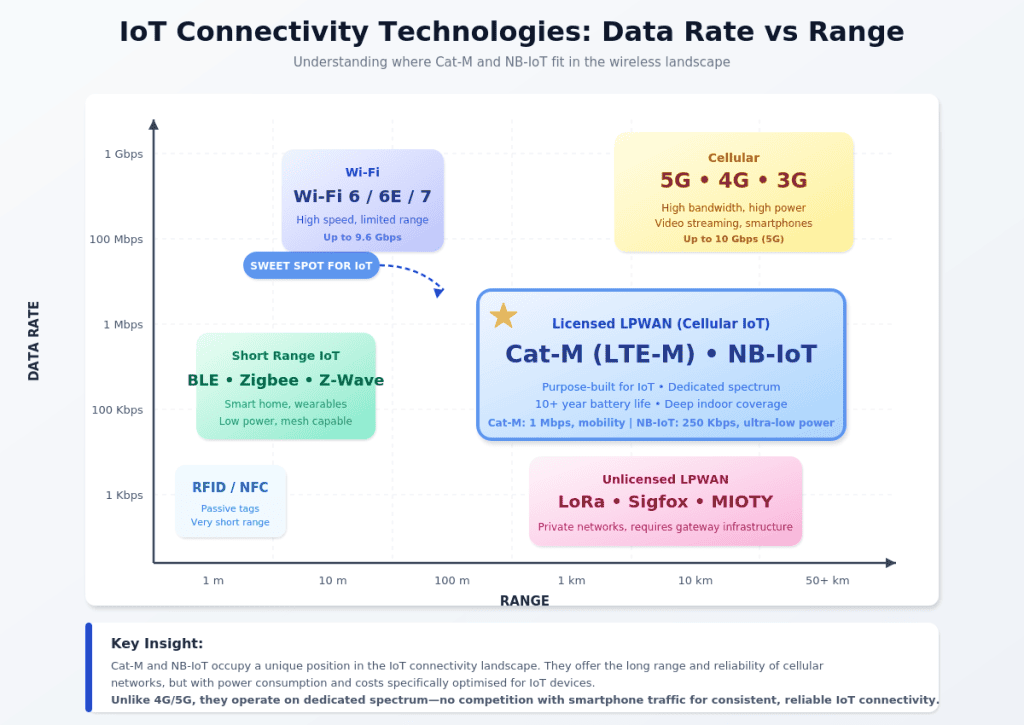
Cat-M and NB-IoT are both 3GPP-standardised cellular technologies operating on licensed spectrum, but they are engineered around machine requirements:
- Very small data payloads
- Infrequent transmissions
- Multi-year battery life
- Harsh RF environments
- Minimal maintenance and intervention
Instead of competing with consumer traffic, these technologies run in dedicated cellular resources that remain usable even when mobile networks are busy. That single architectural decision solves a surprising number of real-world IoT failures.
Cat-M (LTE-M): The Mobile, Two-Way IoT Workhorse
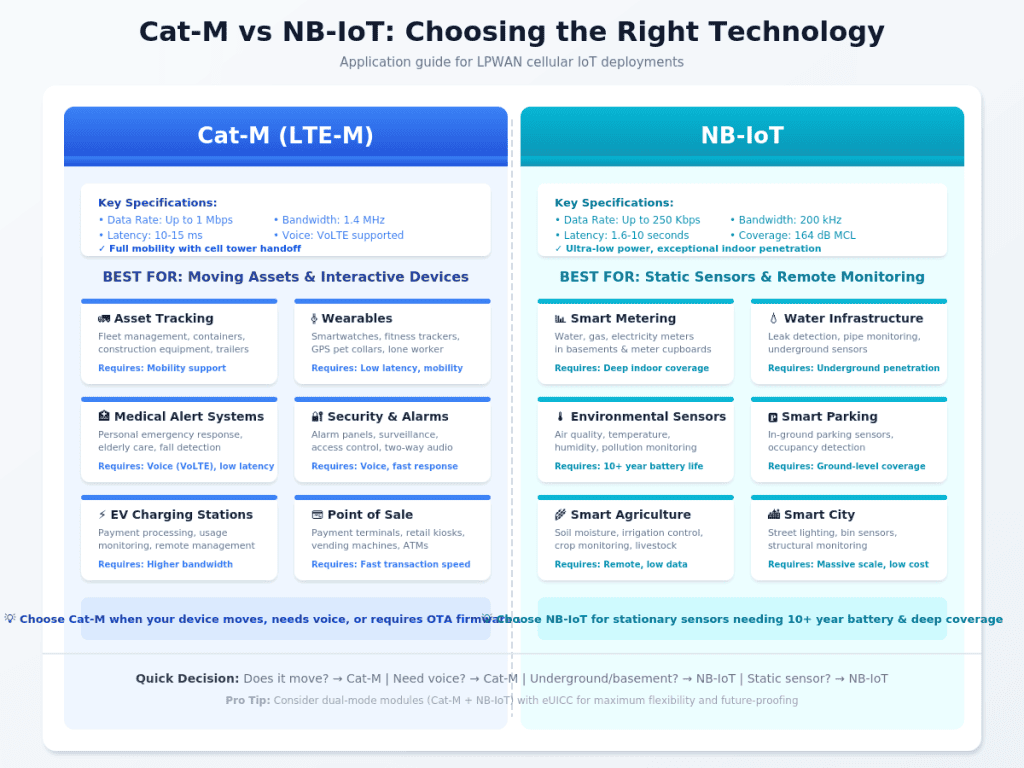
Cat-M sits closer to conventional LTE than NB-IoT, but with drastically lower power consumption and simplified radio requirements. It is the right choice when devices need to move, talk back, or be updated remotely.
What Cat-M Actually Offers
Cat-M uses a narrow 1.4 MHz channel instead of the wide channels used by standard LTE. Combined with aggressive power-saving features, this allows devices to remain dormant for long periods and wake only when needed.
In practical terms, Cat-M provides:
- Data rates up to around 1 Mbps
- Low latency suitable for near-real-time communication
- Full mobility support with cell handover
- Two-way communication
- Support for voice services
- Firmware updates over the air
Just as importantly, Cat-M devices can maintain these capabilities while achieving battery lifetimes measured in years rather than months.
Where Cat-M Makes Sense
Cat-M is ideal for applications where mobility or interaction matters:
Asset tracking and fleet management
Wearables and personal safety devices
Medical alert systems with voice
Security and alarm panels
Payment terminals and kiosks
EV charging infrastructure
Mobile industrial equipment
If a device moves between cells, needs firmware updates, or requires two-way communication beyond basic telemetry, Cat-M is usually the right tool.
NB-IoT: Built for Endurance, Coverage, and Scale
NB-IoT takes a different approach. It sacrifices speed and responsiveness in favour of extreme power efficiency and exceptional coverage.
NB-IoT operates in an ultra-narrow 200 kHz channel, allowing it to reach places where even Cat-M can struggle.
What NB-IoT Prioritises
NB-IoT is designed around one central idea: devices that transmit very small amounts of data very infrequently, often from difficult locations.
Its characteristics include:
- Very low data rates
- High latency, unsuitable for real-time interaction
- No seamless handover between cells
- Exceptional indoor and underground penetration
- Extremely low power consumption
- Massive device density per cell
NB-IoT is not fast, and it is not chatty. But it is extremely reliable when conditions are poor.
Where NB-IoT Excels
NB-IoT is the natural choice for fixed, long-life sensors:
Water, gas, and electricity metering
Leak detection and flood monitoring
Environmental and air-quality sensors
Smart parking sensors
Agricultural monitoring
Street lighting and infrastructure telemetry
If a device is stationary, battery-powered, and expected to operate for a decade without intervention, NB-IoT is often the most sensible option.
Cat-M vs NB-IoT: Choosing the Right Tool
Cat-M and NB-IoT are not competing technologies. They are complementary.
The choice comes down to a few practical questions.
Does the device move?
If yes, Cat-M is the correct choice. NB-IoT does not support seamless mobility and will struggle with moving assets.
Is two-way communication required?
Cat-M supports richer interaction and voice. NB-IoT is primarily uplink-focused.
How much data needs to be transferred?
Firmware updates, images, or configuration changes push you toward Cat-M. Small periodic telemetry suits NB-IoT.
Where is the device located?
Basements, underground enclosures, reinforced concrete structures, and meter pits strongly favour NB-IoT due to its superior penetration.
How critical is latency?
If timing matters, Cat-M wins. NB-IoT latency is measured in seconds, not milliseconds.
In many modern designs, the safest approach is dual-mode hardware that supports both Cat-M and NB-IoT, combined with eSIM or multi-network SIM provisioning. One device, multiple network options, fewer long-term risks.
The UK Network Reality
In the UK, Cat-M and NB-IoT availability varies by operator, geography, and deployment strategy.
NB-IoT coverage is generally stronger for fixed infrastructure use cases, while Cat-M coverage is growing steadily in urban and industrial areas. No single network is perfect everywhere, which is why multi-network IoT SIM strategies are becoming the norm rather than the exception.
Designing an IoT system around a single operator assumption is increasingly risky, especially for deployments intended to last 10–15 years.
Why Dedicated IoT Spectrum Matters
One of the most overlooked advantages of Cat-M and NB-IoT is isolation from consumer congestion.
When mobile networks are busy, consumer traffic always wins. Video streaming, social media, and app downloads will consume available resources long before a sensor packet is prioritised.
LPWAN technologies avoid this problem by design.
The result is:
- More consistent connectivity
- Predictable performance during peak times
- Reduced packet loss
- Lower operational support costs
- Fewer site visits
For large IoT estates, this predictability is often more valuable than raw speed.
Hardware and Design Considerations
Cat-M and NB-IoT require dedicated modem support. Not all 4G hardware is compatible.
When selecting hardware, consider:
- Support for UK frequency bands, especially sub-1 GHz
- Antenna design and placement
- Power management capabilities
- Long-term firmware support
- Remote update capability
Industrial IoT hardware vendors increasingly offer Cat-M, NB-IoT, or dual-mode devices designed specifically for these use cases. Choosing hardware designed for LPWAN from day one avoids many common deployment failures.
Longevity and the 5G Question
Cat-M and NB-IoT are not transitional technologies. They are formally part of the 5G ecosystem under the massive machine-type communications model.
They coexist with 5G, share spectrum efficiently, and continue to evolve through 3GPP releases. Deployments made today are expected to remain supported well into the next decade.
In other words, investing in Cat-M and NB-IoT is not betting against 5G. It is using the right part of it.
Final Thoughts
Cat-M and NB-IoT are not about chasing performance headlines. They are about building IoT systems that behave sensibly in the real world.
If your devices move, speak, or update, Cat-M is usually the answer.
If your devices sit quietly for years in hostile RF environments, NB-IoT is hard to beat.
If you want resilience, flexibility, and future-proofing, supporting both is often the smartest design decision.
For anyone designing IoT systems intended to scale and survive long-term, low-power cellular is no longer optional. It is the foundation.
Related reading


