
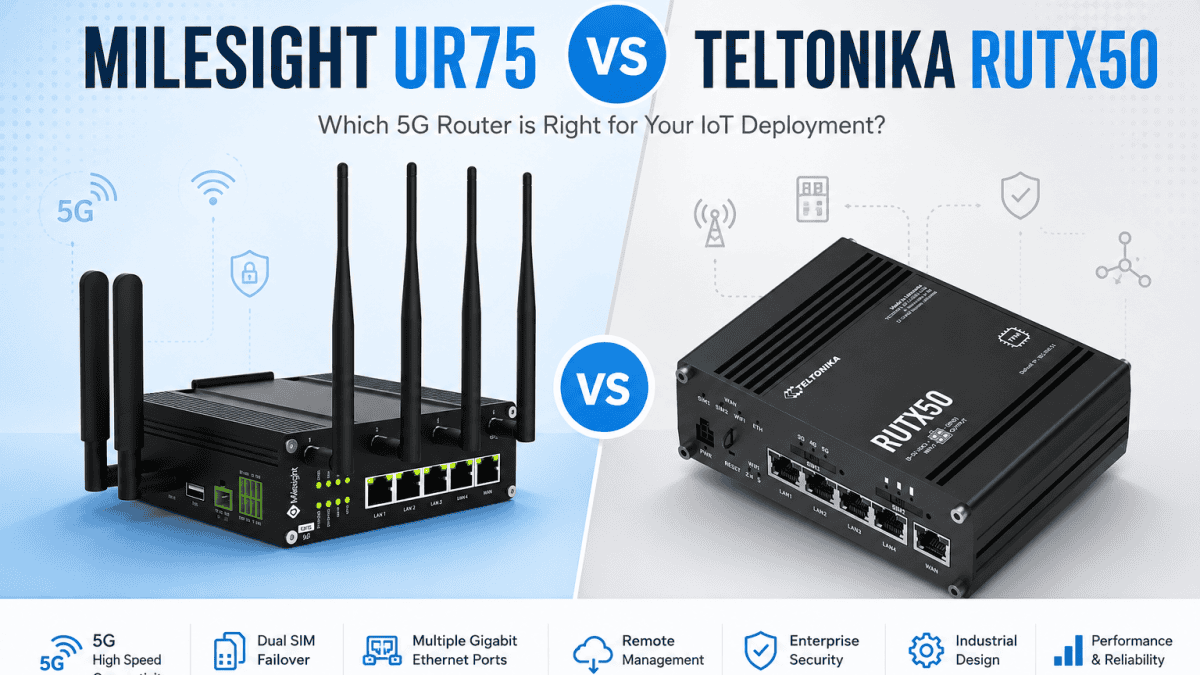
Milesight UR75 vs Teltonika RUTX50: Which 5G Industrial Router?
Two serious 5G industrial routers with similar price tags, identical form factors, and overlapping feature sets. The differences run deeper than the spec sheet suggests – and for a growing proportion of industrial deployments, the newer challenger has a compelling case.
The Teltonika RUTX50 has been the go-to 5G industrial router in the UK market for the past three years. It earned that position through solid hardware, an excellent operating system, and one of the best fleet management platforms in the industry. Those are real advantages, and this comparison does not pretend otherwise.
The Milesight UR75 is a different proposition. It launched under Milesight’s newly formalised Networks division and arrives with meaningfully faster processing hardware, Wi-Fi 6, optional PoE output, a longer warranty, and a development environment that gives IoT engineers considerably more to work with. For deployments that do not depend on Teltonika’s RMS ecosystem, it makes a strong case.
This comparison goes through both devices in detail – hardware, software, management, and the use cases where each one is the better answer.
Hardware: where the UR75 pulls ahead
On paper, both routers look similar: 5G Sub-6GHz SA/NSA, dual SIM failover, 5-port Gigabit Ethernet, RS232/RS485 serial, DI/DO, GPS. The hardware diverges significantly on the components that determine actual performance.
| Specification | Teltonika RUTX50 | Milesight UR75 |
|---|---|---|
| 5G peak downlink | 3.3 Gbps (4×4 MIMO) | 4.67 Gbps |
| 5G uplink | 900 Mbps | Check datasheet by variant |
| 4G fallback | LTE Cat 20 – 2.0 Gbps DL | Cat 4/6/12/20 (variant dependent) |
| CPU | Quad-core ARM Cortex-A7, 717 MHz | Quad-core ARM Cortex-A55, 2 GHz |
| RAM / Flash | 256 MB / 256 MB | 1 GB LPDDR4x / 1 GB NAND |
| Wi-Fi | Wi-Fi 5 (802.11ac Wave 2), 867 Mbps | Wi-Fi 6 (802.11ax), 1.8 Gbps |
| Ethernet | 5 x Gigabit (1 WAN + 4 LAN) | 5 x Gigabit (1 WAN + 4 LAN) |
| SIM slots | 2 x Mini SIM (2FF), auto failover | 2 x Nano SIM, auto failover |
| Serial ports | RS232 + RS485 (4-pin connector) | RS232 + RS485 |
| Digital I/O | 1 x DI + 1 x DO | 1 x DI + 1 x DO |
| PoE PSE output | None (passive PoE input on LAN1 only) | Optional: 4 x 802.3af/at, 30W/port, 60W total |
| USB | 1 x USB 2.0 Type-A | 1 x USB 3.0 Type-C |
| GNSS | GPS, GLONASS, BeiDou, Galileo, QZSS | Multi-constellation GNSS |
| Operating temp | -40°C to +75°C | -40°C to +70°C |
| Ingress protection | IP30 | IP30 |
| Power input | 9-50V DC | 9-48V DC (standard) / 48V DC (PoE version) |
| Mounting | DIN rail, wall, desktop | DIN rail, wall, desktop |
| Warranty | 2 years | 3 years |
The processor and memory gap is the most significant hardware difference and the least discussed. The UR75 runs a quad-core Cortex-A55 at 2 GHz with 1 GB of LPDDR4x RAM. The RUTX50 runs a Cortex-A7 at 717 MHz with 256 MB of RAM. These are not minor incremental improvements – the Cortex-A55 is a fundamentally different architecture with substantially higher instructions-per-cycle performance. For a device running active VPN tunnels, MODBUS polling, Node-RED flows, and cellular data simultaneously, that headroom matters in practice, not just on a spec sheet.
The PoE argument
The PoE PSE version of the UR75 (UR75-504AE-P-W2) delivers four 802.3af/at ports with a 60W combined budget. That means a single device provides 5G cellular backhaul and powers four PoE cameras, sensors, or access points over the LAN ports. No separate PoE injector. No additional switch. For CCTV deployments, remote monitoring installations, and temporary or space-constrained sites, that is a genuine architecture simplification that the RUTX50 cannot match in any configuration – it has no PoE PSE output at all, only passive PoE input on LAN1 for powering the router itself.
Wi-Fi 6
Wi-Fi 5 to Wi-Fi 6 is not just a throughput upgrade. Wi-Fi 6 (802.11ax) introduces OFDMA – allowing the router to serve multiple clients simultaneously on subdivided channels rather than sequentially. In environments with several concurrent wireless connections, this reduces latency and improves throughput for all clients. For a router acting as both cellular WAN and wireless access point for a site, the UR75’s Wi-Fi 6 is meaningfully better than the RUTX50’s Wi-Fi 5 in realistic multi-client conditions.
Software and management: where the RUTX50 wins
This is the honest counterweight to the hardware story, and it deserves full treatment.
RutOS
Teltonika’s RutOS is a mature, deeply documented operating system built on OpenWRT. It has been in active development for over a decade, is supported by an extensive official Wiki, and is used by a large community of integrators who share configurations, scripts, and troubleshooting guidance openly. The breadth of protocol support is exceptional: OPC UA, DNP3, DLMS/COSEM, Modbus TCP/RTU, MQTT, TR-069, SNMP, and more – all configured through a consistently designed web interface. For integrators who encounter a configuration problem, the probability that someone has already solved it and documented the solution publicly is very high.
RMS
The Teltonika Remote Management System is the strongest single reason to choose a RUTX50 over the UR75 for fleet deployments. RMS provides centralised remote access, configuration management, firmware update deployment, event monitoring, VPN management, and TAVL tracking across thousands of devices from a single platform. It is mature, reliable, and deeply integrated with RutOS. Integrators who manage large Teltonika fleets through RMS have an established workflow that is genuinely difficult to replicate on competing platforms.
VPN breadth
The RUTX50’s VPN support is exceptional. WireGuard, ZeroTier, Tinc, and Tailscale are available alongside the standard OpenVPN, IPsec, GRE, and L2TP suite. The UR75 covers the mainstream VPN protocols well but does not match this breadth. For deployments where WireGuard specifically is a requirement, the RUTX50 is the answer.
The UR75’s software advantages
The UR75 is not simply weaker on software – it has a different and in some respects more developer-friendly approach.
Node-RED and Python SDK
The UR75 ships with an embedded Node-RED development environment and a Python SDK. Node-RED is a widely used visual programming tool for IoT data flow – connecting sensors, protocols, APIs, and cloud platforms without writing low-level code. Having it embedded in the router rather than requiring a separate edge device is significant for applications where local data processing, protocol translation, or conditional logic is needed at the edge. The Python SDK allows custom applications to run directly on the router hardware. These are genuine capabilities that extend what the UR75 can do as an edge compute device, not just a connectivity box.
Milesight DeviceHub
DeviceHub is Milesight’s fleet management platform – centralised configuration, firmware updates, real-time monitoring, and reporting. It is less mature than RMS and lacks the depth of integration that Teltonika has built over a decade. But for organisations without an existing RMS estate, starting fresh on DeviceHub is not a significant disadvantage. A detailed look at how DeviceHub works is available at this explainer.
On the throughput headline: the UR75 claims 4.67 Gbps downlink vs 3.3 Gbps for the RUTX50. Real-world 5G Sub-6GHz throughput at UK industrial sites in 2026 is rarely above 500 Mbps and frequently much less – network conditions, signal strength, and band availability are the limiting factors, not the router’s modem ceiling. The throughput numbers are worth knowing but are not a practical decision factor for most deployments.
Use case analysis
CCTV and surveillance deployments
The UR75 PoE version is the clear answer here. A single device provides 5G backhaul, powers up to four cameras, and runs GPS tracking. Hardware count at each site drops. The Wi-Fi 6 performance is relevant if wireless cameras are in the mix. The 3-year warranty matters for hardware that is typically installed and left for extended periods. The RUTX50 requires a separate PoE switch or injector for every camera site, adding cost and a potential failure point.
Industrial M2M and SCADA
Both routers have RS232/RS485 and DI/DO built in, so they are equivalent at the hardware interface level. The edge goes to the RUTX50 for SCADA integration because RutOS’s OPC UA support, DNP3, and DLMS/COSEM coverage is broader and better documented. For integrators connecting to established industrial protocol ecosystems, the Teltonika tooling is more mature. However, for custom protocol translation or data processing at the edge, the UR75’s Node-RED environment and faster processor make it more capable as an edge compute device.
Fleet management at scale
If the deployment involves hundreds of devices that need centralised management, firmware control, and remote access, and the team is already familiar with RMS, stay with the RUTX50. Switching platforms at fleet scale for marginal hardware gains is not justified. If starting fresh with no existing RMS investment, the UR75 on DeviceHub is a viable alternative worth evaluating.
Remote site connectivity with wireless devices
For any deployment where the router is providing Wi-Fi coverage to modern endpoints – Wi-Fi 6 access points, recent laptops, newer sensors – the UR75’s Wi-Fi 6 and faster processor deliver meaningfully better wireless performance. The RUTX50’s Wi-Fi 5 is adequate for lower-density situations but is outclassed when multiple clients are competing for bandwidth simultaneously.
Harsh environment deployments
The RUTX50’s +75°C upper temperature limit versus the UR75’s +70°C gives it a five-degree advantage in sealed high-temperature installations. Both are rated to -40°C at the lower end. The RUTX50’s wider 9-50V DC power input range also provides more flexibility in power-variable industrial environments. For the most extreme environmental conditions, the RUTX50 edges ahead.
Ecosystem honesty: Milesight Networks launched its formal industrial networking division in April 2026. The UR75 hardware is solid and the product has been shipping for several years. But the DeviceHub platform and UK support infrastructure are less established than Teltonika’s. For mission-critical deployments where direct vendor support and an extensive UK integrator community matters, that is a real consideration.
The verdict
- Existing Teltonika/RMS fleet deployments
- Complex SCADA and industrial protocol integration
- WireGuard, ZeroTier, or Tailscale VPN requirements
- Operating temperatures above +70°C
- Deployments where UK integrator community support matters
- Power environments requiring up to 50V DC input
- CCTV and surveillance – PoE output eliminates separate switch
- Wi-Fi 6 performance with multiple concurrent wireless clients
- Edge compute applications needing Node-RED or Python SDK
- High-throughput data processing on the device (faster CPU, 4x RAM)
- Long-lifecycle deployments where 3-year warranty reduces risk
- Greenfield deployments with no existing RMS estate
- Any application where PoE-powered devices are part of the design
The RUTX50 earned its reputation and holds it. For organisations already invested in the Teltonika ecosystem, the case for switching is not compelling on hardware grounds alone. But for engineers specifying hardware without that constraint, the UR75 is a more capable device in the specifications that matter most for modern IoT deployments – processing power, wireless generation, PoE architecture, and developer tooling. The Milesight case is strongest wherever cameras, Wi-Fi clients, or on-device data processing are in the picture.
Teltonika RUTX50 – £359 excl VAT. RMS licences available separately.
Milesight UR75 standard and UR75 with PoE both available at Router Store.
Not sure what’s right for your deployment?
Leave your details and a question. We respond to every genuine enquiry – no sales pitch, just a straight answer from someone who works in this space every day.
Related reading