244 Million IoT Connections: What Vodafone Reveals About How the IoT Market Really Works
Vodafone runs one of the largest IoT businesses on earth. Take it apart and you learn what the UK IoT market actually sells, who really buys it, and how the money is made. The SIM is only where the conversation starts.
Vodafone reports 244 million IoT connections. It sells far more than SIM cards: a connectivity management platform, pre-configured hardware, professional services and an ecosystem of partners, all aimed at connecting a physical asset to a business process. Understanding how a business this size finds and wins IoT work explains where the real value sits, and where a smaller UK specialist can compete.
Vodafone's FY26 results, published in May 2026, put its IoT estate at 244 million connections. Pause on that figure. It is more than three connected devices for every person in the United Kingdom, sitting inside the estate of a single company.
It is easy to picture that as 244 million SIM cards disappearing into smart meters, cars and trackers. Look more closely and something more interesting appears. Vodafone is not really selling SIM cards. It is selling the ability to connect a physical thing to a business process, and it has built an entire commercial organisation around finding those things.
A lift that reports a developing fault before it fails. A pharmaceutical shipment reporting its temperature across a continent. An EV charger talking to its payment platform. An industrial machine monitored hundreds of miles from the nearest engineer. Somewhere inside most of those solutions there may be a cellular module and a SIM. The value is almost everything built around it.
This article takes Vodafone apart as a specimen, because very few people outside the company understand the machinery behind the SIM. What it shows is a useful map of how the commercial IoT market actually works in 2026, and it applies just as much to a UK deployment of forty sites as to a global product launch.
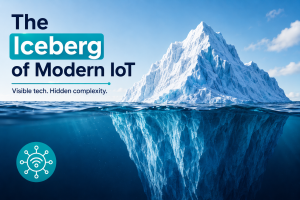
The strange thing about IoT: most of it is invisible
Think about how visible the smartphone industry is. We know the manufacturers, we recognise the handsets, and operators advertise consumer tariffs constantly. Commercial IoT is the opposite. You could pass dozens of connected devices in an ordinary day without knowing any of them were online.
The lift at the station. The payment terminal in a shop. An EV charger. A digital advertising screen. A delivery van. A CCTV camera. A traffic signal. A vending machine. A smart electricity meter. A building management controller. A refrigerated cabinet in a supermarket. Some use fixed connectivity or Wi-Fi, some use private networks, but huge numbers use cellular. The person interacting with the device usually has no idea which network sits behind it.
That makes commercial IoT fundamentally different from consumer mobile: the person using the service is often not the person paying for the connectivity.
Who actually buys an IoT SIM?
Consider a lift. The person stepping into it is not Vodafone's customer. The building owner may not be either. The connectivity is more likely part of the lift manufacturer's remote monitoring and maintenance service. The same pattern repeats across the sector: a vehicle manufacturer connects its cars, a security firm connects thousands of alarm panels, an EV operator connects chargers, a utility connects meters, an equipment maker connects machines.
This explains the extraordinary scale. A traditional business mobile contract might give 500 staff 500 handsets. One successful relationship with an original equipment manufacturer (OEM) can eventually create tens or hundreds of thousands of connected products as they leave the factory. The commercial unit is not a person. It is a thing.
The connectivity provider stops selling contracts one at a time and becomes embedded inside somebody else's product.
What does Vodafone actually sell?
The obvious answer is connectivity. Examining the current portfolio shows how incomplete that answer has become. There are really four layers, and the SIM is the least valuable of them.
1. Connectivity
At the centre sits Vodafone Managed IoT Connectivity: conventional cellular alongside NB-IoT, LTE-M, eSIM and, increasingly, satellite. For most buyers this is the visible product and the one they instinctively compare on price.
2. The platform (the real product)
Managing five SIMs is trivial. Managing 50,000 is a different discipline. Someone has to know which SIM is in which device, whether it is active, how much data it is using, whether its behaviour has suddenly changed, which service profile applies, who is allowed to reconfigure it, and whether a device that should be talking has gone silent.
Vodafone's Managed IoT Connectivity Platform provides that control: activation, suspension and deactivation, usage monitoring, service profiles, reporting, user roles and permissions, and application programming interfaces (APIs) so connectivity management becomes part of other business systems. At scale, the provider is not selling airtime. It is providing the infrastructure to manage the communications lifecycle of an entire population of machines over many years. The monthly SIM charge is highly visible on a quotation; the ability to run 50,000 remote endpoints for a decade matters far more.
3. Hardware
You might assume a network operator would leave routers and gateways to someone else. Vodafone does not. Its IoT device proposition combines its connectivity with pre-tested, pre-configured hardware, shipped with a Vodafone Global IoT SIM already installed. Alongside its own MachineLink devices, the current device page names a curated selection of specialist manufacturers including Cradlepoint, Digi International and Teltonika Networks.
The commercial logic is simple. For the customer, sourcing router, SIM, configuration, logistics and support from several suppliers creates complexity. One provider, one contract, one delivery makes deployment easier. The wider lesson is worth holding on to: even one of the world's largest operators does not try to manufacture every component. The value is in making the pieces work together.
4. Professional services
The clearest sign the market has moved beyond connectivity is that Vodafone sells IoT consultancy: technical design, device optimisation, testing, low-power connectivity advice and a security portfolio covering secure-by-design work, assessments and evaluation. That means the company can be involved before the customer has even settled what the finished architecture looks like. It is not waiting at the end of the project to hand over SIMs. It can help design the project that eventually needs them.
How do you sell 244 million IoT connections?
Nobody rings 244 million businesses and asks whether they would like a SIM. The scale comes from finding organisations able to deploy hundreds, thousands or millions of connected things, and working much further up the decision than a normal connectivity sale.
Vodafone's IoT specialists work alongside existing Vodafone Business account teams, technical resources and partners to find and develop projects. This is an overlay model. A general account manager does not need to understand embedded modems, LPWAN or eSIM. They need to spot the opportunity. The specialist is then pulled into the conversation, which turns a discussion about ordinary telecoms into something considerably larger. Because so much of the proposition is organised around industries rather than radio technologies, the buyer is usually captured while asking a business question, not a connectivity one.
Imagine a refrigeration manufacturer
Picture a British manufacturer of commercial refrigeration with 5,000 units installed across Europe. Historically, maintenance is reactive: something fails, the customer notices, someone phones, an engineer visits. Now the manufacturer asks a different question: could our equipment tell us it is going wrong before the customer notices?
That single question starts an IoT project. Temperature, compressor operation, power draw and door activity need monitoring, so the unit needs sensors and a controller. Data needs transmitting, and some customer sites will not allow the equipment onto their corporate network, so cellular starts to look attractive. Now it needs a modem or router, an antenna, and a SIM or eSIM. The units sell across Europe, so roaming matters. They must reach a cloud platform securely, someone must monitor 5,000 connections, engineers may need remote access, firmware may need updating in the field, and alerts must land somewhere useful.
"Can our fridges tell us when they are failing?" has become 5,000 connected devices plus hardware, antennas, connectivity, a platform, security, cloud integration, management and support, and potentially 5,000 recurring subscriptions lasting the operational life of the equipment. That is why the commercial IoT market is so valuable, and why Vodafone does not need to find 244 million customers. It needs to find customers that own, make or operate large numbers of things.
Two real examples
KONE. The lift and escalator manufacturer uses Vodafone IoT for real-time monitoring and proactive diagnostics across its global network of equipment. The outcome that matters is not that a lift has a SIM. It is that connectivity helps shift maintenance from reactive towards proactive, so the machine becomes part of the service operation around it. A manufacturer stops simply selling a machine and starts selling services around it for its whole life.
Controlant. This pharmaceutical logistics specialist puts Vodafone Business IoT SIMs inside its reusable Saga data loggers, which monitor temperature, location and light while medicines travel internationally. The SIMs provide connectivity across roughly 570 networks in more than 180 countries. An independent Carbon Trust study credited the solution with avoiding around 16,700 tonnes of CO2 equivalent across deliveries in a single year, with reported successful delivery rates above 99% against a previous industry loss rate near 35%. The customer does not care about the cellular link. It cares whether a temperature-sensitive shipment stayed within its permitted range. The connection makes that knowable.
Vodafone is turning IoT into a platform business
The corporate strategy makes the direction explicit. In January 2024 Vodafone announced a ten-year partnership with Microsoft and confirmed that its managed IoT connectivity platform, then connecting around 175 million devices, would become a separate, standalone business by April 2024. The stated aim was to attract new partners and customers, open the platform through APIs and the Azure ecosystem, and hyperscale it well beyond Vodafone's own network.
That is a meaningful shift. A traditional operator builds a network and connects its own customers. A platform company can provide the technology through which other organisations, including other operators, manage connectivity too. Vodafone increasingly sees the opportunity as bigger than putting its own SIMs into things.
The Group reports 244 million IoT connections across all its markets. The standalone Vodafone IoT platform business is the managed-connectivity arm within that. They are related but not identical figures, which is why headline numbers vary between sources and dates.
Do you actually need Vodafone for IoT?
Not necessarily, and this is where buyers should separate the technology they need from the supplier structure they need. Vodafone's global footprint is compelling for some deployments and overkill for others. A multinational launching tens of thousands of connected products has very different requirements from a UK business running forty remote sites. There are broadly four routes to buying cellular IoT connectivity.
| Route | Best suited to | Strength | Watch out for |
|---|---|---|---|
| Mobile network operator (e.g. Vodafone) | Large enterprise and global estates | Scale, own network, platform, professional services | Enterprise focus can be heavy for small deployments |
| IoT connectivity provider / MVNO | Multi-network and cross-border estates | Aggregated networks, flexible commercials, eSIM, roaming | Depends on underlying operator agreements |
| IoT solutions provider / integrator | Small and medium deployments needing a whole system | Hardware, antenna, VPN, cloud and install bundled | Capability varies; check the depth behind the pitch |
| Build it yourself | Technically strong in-house teams | Full control and potentially lowest unit cost | You own the integration and support problem |
There is no universally correct model. A 20-device UK monitoring project and a 100,000-device international launch should not share a procurement strategy. For a deeper look at where a specialist or integrator fits versus a large operator, our IoT connectivity guide works through the trade-offs.
Questions to ask an IoT connectivity provider
Rather than opening with "how much is the SIM?", establish what the deployment actually needs:
- Which countries will the devices operate in, and on which networks?
- Is the connectivity steered or unsteered, and what happens when the preferred network is unavailable?
- NB-IoT, LTE-M, 4G or 5G? Physical SIM or eSIM?
- How are connections provisioned and managed, and is there an API?
- Do you need private IP addressing or a VPN, and does anyone need inbound remote access to the device?
- How is abnormal data usage detected, and what happens when a device stops communicating?
- How long will the equipment stay deployed, and what happens when older mobile technologies are retired?
- Who supports the hardware, and who is responsible when the router works but the application does not?
- How easily can the deployment move to another provider later?
That last point is becoming more important as eSIM and the GSMA SGP.32 standard change how IoT connectivity is provisioned and switched. Our IoT eSIM guide explains why remote provisioning reshapes the buyer's leverage.
Why IoT connectivity pricing is never simple
Search for IoT SIM pricing and it is tempting to expect a consumer-style tariff: so much a month, so many gigabytes, done. Industrial and enterprise IoT rarely works that way. One deployment might use a few megabytes a month but need connectivity across several countries; another might push hundreds of gigabytes of video. One customer needs ordinary internet access; another needs private addressing and a secure link into its corporate network. Contract length, roaming footprint, pooled data, platform access, eSIM capability, security and professional services all move the number. Comparing on the headline monthly SIM price alone is misleading. A cheap SIM that triggers an expensive site visit is not cheap.
The bigger opportunity: connected products
Perhaps the most important lesson from Vodafone's scale is not about telecoms at all. It is about manufacturers. For decades they made products, sold them and lost sight of them until something broke. Connectivity changes that relationship. A manufacturer can know where its equipment is, whether it is working, how it is used, when it needs maintenance, whether consumables are running low and whether software needs updating.
That enables new commercial models: predictive maintenance, remote support, equipment-as-a-service, usage-based charging, automated replenishment and connected warranties. The IoT connection stops being an operational cost and becomes the foundation of recurring revenue for the company deploying it.
Where satellite fits
Vodafone's coverage story no longer stops at the edge of the terrestrial network. It is building two distinct satellite capabilities: a direct-to-device broadband service for standard smartphones through its AST SpaceMobile joint venture, and a standards-based NB-IoT-over-satellite service for remote IoT devices through a partnership with Skylo. That is a large enough subject to deserve its own treatment, which we give it in Vodafone and the final frontier: inside its NTN and satellite IoT strategy. For the wider technology, see our non-terrestrial networks explainer.
The invisible IoT economy
The most striking thing about 244 million connections may be how little we notice them. Tomorrow you might enter a connected lift, drive past a connected substation, pay at a connected terminal, charge a car through a connected charger or receive a medicine that travelled inside a connected cold chain. None of it needs the word IoT printed on it. The technology has disappeared into the infrastructure around us, and that is a sign the market is maturing.
The biggest IoT businesses are not really selling "the Internet of Things". They are helping ordinary physical businesses connect machines, products and assets to software. The SIM is simply where the conversation often starts.
Scoping an IoT deployment?
If you are working out the architecture for a connected project, from a handful of remote sites to a product rollout, tell us the shape of it and we will point you to the right reference material and considerations. No sales pitch.
We use these details only to respond to your enquiry.
Vodafone IoT: key facts
| Metric | Reported position |
|---|---|
| IoT connections | 244 million (Group, FY26) |
| Countries reached | More than 180 |
| Business customers | Around 5 million, across 75 countries |
| Standalone IoT business | Established April 2024, with Microsoft investment |
| IoT leadership | Erik Brenneis, CEO, Vodafone IoT |
| Example hardware partners | Cradlepoint, Digi International, Teltonika Networks |
| Core proposition | Managed IoT Connectivity, plus platform, hardware, services |
| Satellite | AST SpaceMobile (direct-to-device); Skylo (NB-IoT NTN) |
Figures checked against Vodafone's FY26 reporting and Vodafone Business information available in August 2026. Connection numbers and product availability change over time.