Overview
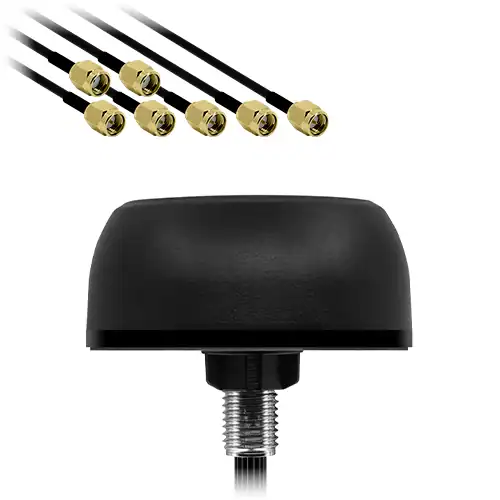
The Siretta Tango 57 is a multi-technology MIMO puck antenna designed for industrial IoT deployments where a single compact mounting point needs to serve multiple radio technologies simultaneously. Its defining feature is the consolidation of seven antenna connections – four for 5G and 4G LTE, two for Wi-Fi 7, and one for GPS – into a single low-profile dome enclosure rated IP68 for permanent outdoor installation.
The significance of this is practical. A 5G industrial router with full 4×4 MIMO cellular capability, dual-band WiFi, and GPS typically requires six to seven antenna connections served by separate antenna elements – each needing its own mounting hole, cable run, and weatherproofing. The Tango 57 reduces this to a single through-hole mounting point and a set of pigtail cables to the router ports. For rooftop, vehicle, and outdoor enclosure installations where cable penetrations are expensive and weather sealing is critical, this consolidation has real operational and cost value.
SMA Male
4×4 MIMO capable
RP-SMA Male
802.11ax
SMA Male
Position and timing
Frequency Coverage
The cellular ports on the Tango 57 cover 617 MHz to 6000 MHz. This is genuinely wideband – it encompasses every 4G LTE band deployed by UK operators (including the low 700-800 MHz bands that provide rural coverage) through to the mid-band 5G frequencies being deployed across UK cities and infrastructure corridors. It also covers sub-6GHz 5G NR bands used by UK operators including EE’s 3.4-3.8 GHz 5G spectrum.
The two Wi-Fi ports cover dual-band 802.11ax (Wi-Fi 7) – 2.4 GHz for range and 5/6 GHz for throughput. Having two RP-SMA ports means routers with dual-band Wi-Fi radios can connect both the 2.4 GHz and 5 GHz chains through the single puck, maintaining the MIMO diversity that modern Wi-Fi performance depends on.
The GPS L1 port covers 1575.42 MHz – the primary civilian GPS frequency. This is relevant for any deployment where the router needs GPS-disciplined NTP timing (common in utility and substation deployments where precise time synchronisation is a SCADA requirement) or where location data is part of the asset management workflow.
IP68 Rating – What This Means in Practice
IP68 is the highest standard enclosure protection rating in the IEC 60529 classification. It means the antenna is both completely dust-tight (the 6) and protected against continuous immersion in water at depth specified by the manufacturer (the 8). This is a step above IP67, which covers temporary submersion to 1 metre for 30 minutes. IP68 is appropriate for installations in splash zones, water treatment facilities, marine environments, and any outdoor location where standing water or pressure washing is a realistic scenario.
For most industrial IoT rooftop or outdoor cabinet installations, IP67 would be sufficient – but IP68 provides headroom. It means the antenna can be installed without the careful attention to sealing and orientation that an IP65 or IP66-rated device would demand. The enclosure integrity is not sensitive to water pooling around the base or to heavy rainfall driving water into cable entry points – provided the cables and connectors are also correctly sealed.
MIMO Performance and Element Isolation
For a multi-element MIMO antenna to perform correctly, the individual antenna elements must be electrically isolated from each other. Poor isolation between elements causes the signals on different MIMO chains to correlate – the modem sees similar signals on both inputs and cannot separate the data streams effectively, collapsing MIMO throughput gain back toward single-antenna performance.
Siretta specifically cites high isolation between elements as a design characteristic of the Tango 57. Achieving this in a compact puck where the elements are physically close together requires careful RF engineering – orthogonal polarisation, strategic element placement, and internal shielding between the cellular, Wi-Fi, and GPS sections. A cheap multi-element puck antenna that does not address isolation will show adequate specifications on paper but deliver degraded MIMO performance in use. Siretta’s anechoic chamber testing and third-party validation of the Tango 57 data provides evidence that the isolation performance matches the design intent.
Siretta’s Test Data Approach
Siretta are one of the few antenna manufacturers in the UK market who publish independently validated, anechoic chamber-tested performance data for their products. The Tango 57 datasheet includes the Spectral View Diagram – a frequency sweep from 400 MHz to 8000 MHz where each frequency range is colour-coded based on measured radiated efficiency and VSWR:
This visualisation makes it immediately clear which bands the antenna performs well on and which are marginal – without requiring the reader to interpret raw dBi gain tables. Combined with the full peak gain per band data and 2D radiation plots in the datasheet, it gives specifiers enough information to make a genuine like-for-like comparison rather than relying on headline marketing claims. Download the datasheet direct from the Siretta product page before finalising antenna selection for any specific deployment.
Available Configurations
The full configuration. Four SMA Male cellular/GPS cables and two RP-SMA Male Wi-Fi cables on a 1m pigtail. The right choice for 5G routers with 4×4 MIMO cellular plus dual-band Wi-Fi and GPS, such as the Milesight UR75.
Reduced cellular MIMO – two cellular ports and two Wi-Fi ports, no GPS. Appropriate for routers with 2×2 LTE MIMO and dual-band Wi-Fi where GPS timing is not required. Lower cost where the full 7-in-1 specification is not needed.
Custom cable lengths and connector types are available from Siretta for volume orders. Extension cables are also available separately – order ASMA500B058L13 to extend the cellular and GPS ports by an additional 5 metres, or ASMD500C058L13 for the Wi-Fi ports.
Compatible Hardware
Router compatibility notes
- Milesight UR75 (5G): 4x cellular SMA ports + Wi-Fi + GPS – the 7-in-1 Tango 57 covers all connections. Natural pairing for the UR75 in outdoor or vehicle installations.
- Milesight UF51 (5G outdoor CPE): Already IP67-rated with integrated antennas – Tango 57 not required but could supplement for challenging signal environments.
- Milesight UR35 / UR32 (4G dual-SIM): 2x cellular SMA ports. Use the 4-in-1 TANGO57/MIMO22 variant if Wi-Fi is also needed, or a simpler 2-port MIMO antenna if cellular only.
- Teltonika RUTX50 (5G): 4x cellular antenna ports plus Wi-Fi and GPS – compatible with 7-in-1 Tango 57.
- Any 5G router with 4x SMA cellular ports: Check connector types – the Tango 57 ships with SMA Male pigtails for cellular. Most industrial routers use SMA Female sockets, so direct connection is straightforward.
Ideal Deployment Scenarios
Smart Utilities and Substations
Single roof or enclosure top mount replaces multiple antenna penetrations. GPS port provides L1 timing for NTP synchronisation of SCADA and protection relay systems.
Transportation and Fleet
Single vehicle roof penetration for 5G/4G, Wi-Fi, and GPS. IP68 handles the wash-down environments typical of bus, rail, and commercial vehicle applications.
Marine and Offshore
IP68 is the appropriate specification for marine installations. Wideband coverage across all cellular bands accommodates changing network availability as vessels move between coverage areas.
Industrial Outdoor Cabinets
Pole or enclosure top mount. Single cable entry point simplifies weatherproofing. 5G future-proofing on a site where 4G is the current connectivity but 5G coverage is expected within the deployment lifetime.
Smart Agriculture
Pole-mounted on agricultural buildings or boundary structures. Wi-Fi coverage for local sensor networks and equipment; cellular backhaul; GPS for precision agriculture applications.
BESS and Renewable Energy
Single mount on inverter cabinet or site structure. Cellular SCADA comms, GPS NTP timing, and Wi-Fi for local engineering access in one unit. See also the Milesight for utilities guide.
Antenna Selection Context
The Tango 57 is the right choice when consolidation is the primary driver – multiple technologies, single mounting point, IP68 protection. It is not always the right choice when maximum gain in a specific direction is the requirement. A dedicated high-gain directional cellular antenna will outperform the Tango 57 on cellular throughput in a challenging coverage environment because it can focus its aperture entirely on the cellular link rather than sharing the physical structure with Wi-Fi and GPS elements.
For a substation in a rural area with marginal cellular coverage, the correct specification might be a high-gain directional cellular panel aimed at the nearest mast, plus a separate GPS timing antenna – rather than the Tango 57’s balanced multi-technology approach. For the same substation in an area with good 5G coverage, the Tango 57’s consolidation benefit outweighs the marginal gain difference. Understanding this trade-off is part of proper antenna selection – see the IoT antennas guide for the broader context on MIMO, gain, and installation decisions.
- Siretta Tango 57 product page – full datasheet, Spectral View Diagram, and ordering information direct from Siretta
- IoT Antenna – independent antenna selection guide for cellular IoT and LoRaWAN deployments
- Why IoT Antennas Matter – signal metrics, MIMO, cable loss, and installation guidance
- Milesight Industrial Routers – UR75 and UR35 specifications and antenna port configurations
- Cellular Connectivity for IoT – 5G, 4G, and MIMO technology explained


