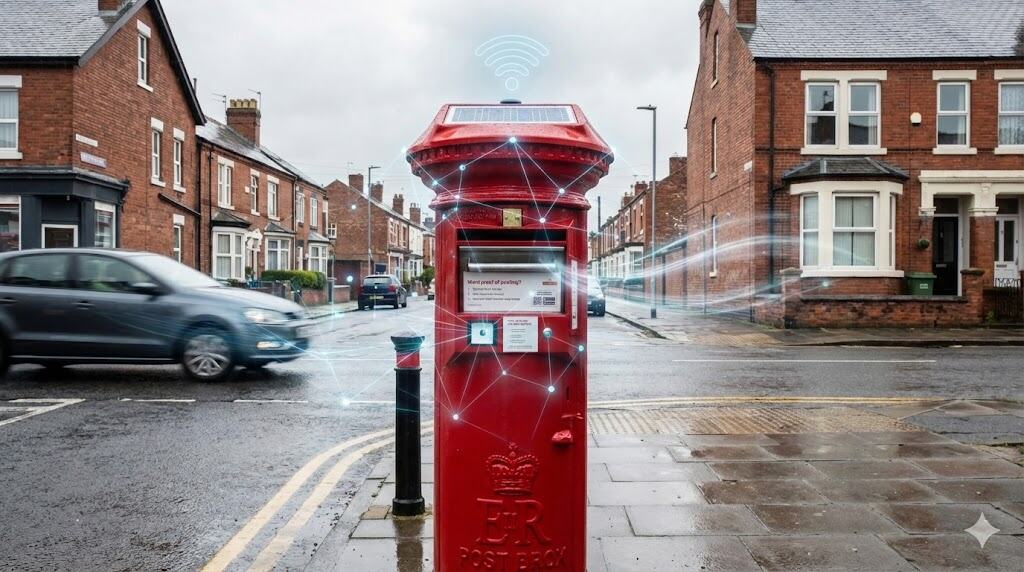
You’ve probably walked past one already and not noticed. A perfectly ordinary red pillar box, standing on a wet pavement somewhere in suburban Britain – except for one small detail. A round black module on the cap. That, it turns out, is the most interesting piece of hardware on your street.
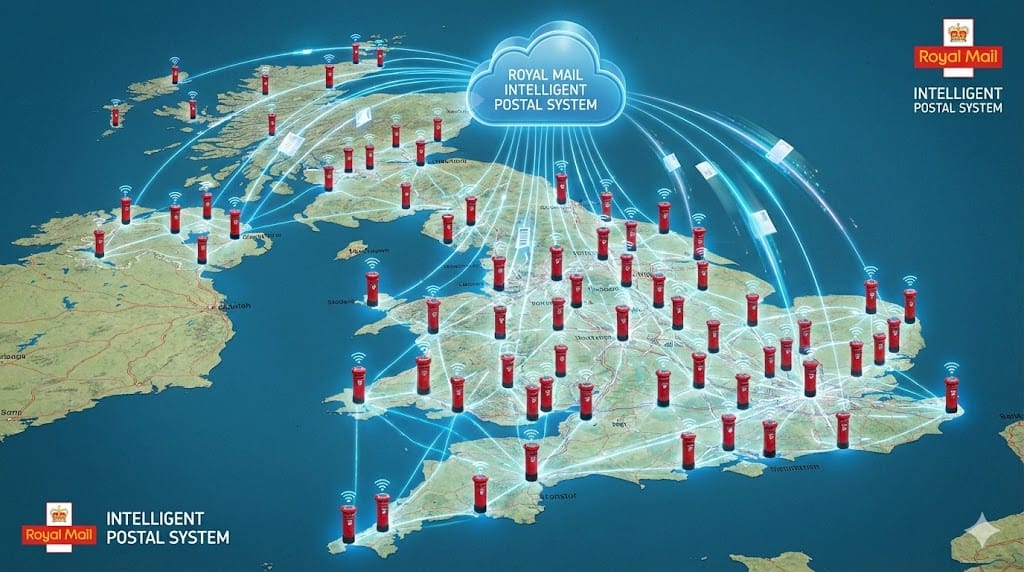
Royal Mail is rolling out 3,500 solar-powered “postboxes of the future” across the UK, following a successful pilot in Hertfordshire and Cambridgeshire. The official story is about convenience – scan a barcode, a drawer opens, drop in a shoebox-sized parcel, get digital proof of posting. Simple. Clean. Modern.
But from an IoT perspective, this is something considerably more significant than a smarter post slot. It is one of the largest cellular-connected street furniture deployments in UK history, attached to a network of 115,000 locations. And the way it has been engineered tells you almost everything you need to know about where connected infrastructure is actually heading.
This article pulls apart the hardware, the connectivity architecture, and the supply chain – separating confirmed facts from well-grounded inference – and then zooms out to look at the much broader pattern this represents. Because the smart postbox is not an outlier. It is one visible example of something that is happening everywhere, to the objects you use every day, without any fanfare at all.
What Royal Mail Has Confirmed
Before the speculation, here are the facts that have been publicly stated across Royal Mail’s own press release, BBC News, The Guardian, ITV News Anglia, and TIME magazine (which named the postbox of the future a Best Invention of 2025).
The new units are retrofits fitted to existing pillar boxes. They include a solar panel positioned due south to power the electronics, a battery pack for operation during low-light periods, a separate drop-down drawer for parcels up to shoebox size, a barcode scanner interface, and a conventional letter slot that remains unchanged. The Royal Mail app handles proof of posting, using the phone’s 4G connection and location services.
The pilot ran in April 2025 across five locations in Hertfordshire and Cambridgeshire, including Ware, Hertford, Letchworth and Fowlmere. The national rollout of 3,500 units followed. Staffordshire-based precision engineering firm Alpha Manufacturing has publicly confirmed involvement in the project, specifically referencing the kind of work involved – custom sheet metal housings and integrating electronics into weatherproof enclosures for street furniture applications.
That is the verified baseline. Everything beyond it is expert inference, clearly labelled as such.
That Black Puck on the Cap – What It Actually Is
[FAQ] What is the antenna on the new Royal Mail smart postbox?
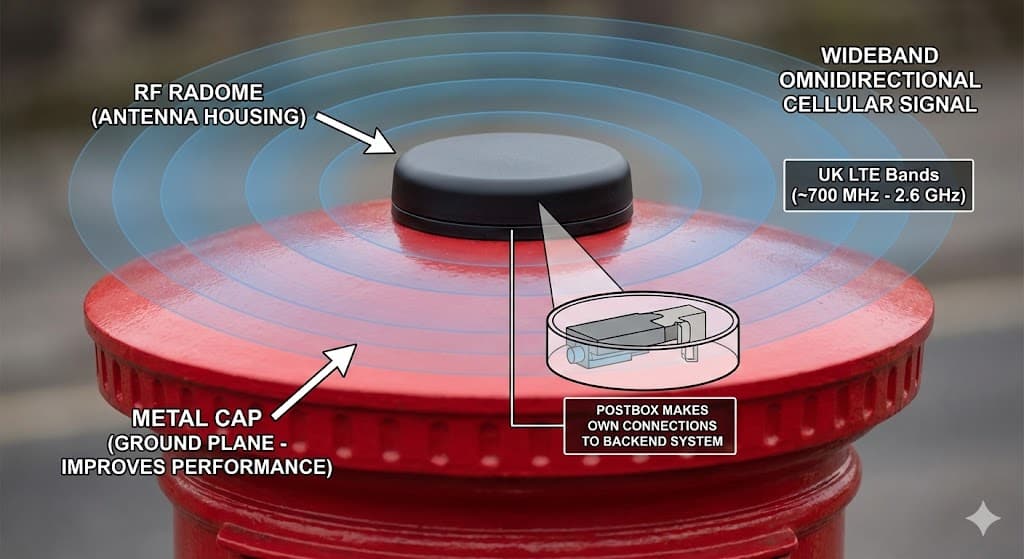
The round black module visible on top of the upgraded postboxes is almost certainly an RF radome – a weatherproof enclosure housing a cellular antenna. This is standard practice for outdoor IoT street furniture. Whip antennas are avoided because they invite vandalism, create water ingress risk at the mount point, and look conspicuous. A low-profile puck radome bonded to the top cap solves all three problems.
What makes this interesting is what it implies. The postbox is not just relying on the user’s phone for connectivity. The box itself has a radio. That radio needs an antenna. And the fact that antenna exists tells you the box is making its own connections to a backend system – not just passively waiting for instructions from an app.
Royal Mail has not publicly named the antenna manufacturer, the modem vendor, or the cellular network provider. This is entirely normal for infrastructure rollouts of this type. You do not publish your RF stack or your SIM strategy when you are deploying public-facing devices at national scale.
What the form factor and operating requirements tell us is this: the antenna is most likely a wideband omnidirectional unit covering UK LTE bands from approximately 700 MHz to 2.6 GHz, designed for IP-rated outdoor mounting on a metal surface. The metal cap of the postbox provides a useful ground plane, which actually improves antenna performance if the design accounts for it. GNSS capability is possible but probably unnecessary – Royal Mail has a fixed asset register and does not need GPS per box for routine operations.
Why the Box Itself Needs Connectivity
[FAQ] How do IoT post boxes work – does the postbox connect to the internet itself?
This is the question most mainstream coverage skips past. It is also the most important one.
Consider what happens when someone presents a barcode to the scanner. The box needs to decide whether to open the drawer. If it opens for any barcode-shaped object, it becomes a vandal’s free dispenser – open on demand, fill with rubbish, jam the mechanism, cause downtime across the fleet. That failure mode is obvious and would be exploited within days of deployment.
The sensible solution is label validation: the box queries a backend service to confirm the barcode represents a legitimate Royal Mail parcel label that is eligible for this channel. It receives a response, and only then operates the actuator.
There are offline alternatives – local format checking, cryptographic token validation – but online or hybrid validation is the cleanest approach at scale because it gives Royal Mail real-time control over what gets accepted, without requiring physical firmware updates to change acceptance rules. It also generates an event log per transaction, which is your proof-of-posting audit trail.
That validation call requires the box to have its own internet connection. Enter the cellular modem and the puck antenna.
Beyond validation, any sensibly operated IoT fleet sends telemetry: battery state of charge, solar input, temperature, door cycle count, motor current draw, fault codes. Without that data, you are flying blind. You only discover a failed unit when a customer complains or an engineer happens to walk past. With telemetry, you know a battery is degrading three months before the unit goes offline, and you can schedule maintenance before failure.
The Power Architecture: Harder Than It Looks
A solar panel positioned due south is a meaningful engineering constraint, not a PR line about sustainability. It means the box cannot rely on mains power, cannot assume good solar input in winter, and must balance energy harvesting against the energy demands of a motorised mechanism.
The motorised drawer is the demanding part. A camera scanner, microcontroller, and cellular modem in standby mode draw relatively little current. A drawer actuator cycling open and closed draws a burst of significantly higher current every time someone uses the box. On a busy urban postbox, that could be dozens of cycles per day. On a quiet rural one, perhaps a handful per week.
Good power architecture means an appropriately sized LiFePO4 or ruggedised lithium battery pack, a charge controller that handles the solar input and protects against overcharge and deep discharge, a power management controller that keeps the main electronics in deep sleep and wakes them only when needed, and a modem that duty-cycles its connection rather than maintaining a permanent session.
Get this wrong in either direction and you have a problem. Undersize the battery and you get winter field failures across the fleet. Oversize it and you add cost, weight, and eventual hazardous waste disposal issues. The fact that Alpha Manufacturing is confirmed to be involved in the electronics enclosure and sheet metal integration suggests the engineering has been properly thought through, not bolted together from off-the-shelf parts.
Who Is Building It? The Supply Chain as Best Guess
Royal Mail has not published a supplier list. What the available evidence suggests is a multi-party supply chain, which is entirely normal for a retrofit programme of this complexity.
The physical postboxes themselves have historically been produced by specialist UK manufacturers. Machan Engineering in Scotland has long been associated with UK pillar box manufacturing – though their specific involvement in this retrofit programme has not been publicly confirmed. The retrofit kit – the cap assembly, solar panel, electronics enclosure, front panel, drawer mechanism – is a separate design challenge requiring precision fabrication, weatherproofing, and integration.
Alpha Manufacturing is confirmed to be involved in that fabrication and integration work. Their involvement in the street furniture sector and their publicly stated connection to the solar postbox project make them one of the few named suppliers in the entire programme.
For the electronics and connectivity layer, the best-guess shortlist based on deployment requirements points toward LTE Cat 1 or Cat 1 bis as the most likely modem category. This is the pragmatic mainstream choice for low-throughput IoT deployments where you need good UK coverage, reasonable power consumption, and a long support lifecycle. LTE-M is possible if they optimised hard for power. NB-IoT is less likely given the latency requirements of drawer validation.
For SIM and connectivity, a national infrastructure operator deploying 3,500 units across diverse street environments would be ill-advised to rely on a single-network consumer SIM. Street furniture gets placed where humans want it, not where RF is ideal. The sensible procurement model is either a direct IoT contract with a UK MNO at commercial scale, or an IoT MVNO providing multi-network roaming SIMs under a single managed contract. The latter is particularly attractive because it gives coverage resilience without requiring Royal Mail to manage multiple carrier relationships.
The backend platform – label validation, telemetry ingestion, device management, firmware updates, monitoring – is either built in-house within Royal Mail’s technology estate or provided by a systems integrator. Royal Mail has significant in-house technology capability given its scale, but the IoT device management layer is specialised enough that a platform partner is plausible.
The Security Architecture Nobody Is Talking About
A publicly accessible, motorised mechanism connected to the internet is an attack surface. It is worth being explicit about this, not to be alarmist, but because it is exactly the kind of thing that gets overlooked when a project is being sold on convenience rather than engineering.
A well-designed deployment needs device-level authentication so each box has a unique identity that cannot be spoofed, encrypted communications so the validation exchange cannot be intercepted and replayed, rate limiting per device so a single box cannot be made to cycle indefinitely, tamper detection that triggers an alert when someone attempts to force the mechanism, and a safe failure mode that locks rather than opens when connectivity is lost or a fault is detected.
Royal Mail will not and should not publish its security architecture. But the existence of this attack surface is worth acknowledging – particularly for anyone in the IoT sector who is designing similar public-facing mechanisms. Fail-open is not an acceptable default. Audit trails must be non-repudiable. Device identity must be managed, not assumed.
The Bigger Picture: IoT Is Already Everywhere You Walk
The smart postbox feels novel because it wraps new technology around something so familiar. But step back and the pattern it represents has been unfolding around us for years. The postbox is just one of the most recognisable examples in a long and growing list of ordinary objects that have quietly become cellular-connected edge devices.
Parcel Lockers and Click-and-Collect Points
InPost’s locker network – visible in supermarket car parks, petrol station forecourts, and high streets across the UK – is essentially the same architecture at different scale. Each locker bank is a cellular-connected device with a barcode scanner, individual compartment actuators, a battery backup, and a cloud platform managing parcel tracking, PIN generation, and fleet monitoring. Amazon Hub lockers operate on the same principle. The user interaction is different but the engineering underneath – LTE backhaul, event-driven validation, remote management – is identical to what Royal Mail is deploying in pillar box form.
Laundry Machines at Supermarkets
This one surprises people. The banks of washing machines appearing outside some Tesco and Morrisons stores are cellular IoT devices. Each machine is connected, monitored remotely, able to accept payment via app or card reader with cloud authorisation, and reportable for maintenance. The operator knows cycle counts, fault states, revenue per machine, and which units need servicing – without sending an engineer to physically inspect them. It is exactly the same pattern: take a traditionally dumb mechanical device, add a cellular modem and a management platform, and turn it into something you can run as a monitored service.
EV Charging Points
Every publicly accessible EV charger in the UK is a cellular IoT node. It authenticates the vehicle or user, communicates real-time status and pricing, logs session data for billing, and reports faults to a network operations centre. The antenna housings on charging columns are immediately recognisable to anyone who works in the sector. The connectivity requirements – reliable uplink, low latency for session start and stop, telemetry – are almost exactly the same as the smart postbox.
Smart Waste Bins
Bigbelly and similar systems have been deploying cellular-connected compacting bins in UK city centres for years. Each unit reports fill level, compaction cycles, battery state, and fault conditions. Waste collection routes are dynamically optimised based on actual fill data rather than fixed schedules. The efficiency gains are real and measurable. The hardware architecture is solar-powered cellular IoT. The postbox programme is not pioneering this category – it is joining a well-established one.
Traffic Monitoring and Smart Parking
The small rectangular units bolted to lamp posts and road furniture across most UK urban areas are cellular IoT sensors reporting vehicle flow, journey times, and parking bay occupancy. Local authorities use this data for dynamic routing, congestion charging, and parking management. Each unit has a battery or solar supply, a low-power cellular modem, and a simple telemetry platform. They are so unremarkable that most people genuinely do not notice them despite walking past dozens per week.
Environmental Monitoring Stations
Air quality sensors, flood level monitors, weather stations – all now routinely deployed as solar-powered cellular IoT nodes. The Environment Agency’s flood warning network, for example, relies on thousands of remote sensing points, many of them battery or solar powered with LTE or NB-IoT backhaul, sending water level data at regular intervals to a centralised platform. When a river gauge goes offline, it triggers an alert before anyone notices the data has stopped.
Rail Trackside Infrastructure
Network Rail operates cellular IoT monitoring across thousands of trackside locations – monitoring axle counters, point machines, cable theft detection, level crossing health. Each is a remote cellular endpoint with the same fundamental requirements: reliable connectivity, low power where mains is unavailable, remote diagnostics, long service lifecycle. The engineering decisions made for a smart postbox and a trackside monitoring unit are closer than most people would expect.
The Pattern Underneath All of It
Look across all these examples and the same engineering pattern repeats. A traditionally dumb or manually managed physical asset gains a power source (solar where mains is unavailable), an embedded controller, one or more sensors or actuators relevant to its function, a cellular modem with an industrial-grade SIM, an antenna suited to its mounting environment, and a cloud platform for telemetry, management, and event processing.
The customer-facing feature – the parcel drawer, the locker compartment, the charging socket, the compacting bin – is almost never the hard part. The hard part is the lifecycle engineering: sizing the battery correctly for year-round operation, choosing a modem category that balances power and coverage, selecting a SIM strategy that provides multi-network resilience without creating unmanageable contract complexity, designing the firmware for reliable operation across a fleet that cannot be easily accessed for physical intervention, and building the operations platform that makes 3,500 units – or 300,000 – manageable by a team of realistic size.
This is not the IoT of conference presentations and concept videos. It is the IoT of engineering margins, battery chemistry, and support escalation paths. The successful deployments are the ones that disappear into the environment. The ones that fail tend to do so quietly, expensively, and invisibly – until someone notices that a third of the fleet stopped reporting six months ago.
What This Means If You Work in IoT Connectivity
For anyone in the connectivity supply chain – whether you are a systems integrator, a SIM provider, a router manufacturer, or a managed services operator – the Royal Mail deployment represents a template worth studying carefully.
The connectivity model chosen here will be running for a minimum of five to ten years. The SIM vendor, whether an MNO or MVNO, is signing up for a long-term infrastructure relationship, not a short product contract. The antenna and modem will be expected to outlast multiple generations of consumer devices. The device management platform will need to handle firmware updates, credential rotation, and fleet monitoring at scale without requiring physical access to the units.
These are the requirements that separate genuine industrial IoT connectivity providers from those who have repackaged consumer mobile products and added “IoT” to the branding. Multi-network resilience, private APN or VPN architecture, eSIM or eUICC capability for long-lifecycle devices, centralised device management, and clearly defined SLAs for a connected infrastructure asset are the baseline, not the premium offering.
The smart postbox is painted red. But the engineering inside it is the same engineering that keeps energy meters, water monitors, traffic sensors, and EV chargers running. Understanding that is the starting point for selling into this market effectively.
A Note on What Is Confirmed vs Inferred
In the interest of accuracy: the confirmed facts in this article come from Royal Mail’s own press release, BBC News, The Guardian, ITV News Anglia, TIME magazine, and Alpha Manufacturing’s published content. The supply chain details for the modem, SIM, antenna, and backend platform are expert inference based on deployment requirements and industry patterns – not confirmed supplier disclosures. Where we have used phrases like “most likely”, “best guess”, or “the sensible design choice”, that distinction is intentional. Royal Mail has not publicly named its connectivity or electronics supply chain, which is standard practice for national infrastructure operators.
If you are standing next to one of these boxes and want to go further, the confirmed path to supplier identification is the UKCA/CE label inside the service panel, any moulded part number on the antenna radome, and engineer-facing QR codes or service plates on the electronics enclosure.
Final Thought
That red postbox on a wet British pavement is no longer just cast iron and paint. It is a node in a national logistics network – solar powered, cellular connected, remotely monitored, and capable of being reconfigured in software without anyone going near it.
And it is one of hundreds of thousands of ordinary objects that are quietly making the same transition around us, on every high street, in every car park, on every railway line in the country.
The future of IoT was never going to announce itself. It was always going to look exactly like a postbox.
Sources and further reading: Royal Mail / International Distribution Services press release (2025). BBC News – Solar-powered postboxes rollout. The Guardian – Postboxes of the future trial, April 2025. ITV News Anglia – Hertfordshire pilot coverage. TIME Magazine Best Inventions 2025 special mentions. Alpha Manufacturing – Solar-powered postboxes (alphamanufacturing.co.uk).
Related reading


