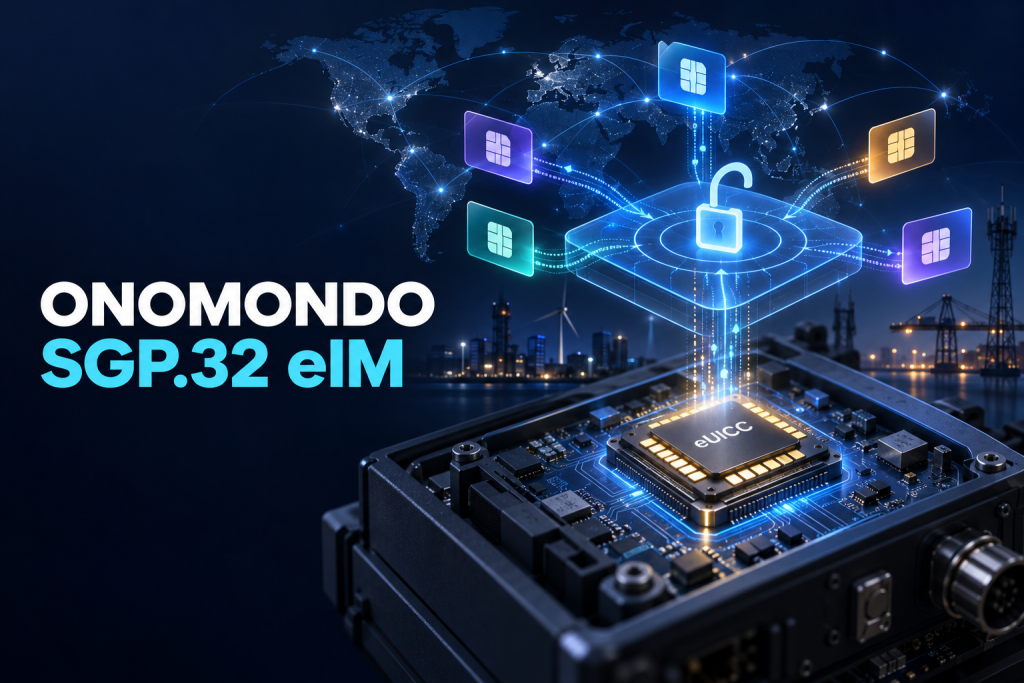
Onomondo has launched its own SGP.32 eSIM IoT Remote Manager (eIM), the component that controls which eSIM profiles sit on a device. Unusually, it can be used with Onomondo connectivity or entirely without it. The pitch targets a real risk: that the eIM, not the SIM, becomes the next place cellular IoT gets locked in. Onomondo’s announcement runs in full below, followed by the IoTPortal view.
The following press release was issued by Onomondo on 16 September 2026 and is published here in full. The IoTPortal view follows at the end.
What Onomondo has launched
Copenhagen, Denmark, 16 September 2026. Onomondo today announces the launch of its own eSIM IoT Remote Manager (eIM). It is designed to prevent a new form of vendor lock-in emerging around SGP.32 by giving enterprises the freedom to change connectivity providers throughout the lifetime of their IoT devices worldwide.
The launch expands Onomondo’s IoT infrastructure with a self-built, end-to-end SGP.32 eSIM offering spanning eUICC SIMs, eSIM profiles with global cellular connectivity, and now an eIM to remotely manage which profiles are installed on each SIM.
That infrastructure gives businesses the foundational technology to turn what happens in the physical world into useful data, spanning device, connectivity and cloud, built and run as one programmable system.
The eIM is effectively the remote control for IoT eSIMs. It enables enterprises to manage the eSIM profiles in deployed devices without physically retrieving them. But unlike eIMs that are tied commercially or technically to a particular connectivity provider or platform, Onomondo’s eIM can be used independently of Onomondo connectivity.
| SGP.32 component | Role | Field-changeable? |
|---|---|---|
| eUICC SIM | The secure chip that stores the eSIM profiles | Remote reconfiguration is mandatory under the standard |
| eSIM profile | The operator identity and credentials on the SIM | Downloaded, enabled, disabled and deleted remotely |
| eIM | The remote manager that controls the two above | Only if the vendor chose to make it configurable |
The distinction matters because SGP.32 is designed around component interoperability to give enterprises far greater control over cellular connectivity after an IoT device has been deployed. eSIM profiles can be remotely downloaded, enabled, disabled and deleted with the eIM, without physically accessing the device or replacing its SIM. In principle, an enterprise can therefore change connectivity provider remotely.
SGP.32 is the industry’s opportunity to finally put IoT companies in control of their cellular connectivity. But that promise only works if customers have a practical ability to change providers, not simply a theoretical ability defined by a technical standard.
Henrik Aagaard, CTO, Onomondo
An eIM shouldn’t become the new lock-in point. We have built ours so customers can use it with Onomondo connectivity or without us. That’s SGP.32 implemented the way we believe the standard is intended. If their requirements change five or ten years from now, they should still be able to make the connectivity decision that’s right for their business.
Henrik Aagaard, CTO, Onomondo
SGP.32 lock-in and why it matters
The three components of eSIM IoT, eUICC SIMs, eSIM profiles and the eIM, must be interoperable as per the GSMA’s technical specifications to give users control of their fleet’s connectivity throughout its lifetime.
Technical interoperability does not necessarily mean commercial interchangeability. The SGP.32 standard makes the operations for remotely changing an eIM’s configuration mandatory only for the eUICC.
The eIM is emerging as a critical point in that distinction, because if an eIM is not configurable, the customer cannot replace the eIM controlling its fleet. The eIM effectively becomes a closed gateway, leaving the customer locked into the ecosystem it provides access to.
The result risks recreating the very problem SGP.32 was intended to solve: the customer can theoretically change connectivity provider, but the architecture or commercial model surrounding the eIM can make exercising that freedom difficult.
For enterprises deploying hundreds of thousands, or millions, of devices that may remain operational for ten years or more, the consequences can be significant. A connectivity decision made when a product is manufactured can leave the business dependent on the same eIM years later.
Without genuine interchangeability, changing connectivity providers could ultimately require physical intervention, potentially across devices already installed in vehicles, industrial machinery, meters, payment terminals and other equipment distributed around the world.
This is precisely the operational problem that remote SIM provisioning for IoT was engineered to eliminate.
Onomondo has therefore made its eIM fully configurable and available independently of its own connectivity. Customers can use Onomondo’s complete eSIM IoT ecosystem, combine its eIM with connectivity from other providers, or change how their fleet is configured as their business requirements evolve.
From “freedom to leave” to freedom to choose
Onomondo has long based its cellular IoT model on what it calls “freedom to leave”, customers should not have to replace their SIM estate simply because they want to replace Onomondo. SGP.32 brings that principle into the technical architecture of eSIM IoT.
Onomondo’s eIM now extends the same principle to the remote management layer: customers can choose Onomondo today without having to assume that Onomondo will necessarily remain the right choice throughout the lifetime of every device. That effectively turns “freedom to leave” into freedom to choose, now and in the future.
Availability
Onomondo’s eIM is available today. It can be used as part of Onomondo’s complete SGP.32 ecosystem, including eUICC SIMs, eSIM profiles and cellular connectivity, or independently with connectivity from other providers. The eIM is designed for companies deploying cellular IoT fleets that want to retain control over how connectivity is provisioned and changed throughout the operational lifetime of their devices.
About Onomondo
Onomondo is a global IoT infrastructure provider redefining how businesses connect and manage devices worldwide. Launched in 2018 and headquartered in Copenhagen, Denmark, Onomondo unifies 680+ networks into a single core network infrastructure to deliver simpler and more flexible IoT connectivity. With real-time troubleshooting tools, traffic insights and direct cloud integrations, Onomondo gives companies greater visibility and control over their IoT operations, making it easier to develop, deploy and scale. Customers include Maersk, Carlsberg, Donkey Republic, DOJO and Connected Cars. For more information visit www.onomondo.com.
Source: the announcement was issued by Onomondo. Read more on Onomondo’s SGP.32 eSIM page. Media contact: media@onomondo.com.
The IoTPortal view
Every connectivity vendor now claims to end lock-in, so a press release built around the word “freedom” earns a raised eyebrow by default. Strip out the marketing, though, and Onomondo has landed on a real and under-discussed problem.
Lock-in in cellular IoT has never actually gone away. It has migrated. It used to live in the operator profile welded to a physical SIM. eUICC and SGP.32 moved it into the eSIM OS burned into the silicon at manufacture. The eIM is simply the next floor down. As the release itself concedes, the standard makes remote reconfiguration mandatory for the eUICC but not for the eIM, so the component that actually controls your fleet can quietly become the part you cannot replace. Onomondo is right that this is where the next trap is being set.
Technical interoperability is not the same as commercial interchangeability. A fleet can be fully standards-compliant and still be stuck.
Building an eIM that is configurable and can be pointed at other providers is, on the face of it, the standard implemented in the spirit it was written. Credit for that. It is also good strategy: the quickest way to sell SGP.32 is to remove the buyer’s fear of being trapped, and Onomondo is not the first to work that out. Independent public interoperability tests have already migrated live devices between providers using a third party’s eIM platform, with Onomondo among those demonstrating profile switching. Openness here is commercial self-interest that happens to line up with the customer’s interest, which is the best kind.
The test, as always, is whether “use it without us” survives contact with the commercial terms. Interchangeability that is genuine in the architecture can still be made slow, costly or awkward in the contract, and a fleet of hundreds of thousands of devices is exactly the point at which “awkward” quietly becomes “never bothered”. If you are buying into any SGP.32 stack on a ten-year horizon, do not take the exit on trust. Ask to be shown it: who else can operate the eIM, on what terms, and what it actually takes to hand your fleet to another provider. A vendor that means it will walk you to the door without flinching.
Onomondo eIM: frequently asked questions
What is an eIM in SGP.32?
The eSIM IoT Remote Manager (eIM) is the component that remotely controls which eSIM profiles are installed on a device’s eUICC SIM. It lets an operator download, enable, disable and delete profiles over the air, without physically touching the hardware.
Does SGP.32 prevent vendor lock-in?
Not on its own. SGP.32 makes remote reconfiguration mandatory for the eUICC but not for the eIM, so if the eIM controlling a fleet is not configurable or replaceable, a customer can still be locked in despite the standard. Real interchangeability depends on how each vendor implements and prices the eIM.
Can you change IoT connectivity provider without replacing the SIM?
That is the goal of SGP.32. eSIM profiles can be swapped remotely on a deployed device, so in principle the network can change without a site visit. In practice it only works if every component, including the eIM, stays open and changeable.
Press release source: Onomondo, 16 September 2026. Standards reference: GSMA SGP.32. The IoTPortal view is written by Peter Green and is independent editorial comment.