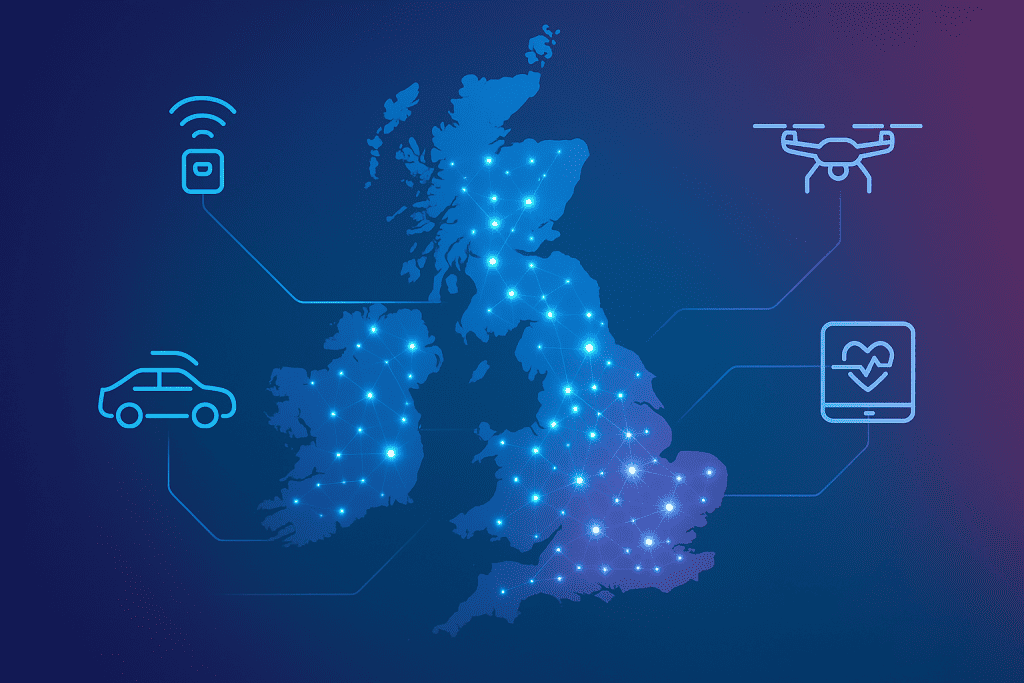
Virgin Media O2 has just switched on its 5G SA (Standalone) network across hundreds of towns and cities, now covering more than 70% of the UK population. This marks a turning point in mobile connectivity: the shift from 5G as a marketing badge to 5G as a fully independent, next-generation platform.
For consumers, this means faster and more reliable connections on newer phones. For IoT, it means much more: ultra-low latency, massive device density, and the introduction of features like network slicing that can transform how industrial and business systems run.
From 5G Non-Standalone to Standalone
Most “5G” we’ve had in the UK until now was non-standalone (NSA). That setup relies on existing 4G networks for control signalling. It delivers faster speeds than LTE, but it can’t unlock the full potential of the 5G standard.
Standalone is different. With a dedicated 5G core network, it enables:
- Ultra-low latency for real-time operations
- Network slicing to create dedicated, isolated segments of the network
- Support for massive IoT deployments with far higher device density per cell
- More flexible quality of service (QoS) controls
- Better spectral efficiency and re-use of freed-up 3G spectrum
For IoT projects, that translates into more predictable, reliable and scalable connectivity.
O2’s Rollout
Virgin Media O2 has activated 5G SA in around 500 towns and cities, promising at least 90% outdoor coverage in those areas. Business customers were given early access, enabling pilots of network slicing and other enterprise features.
The company is also phasing out its legacy 3G services, reallocating that spectrum to 4G and 5G. For IoT deployments still dependent on older modules, this makes migration urgent.
What This Means for IoT
Lower Latency for Real-Time IoT
Applications such as robotics, machine control, and AR-assisted maintenance depend on latency measured in milliseconds. O2 5G SA can deliver that, where NSA could not.
Network Slicing for Dedicated IoT Lanes
With slicing, businesses can reserve their own “lane” in the network, isolated from consumer traffic. That means more predictable performance for critical applications like healthcare, logistics, or energy monitoring.
Scaling Up Device Density
Smart cities, precision agriculture, and industrial automation often require tens of thousands of sensors per square kilometre. 5G SA is built for that kind of density.
Better Quality of Service
Operators can now offer IoT customers service levels tailored to their needs. For example, prioritising SCADA telemetry or CCTV backhaul over non-critical bulk data.
Freed-Up Spectrum
As 3G switches off, the refarmed spectrum strengthens both 4G and 5G coverage. That benefits IoT deployments in semi-urban and rural areas where spectrum is scarce.
Next Steps for IoT Engineers and Businesses
- Audit existing deployments – check which devices are 5G SA capable, which are NSA only, and which are still on 3G/2G.
- Select SA-ready modules and routers – futureproof projects by ensuring hardware supports standalone operation.
- Plan migration from 3G now – don’t leave it until networks are fully shut down.
- Engage with operators – start conversations about network slicing and tailored SLAs.
- Re-architect IoT workloads – take advantage of edge computing opportunities that 5G SA brings.
Final Thoughts
The launch of Virgin Media O2 5G SA Standalone network is a milestone that matters far beyond faster phones. For IoT projects in the UK, it’s the foundation for more ambitious deployments, from connected vehicles and smart infrastructure to remote monitoring and predictive maintenance.
Those who prepare early — by upgrading hardware, planning migrations, and exploring new service models — will gain a real advantage as the UK’s networks evolve.
Related reading