
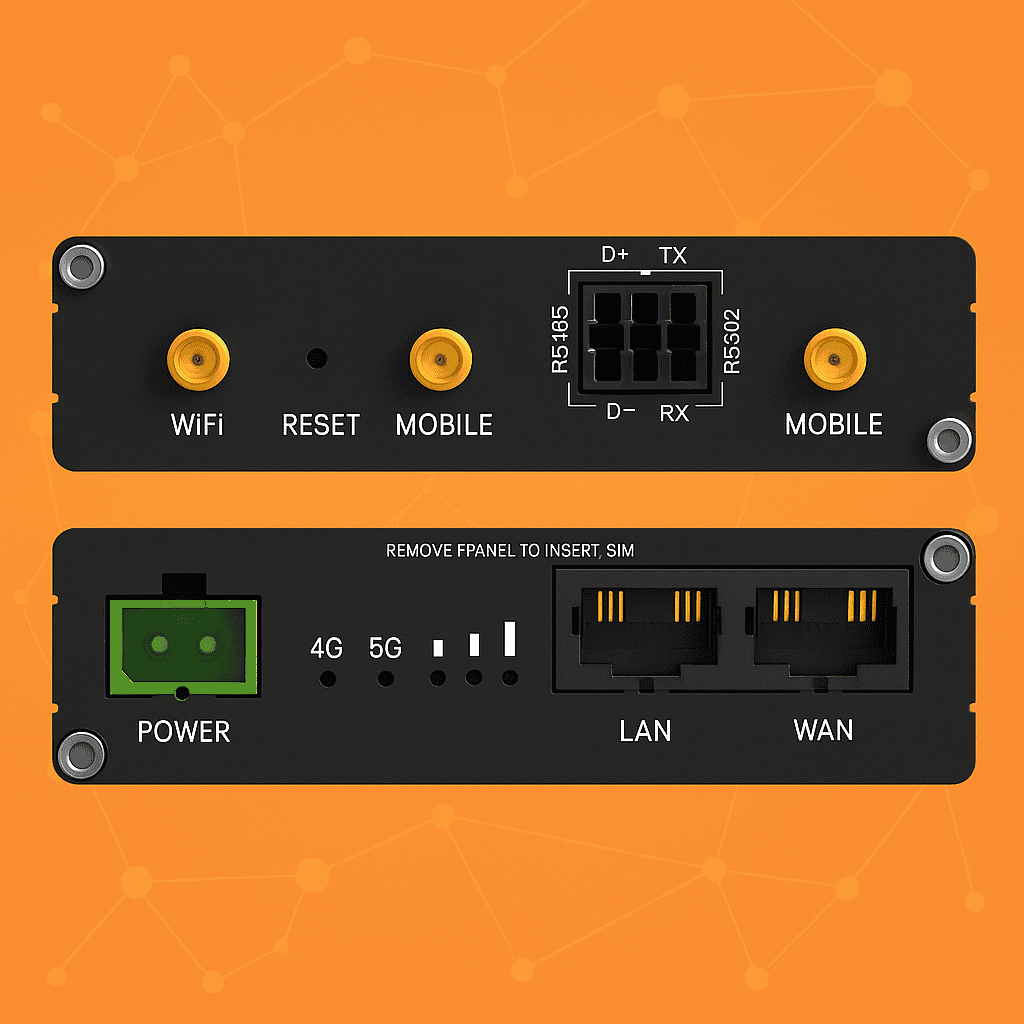
Why The RUT276 Is Great for IIoT (Industrial IoT)
Industrial systems don’t move fast. They’re designed to keep running, sometimes for decades.
Most still communicate over RS485 or RS232, and they do it reliably. The challenge isn’t the equipment — it’s access. The business wants the data in dashboards, SCADA, analytics platforms, or remote monitoring portals.
The Teltonika RUT276 gives you that bridge without disturbing the equipment.
Connect RS485/RS232 devices directly to IP networks or the cloud — using 5G RedCap.
No serial converters, no extra hardware, no rewiring.
It’s a compact industrial router built for cabinets, control panels, solar fields, and pump stations.

What the RUT276 Actually Does
It sits between your legacy equipment and your cloud or IP network:
RS485 / RS232 → RUT276 → 5G RedCap → Cloud (MQTT/HTTPS)
- Reads Modbus / BACnet / DNP3 / DLMS / OPC UA
- Publishes to cloud platforms via MQTT or HTTPS
- Offers secure remote maintenance through VPN
All from one device.
Why 5G RedCap Works Better for Industrial Deployments
Full 5G is overkill in most industrial environments.
You don’t need 1 Gbit streaming — you need predictable low-latency connectivity.
5G RedCap is the perfect balance:
- Faster than 4G Cat4
- Lower cost and lower power than full 5G
- Optimised for IoT, telemetry and M2M
This matters because industrial IoT is about continuity and lifecycle, not raw bandwidth.
Built-In RS485 and RS232 (No Media Converters)
Many “industrial routers” are just consumer routers with metal housings.
The RUT276 is different — serial is part of its architecture.
You get:
- RS485 (2-wire, half duplex)
- RS232 (TX/RX/GND)
And on the firmware side (RutOS), you get native support for:
- Modbus RTU/TCP
- BACnet Router
- OPC UA Client & Server
- DNP3 (SCADA telemetry)
- DLMS (smart metering)
You poll values directly from devices and send them to:
- Cloud brokers (MQTT)
- HTTPS endpoints
- IoT or SCADA platforms
No scripting PAINS.
No random Windows applications to babysit.
SIM & Connectivity Options
The RUT276 includes:
- Dual SIM slots (Mini-SIM 2FF)
- Automatic SIM failover
- Band locking and signal monitoring
- APN auto-detection
Recommended SIM setups:
| SIM Type | Best Use Case |
|---|---|
| Multi-network roaming IoT SIM | A Multi-Network SIM or Roaming SIM can help with resilience, by having access to multiple networks on a single IoT SIM. |
| Private IP SIM | Ideal when combining with VPN access |
| Public IP SIM | Only use when necessary. Must be firewalled to prevent bot traffic – ore use the router as a VPN server and only allow VPN connections. |
The RUT276 is built to stay online — even when coverage fluctuates.
RutOS and RMS: The Hidden Advantage
RutOS (inside the router)
Industrial firmware with:
- Data to Server (serial polling → MQTT/HTTPS)
- VPN (WireGuard, OpenVPN, IPsec, ZeroTier)
- Firewall, VLAN, VRF routing
- Modbus/BACnet/OPC UA/DNP3/DLMS tools
RMS (Teltonika’s cloud platform)
- Remote configuration
- Firmware upgrade automation
- Remote VPN into connected equipment
In practice, it means:
No engineer travelling to site just to “change a setting”.
Case Study: Solar Inverter Monitoring (Modbus RS485 → MQTT Cloud)
Site:
Remote solar installation, multiple inverters, RS485 Modbus only.
Old approach:
Industrial PC + USB-RS485 adapters.
Windows updates rebooting the system at the worst time.
New solution using RUT276:
- RS485 wired directly into RUT276
- RutOS polls Modbus registers
- Data published to MQTT broker every 10 seconds
- Multi-network SIM ensures always-on connectivity
- RMS used to remotely update firmware and VPN into the LAN
Result:
Zero PC on-site.
Zero converters.
Zero downtime due to operating system issues.
Huge reduction in site visits.
RUT145 & DAP145 — When 5G Isn’t Required
Teltonika built a complete “serial modernisation trio”:
| Device | Backhaul Type | Best Use Case |
|---|---|---|
| RUT276 | 5G RedCap | Serial → Cloud / remote sites |
| RUT145 | Ethernet | Serial → LAN / fixed infrastructure |
| DAP145 | Wi-Fi (mesh + fast roaming) | RS485 devices where cabling is impractical |
Choose the transport that suits the environment — no bodging installations.
Box Contents
Included in the RUT276 standard package:
- RUT276 Router
- 2-pin industrial DC power terminal
- 2×3-pin terminal connectors (RS485/RS232)
- Hex key
- SIM Adapter kit
- Quick Start Guide
Order Codes
| Order Code | Description |
|---|---|
| RUT276000000 | Standard package (no PSU included) |
| RUT276000020 | Mass / bulk packaging code |
Compatible Accessories
Mounting & Power
- Surface mounting kit
- DIN rail kit (standard or compact)
- DIN rail adapter plate
- BAT120 mini UPS module
- 9W power adaptors (UK, EU, US, AU, Universal)
- Automotive power cable (12V DC)
- 4-pin DC power plug with contact terminals
- 4-pin to 4-pin power cable
- 4-pin to barrel power adapter
Antennas
- 5G SMA paddle antenna
- 5G SMA compact paddle antenna
- 5G SMA magnetic base IoT antenna
- Wi-Fi RP-SMA paddle antenna
- SMA extension cables
Accessories may vary based on region and packaging.
Glossary (30 Quick Terms)
| Term | Description |
|---|---|
| RUT276 | Industrial 5G RedCap serial router |
| RS232 | Point-to-point serial communications |
| RS485 | Long-distance, multi-drop serial bus |
| PLC | Programmable Logic Controller |
| Modbus RTU/TCP | Classic industrial polling protocol |
| BACnet | Building automation / HVAC communication |
| OPC UA | Modern industrial interoperability |
| DLMS | Utility metering protocol |
| DNP3 | SCADA telemetry protocol |
| Data to Server | RutOS engine to publish device data |
| MQTT | Cloud messaging protocol |
| HTTPS Push | Direct HTTPS data delivery |
| RutOS | Teltonika industrial firmware |
| RMS | Teltonika remote management platform |
| VPN | Secure tunnel for remote access |
| WireGuard | Fast, efficient VPN |
| IPsec | Traditional secure VPN |
| ZeroTier | Virtual Layer 2 network overlay |
| APN | Packet data profile for SIM access |
| Dual SIM | SIM redundancy/failover |
| PDN | Packet data network routing |
| Band Locking | Forces modem to specific cellular bands |
| VLAN | Network segmentation |
| VRF | Separate routing tables for isolation |
| PoE-In | Power over Ethernet input support |
| Passive PoE | Power delivered over spare pairs |
| DIN Rail Mount | Industrial mounting format |
| FOTA | Firmware updates remotely |
| SNMP | Device monitoring via network management tools |
| TR-069 | Remote provisioning standard |
Conclusion
The RUT276 offers something rare in industrial networking:
A clean path to the cloud without disturbing working equipment.
- Built-in RS485 & RS232
- 5G RedCap (designed for IoT / stable throughput, not speed bragging)
- Dual SIM resilience
- RutOS + RMS remote access
- Industrial housing and mounting
If your project requires data from legacy systems without rebuilding them, the RUT276 is a very smart choice.
FAQ — RUT276
1) Does the RUT276 support eSIM?
No. The RUT276 has two Mini-SIM (2FF) slots on a stacked tray. There is no eSIM.
2) What SIM setup do you recommend?
For most industrial sites: a multi-network roaming IoT SIM for resilience, and a Private IP SIM + VPN for secure remote access. Use Public IP SIMs only when you must, and lock them down to avoid bot traffic and excess data use.
3) Can the RUT276 publish Modbus/BACnet/DNP3/DLMS data to the cloud?
Yes. Use Data to Server to poll values and push them to MQTT or HTTPS. You can extend the logic with Lua.
4) Which serial interfaces are built in?
RS485 (2-wire, half-duplex) and RS232 on a 6-pin terminal block. No external converters needed.
5) Is Wi-Fi included, and how many clients can connect?
Yes. 2.4 GHz 802.11b/g/n (AP/Client/Mesh/Multi-AP). Up to 50 clients, with 802.11r/k/v fast roaming options.
6) How many Ethernet ports are there?
Two 10/100 Mbps RJ45 ports: 1× WAN and 1× LAN.
7) Does it support PoE?
Yes. Active PoE-In (802.3af Class 0) on the LAN port and passive PoE (16–57 VDC) support.
8) What VPN options are available?
WireGuard, OpenVPN, IPsec (IKEv1/v2), plus L2TP, PPTP, SSTP, ZeroTier, DMVPN, GRE, Tinc, EoIP, OpenConnect.
9) Can I reach PLCs remotely without port forwarding?
Yes. Use RMS VPN or your own WireGuard/OpenVPN/IPsec. Best practice is a Private IP SIM + VPN.
10) Does it support band locking and detailed modem stats?
Yes. Band lock is available. You can view RSSI, RSRP, RSRQ, SINR, operator, RAT, cells, and traffic graphs in RutOS.
11) Power input and consumption?
9–57 VDC via 2-pin terminal (reverse-polarity and surge protection). Typical draw: < 2 W idle, < 3.5 W max.
12) What’s included in the box?
Router, 2-pin DC power terminal, 2×3-pin RS232/RS485 connector, hex key, SIM adapter kit, Quick Start Guide, packaging.
13) Does it support microSD storage?
Yes. microSD up to 2 TB (FAT32/NTFS/ext2/3/4) for storage, Samba, and DLNA use cases.
14) Which industrial protocols are built in?
Modbus RTU/TCP, BACnet Router, OPC UA Client/Server, DNP3, DLMS/COSEM, MQTT broker/publisher.
15) How is it managed at scale?
Via RMS (Teltonika’s cloud) for fleet config, FOTA, alerts and remote VPN, plus TR-069, SNMP (v1/v2/v3), WebUI/SSH/CLI, and JSON-RPC.
16) Can it run as a hotspot/captive portal?
Yes. Captive portal with RADIUS, SMS/SSO options, user groups/limits, themes, and Hotspot 2.0 support.
17) What security features are available besides VPNs?
IPv4/IPv6 stateful firewall, zone policies, web filtering (allow/deny), DDoS/SYN-flood/port-scan protections, 802.1X, certificate manager (incl. Let’s Encrypt, SCEP).
18) Does it support VLANs and VRF?
Yes. Port/tag-based VLANs and initial VRF support for routing separation.
19) Which SIM size is required?
Mini-SIM (2FF), two slots (stacked tray).
20) Physical build and mounting options?
Aluminium enclosure, 83 × 25 × 83 mm, 132 g. Mounting via DIN rail, wall, or flat surface (kits available).
21) What about firmware updates?
Local updates via WebUI/CLI and remote FOTA via RMS. You can keep settings during upgrades.
22) Does it have Dynamic DNS and DNS-over-HTTPS?
Yes. DDNS (77+ providers) and DNS-over-HTTPS are supported.
23) Can I bridge the mobile IP to a device on the LAN?
Yes. Bridge, Passthrough, and Framed Routing modes are available depending on your design.
24) What happens if I use a Public IP SIM without strict rules?
Expect bot scans and unwanted traffic. This can inflate data usage and create security risk. If Public IP is mandatory, restrict exposure with firewall rules and VPN-only access.
25) Are there region-specific power supplies and antenna options?
Yes. EU/UK/US/AU/Universal PSUs and multiple SMA/RP-SMA antenna options (5G and Wi-Fi). Confirm at ordering.
26) Does the RUT276 include Wi-Fi mesh and fast roaming?
Yes. Mesh (802.11s) and fast roaming (802.11r/k/v) features are available.
27) Can I run multiple PDNs/APNs?
Yes. Multiple PDN is supported to segregate traffic by service.
28) Is certificate-based Wi-Fi/802.1X supported?
Yes. WPA2-Enterprise/WPA3-EAP with EAP-TLS, 802.1X and a full certificate manager.
29) What are the regulatory marks?
CE, UKCA, EAC, UCRF, RCM, CB, with EMC/RF/Safety standards as per the technical specification.
30) When should I choose RUT145 or DAP145 instead?
- RUT145 if you already have a reliable wired Ethernet backhaul.
- DAP145 if you need RS485 over Wi-Fi (mesh/roaming) where cabling isn’t feasible.
- RUT276 for serial-to-cloud over 5G RedCap at remote or unmanned sites.
| RUT276 – Full Technical Specification | |
|---|---|
| Mobile / Cellular | |
| Mobile module | 5G Sub-6GHz SA RedCap (223 Mbps DL / 123 Mbps UL), 4G LTE Cat 4 (195 Mbps DL / 105 Mbps UL) |
| 3GPP Release | Release 17 |
| Mobile metrics | IMSI, ICCID, operator, connection state, network type, bands, RSSI, SINR, RSRP, RSRQ, EC/IO, RSCP, LAC, TAC, Cell ID, ARFCN/UARFCN/EARFCN graphs and history |
| SMS / SMPP | Send/receive, SMS↔EMAIL, HTTP API, scheduled SMS, SMS to SMS, autoreply |
| USSD | Supported |
| Operator control | Block/allow list by country or operator |
| Multiple PDN | Different PDNs for different services |
| Band management | Band locking, used band display |
| APN | Auto APN detection |
| SIM slots | Dual Mini-SIM (2FF), stacked tray, SIM PIN management |
| Bridge mode | Direct link between ISP and LAN device |
| Passthrough | Assigns mobile WAN IP directly to LAN device |
| Framed routing | Supports routed IP behind the mobile module |
| Wireless (Wi-Fi) | |
| Wireless mode | 2.4GHz Wi-Fi (802.11b/g/n) AP, Client (STA), Mesh (802.11s), Multi-AP |
| Security | WPA2/WPA3, WPA2-Enterprise, WPA3-SAE/EAP, OWE, EAP-TLS (PKCS#12), MAC filtering, client isolation, Protected Management Frames (802.11w) |
| Fast Roaming | 802.11r, 802.11k, 802.11v |
| Max users | Up to 50 Wi-Fi clients |
| Convenience features | Wi-Fi QR onboarding, SSID hide/stealth mode, WMM |
| Ethernet | |
| Ports | 2× RJ45 (1× LAN, 1× WAN), 10/100 Mbps, auto MDI/MDIX |
| PoE | PoE-In on LAN port (802.3af Class 0), passive PoE support (16–57V) |
| Networking | |
| Routing | Static routing, BGP, OSPFv2, RIP v1/v2, EIGRP, NHRP, policy-based routing |
| Protocols | IPv4, IPv6, PPP, ARP, TCP, UDP, ICMP, GRE, ESP, IP NAT |
| Connection monitoring | Ping reboot, Wget reboot, periodic reboot, LCP/ICMP inspection |
| DHCP | Server/relay, static leases, MAC wildcard support |
| QoS / SQM | Traffic prioritisation (port, protocol, service) |
| DNS over HTTPS | Encrypted DNS resolution |
| DDNS | Supports 77+ providers |
| Backup links | Failover via Wi-Fi WAN, Mobile, VRRP, Wired |
| Load balancing | Multi-WAN balancing |
| Hotspot | Captive portal, RADIUS support, SSO, themes, traffic limits |
| VRF | Initial support |
| Security | |
| Firewall | IPv4/IPv6, stateful firewall, zone-based, custom rules, DMZ, NAT/NAT-T/NAT64 |
| Attack prevention | DDoS, SYN flood, port scan & SSH/HTTPS attack protection |
| Authentication | PSK/certificates, X.509, TACACS+, RADIUS, time-based lockouts |
| VLAN | Port & tag based VLAN |
| WEB filter | Blacklist / whitelist |
| VPN | |
| WireGuard | Client + Server |
| OpenVPN | Client + Server (27 encryption methods) |
| IPsec | IKEv1/v2, AES/3DES/GCM variants |
| Other VPN types | L2TP, PPTP, SSTP, ZeroTier, DMVPN (phase2/3), GRE, Tinc, EoIP, OpenConnect |
| Industrial Protocols / Serial Data | |
| Modbus | Client/Server; RTU (RS232/RS485), TCP; custom registers; rich data formats (INT/UINT/Float, ABCD/CDAB/LSB etc.) |
| BACnet | Router (RTU + TCP), BBMD support |
| OPC UA | Client + Server |
| DNP3 | Station / Outstation (RTU + TCP) |
| DLMS/COSEM | Client mode (RTU + TCP) |
| Data to Server | MQTT / HTTPS publishing, LUA scripting |
| MQTT Broker | Built-in broker & client |
| Serial / I/O / SD | |
| Serial ports | 1× 6-pin terminal (RS232 + RS485) |
| RS232 | No flow control signals |
| RS485 | 2-wire half duplex |
| Serial functions | Console, Serial-over-IP, Modbus gateway, NTRIP client |
| SD card slot | MicroSD up to 2TB (FAT32, NTFS, ext2/3/4) |
| System | |
| CPU | Mediatek MIPS 580 MHz |
| RAM | 128 MB DDR2 |
| Flash storage | 32 MB SPI Flash |
| Operating system | RutOS (OpenWrt Linux-based) |
| Firmware tools | Backup, profile management, FOTA (via RMS), custom branding, SDK |
| Power | |
| Input voltage | 9–57 VDC (reverse polarity + surge protection) |
| PoE Input | 802.3af Class 0 (12.94 W) on LAN port; passive POE 16–57 VDC |
| Power consumption | Idle < 2W, Max < 3.5W |
| Physical Interfaces | |
| Antennas | 2 × SMA (cellular), 1 × RP-SMA (Wi-Fi) |
| SIM | 2 × Mini-SIM (2FF) |
| LEDs | Connection type (2), mobile signal strength (3), LAN (2), power (1) |
| Reset | Reboot / user-default / factory reset |
| Physical Characteristics | |
| Casing | Aluminium industrial housing |
| Dimensions (W×H×D) | 83 × 25 × 83 mm |
| Weight | 132 g |
| Mounting options | DIN rail, wall, flat surface (kits available) |
| Regulatory & Certifications | |
| Certifications | CE, UKCA, EAC, UCRF, RCM, CB |
| EMC / Safety | EN 55032, EN 55035, EN 61000-3-2/3-3, EN IEC 62311, EN IEC 62368-1, AS/NZS 62368.1, EN 61000-4 immunity suite |
| Ordering | |
| Order codes | RUT276000000 (standard), RUT276000020 (mass/bulk) |
| Box contents | RUT276, 2-pin power terminal, 2×3 pin serial plug, hex key, SIM adapter kit, QSG, packaging |


5G RedCap: what it is, what you’ll get today, and how it rolls out in the UK
5G RedCap (a.k.a. NR-Light) is a 3GPP Release-17 profile that sits between LTE Cat-4/6 and full-blown 5G eMBB. It strips out the heavy bits of 5G (massive bandwidths, 4×4 MIMO) and keeps the parts that matter for industrial IoT: low latency, better uplink scheduling, efficient signalling, and long-term 5G core compatibility.
Perfect for telemetry, PLCs, sensors, serial gateways (RS232/RS485), CCTV status channels, EV chargers, and anything that needs reliable IP with modest throughput.
Typical radio capabilities you can expect from RedCap-class routers
(Figures vary by modem, network, and band plan. These are realistic planning numbers rather than lab peak claims.)
- 5G NR (FR1, RedCap)
- Channel bandwidth: typically up to 20 MHz per carrier (sub-6 GHz).
- MIMO: usually 2×2 DL / 1×1 UL (device and band dependent).
- Modulation: up to 256-QAM DL/UL where the network enables it.
- Peak user throughput (good RF): 120–220 Mb/s down, 20–80 Mb/s up.
- Latency: ~15–30 ms end-to-end in a healthy 5G SA network.
- Carrier aggregation (NR-CA): early RedCap implementations are typically single-carrier NR; some chipsets add limited CA in later releases/firmware. Many deployments use EN-DC (LTE anchor + NR data) during the transition.
- LTE fallback (for coverage today)
- Category: commonly Cat-4 or Cat-6 depending on module.
- LTE-CA: up to 2×CA on Cat-6 where the network/bands allow.
- Peak user throughput (planning): 50–150 Mb/s down, 10–40 Mb/s up.
- Latency: ~25–50 ms in well-loaded UK networks.
- SIM/eSIM: standard 3FF (nano) with eUICC/eSIM options on many modules for flexible profiles.
- Bands: UK-typical n28/n20 (coverage), n78 (capacity), n1/n3/n7 for LTE/EN-DC mixes, plus legacy LTE bands for wide area reach.
The UK rollout reality (plain English)
- Requires 5G Standalone (SA): RedCap attaches to the 5G core. UK operators are enabling SA progressively; it’s not everywhere yet.
- Where it works first: major cities, high-priority industrial zones, and sites already upgraded to SA with compatible spectrum (often n78 and refarmed low-bands).
- 2025–2026: selective commercial availability and pilots across EE/BT, Vodafone, Three, and VMO2 footprints where SA is live. Enterprise projects go first.
- 2026–2027: wider regional coverage as SA upgrades expand and refarming frees more 5G FR1 spectrum for IoT profiles like RedCap.
- Device onboarding: expect periodic firmware updates enabling new bands/features (e.g., EN-DC tweaks, optional NR-CA as operators light it up).
(No drama: this is a software-led rollout. As SA coverage grows, RedCap devices simply start attaching to 5G where available.)
Why buying a RedCap router now still makes sense
- It works brilliantly on LTE today. Even if your cell only offers 4G, a RedCap-class router will deliver fast, stable, low-latency IP for industrial traffic. Most serial and telemetry jobs need tens of kilobits to a few megabits—well within LTE Cat-4/6.
- Future-proof attachment. As SA pops up at your sites, the router can attach to 5G RedCap automatically, improving uplink scheduling and latency without a truck roll.
- Lower complexity than eMBB 5G. Smaller bandwidths, simpler RF chains, and typically lower power draw than 4×4 eMBB gear—ideal for cabinets and plant rooms.
- Better spectrum efficiency for IoT loads. RedCap is designed for lots of modest-rate devices, not a handful of phones blasting 1 Gb/s.
Practical planning tips (UK)
- Assume LTE first, enable 5G when it arrives. Configure APNs, QoS, and VPN the same way you would for LTE; let 5G SA attach when the cell supports it.
- Favour low-band coverage + n78 where present. For fixed sites, external antennas aimed at a reliable sector beat chasing headline speeds.
- Keep firmware current. RedCap features (and SA attachment behaviour) improve with module/router updates as operators tune their cores.
- Use VPN/RMS from day one. Avoid public inbound exposure; use RMS/VPN for management and whitelisted egress to your platforms.
Quick spec snapshot to drop into a product page
- 5G RedCap (FR1): up to 20 MHz channel BW; typical 2×2 DL / 1×1 UL; up to 256-QAM; planning speeds 120–220 Mb/s DL / 20–80 Mb/s UL; ~15–30 ms latency on 5G SA.
- LTE fallback: Cat-4/6 with 2×CA where available; planning speeds 50–150 Mb/s DL / 10–40 Mb/s UL; ~25–50 ms latency.
- Core requirement: 5G SA preferred; EN-DC used during transition in some networks.
- SIM: physical nano-SIM; eSIM/eUICC on many modules.
- Use cases: PLC/SCADA via RS232/RS485, metering, EV charging, kiosks, sensors, retail, remote maintenance.
Bottom line: buy once. You get solid LTE right now with industrial-grade performance, and seamless RedCap as UK SA coverage expands—no swap-outs, no drama.