AI knows. Brian understands. Sometimes they are both wrong.
Motor 7 has been running for eleven years. The sensors say it is fine. Brian is not convinced. A long read about edge AI, the quiet value of an experienced engineer, and what a plant loses the day he walks out of the gate.
Brian and Motor 7
It is a quarter past six and the plant is still deciding whether to wake up properly. Brian is doing his round, the same round he has done for the best part of thirty years, a slow walk down the length of the line with his hands in his pockets and his head very slightly cocked, like a man listening for one particular voice in a crowded room.
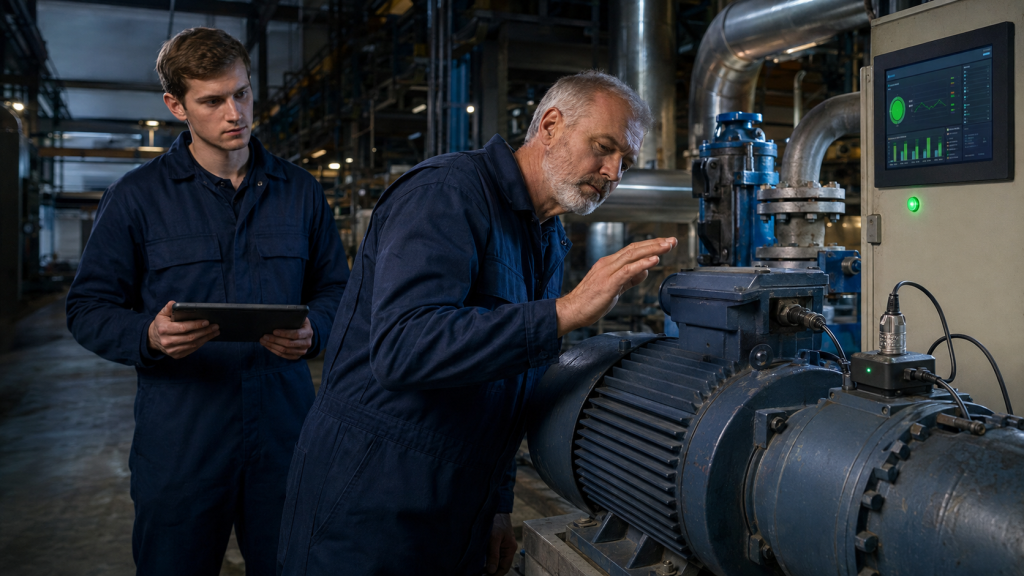
He stops at Motor 7. He does not look at it first. He listens. Then he takes one hand out of his pocket, holds it flat a few inches from the housing, and leaves it there for longer than seems necessary. Then he says, to nobody in particular, that it is on the way out.
Motor 7 drives a pump in the middle of the line and has turned, more or less continuously, for eleven years. This morning there is nothing obviously wrong with it. It is not too hot to touch. It is not making the kind of noise that makes people stop and look. The dashboard on the wall, of which more shortly, says it is completely fine. Brian says it is going. Not today, not necessarily this week, but going.
Ask him how he knows and you will not get a satisfying answer. Something in the pitch that was not there on Tuesday. A warmth in a place that was cool last month. A smell he would struggle to describe and could pick out of a hundred others. Thirty years of motors, compressed into a feeling he cannot fully put into words. That is the first thing to understand about Brian. He does not have the data. He has something the data has never quite managed to write down.
What Brian actually knows
There is a temptation, when you meet a Brian, to file him under experience and move on, as though experience were simply a large pile of the same stuff a newcomer has a small pile of. That is not really what is going on. What Brian has is not more information. It is a different kind of knowledge altogether.
The philosopher Michael Polanyi had a phrase for it: we know more than we can tell. He called it tacit knowledge, the understanding that lives in the hands and the senses and the judgement rather than in the manual. It is the knowledge that lets a skilled worker feel that a cut is about to bind, or a driver sense that a road has turned icy before anything on the dashboard has said so. You cannot simply download it, because the person who has it cannot fully spell it out. It was built slowly, by doing the thing thousands of times and paying close attention to what happened next.
Brian's version of it is a library of failures. He has stood next to motors as they died in every way a motor can die, and a few ways they are not supposed to. Each one left a trace. A particular knock that meant a bearing on its way out. A hesitation on start-up that meant something in the windings. A vibration you felt through the soles of your boots rather than heard. Over the years these traces have fused into something closer to instinct than analysis, and the only reason it looks like magic is that the working has been lost. Brian is not guessing. He is matching what he senses against three decades of examples, at a resolution no specification sheet ever captured.
There was a night, a few winters ago, when the line was running hard to clear a backlog and everything on the board was green. Brian walked past a gearbox and stopped. He could not have told you exactly what was wrong. He told the shift manager to take it off line. The shift manager, reasonably, asked why, because taking it off line meant missing the backlog and a difficult conversation in the morning. Brian said he did not like the sound of it. That was the entire technical justification on offer: he did not like the sound of it. They took it off line. When they opened it up, a bearing was moments from letting go in a way that would have taken the gearbox, the motor and most of a week's production with it.
Nobody wrote that down properly. It went into the logbook as a bearing replacement. The thing actually worth capturing, that a human being heard a failure the instruments had not yet noticed and was trusted enough to act on it, went nowhere. That is the value of Brian, and it is almost impossible to put on a balance sheet, right up until the year he is not there and the gearbox goes.
The machine that never sleeps
It would be a cheap and dishonest article that spent its length praising Brian and sneering at the box on the wall. The box is genuinely remarkable, and the urge to cast it as the villain of the piece should be resisted.
Motor 7 is watched by a vibration sensor, a temperature probe and a current monitor, feeding a small model on a gateway a few metres away, with a digital twin of the whole line in the cloud. This system does something Brian, for all his gifts, simply cannot. It does not watch one motor. It watches two hundred, at the same time, without ever getting tired, bored, distracted or emotionally invested. It runs a frequency analysis on every one of them, many times a second, and it catches the kind of slow drift that no human notices precisely because it is slow: the quarter of a degree a month, the barely perceptible creep in a vibration signature, the change that is invisible on any single day and unmistakable across a year of stored data.
It never has an off day. It does not go on holiday and hand over to someone who does not know the plant. It does not retire. And it does something quietly democratic that deserves more credit than it usually gets. It takes a version of the expertise that used to live only in the Brians and makes it available on every shift, in every plant, to people who have not yet earned it the hard way. A newly qualified engineer with a good condition-monitoring system in front of her has a kind of borrowed intuition that would otherwise have taken twenty years to build by ear. That is not nothing. That is a real transfer of capability, and anyone who has watched a plant limp along waiting for the one person who understands the extruder to get back from leave knows exactly why it matters.
So this is not a story about a wise human and a foolish machine. Both of them are, in their own way, extraordinary. The trouble starts, as it usually does, when each is asked to do the thing the other is better at.
When the machine is confidently wrong
A dashboard is only ever as honest as what feeds it. A vibration sensor can drift out of calibration and report a healthy signal from a sick machine. A model can be blind to a failure mode it was never trained on, which happens more often than vendors like to admit, because the interesting failures are rare by definition. Worse, a reading can be perfectly authentic, encrypted end to end, delivered over a private APN with valid certificates, and still be completely wrong, because the sensor itself is lying or the world around it has been disturbed. We have written before about how authentic data can still tell a lie, and a model cannot smell a motor.
The model is confident because confidence, in a model, is simply arithmetic performed on the data it was given. It is not wisdom about the data it never received. Green does not mean healthy. Green means nothing has crossed a threshold somebody thought to set, measured by sensors somebody assumed were telling the truth.
When Brian is confidently wrong
It would be easy to stop there, with the wise old engineer vindicated over the cold machine. That would be a lie of a different kind, because it romanticises Brian. Experience entrenches habit at least as readily as it builds instinct. Brian has watched a hundred motors fail, which is precisely why he might miss the hundred and first when it fails in a way he has never seen. He has pride, and a mortgage, and a quiet suspicion of the grey box that arrived on the wall to do a part of the job he used to own outright.
The awkward part is that Brian's confidence looks exactly the same from the outside whether he is right or whether he is running on a rule that quietly stopped being true. A motor gets redesigned. A lubricant changes. A new drive introduces a failure mode that behaves nothing like the ones in his library. Brian will read it with total conviction using the old map, and total conviction is a poor guide to whether the map still fits the ground. Automation bias, the habit of trusting the confident-looking output, is usually described as something humans do to machines. It is just as easily something a plant does to Brian. Neither he nor the model has earned the right to be believed automatically. Both are sometimes right for the wrong reasons, and both are occasionally, confidently, completely wrong.
The trouble with Brian is that he is fifty-eight
Here is the fact that turns all of this from an interesting debate into an urgent one. Brian is fifty-eight. In seven years, on a good day, he is gone, and there is no queue of Brians forming behind him.
The people who look after the physical machinery of the modern world are, on average, getting older, and fewer young people are choosing to replace them. The trades that produce a Brian, the ones where you learn by standing next to something for years until it teaches you its language, have spent a long time being quietly run down and talked down. The result is a slow, unglamorous shortage that rarely makes the news: the understanding is retiring faster than it is being replaced.
You can read that timing as a disaster or as a rescue, and both readings have something to them. The hopeful version is that condition monitoring and edge AI arrive just in time to catch some of what the Brians knew before it walks out of the gate for good. The bleak version is that we build systems that quietly assume a Brian will always be standing there to sense-check them, and then act surprised when there is nobody left in the room who can tell that the green dashboard is lying.
Which is why the genuinely interesting question is not whether the machine can replace Brian. It cannot, not fully, and pretending otherwise is how you end up handing a confident model the keys with nobody present who can smell the motor. The genuinely interesting question is whether we can capture enough of what Brian understands, while he is still here to give it, that the plant keeps its judgement after he has handed in his locker key.
It was never AI versus Brian
The whole framing of man against machine is the mistake. The system worth building is not the one where the algorithm replaces Brian, nor the one where Brian is allowed to overrule the algorithm whenever it wounds his pride. It is the one where the two are deliberately made to argue. Brian logs his hunch about Motor 7 into the same system that is currently calling it green. The model treats that hunch as a signal and goes looking, weighting the next hours of telemetry differently, checking the readings Brian cannot see against the rest of the fleet. The disagreement itself becomes the thing worth investigating, rather than an inconvenience to be settled by whoever happens to outrank whom.
That is a far more useful relationship than deference in either direction. It is also, worth noticing, exactly the relationship this article is trying to have with its own critic a little further down the page. Neither party assumes the other is right. Each is asked what the other has missed.
Which leaves the awkward question no dashboard answers. When Brian and the model still disagree, and something has to be done, who owns the decision? At two in the morning, with the pump running and the next maintenance window three days away, someone has to be allowed to make the call, and everyone has to know in advance who that someone is. That is not a technical problem. It is a question of accountability, and it is the least glamorous and most important part of putting AI anywhere near a physical machine.
Brian 4.0
We spend a great deal of energy asking how to upgrade the AI. The upgrade that actually matters is not a better model. It is a better pairing. Brian 4.0 is not a smarter Brian, and it is certainly not a Brian replaced by software. It is Brian, plus the machine, plus the data, with a younger engineer standing alongside all three, being taught to read what the sensors show, what the model predicts and what Brian feels, and to weigh the three against each other rather than picking a favourite and defending it.
The practical version of this is unglamorous and entirely achievable, which is the good news given the clock. Capture Brian's hunches at the moment he has them, in the flow of the work, rather than hoping he writes them up at the end of a shift when the moment has gone. Test them against what the telemetry and the outcomes actually do, so the plant learns which of his instincts hold and which have quietly expired. Feed the result back, so that both the model and the next engineer learn something from it. Do none of this, and the day Brian retires, three decades of knowledge that was never written down leaves through the gate with him, and the digital twin carries on cheerfully green, none the wiser about everything he understood.
Sometimes you toss for it
There is a version of this article that ends with a neat resolution, a diagram of the optimal human-and-machine decision workflow, and a confident claim that the future is collaborative. Real plants do not work like that. Sometimes there is simply no optimised answer to be had. Brian says stop it. The model says run it. The window is Thursday. You make a reasonable decision with imperfect information and you get on with the day.
Brian would listen to the algorithm, argue his corner, and then, after a few pints, suggest they toss for it. Loser buys the next round. Motor 7 will still be there in the morning, and the world will carry on turning. Which is, underneath the joke, rather the point. Technology never stopped being a tool. We simply stopped treating it like one. AI knows. Brian understands. Sometimes they are both wrong, and a reasonable decision taken with imperfect information is still, on most days, the whole of the job.
We asked an expert what we had missed
We did not write Brian to be told we were right. Before publishing, we sent the argument to Dr Gleb Tsipursky, a behavioural scientist who studies how organisations actually adopt AI, and whose earlier guest piece on failure ownership in edge AI ran on IoTPortal. We asked him a single question: what have we got wrong?

The core point I'd emphasize is that organizations should capture experienced engineers' hypotheses in the flow of work, test them against telemetry and outcomes, and deliberately pair younger engineers with both the machine and the data. That transfers judgment without romanticizing experience or treating the digital representation as a substitute for direct exposure.
Which is a sharper instruction than the story above quite manages on its own, and it lands on the same nerve. Notice that he does not take Brian's side. He warns, in the same breath, against romanticising experience and against letting the digital twin stand in for direct exposure, the machine's failure mode and Brian's named together in a single sentence. The work is not to decide who wins. It is to capture the hunch while it is fresh, test it honestly against what actually happens, and make sure the next engineer learns from the machine, the data and Brian all at once, before the clock on the last of those runs out. We think he is right. Brian would argue the toss, and then probably buy him a pint.

