AWS Connects NB-IoT to Amazon Bedrock: Why Conversational IoT Data Is the Bigger Story
A new AWS reference architecture pipes NB-IoT and LoRaWAN telemetry into a dual-path pipeline topped with a Bedrock AI agent that answers plain-English questions. The connectivity is familiar. The shift in who gets to interrogate IoT data is not.
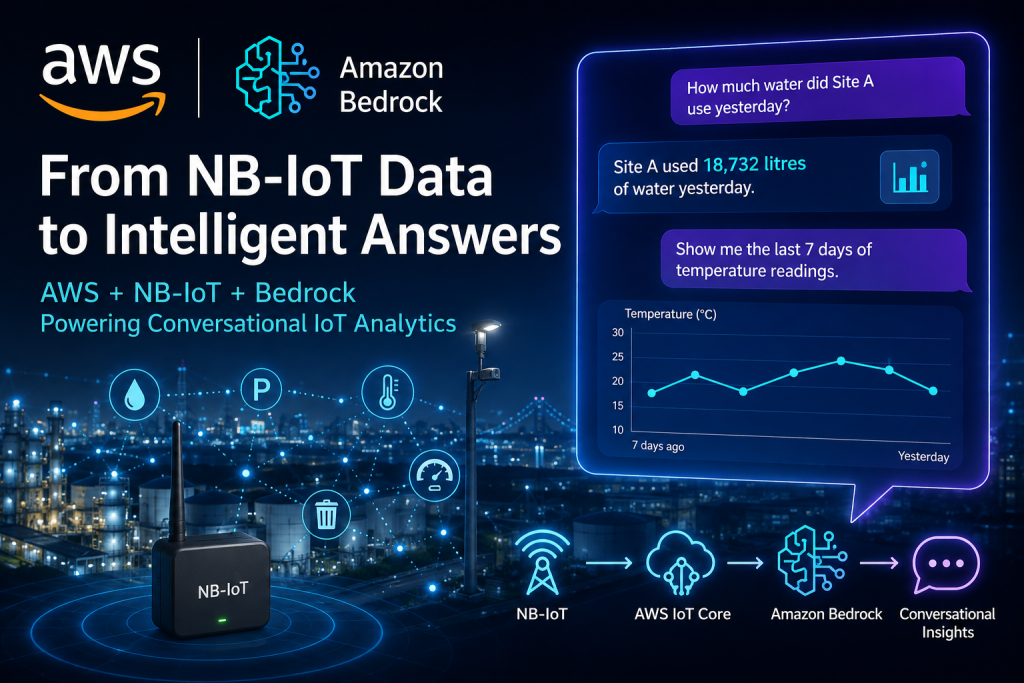
On 20 July 2026 AWS published a reference architecture that ingests NB-IoT and LoRaWAN telemetry, splits it into a real-time path and a historical path, and puts an Amazon Bedrock agent on top so people can query the data in plain English. It is a design pattern with sample dashboards, not a product or a named deployment. The headline is the AI. The more useful signal is that connectivity keeps commoditising while the value moves to how well you can question the data.
What AWS has actually published
It is worth being precise about what this is. AWS has not become an NB-IoT operator, and there is no new managed service to buy. What its IoT team published, on 20 July 2026, is a reference architecture: a documented pattern for wiring existing AWS services together, written by two London-based AWS solutions architects and pitched at an advanced technical audience.
The business case AWS leads with is maintenance. It cites McKinsey research suggesting that digital maintenance and reliability programmes can lift asset availability by 5 to 15 percent and cut maintenance costs by 18 to 25 percent. Those are potential ranges from broad transformation work, not guarantees from this architecture, and the two dashboards used to illustrate it, a solar farm monitor and a smart building query tool, are explicitly labelled as samples rather than named customer deployments. That distinction matters if you are deciding whether this is production-ready or a diagram waiting for its first real fleet.
One message, two jobs
The core idea is a dual-path pipeline, and it addresses a real problem. A single telemetry reading has two very different lives. A compressor running at 84 degrees right now is an operational event that might need an immediate response. The same reading, sat alongside three years of history from hundreds of machines, is a dataset for spotting patterns. Optimising one store for both jobs has always meant compromises, so AWS separates them at the point of ingestion.
Getting the data in comes first. NB-IoT devices reach AWS IoT Core through a cellular operator or connectivity partner that bridges the radio network to AWS, typically using lightweight protocols such as UDP or CoAP with a broker handling translation. LoRaWAN devices arrive through gateways running LoRa Basics Station into AWS IoT Core for LoRaWAN, sending compact base64 binary that a device-specific Lambda decoder turns into JSON. The AWS IoT Core rules engine then fans each message down both paths at once.
| Real-time path | Historical path | |
|---|---|---|
| Job | Immediate anomaly detection and alerting | Long-term trends and pattern analysis |
| Route in | Amazon Kinesis Data Streams | Amazon Data Firehose |
| Processing | Managed Service for Apache Flink (stateful stream processing) | AWS Glue ETL across a three-tier S3 store (raw, cleansed, aggregated) |
| Store / query | Timestream for InfluxDB 3, single-digit millisecond queries | Amazon Athena SQL over cleansed and aggregated S3 |
| Front end | Amazon Managed Grafana dashboards and alerts | Grafana, plus the conversational agent |
One honest detail sits inside the real-time path. At the time of writing, Apache Flink ships no native sink for InfluxDB, so the architecture requires a custom sink built against the InfluxDB v3 write API. It is a small point, but it is the kind of integration work that separates a reference diagram from a running system, and AWS deserves credit for stating it plainly.
Asking your estate a question in plain English
The historical path is where the generative AI earns its place. Anyone who has run a large deployment knows the pattern: the organisation holds an enormous amount of data, and a handful of people can actually query it. A maintenance manager should not need to write SQL to find out how the fleet is behaving.
AWS puts a conversational layer on top using Amazon Bedrock AgentCore, hosting Strands AI agents that call large language models through Bedrock. Ask it something in plain language and it constructs the query for you.
It runs: SELECT region, AVG(battery_level) FROM device_metrics GROUP BY region
The part that makes this more than a novelty is underneath. Amazon Titan Text Embeddings read the AWS Glue Data Catalog so the agent understands what the fields actually mean, retrieval-augmented generation through Bedrock Knowledge Bases helps it write valid SQL, and a feedback loop through Athena re-runs and refines queries that fail, asking the user to clarify when a request is ambiguous. The language model interprets intent and translates the answer back. The database still does the querying. That division of labour is far more defensible than asking an LLM to somehow analyse the data itself.
The consequence is about access, not chat. When the interface is a question rather than a query, the people who can interrogate an IoT estate stops being just the database team. A facilities manager can ask which buildings used more energy this July than last, and a water utility can ask which meters have shown unusual overnight flow for a fortnight. Those are business questions, and until now they have needed a translator.
Why NB-IoT is the interesting half
There is a neat asymmetry in this architecture. Generative AI is about as computationally heavy as computing gets. NB-IoT, frozen in 3GPP Release 13 back in 2016, is the opposite: deliberately simple silicon designed for devices that wake, send a few bytes, and sleep, chosen for deep coverage, decade-long battery life and massive device density rather than throughput.
That is the point. A meter buried in a basement does not need to run a model. It needs to report its reading reliably. The intelligence lives elsewhere. The edge stays cheap and dumb while the cloud around it becomes progressively smarter, which is a sound model for massive IoT and particularly relevant to UK utilities and smart metering, where the fleets are enormous and each message is tiny. It also quietly retires an old argument. Once the telemetry lands in a common data layer, whether it arrived over NB-IoT, LoRaWAN or LTE-M matters far less than whether it is normalised and understood. The radio still matters intensely at the device; the transport matters much less at the query.
The parts AWS does not dwell on
A clean diagram hides real work, and this is where an operator should read carefully rather than get carried away.
Decoders scale with device diversity, not device count: every sensor model that encodes its payload differently needs its own decoder, built and maintained separately. The AI is only as good as the catalogue beneath it, and Glue metadata in a live fleet tends to lag behind new device types, so the agent can be reasoning against a stale picture of what is in the data. AWS also publishes no accuracy figures for its natural-language to SQL translation.
Then there is hallucination. A confident, wrong answer is a nuisance in marketing copy and a liability in an industrial system. Ask whether any freezer breached its threshold yesterday, and the gap between "no" and "freezer 14, for 47 minutes" has regulatory and safety weight. The Athena validation loop, which forces the agent to run a real query against authoritative data rather than invent a reply, is arguably the most important safeguard in the whole design. For critical work, traceability of what was asked, which dataset was queried and what period was assumed will matter as much as the answer.
Security and cost close the list. A conversational agent hands users powerful reach across operational data, so role-based permissions must hold, and the boundary between reading data and acting on it becomes sharper the moment agents move from "which pumps are overheating" to "switch off the pumps that are overheating". And a stack spanning IoT Core, Kinesis, Flink, Firehose, S3, Glue, Athena, Timestream, Grafana, Lambda and Bedrock is not cheap or simple. For 500 sensors it is overkill; for five million meters the economics change entirely. AWS notes the design is modular for exactly this reason. Start with the business problem, not the architecture diagram.
The IoTPortal view
Strip away the service names and this is a story about where value sits in IoT. A single reading, temperature 84.2, battery 2.91 volts, is almost meaningless on its own. Put it in context with ten million previous readings and it can flag a failing asset weeks early. AI does not need the device to produce more data. It needs context around the little the device already sends.
For connectivity providers the implication is direct. Moving a byte is becoming a commodity, and charging by the megabyte captures little value when an NB-IoT sensor sends a trickle each month. The value is up-stack, in device management, normalisation, security and analytics, in the knowledge extracted from the byte rather than its transport. That is the same lesson behind the way chatty telemetry inflates data bills: the data itself is where the cost and the value both live.
The unfashionable footnote is that the boring foundations still decide the outcome. Good radio coverage, reliable devices, sensible payload design, accurate metadata and clean data quality are what make any of this work. A generative agent sitting on badly structured telemetry just gives you a faster, more convincing way to misread it. The edge and cloud both keep their jobs here, too. The right question is not edge or cloud, but which decision belongs where. Build the foundations properly and the most important IoT interface of the next decade might not be another dashboard. It might just be a box that says: ask your network a question.
Frequently asked questions
Has AWS launched a new NB-IoT service?
No. AWS has published a reference architecture, which is a documented design pattern for combining existing AWS services. It is not a new managed product, and AWS is not acting as an NB-IoT network operator. NB-IoT connectivity still comes from a mobile operator or connectivity partner that bridges the radio network into AWS IoT Core.
What is the dual-path design and why does it matter?
Incoming telemetry is split into two parallel paths at the AWS IoT Core rules engine. A real-time path uses Kinesis Data Streams, Apache Flink and Timestream for InfluxDB 3 for immediate anomaly detection. A historical path uses Data Firehose and a three-tier S3 store processed by AWS Glue for long-term analysis with Athena. It lets one message serve both an urgent operational job and slower analytical jobs without compromising either.
How does the plain-English querying work?
Amazon Bedrock AgentCore hosts an AI agent that turns a natural-language question into SQL. Titan Text Embeddings help it understand the Glue Data Catalog metadata, retrieval-augmented generation helps it write valid queries, and an Athena feedback loop re-runs and corrects failed queries. The database performs the actual query; the model interprets the request and explains the result.
Is it safe to trust an AI agent with operational IoT data?
With safeguards. The main risk is a confident but wrong answer, which is why the design validates every query against authoritative data through Athena rather than letting the model invent a reply. Role-based access control, audit trails and a hard line between reading data and controlling equipment are essential, especially if agents are ever allowed to trigger actions.
Does NB-IoT versus LoRaWAN still matter here?
At the device it matters a great deal: coverage, power, cost and mobility all differ. Once the telemetry reaches a common data layer and is normalised, the transport becomes far less important than whether the data is clean and well described. The architecture treats both as ingestion options feeding the same pipeline.