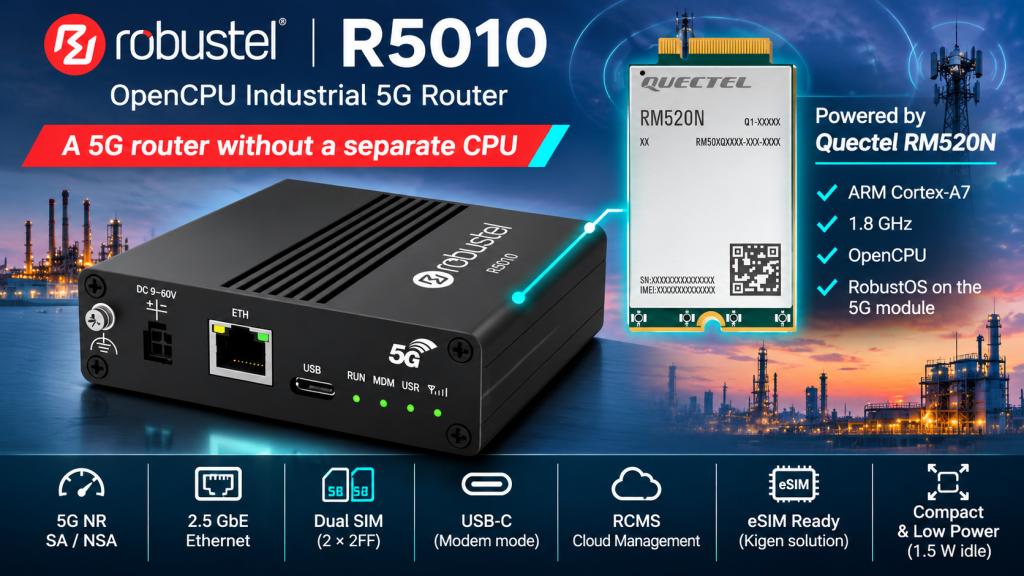
One Chip Doing Two Jobs: Why the Robustel R5010 Runs Its Router on the 5G Module, and Who Else Is Doing It
Most 5G routers carry two computers: one to run the router, one buried inside the modem. Robustel's R5010 throws the first one away. It is a quietly important design choice, and it reaches further than one compact box.
What the Robustel R5010 does differently
Open up almost any industrial cellular router and you find two processing environments. There is a host processor running the router's operating system, firewall, VPN and management agent, and there is the cellular module, which has its own application processor and modem cores to handle the radio side. The two talk over an internal USB or PCIe link, and the router treats the modem as a peripheral.
The Robustel R5010 removes the host. Robustel's own spec sheet lists the CPU simply as "System on Module" and describes RobustOS as a lightweight Linux kernel running on the module. Robustel's SDK documentation is more specific: the CPU is built into the Quectel RG520N 5G module, a Release 16 part on Qualcomm's Snapdragon X62 platform, and both the flash and the RAM are the module's own. In plain terms, the router operating system lives on the application processor that already sits inside the modem. There is no second board-level computer.
I have spent long enough taking routers apart to know that this is not a gimmick. Every component you remove from a cellular router is a component you no longer buy, place, power, cool, qualify or support for ten years. The interesting question is not whether it works (Robustel has been shipping the R5010 since its launch on 1 February 2024) but where the approach makes sense, where it does not, and whether the rest of the industry is heading the same way. The short answer to the last question is that some of it already has.
Two architectures, side by side
The difference is easiest to see drawn out. In a conventional design the module is a modem and nothing more, as far as the router is concerned. In the integrated design the module's own Linux environment is the router.
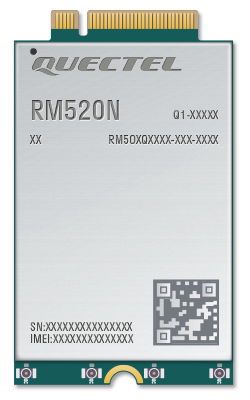
The module makers have names for this. Quectel calls its framework QuecOpen and describes it as letting a module act as the main processor of a device. Fibocom uses the industry's more generic label, OpenCPU. The principle is the same: the module vendor exposes its application processor, a Linux build and an SDK, and the equipment maker writes its product on top.
The R5010 hardware at a glance
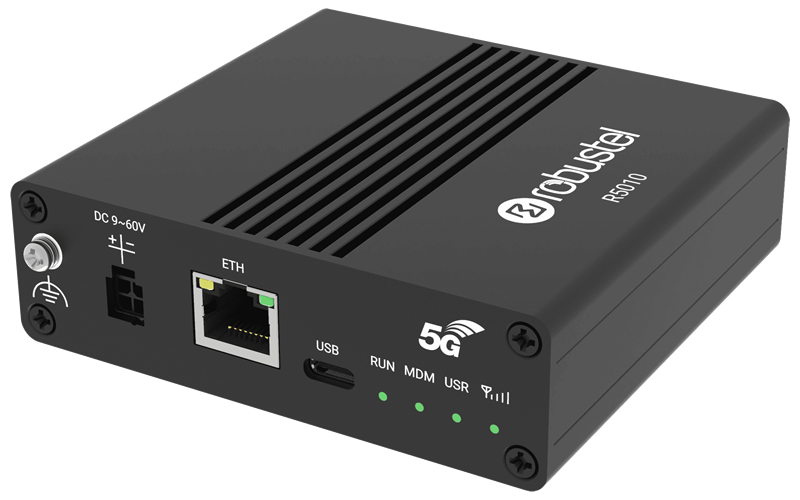
The headline point is how little there is. One cellular module, two SIM slots, one 2.5 GbE port with optional PoE-PD, a USB-C port that can also present the unit as a modem, and a small metal box. Everything below is from Robustel's current product page and SDK documentation.
| Specification | Robustel R5010 |
|---|---|
| Cellular | 5G NR SA/NSA, 4G LTE, 3G; 3GPP Release 16 |
| Processor | Built into the Quectel RG520N 5G module; no separate host |
| System memory | 110 MB flash, 192 MB RAM, both inside the module |
| Space for your own apps (SDK) | 10 MB flash, 45 MB RAM; C and C++ |
| SIM | 2 x Mini SIM (2FF), single module |
| Antennas | 4 x SMA |
| Ethernet | 1 x 2.5 Gbps LAN, optional 802.3at PoE-PD |
| USB | 1 x USB 3.1 Type-C for power, network (modem mode) and debug |
| Power | 9 to 60 V DC, or 5 V/3 A over USB-C; 1.5 W idle, 15 W max at 12 V |
| VPN | IPsec, OpenVPN, GRE, L2TP, PPTP, DMVPN |
| Management | RCMS cloud, web, CLI, SMS; Smart Roaming |
| Physical | 100 x 94 x 30 mm, 276 g, IP30, -40 to +70 °C, DIN rail, wall or desk |
| EMEA/ANZ 5G bands | n1/3/5/7/8/20/28/38/40/41/75/76/77/78 |
For UK use that band list covers what matters: n78 for the 3.4 to 3.8 GHz capacity layer, plus n1, n3, n8, n20 and n28 for wider-area coverage. As ever, check the operator and the site before you check the datasheet.
Two things in that table deserve a second look. The 1.5 W idle figure is genuinely low for a 5G router, and it is the kind of number you get when there is no second computer ticking over. The 10 MB of flash available to the SDK is the other side of the same coin, and I will come back to it.
I have seen gigabit-plus throughput figures attached to this router on social media. A 2.5 GbE port removes the old 1 Gbps Ethernet ceiling, and the 5G module's theoretical peak is higher still, but neither is a measure of what the box will route with NAT, firewall rules and an IPsec tunnel running on a single module CPU. I have not seen independent test data, so treat any single figure as a starting point for your own bench test rather than a promise.
Why removing the host processor matters
The obvious win is the bill of materials. A conventional router needs a host SoC, its RAM, its flash, the power rails to feed them and the board area to route it all. Not every one of those is a separate chip, but the subsystem is real, and in the R5010 it simply is not there. Robustel markets the unit as a low-cost industrial 5G router and that is where the saving comes from. I would not put a number on it without a teardown, but the direction is not in doubt.
The second win is power and heat. A small sealed box with no fan has to shed everything it consumes, and an idle host processor is wasted heat. The published 1.5 W idle figure makes the R5010 credible on PoE and in installations with a tight power budget. Under load the radio dominates, so a router in a weak-signal spot will still run warm whatever its architecture.
The third win is less discussed and, in my experience, just as valuable: integration. Anyone who has supported routers in the field knows the class of fault where the modem hangs, the host does not notice, and the unit sits there looking healthy with no data. The internal link between host and modem, its drivers, its power sequencing and its reset logic are a rich source of exactly that kind of bug. Take the link away and a whole category of failure goes with it. That alone is a good reason to like the design for unattended sites.
Finally there is size. The R5010 is small enough to mount externally in an enclosure close to the antennas and feed a firewall indoors over one PoE cable, which is precisely how one UK deployment uses it (more on that below).
The trade-offs: why two processors are not a bad idea
None of this makes the conventional design wrong. It makes it a different tool, and the R5010 is honest about its limits if you read the spec sheet properly.
Very little room for your own code
Ten megabytes of flash and 45 MB of RAM for SDK applications is enough for a small protocol converter or a monitoring agent. It is nowhere near enough for containers, a local database or anything you would call edge computing. If you need that, you want a router with a proper host, or a separate edge box behind the router. Our comparison of smart modules, SBCs and routers covers where each fits.
One CPU for everything
Routing, NAT, firewalling, VPN encryption and the management agent all share the module's application processor. How much that matters depends on the module's hardware acceleration and how the vendor has partitioned the workload, which nobody publishes in detail. The practical advice is simple: benchmark the tunnel you will actually run, at the temperature you will actually run it.
Tighter coupling to the module vendor
This is the one I would think hardest about for a long-life deployment. In a two-processor router the manufacturer can swap the modem when it goes end of life and keep the rest of the software. In an integrated router the operating system is built on the module vendor's Linux, kernel and SDK. When that module reaches end of life, the router's software platform moves with it. Firmware patching and vulnerability response also depend partly on the module vendor's own release cadence, which is worth asking about directly given the security expectations now placed on cellular routers. Robustel points to third-party penetration testing of RobustOS, last publicised for Q4 2022; for a 2026 purchase I would want the current advisory and patch policy instead.
One port, no Wi-Fi, no serial
That is a design choice, not a flaw. The R5010 is a 5G handoff for a network that already exists. If the cabinet needs a switch, Wi-Fi and RS-485, buy a router that has them.
Where it fits: a real UK deployment
Robustel publishes a case study with Jones Technology, a UK managed service provider, which standardised on the R5010 for 5G failover across hundreds of sites for a large quick service restaurant brand. Each site already had an SD-WAN firewall with dual WAN; the R5010 sat in an external enclosure for better signal, with unlimited data SIMs drawn from more than one UK network, and RCMS gave the MSP visibility of the estate.
That is exactly the job this architecture is built for. The firewall does the clever networking; the 5G box just needs to be cheap, small, low power, manageable and reliable. Multiply a modest per-unit saving across a restaurant estate and the business case writes itself.
| Application | Fit | What to check |
|---|---|---|
| 5G backup for SD-WAN | Strong | Failover detection and recovery times with your appliance |
| Primary 5G broadband | Strong | Coverage at the mounting point, tariff, sustained throughput |
| Temporary and pop-up sites | Strong | PoE budget, enclosure, remote access |
| CCTV backhaul | Conditional | Sustained uplink, data allowance, heat under load |
| Multi-device industrial LAN | Weak | Single port; needs an external switch |
| Edge computing | Weak | 10 MB SDK flash is not enough |
Who else is doing it?
Here is the part that surprised me when I went looking. The single-module router is not a Robustel invention, and it is not new. It has been spreading quietly through the industry for years, mostly in the product categories nobody writes press releases about.
The module makers built the platform first
Quectel's open platform dates back to its LTE modules. Its 2017 QuecOpen material for the EC25 family describes running customer applications on the module's Cortex-A7 and removing the external host processor and memory. Fibocom announced an OpenCPU solution in April 2022 built on its FG160 Release 16 5G module, aimed at fixed wireless access equipment: MiFi units, indoor units and outdoor units. Its pitch was the same as Robustel's: lower power, smaller devices, better cost.
Teltonika has been shipping it too
I know some readers will say we cover Teltonika enough, but the comparison here is too good to leave out. Teltonika's TRB500 5G gateway lists a single-core ARM Cortex-A7 at 1.5 GHz with 256 MB of RAM. Its RutOS package feed targets Qualcomm's sdxprairie platform, which is a modem chipset family, and owners have posted modem firmware strings carrying an OCPU tag. That is a router OS running on a 5G module. The RUTX50, which used the same Quectel RG501Q module family, did it the conventional way with a separate quad-core host. Same vendor, same modem, two architectures: one for the single-port gateway, one for the five-port router with Wi-Fi. The TRB501 successor, with Release 16, 2.5 GbE and an eSIM option, lists the same class of single-core Qualcomm Cortex-A7 and no separate host, so the pattern looks set to continue.
That tells you something useful. Teltonika and Robustel have both arrived at the same rule: if the product is a single-port 5G handoff, put the router on the module; if it is a multi-interface router, keep a host. I expect most of the industry to follow that line rather than move everything to one design.
What comes next
I would expect integrated designs to spread first into single-port 5G gateways and modems, outdoor FWA units feeding an indoor firewall, and compact smart-module based devices where a module can also run light data collection. As RedCap modules become the default for mid-rate industrial work, I would be surprised if their open-platform builds did not end up running small router operating systems too. Full-featured industrial routers, with switches, Wi-Fi, serial ports, containers and complex VPN estates, will keep their dedicated processor. Our list of OpenWrt-based industrial routers is a reminder of how much software those boxes now carry.
The eSIM connection: Robustel, Kigen and the plastic eUICC
Robustel's other big move of the past year points in the same direction: get more from the hardware you already have. In October 2025 Robustel and Kigen announced that Robustel had adopted Kigen's eSIM operating system, its eIM (the SGP.32 remote manager) and its LPA developer tools, including the Kigen C-SDK. The headline for existing estates was a Kigen eUICC in a normal plastic SIM card. Robustel's own wording is that any Robustel product can become eSIM enabled with a Kigen plastic eSIM and the latest RobustOS firmware, turning single-SIM units multi-carrier and adding another layer of redundancy to dual-SIM ones.
Two qualifications matter. First, Robustel's July 2026 guidance says its current eSIM workflow is SGP.22, with SGP.32, the IoT Profile Assistant and the eIM described as the direction of travel. That matches what I see across the router market, and our IoT eSIM guide explains why the difference matters. Second, I have not found R5010-specific confirmation of the plastic eUICC workflow. Its two 2FF slots take the card; whether a given firmware build drives the full profile lifecycle on this model is a question to put to Robustel before you build a rollout on it.
Why the single-module design makes this more interesting
Under SGP.32, the IoT Profile Assistant is the software that sits between the eUICC and the eIM. It can live on the eUICC itself (IPAe) or on the device (IPAd). On a conventional router, IPAd means the host processor. On an R5010-class router, the device is the module. The profile assistant, the router OS and the modem firmware are all running in the same place.
That has a consequence I think buyers have not yet priced in. Module vendors are already putting SGP.32 support into module firmware: SIMCom said in March 2025 that its Cat 1 bis modules were getting SGP.32 firmware. For a single-module router, the module vendor's SGP.32 roadmap effectively becomes the router's SGP.32 roadmap. That can be a shortcut, because the router maker inherits work it would otherwise have done itself, or a constraint, because it cannot move faster than the module. Either way, when you assess an integrated router for a long-life eSIM estate, ask about the module firmware as well as the router firmware. Our sister site has a detailed piece on why modem firmware decides SGP.32 readiness, and the Kigen SGP.32 profile covers where Kigen's eUICC OS sits in that stack.
The R5010 and the Kigen work solve different problems, but they share a philosophy. One removes a processor by using the module's own; the other removes a SIM swap by making the card in the slot programmable. Put them together and you get a small, cheap 5G box whose operator can change remotely for years. That is a better proposition for a large estate than raw 5G speed, and it is where I expect the real competition in this segment to happen.
If you are planning the eSIM side, the plain explanation of what SGP.32 is on euicc.co.uk and its piece on what an eUICC can and cannot protect over a long device life are both worth reading alongside this one.
Will single-module design make 5G as cheap as 4G?
It helps, but no. The expensive part of a 5G router is still the 5G module: the RF front end, four antenna paths, the baseband and the certification behind it. Removing the host trims the cost around the module, not the module itself. Volume, support and channel margin then decide the shelf price.
What it does do is make a single-purpose 5G box cheap enough to bolt onto an existing network without arguing about budget, and that is the market where 5G has been hardest to justify. For a remote alarm panel or a meter, 4G Cat 1 or LTE-M is still the right answer. For a store, a kiosk or a site that wants a fast second path into an SD-WAN firewall, this kind of router changes the arithmetic.
What to test before you specify one
If you are considering the R5010 or any single-module router, these are the tests I would run on the bench before I committed an estate to it. Measure sustained Ethernet-to-5G throughput with NAT and your real firewall rules, then repeat it with your IPsec, OpenVPN or WireGuard tunnel running. Pull the cellular connection repeatedly and time recovery, then time a switch between the two SIMs. Leave it carrying traffic in the hottest enclosure you plan to use. Confirm that the exact firmware build supports every VPN and management feature you need, and ask for the vendor's security maintenance period in writing. Finally, if eSIM is in your plan, ask which SGP standard the firmware supports today on that model, not on the range.
Features such as plastic eUICC support, SGP.32 and specific VPN types are firmware and model dependent. Confirm them against the exact product code and firmware version you will deploy.
Frequently asked questions
Does the Robustel R5010 have a separate CPU?
No. Robustel's SDK documentation states that the R5010 CPU is built into its Quectel RG520N 5G module, with the module's own flash and RAM. RobustOS runs on that application processor rather than on a separate host processor.
What is an OpenCPU or QuecOpen router?
It is a device whose main software runs on the cellular module's own application processor, using an SDK the module vendor provides. Quectel calls its platform QuecOpen and Fibocom uses the name OpenCPU. It removes the need for a separate host processor and memory.
Can I run my own applications on the R5010?
Yes, in C or C++ through the RobustOS SDK, but Robustel allocates only 10 MB of flash and 45 MB of RAM for SDK applications. That suits lightweight agents and converters, not containers or edge computing workloads.
Does the R5010 support Kigen plastic eSIM cards?
Robustel says any of its products can be eSIM enabled with a Kigen plastic eSIM and the latest RobustOS firmware, and the R5010 has two standard 2FF slots. Model-specific confirmation for the R5010 was not published at the time of writing, so check the firmware with Robustel before deploying.
Does Teltonika make single-module 5G routers?
The evidence points that way for its TRB5 gateways. The TRB500 lists a single-core Cortex-A7 and its RutOS package feed targets a Qualcomm modem platform, while multi-port routers such as the RUTX50 used a separate host processor with the same module family.