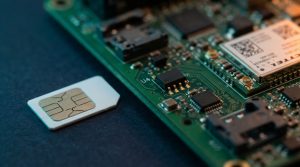
What is an eIM? If the eUICC is the key safe in your device, the eIM is whoever holds the authority to restock it. It’s the piece of SGP.32 that most buyers never see, never touch and rarely ask about, and it’s the piece that decides whether “switch operator over the air” is something you can actually do or just something on a slide.
In the first two parts of this series I covered eSIM vs eUICC and what an eUICC is. This one is about the remote manager. It’s the part I’d spend the most time on before signing anything.
In one sentence. The eIM, or eSIM IoT Remote Manager, is the server-side system defined in the GSMA’s SGP.32 standard that tells an IoT device’s eUICC which operator profiles to download, enable, disable or delete, using instructions the chip can verify cryptographically before it obeys them.
What an eIM actually does
Under the consumer standard, SGP.22, the decision to load a new profile is made by a person. You scan a QR code, the phone asks you to confirm, and the profile arrives. An IoT device has no person, no screen and often no keyboard. Somebody still has to make the decision and give the order, and SGP.32 hands that job to the eIM.
In practice an eIM does four things:
- Triggers profile downloads. It tells the device which profile to fetch from an operator’s profile server, the SM-DP+, either by letting the device collect it directly or by fetching it on the device’s behalf.
- Manages profile state. It sends signed instructions to enable, disable or delete profiles. The GSMA calls these profile state management operations, or PSMOs.
- Manages who’s in charge. It can add, update or remove eIM configuration data on the chip, which is how control is handed from one eIM to another.
- Keeps the record. It collects results and notifications so you know what each device has, what’s enabled and what failed.
The important word is signed. The eUICC holds configuration data for each eIM it trusts, including that eIM’s public key or certificate. When a package of instructions arrives, the chip checks the signature against that stored data. An instruction from an eIM it doesn’t recognise goes nowhere.
How the eIM fits into SGP.32
Here’s the flow for the most common job: moving a device onto a new operator’s profile.
Two details are worth knowing. First, the eIM never holds the operator’s secret keys. Those travel encrypted from the SM-DP+ straight into the chip, so the eIM is the conductor, not the vault. Second, the messages between the eIM and the device are lightweight by design, with CoAP over UDP available alongside HTTPS, so the same model can work on an NB-IoT sensor as well as a 5G router.
The IPA is the go-between in the device, and where it lives (in the eUICC or in the device software) has real consequences. I went through those in the SGP.32 readiness chain.
eIM vs SM-DP+ vs SM-SR: who does what
The eIM gets confused with the other servers in the eSIM world, so here’s the line-up.
| System | Standard | Who usually runs it | Its job |
|---|---|---|---|
| SM-DP+ | SGP.22 and SGP.32 | Operator or its SIM vendor | Prepares and encrypts each operator profile for a specific chip |
| eIM | SGP.32 | Connectivity provider, eUICC vendor, platform or the enterprise itself | Decides which profiles a device has and which is enabled, and signs the instructions |
| LPA | SGP.22 | Built into the phone or device | The consumer equivalent of the IPA, driven by a person |
| SM-SR | SGP.02 | Typically the operator or its platform partner | The older M2M model, where the network side pushes changes and switching needs platform integration |
That last row is why the eIM matters. Under SGP.02, moving a fleet to another operator generally meant getting the old and new operators’ platforms to cooperate. SGP.32 moved the decision to a role the customer can, in principle, choose for themselves.
eIM portability: the bit to check before you buy
An eUICC can trust more than one eIM. The current eIM can add another eIM’s configuration data to the chip, update it or delete its own, and the device’s IPA can also add the initial configuration. That’s the standard’s route out of lock-in: your current provider hands control to the next one without anybody touching the hardware.
Note the words “the current eIM can”. The handover depends on the party you’re leaving agreeing to do it. The standard defines the mechanism, but it leaves a lot of room for how providers implement and sell it. Some devices may offer a reset route through the IPA that clears the eIM configuration altogether, which is a workaround rather than a plan.
My take. The question isn’t “do you support SGP.32?” Everyone says yes. The question is “if I leave you, will you add my next eIM to every chip in my fleet, how quickly, and is that in the contract?” If the answer is vague, the lock-in that SGP.32 was meant to remove has simply moved into the eIM. I’d want that clause written down before the first device ships.
Who runs eIMs today
The market has split into a few camps, which I’ll come back to in part four of this series.
- eUICC vendors with their own eIM. Kigen launched what it called the first market-ready SGP.32 eIM in October 2024, and other SIM makers, such as G+D, sell eSIM management platforms that cover SGP.32.
- Connectivity providers with their own eIM. 1GLOBAL, Eseye, Vodafone IoT and others now offer SGP.32 management alongside their connectivity, typically with their own bootstrap profile.
- eIMs sold separately from connectivity. In September 2026 Onomondo launched an eIM that it says can be used without its connectivity. There’s also an open-source eIM implementation, published through the Osmocom project, which is useful for anyone who wants to see how the plumbing really works.
- Control layers above the eIM. Some providers are building orchestration across several eIMs and operators, as with CSL’s purchase of IoTM.
Large enterprises can also run their own eIM and ask for chips to be built with it already trusted. For most fleets that’s overkill, but for a utility or a car maker it’s a serious option, and it’s the one that gives the most control.
For a dedicated reference on eIM vendors and terms, see our sister site esimiotmanager.com.
Six questions to ask an eIM provider
- Which SGP.32 version and which certification? v1.2 is the certification baseline today, and v1.3 was published in May 2026.
- Which IPA modes do you support? IPAe, IPAd or both, and on which modules have you tested them?
- Which profiles can you trigger? Only your own, or any operator’s SM-DP+?
- Will you add another eIM on request? How quickly, at what cost, and is it written into the contract?
- Who owns the bootstrap profile? And what happens to it if we move?
- How is the eIM secured? Who can sign instructions, how are the signing keys protected, and what does the audit trail show? I’ll come back to why that matters in our OT security series.
What is an eIM: quick answers
What does eIM stand for?
eSIM IoT Remote Manager. It is the remote management role defined in the GSMA’s SGP.31 and SGP.32 specifications for IoT devices that have no user interface.
What is the difference between an eIM and an SM-DP+?
The SM-DP+ prepares and encrypts operator profiles for a specific eUICC. The eIM decides which profiles a device should have and which should be enabled, and sends signed instructions to the eUICC through the IoT Profile Assistant.
Can I change eIM provider?
The standard allows an eUICC to trust more than one eIM, and the current eIM can add another eIM’s configuration data. In practice that depends on your current provider agreeing to do it, so put it in the contract.
Does the eIM hold my operator keys?
No. Operator profiles travel encrypted from the SM-DP+ to the eUICC. The eIM orchestrates the process and signs instructions but does not see the profile secrets.
Do I need my own eIM?
Most fleets use an eIM run by their connectivity provider, eUICC vendor or a specialist platform. Running your own gives the most control and suits very large or long-lived estates, but adds cost and responsibility.
Sources: GSMA, SGP.32 eSIM IoT Technical Specification v1.2 and v1.3 (eIM configuration data, eUICC packages, ESipa); GSMA, SGP.31 v1.3 eSIM IoT Architecture and Requirements; 1GLOBAL, eSIM IoT Manager specification; 1oT, eIM functions in IoT eSIM; Onomondo, eIM product update (September 2026); Osmocom, onomondo-eim project; Alertify, SGP.32 in 2026. Diagram by IoTPortal.
The eSIM explained series: Part 1: eSIM vs eUICC · Part 2: What is an eUICC? · Part 3: What is an eIM? (you are here) · Part 4: SGP.32’s three-body problem