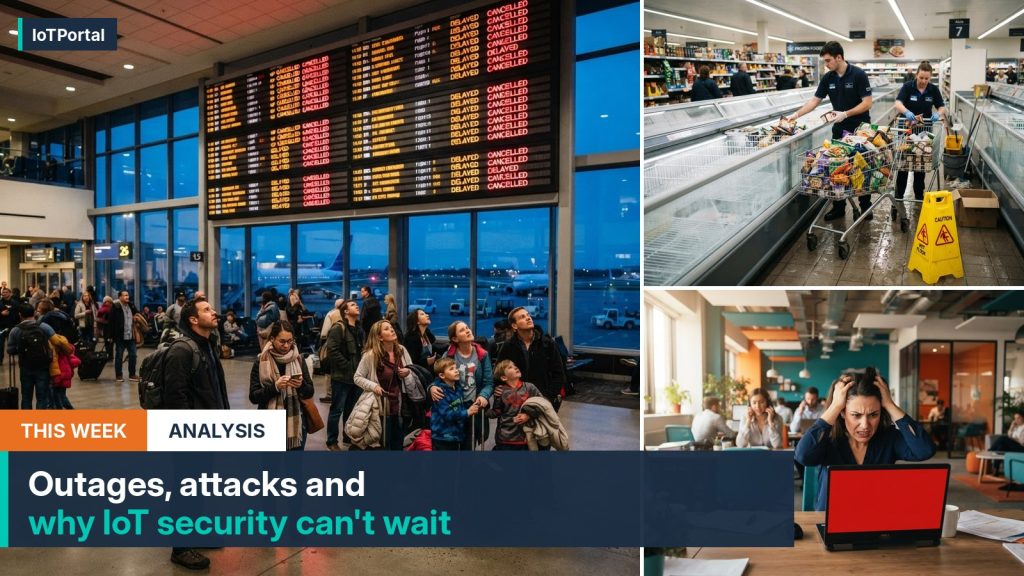
November’s outages created two jobs for anyone running connected kit, and both are IoT security jobs. The first is keeping essential services working when a supplier falls over. The second is protecting the accounts your team uses to get them back. Between 5 and 13 November, NTT Docomo’s 5G standalone network failed twice, Microsoft 365 went down across dozens of countries and the US held every departing flight for more than four hours. According to the organisations involved, none of those was a cyber attack. But within hours of Outlook going down, criminals were sending outage-themed phishing. In the same fortnight, attackers cooked supermarket freezers across Europe through controllers left on the open internet. I’ve spent 25 years putting connected kit into cabinets and plant rooms, and I don’t think there’s been a better time to make the case. The lesson is free this month. Take it.
The fortnight at a glance
Four outages sit on one side, with Docomo counted twice, and the attacks and scams sit on the other. The same detail is in the table and lists below if the graphic is hard to read on a phone.
Four outages, and what officials said caused them
| Event | When | What broke | Cause, as stated |
|---|---|---|---|
| NTT Docomo 5G SA (twice) | 5 Nov, and 11 Nov from 10:34 to 19:17 JST | Voice, data and SMS for 5G standalone customers nationwide. 4G, other 5G, MVNOs and emergency calls kept working | Docomo: congestion in the switches handling 5G SA subscribers. It said it found no trace of unauthorised access |
| Microsoft 365 | Thursday 12 Nov into Friday 13 Nov | Outlook, Exchange Online, Teams and Copilot in dozens of countries. ITV News reported UK police forces unable to receive web reports and GP practices and NHS trusts unable to answer email | Microsoft, as quoted by ITV News: an issue with a recent network capacity upgrade, not related to cyber or AI agents |
| FAA nationwide ground stop | Friday 13 Nov, issued at 3:54pm Eastern and lifted at about 8:15pm | Departures from US airports, after intermittent telecoms failures affected air traffic control communications and radar | Transportation Secretary Sean Duffy blamed outdated equipment and routers overloaded with data. Homeland Security Secretary Markwayne Mullin said there was no cyber attack |
Look at the causes and there’s a pattern I’ve seen in every network I’ve ever worked on. Docomo had announced only days earlier that it would speed up its move to 5G standalone. Microsoft was adding capacity. The FAA is mid-way through modernising, and Duffy put the failure down to old equipment that couldn’t cope. All three were trying to make things better, and all three fell over in the gap between old and new. The FAA had also announced its new AI traffic planning tool, SMART, across all 22 en-route centres three days earlier. Duffy ruled out any link, and the full technical account isn’t public yet.
None of that is a reason to stop upgrading. It’s a reason to change things carefully, in stages, with a way back. That applies to a router firmware push across 400 sites just as much as it applies to an air traffic network.
The other thing all three had in common: for the first few hours, nobody could say for certain that it wasn’t an attack. Docomo’s fifth update was the first to say it had found no sign of a cyber attack. Homeland Security’s first line on the ground stop was that there was “no indication yet” of anything nefarious. If a supplier the size of Microsoft needs hours to rule out an attack, how quickly could you tell, if half your remote sites went dark tomorrow?
What was happening in the shadows
The clearest example came straight out of the Microsoft outage. Within hours of Outlook going down, people were getting fake password reset emails and texts. Field Effect says it detected a credential phishing email dressed up as a Microsoft notification on 13 November, and fake support calls and refund offers were doing the rounds too. Kaspersky warned businesses to brief their staff. McAfee warned US travellers about fake rebooking and compensation links after the ground stop. None of it is new. After the CrowdStrike outage in 2024, the NCSC saw the same jump in outage-themed phishing. It works because an outage is the one moment people expect an unusual email from IT.
If your router management platform, SIM portal and remote access tool share your corporate sign-in, this matters more than it looks. Steal that one login during an outage and nobody needs to attack a single device. They just log in to the fleet.
The other attacks were aimed at the least glamorous IoT you can think of: the controllers that run supermarket fridges and freezers.
- On 2 November, refrigeration in supermarkets and food businesses across at least eight European countries was switched to defrost or set to 50°C overnight. Chains named in the reporting include Delhaize, Carrefour, ICA, Coop, SuperValu and Selver, plus butchers and small shops in the Netherlands.
- On 3 November, the French blood service confirmed an incident at a refrigeration equipment provider that changed temperature and defrost settings at three of its sites.
- On 5 November, CISA, the FBI and three other US agencies published a joint fact sheet telling cold chain operators to take refrigeration controllers off the internet and change default passwords.
- On 9 November, French foreign minister Jean-Noël Barrot publicly blamed Iran’s Revolutionary Guard for the earlier attack of 11 to 12 October. The foreign ministry’s formal statement followed on 10 November. It names the Shahid Kaveh unit and says more than 700 French retail sites were targeted, and at least 15 fires broke out. That attribution covers October only. The November wave hasn’t been attributed to anyone.
How did they get in? Not with anything clever. Danfoss told Dutch broadcaster NOS that affected systems there weren’t on a secure network and still used default passwords. Several of the hit controllers were old models that no longer get updates. In some cases the weak point was a remote monitoring connection run by a contractor outside the retailer’s main network. I went through the French attack and who was responsible in the supermarket refrigeration cyberattack. A month later, the same lesson was taught again in eight more countries.
Why now is the time to get secure
I’ll be honest about why I keep banging this drum. In my experience most estates only get secured straight after a scare, and usually somebody else’s. The fridge controllers are a good illustration. Censys data, reported by The Hacker News, shows the number of internet-exposed Danfoss StoreView systems it could see fell from 3,004 to 708 between 9 October and 5 November, a drop of about 76%. That’s a fall in observed exposure, not proof that every one was secured. But it happened in the weeks after France’s fridges started cooking, not in the years before.
There are several good reasons not to wait for your own incident:
- The UK threat picture isn’t calming down. The NCSC’s annual review, published on 3 November, counted 80 nationally significant incidents in the year to August, and its chief executive warned of a possible unprecedented rise in the coming months.
- Physical-world IoT is now a target in its own right. Ransomware wants data. The refrigeration attacks wanted warm freezers, and that’s a different kind of attacker with a different kind of patience.
- The rules have teeth. Since 11 September 2026, manufacturers selling into the EU must report actively exploited vulnerabilities and severe incidents under the Cyber Resilience Act, including for products already on the market. More on that in our Cyber Resilience Act guide for IoT device makers.
- Your attention is the scarcest thing you’ve got. The best time for an attacker is when your team is already busy with something else. A fortnight like this one is exactly that.
Six things I’d do this month
Start with what your existing platforms already support. Most of this can be done remotely.
- Search for yourself before someone else does. Put every public IP you own into Shodan or Censys and see what answers. If a router admin page, a camera login or a plant controller is on the list, that’s this week’s job. My piece on the public IP SIM problem explains why so many of these exist.
- Kill default and shared passwords. If one password opens every router on your estate, one phished engineer opens all of them.
- Lock down the logins that reach the fleet. Multi-factor authentication on router management, the SIM portal, remote access and VPN. Brief whoever holds those logins about outage-themed phishing, today.
- Make sure you can tell broken from attacked. Alerts for reboots, configuration changes and unusual data use, sent somewhere a person will see them. Our OT security audit guide has the full checklist.
- Test your bad day. Ask one question: if Microsoft 365 is down, who gets the alarm, and can that person still sign in to investigate? If your alarms only arrive by email through one cloud provider, last Thursday would have silenced them. Add a second route, such as SMS straight from the router. If that SMS rides on the same cellular connection as the router’s data, though, it shares that connection’s fate. For sites where that matters, look at resilience options for remote sites. Keep a tested emergency login for your fleet platform that doesn’t depend on the same sign-in as your email.
- Write down who owns what. Most of the refrigeration victims could point at someone else: the vendor, the contractor, the retailer. Decide now who patches, who watches and who rings the manufacturer. That’s the whole point of who secures the router in the cabinet.
And if your estate runs on cellular, use what the network already gives you: private addressing, SIM locks, usage caps and the ability to suspend a SIM in seconds. I made that case in cellular IoT’s security silver lining.
My take
This fortnight the outages got the headlines and the attacks got the paragraph at the bottom. I’d flip that round. The outages were embarrassing, expensive and very public, but they were honest failures that the people involved will learn from. The attacks were quiet, cheap and aimed at kit nobody thinks about, with the factory password still on it, sat on the open internet because it made a contractor’s life easier ten years ago.
That’s the security in the shadow of the big events. It’s not glamorous, it doesn’t trend on social media, and it’s entirely fixable. So here’s the question I’d leave you with. When your usual supplier is down, can you still receive an alarm and reach your fleet? If you’re not sure, find out this month, on your own terms.
Share this with whoever runs your remote sites, and whoever holds the logins to your router and SIM platforms. They’re the people the phishers are after. If you’d like the next IoTPortal security piece first, sign up to the newsletter.
Quick answers
Were the Microsoft 365 outage and the FAA ground stop cyber attacks?
Not according to the organisations involved. Microsoft, as quoted by ITV News, said its 12 to 13 November 2026 outage was caused by an issue with a recent network capacity upgrade and was not related to cyber or AI agents. For the 13 November ground stop, Transportation Secretary Sean Duffy blamed outdated equipment and overloaded routers, and Homeland Security Secretary Markwayne Mullin said there was no cyber attack.
What caused the NTT Docomo outages in November 2026?
Docomo said congestion in the switches that handle its 5G standalone subscribers caused outages on 5 and 11 November. The 11 November outage ran from 10:34 to 19:17 Japan time, and Docomo said it found no sign of unauthorised access or a cyber attack. 4G, non-standalone 5G, MVNO customers and emergency calls were not affected.
Why do scammers target people during outages?
An outage is when people expect unusual messages from IT and suppliers, so fake password resets, “restore your mailbox” emails, refund offers and support calls look believable. Field Effect reported a Microsoft outage-themed credential phishing email on 13 November 2026.
What were the European supermarket freezer attacks?
On 2 November 2026, attackers changed settings on internet-connected refrigeration controllers in supermarkets and food businesses across at least eight European countries, forcing defrost or setting temperatures to 50°C. Reporting points to exposed controllers, default passwords and outdated software. Separately, France formally attributed an October attack on more than 700 French retail sites to an Iranian Revolutionary Guard cyber unit on 10 November. The November wave has not been attributed.
What should IoT operators do first to improve security?
Check which of your devices are visible on the internet, remove default and shared passwords, add multi-factor authentication to every fleet management platform, set alerts for reboots and configuration changes, and test whether you can still receive an alarm and reach your fleet when your email or cloud supplier is down.
Sources: NTT Docomo network notices, 5 and 11 November 2026, and ITmedia Mobile; Microsoft statements and UK impacts as reported by ITV News, 13 November 2026; US Department of Transportation briefing update, 13 November 2026; ground stop timings from Gizmodo and the Associated Press; Duffy and Mullin remarks via CBS News and Fox Business; Field Effect, Kaspersky, CyberHoot and McAfee advisories, 13 to 14 November 2026; Associated Press, CNBC, NBC News and The Hacker News on the 2 November refrigeration attacks; CISA, FBI, HHS, USDA and DOT joint fact sheet, 5 November 2026; French Ministry for Europe and Foreign Affairs, declaration of attribution, 10 November 2026, and Barrot’s remarks of 9 November via Euronews and IBTimes; Censys exposure data as reported by The Hacker News; NCSC Annual Review 2026; European Commission, CRA reporting obligations. Updated 14 November 2026 to correct the French attribution dates and site count and to tighten source attribution.