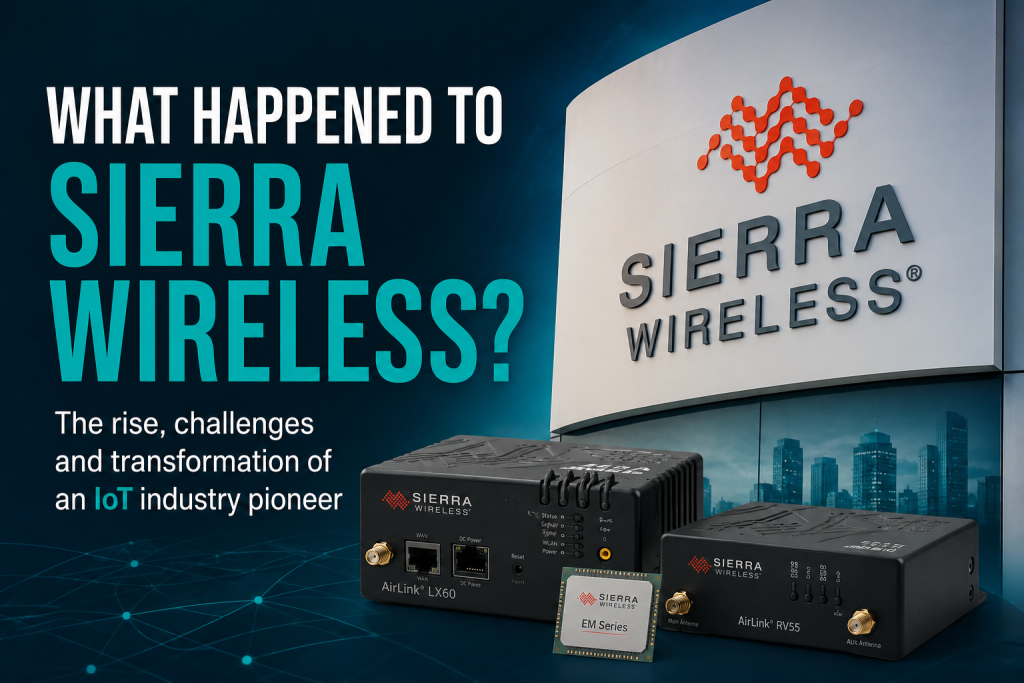
The Great IoT Unbundling: Why Semtech Is Selling Sierra Wireless Modules Just As Cellular IoT Gets More Interesting
In 2023 Semtech bought Sierra Wireless to build a cloud-to-chip IoT company. Three years on it is selling the cellular module business to Compal for $62 million. The headline number looks brutal. The real story is about which layer of the IoT stack now captures the value.
Semtech has agreed to sell the cellular module business it inherited from Sierra Wireless to the Taiwanese manufacturer Compal for $62 million in cash, while keeping the AirLink routers, LoRa and its AI data-centre silicon. This is not the story of Sierra Wireless failing. It is a signal of where value in IoT hardware is moving next.
What Semtech has actually sold
On 13 August 2026 Semtech Corporation (Nasdaq: SMTC) signed a definitive agreement to sell its cellular module business to Compal Electronics (TWSE: 2324) for $62 million in cash, subject to customary adjustments. Compal takes substantially all of the assets and operations that make up that business, including the intellectual property, the customer relationships and the people. Both boards have approved the deal, and completion is expected in the fourth quarter of Semtech's 2027 fiscal year, subject to regulatory approvals.
The reason this matters to anyone specifying connected hardware is simple. The cellular module sits at the heart of a device design. It drives certification, antenna integration, supply continuity, firmware maintenance and the ability to ship the same product across multiple markets. When one of the names that helped invent that market changes hands, it is worth understanding exactly what moved and why.
Do not read the two numbers as "$1.2bn bought, $62m sold". Semtech is not selling all of Sierra Wireless. It is selling one part of it: the embedded cellular module operation. The 2023 acquisition covered a far wider set of businesses, most of which Semtech is keeping. The comparison is meaningless, and half the coverage will get it wrong.
What goes to Compal, and what Semtech keeps
This is the distinction that most of the headlines will blur, so it is worth setting out plainly. The definitive agreement covers the embedded cellular module business only. The router line, the operating systems, the cloud management platforms and the connectivity services all stay with Semtech, as does LoRa and the semiconductor portfolio that is now driving the company's growth.
| Moves to Compal | Stays with Semtech |
|---|---|
| Embedded cellular module business | AirLink routers and gateways |
| Associated module IP | ALEOS, MGOS and AirLink OS |
| Module customer relationships | ALMS, AirLink Manager, AirLink Mobility Manager |
| Module engineering and operations staff | LoRa and the LoRaWAN ecosystem |
| AI data-centre and signal-integrity silicon |
So if you run a fleet of AirLink routers, nothing about this announcement changes your hardware, your firmware or your management platform. Those products remain a Semtech line. What is changing ownership is the business that sells embedded modules to other people who build them into their own products.
The agreement is scoped to the module business, so everything outside it stays with Semtech by default. The stronger signal is what Semtech has done with AirLink while this sale was being negotiated: it launched the RX400 and EX400 5G RedCap routers in January 2026, added support for them in its AirLink Manager and Mobility Manager release in July 2026, and published a FIPS 140-3 firmware roadmap for AirLink OS. That is a product line being invested in, not quietly wound down.
The Sierra Wireless story, told properly
For anyone who came up through machine-to-machine, Sierra Wireless is a name with weight. In the early days of cellular M2M, a connected device often meant a sensor or controller wired through a serial port to a Sierra modem talking to a GSM network. Sierra became one of the defining names in embedded cellular, and it grew with every generation of the technology: 2G, 3G, LTE, then the low-power split of LTE-M and NB-IoT, then Cat 1 bis, then 5G and RedCap.
Along the way the company became much more than a module maker. It built the AirLink router and gateway line, added connectivity services and SIM management, developed device-management software and moved towards full device-to-cloud solutions. That breadth is exactly why Semtech wanted it. When Semtech acquired Sierra Wireless in 2023 for roughly $1.2 billion, it described the combination as bringing together cellular, LoRa and IoT cloud into a single cloud-to-chip company. The deal nearly doubled Semtech's annual revenue and was expected to add around $100 million of recurring IoT cloud services revenue, with roughly $40 million of annualised synergies inside 12 to 18 months.
It is also worth remembering that the module business was already being reshaped long before Compal appeared. Back in 2020, Sierra Wireless sold its automotive embedded module product line to Rolling Wireless for $165 million, choosing even then to concentrate on higher-value work rather than the highest-volume, lowest-margin corners of the module market. The current sale is another step along that same road, not a sudden reversal.
Why sell the modules now?
The obvious question is why Semtech would sell a cellular module business at exactly the moment when RedCap is arriving, smart modules are getting more capable and intelligence is moving towards the edge. On this one we do not have to guess, because Semtech's chief executive has said it plainly.
Speaking at the Morgan Stanley technology conference in March 2026, Hong Hou described the module business as still performing well, with strong backlog and order rates, but carrying roughly 20 percent gross margin. In his own framing it is a good business that fits in someone else's portfolio rather than Semtech's. That is the heart of it. Semtech's semiconductor products run towards 60 percent gross margin, and the company has said the divestiture is meant to lift corporate gross margin towards that level. A 20 percent hardware line inside a business chasing 60 percent margins dilutes the blend with every unit it ships.
It is also worth being precise about the money, because this is where most coverage goes wrong. The painful adjustment on Sierra Wireless already happened, and it happened in Semtech's accounts rather than in this sale. In its 2024 fiscal year Semtech recorded around $755 million of goodwill impairment and a further $131 million of intangible impairment tied to the acquired Sierra business and the macro environment, close to $887 million of charges in a single year. That write-down, disclosed in its filings two years ago, is where the market already recognised that the optimistic case had not materialised. The $62 million from Compal is a separate transaction covering one low-margin unit. Treating the sale price as the loss double counts a charge Semtech booked long ago.
Set against that, the two things Semtech does want are clear. The first is AI data-centre infrastructure: at OFC 2026 the company ran live 1.6-terabit and 3.2-terabit interconnect demonstrations, including its own silicon powering an NVIDIA 1.6-terabit transceiver in a live test platform, aimed squarely at the optical and copper links inside AI clusters. That is a high-margin semiconductor business growing with AI capital spending, and it could not be further from certifying a modem across dozens of operator bands. The second is LoRa and Edge AI, the message at both Embedded World and CES this year. Semtech is not walking away from IoT. It is keeping the parts where it owns differentiated technology and stepping back from the part that has become a scale-and-certification game.
The margin logic above is Semtech's own. What follows is our interpretation. We think this points to a wider pattern in cellular IoT: the reliable money is increasingly made at the silicon and software ends of the chain, not in the middle where you assemble, certify and ship millions of physical modules. Semtech has told us where it wants to stand. It has not told us it believes the entire market works this way, and we should not put that claim in its mouth.
Why Compal is the buyer that makes sense
Compal is not an obscure firm picking up a distressed product line. Founded in 1984, it is one of the largest original design manufacturers on earth, a Fortune 500 company that builds a vast share of the world's notebooks and smart devices. Crucially for this deal, it has been building out communications and IoT hardware for years, running a 5G business since 2018 that spans O-RAN, small cells, 5G wireless modules, satellite user terminals and IoT solutions.
It is already closer to this market than most people realise. Berg Insight lists Compal among the suppliers of automotive network-access-device modules, so it is not entering cellular modules cold. And in 2025 Compal was demonstrating non-terrestrial network IoT hardware with its partner APAL, showing the Hestia dongle that combined 3GPP NTN satellite connectivity with LoRaWAN and other short-range links. A company that already builds satellite-capable IoT hardware and 5G modules is exactly the sort of buyer for whom a certified cellular module portfolio, complete with customers and engineers, is worth more than it is to a semiconductor firm chasing AI interconnect.
Read from both ends, the logic is clean. Semtech says it does not need to manufacture the module itself. Compal says manufacturing and integrating at scale is precisely what it does. The two companies are simply choosing different layers of the same stack.
The market context: a growing business that punishes the middle
None of this means cellular modules are a shrinking business. Berg Insight put global cellular IoT module revenue at $5.6 billion in 2025, up 19 percent, on shipments of 612 million units, up 33 percent. The market is forecast to keep growing towards 976 million units a year by 2030. This is a growing market, but it is a brutally concentrated one.
The five largest vendors by revenue, Quectel, Fibocom, Telit Cinterion, MeiG and China Mobile IoT, together held about 73 percent of the market in 2025, and the volume leaders are almost entirely Chinese vendors benefiting from the sheer scale of their domestic market. That concentration has been building through a wave of consolidation: Telit combined with Thales's cellular IoT business to become Telit Cinterion, Qualcomm absorbed Sequans's 4G LTE IoT product line, and Fibocom reshaped its international module operations. The fastest-growing technology segment, LTE Cat 1 bis, is a low-cost workhorse where scale wins.
That leaves an increasingly uncomfortable middle ground. It is getting harder to survive as simply a good cellular module maker. You need one or more of enormous scale, defensible high-value verticals, recurring connectivity revenue, software and services, semiconductor IP, edge-compute capability or manufacturing integration. Semtech looked at that middle, decided it did not want to compete there, and found a buyer that is built to.
How the big module makers are responding
The tell is what the survivors are doing, because almost none of them are content to remain a plain modem vendor. The largest players are climbing the value chain into smart modules that carry their own application processor and, increasingly, an on-device AI engine, or wrapping the module in antennas, connectivity and services. IoT Analytics puts the high-AI-capability slice of the module market, the parts able to run meaningful edge inference, among the fastest-growing segments, with growth forecast well above 100 percent a year through 2027. The direction is consistent across the field.
| Vendor | Strategic direction |
|---|---|
| Quectel | Scale leader moving into smart and edge-AI modules, open-CPU designs, antennas and end-to-end services |
| Fibocom | Smart-module portfolio tiered by AI and 5G, with edge-AI modules paired to compute platforms |
| Telit Cinterion | Formed by consolidation of Telit and Thales, pairing modules with connectivity and IoT services |
| MeiG | Focused on AI-enabled smart modules and AIoT, built on high-performance application processors |
| Compal (buying Sierra) | Manufacturing scale and device integration, now with acquired module IP, customers and staff |
| Semtech | Leaving embedded modules to concentrate on LoRa and AI data-centre semiconductors |
Read down that column and Semtech's decision looks less like surrender and more like the one player declining to compete in a market that increasingly rewards either enormous manufacturing scale or specialised silicon, and punishes everything in between. The module is not dying. The competition for it is changing shape.
The deeper shift: the module is absorbing the device
This is where the story stops being a corporate transaction and starts being about the architecture of connected products. For years the cellular module was a fairly dumb component: a modem, a radio and a SIM interface. That is changing. Vendors are folding processing, memory, security, an operating environment and increasingly edge intelligence into the module itself. Semtech's own portfolio already hinted at this: its WP series modules carry a Cortex-A applications processor running an on-board application framework, while its RedCap modules cut power and antenna count for mid-tier devices.
Put that alongside two other shifts we have tracked on IoTPortal and a bigger pattern emerges. The eSIM and SGP.32 transition is turning the removable SIM into a remotely provisioned profile inside an eUICC, removing another piece of physical complexity from the device. RedCap is making 5G practical for devices that could never justify full 5G NR. And NTN is starting to fold satellite reach into the same small modules. The direction of travel is unmistakable.
That distinction matters more than it first appears. It is not that the whole module is being squeezed. The plain modem, a radio sitting between a processor and the network, is genuinely exposed. The smart module is doing the opposite: by swallowing the processor, memory, security, eUICC, GNSS and now AI acceleration, it climbs the value chain and consumes functions that used to live in separate chips and boards. So the sharper question this deal raises is whether Compal has bought yesterday's modem business or tomorrow's embedded computing platform. Both readings can be true at once, which is exactly why the transaction is more interesting than its price tag.
This is the same thesis we set out in the smart module versus SBC versus router analysis. Yesterday's architecture put a sensor behind an SBC, behind a router, behind a physical SIM. The emerging architecture collapses much of that into a single intelligent module with its own processor, security, eUICC and application runtime, reaching the cloud only when it needs to. Compal does not just make communications modules. It makes PCs, servers, automotive electronics, wearables and network gear, which is exactly the profile of a company that benefits if the boundaries between module, modem, computer and gateway keep dissolving.
What it means for UK integrators and buyers
For anyone specifying hardware in the UK, there are a few practical takeaways rather than reasons to panic. If you use AirLink routers, this deal does not touch them; they stay with Semtech. If you embed Sierra or Semtech modules, the sensible move is to watch the transition closely as it works through regulatory approval into 2027, and to confirm roadmap and long-term availability with your supplier before committing to a new design, as you would with any change of ownership.
More broadly, the direction of travel should shape how you architect new deployments. Designing around capable smart modules, specifying eUICC and planning for SGP.32, and treating RedCap as the mid-tier path once coverage firms up are all bets on where the hardware is going, not where it has been. The same logic runs through our SBC versus industrial router guidance: put processing where it earns its place, and do not over-build the box when the module is quietly absorbing more of the job.
For balance, note what Semtech's CEO named as the areas of strongest conviction: data centre and LoRa. He did not name routers. Semtech's IoT systems and connectivity revenue is broadly flat while its data-centre business races ahead, so it is fair to ask whether the retained IoT hardware could face the same portfolio review in time. Nothing suggests that is imminent, but it is the honest question to keep in view.
The honest conclusion is not that Sierra Wireless failed. It helped invent the cellular M2M module, and its latest change of ownership tells us the industry it helped create is entering a new phase. The module is not disappearing. It is absorbing more of the device. Semtech wants the silicon and the software; Compal wants the scale to turn ever-smarter modules into millions of finished products; and the plain standalone modem is caught between them. The $62 million question is not why Semtech is selling cellular modules. It is what a cellular module is becoming.


