The short answer
Matt Hatton of Transforma Insights asked this week how you avoid a race to the bottom in IoT connectivity, after a podcast with Go2Sim CEO Hiran Ravat. His answer: a capability with a management wrapper, customised for each customer. I agree, and I think SGP.32 turns that from good advice into the only viable business model.
The argument fits in a paragraph. Data is heading towards free. The SIM is becoming software. Once a customer can move a whole fleet to another provider over the air, nobody stays for price, because someone will always be cheaper. They stay for the people, the portal and the promise written into the contract.
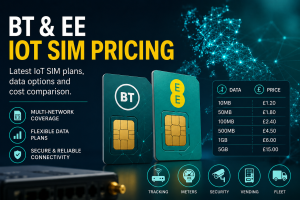
So the model I would build is simple: a low, honest floor of around £2.50 per SIM per month including 1GB, pooled and metered above that, with tiered service levels that customers choose and pay for. The rest of this piece sets out why, who is already moving this way, and what buyers should ask before they sign anything.
The price problem is real, and it is not coming back
Price erosion is not a risk to manage. It is the weather. Transforma Insights has put a name to where it ends: “$1 IoT”, a scenario in which the prevailing price for most IoT connections falls to one US dollar a year within five years.
The market is already halfway there for low-data devices. 1NCE sells a lifetime flat of $15 for ten years, including 500MB and 250 SMS. That is a price designed for meters and trackers that send a few kilobytes a day, and for that job it is hard to beat.
Meanwhile the field keeps getting more crowded. Transforma’s 2026 IoT MVNO landscape profiled 234 MVNOs, up from 188 in the previous edition. Its pricing notes flag three trends worth watching: price erosion (or the lack of it), differentiated tariffs, and providers starting to charge for support plans. That last one matters more than it looks.
The growth is there, but so is the squeeze. Hatton’s forecast, quoted by RCR Wireless, has net new connections growing about 9% a year in Europe and 11% in North America, with value-added connectivity revenue growing only around 6%. More connections, less money per connection. Anyone selling megabytes alone is selling into a falling market.
Two markets wearing one name
Most of the race-to-the-bottom debate goes wrong because it treats IoT connectivity as one market. It is two, and they only share the word SIM.
| Commodity IoT | Service-grade IoT | |
|---|---|---|
| Typical devices | Meters, asset trackers, environmental sensors | Routers behind CCTV, EV chargers, battery storage sites, telecare hubs, kiosks, ANPR |
| Data per month | Kilobytes to a few MB | Hundreds of MB to several GB |
| When it drops | It retries later; nobody notices | Revenue stops, a site goes blind, or someone is unsafe |
| Who buys | Hardware engineer, at bill-of-materials level | Operations or service manager |
| What they compare | Price per connection | Cost of an outage |
| Where price ends up | Towards $1 a year | Set by the service wrapped around it |
The commodity side will go to whoever runs the leanest platform at the biggest scale. There is no shame in that business, but it is not one a specialist wins.
The service-grade side is where the margin lives. The failure mode here is pricing it like the commodity market, then wondering why there is no money left to answer the phone. Wireless Logic’s Nordic CEO put the shift neatly at the start of the year: 2026 is when “connect and forget” stops being viable, because connected devices are becoming business-critical.
What SGP.32 really changes: the exit door opens
SGP.32 is no longer a roadmap slide. Telenor IoT started delivering SGP.32 SIMs on 17 April 2026. IDEMIA, Tele2 IoT and Cisco launched an end-to-end commercial offer at MWC in March. Kaleido Intelligence, quoted by RCR Wireless, expects a commercial ramp through 2026 and a tipping point around 2027 to 2028.
The headline benefit is the one everyone quotes: a customer can switch connectivity profiles in the field without touching the device. If you need the basics first, start with our explainer on what an IoT eSIM is. The commercial consequence gets less airtime, and it is the one that matters here.
When leaving is cheap, staying has to be earned. Under SGP.02 and plastic SIMs, a provider could coast on the cost of a truck roll. A fleet of 5,000 routers was hard to move, so price rises and slow support were tolerated. SGP.32 removes that moat. If the only thing a provider offers is megabytes, a cheaper provider is one API call away.
There is a catch. SGP.32 does not end lock-in, it moves it. The new lock sits in the eSIM IoT Manager (eIM), the platform that tells your devices which profile to load. Own the eIM, and you own the exit door. The market has noticed. Onomondo has launched an eIM it says works independently of its own connectivity, precisely to stop SGP.32 creating a fresh form of lock-in. emnify’s eIM lets customers switch operator profiles via portal or API.
The practical lesson for buyers: the switching freedom is only real if the eIM is independent of your connectivity provider, or contractually portable. Ask before you sign, not after.
The model: £2.50, 1GB, pooled, metered
The price I would put in front of a service-grade customer is £2.50 per SIM per month, including 1GB, pooled across the fleet, with published per-GB metering above the pool. Each part of that does a specific job.
- The floor pays for what costs money regardless of data. Platform, eIM, SIM lifecycle, monitoring and people. Price that honestly and you never have to claw service costs back through overage.
- 1GB included removes bill anxiety. It covers what a typical router does day to day: telemetry, remote management, alarms, firmware pulls. The customer stops watching a meter and starts trusting the service.
- Pooling absorbs the outliers. Each SIM adds its 1GB to a shared pool. The quiet sites carry the busy CCTV site, and nobody gets punished for one device having a bad month.
- Published metering above the pool keeps it fair. One per-GB rate, alerts at set thresholds, an optional hard cap. A runaway device should trigger a phone call, not a four-figure invoice.
An illustration: 100 SIMs gives a 100GB pool for £250 a month. A fleet where most sites use a few hundred MB and a handful stream video at several GB still fits inside that, with no overage and no surprises.
At roughly £30 a year, this sits around forty times above the “$1 IoT” price point. That is the point. The £2.50 is not the product. It is the entry ticket. What the customer is really buying sits on top of it, in the service tier.
Service tiers: where the value actually lives
If the SIM is the entry ticket, the service tier is the seat. Transforma has already spotted providers starting to charge for support plans. I think that becomes standard within three years, and the providers who design tiers properly will set the terms for everyone else.
This is how I would structure them. The response times and contents are my suggested design, not an industry standard.
| Essential | Assured | Critical | |
|---|---|---|---|
| Suits | Non-critical sites, pilots, small fleets | Revenue-bearing sites: EV charging, retail, signage | Safety and infrastructure: telecare, battery storage, CCTV, utilities |
| Support hours | Business hours | Extended hours, 7 days | 24/7/365 |
| First response | Next business day | 4 hours | 30 minutes, by phone |
| Who you reach | Ticket queue | Named account team | Named engineer who knows your estate |
| Monitoring | Portal and self-serve alerts | Proactive offline alerts, monthly usage review | Proactive monitoring with call-out, quarterly service review |
| SGP.32 profile management | Self-serve in the portal | Done for you on request | Planned and executed by the provider, with rollback |
| Resilience | Single profile plus bootstrap | Fallback profile on a second network | Multi-network fallback, satellite option where justified |
| Compliance support | Standard documentation | Incident log on request | Incident reporting pack and audit evidence |
| API and integrations | API, webhooks, Slack or Teams alerts | Plus usage streamed into your cloud or dashboards | Plus events fed into your SIEM or observability stack, private cloud links |
| Service credits | None | Credits against response targets | Credits against response and availability targets |
The human matters most at the top tier. When a telecare hub goes quiet at 2am, the customer does not want a chatbot or a ticket number. They want a person who knows what the device is, where it is, and what changed. Go2Sim makes exactly this pitch: plenty of providers sell connectivity, few take responsibility for whether the system works. That is the differentiator a cheaper rival cannot copy by cutting a price.
Who is ahead, and why
Nobody owns the whole answer yet. Each leader is ahead on one or two of the things that will matter: scale, service, standards, portability, resilience or price. Here is where I think each stands, as of October 2026.
| Provider | What they have done in 2026 | Where they are ahead |
|---|---|---|
| Wireless Logic | 21st acquisition (Simetry, July); bought UK specialist Comms365 in February; signed for Algar Telecom’s IoT unit in Brazil in August; Gartner Leader | Scale and managed service; claims 20 million devices and 25,000 customers |
| Telenor IoT | Commercial SGP.32 SIMs shipping since April; Gartner Leader for the fourth time, listed nine years running | Standards execution at operator scale |
| Soracom-KDDI | First year as a Gartner Leader; satellite NB-IoT via Skylo in a phased commercial launch, switchable on the same SIM | Platform plus satellite on one SIM |
| Vodafone IoT | Trialling Skylo satellite NB-IoT, cellular and satellite from a single SIM | Network reach plus a satellite path |
| emnify | Gartner Visionary; own eIM with portal and API switching; OEM programme for one global SIM SKU | Portability and developer tooling |
| Onomondo | More than €100m funding round, Aspirity Partners taking control (finalising early 2027); independent eIM; own core network | Infrastructure control and anti-lock-in positioning |
| KORE | Taken private by Searchlight and Abry at a $726m valuation; SGP.32 partnership with Kigen | Installed base, now under new owners |
| 1NCE | $15 for ten years, unchanged | The price anchor for commodity IoT |
My read: the operators are winning on standards, the platforms on portability, and Wireless Logic on buying its way to scale. The gap nobody has filled cleanly is service-grade connectivity for the mid-market: fleets of 50 to 5,000 devices whose owners want an SGP.32 exit door, a named human and an SLA with teeth. That is exactly where UK specialists can win, and where consolidators tend to lose focus as they integrate their purchases.
The engines behind the badges: floLIVE, emnify and the white-label layer
Many IoT SIMs sold in the UK do not run on the company whose logo is on the card. Behind a large share of smaller MVNOs and resellers sits an enabler, and two of the most important are floLIVE and emnify. Understanding them explains why the market has 234 MVNOs, and why so many of them end up fighting on price.
floLIVE: the network you never see
floLIVE, headquartered in the UK, says it owns the entire stack: a mobile core from 2G to 5G standalone plus NB-IoT, cloud-native billing and rating, SIM provisioning and the connectivity management platform. Its founder and CEO Nir Shalom set this out to RCR Wireless. It runs local cores in the US, Brazil, Australia, the UK and elsewhere, meshed into one network, so a device in Australia is served in Australia rather than hauled back to a host operator’s core overseas.
The part that matters here is the channel. floLIVE sells “MVNO in a box” and MVNE as a service. Shalom says dozens and dozens of MVNOs run on it in fully white-label arrangements, so their customers never see the name. Operators use it too: Singtel built its new eSIM IoT proposition on floLIVE’s core, with SGP.32 control. MVNO customers reviewing it on Gartner Peer Insights describe floLIVE as their MVNE.
Shalom’s sharpest point is about dependency. In his view, every MVNO is captive to its MNO suppliers, who can raise prices or pull service. floLIVE’s answer is reciprocity: operators run traffic on its stack while it uses their coverage, so neither side can easily switch the other off.
What the enabler layer does to the market
The barrier to launching an IoT MVNO has collapsed. That is good for choice, but it creates a trap. Two resellers on the same enabler share the same core, broadly the same coverage and similar wholesale costs. If they also sell the same thing, price is the only lever left. This is the race to the bottom in its purest form, and the clearest proof that service is the only way out of it.
For resellers, the enabler model is a gift if you use it properly. It gives you a carrier-grade network without building one, which frees your money and people for the things an enabler cannot provide: vertical expertise, a named engineer and an SLA with teeth. Resell the network and add nothing, and you are a price list waiting to be undercut.
Four questions for any tender
- Which MVNE or enabler is behind this provider, and whose core does my data pass through?
- What happens to my SIMs if the reseller fails, or loses its enabler contract?
- Who owns the SGP.32 profiles and the eIM relationship: the reseller, the enabler, or me?
- Where is my data stored and processed, and does that meet my GDPR and data-sovereignty obligations?
emnify: connectivity as a developer tool
emnify, founded in Berlin in 2014, is the other provider Shalom acknowledges as owning the full stack, and it also supplies parts of its platform to other MVNOs. Where floLIVE’s strength is the network underneath, emnify’s is the layer the customer touches.
It treats connectivity like a cloud service. There is a REST and GraphQL API. Its Data Streamer pushes usage and network events in real time into AWS S3 and Kinesis, Google Pub/Sub, Azure Event Hub, Power BI and Datadog. Cloud Connect builds private links into AWS, Azure and Google Cloud. Through Zapier, teams can post a Slack message when a device hits a usage limit or is disabled, and even change a device’s APN from a Slack message.
That changes what “portal” means. The best portal is increasingly no portal at all: connectivity events land in the tools the operations team already lives in, whether that is Slack, Teams, Datadog or a SIEM. For the tiered model, this sets a new baseline. Automation becomes the floor; the human becomes the premium. An Essential-tier customer in 2027 will expect an API, webhooks and chat alerts as standard. What they will pay extra for is the person who acts on the alert.
The consolidation paradox, and why buyers should care
Everyone predicted the IoT MVNO market would consolidate. It mostly has not. Hatton counted nine MVNOs acquired since late 2023, against 28 in the two years before. Wireless Logic is doing most of the buying on its own.
His explanation is valuations. The same article reports General Atlantic’s investment valuing Wireless Logic at about £3.5 billion, close to ten times revenue. When targets are priced like that, most buyers choose organic growth instead.
For customers, the lesson is not about deal multiples. It is this: private equity owns a large slice of your connectivity, and private equity sells. The provider you sign with in 2026 may have a different owner, a different support team and a different price list by 2029. That is not a criticism of any one firm. It is how the ownership model works.
SGP.32, with a portable eIM, is the insurance policy. Add a change-of-control clause that lets you exit without penalty, and an ownership change becomes an inconvenience rather than a crisis.
The UK deadline stack turns connectivity into compliance
A five-year contract signed this month runs straight through four hard dates. Each one makes “who supports this connection, and how” a compliance question, not a procurement detail.
- EU Cyber Resilience Act. Since 11 September 2026, manufacturers selling connected products into the EU must report actively exploited vulnerabilities and severe incidents, with an early warning due within 24 hours. The rest of the Act applies from 11 December 2027. A connectivity provider that can hand over incident logs and device-level evidence becomes part of the manufacturer’s compliance process.
- PSTN switch-off. The analogue network goes on 31 January 2027. Telecare alone serves about 1.8 million UK households, and digital alarms typically use roaming multi-network SIMs. That is a large service-grade market arriving almost overnight.
- 2G sunsets. EE begins switching off 2G from May 2029 and Vodafone plans to follow during 2030, ahead of the 2033 government deadline. A 2G fleet on a five-year term is a migration project, not a renewal.
- Satellite joins the SIM. Vodafone IoT is trialling Skylo satellite NB-IoT from a single SIM, and Soracom has started a phased commercial launch. Within a few years, satellite fallback becomes a line in the top service tier rather than a separate contract.
Seven predictions to 2030
These are my calls, not anyone’s forecast. Hold me to them.
- “Support included” disappears from serious price lists. Service tiers get itemised and priced, the way cloud providers price support plans today. The early signs are already in Transforma’s 2026 data.
- The eIM becomes the main procurement battleground. By 2028, enterprise tenders will ask for an independent or contractually portable eIM as standard, the way they ask for multi-network today.
- Prices split cleanly in two. Commodity LPWA heads towards $1 a year. Service-grade connectivity holds a floor, because its real cost is people and accountability, not megabytes.
- Satellite fallback becomes a tier feature. One SIM, cellular first, satellite NB-IoT when the mast is gone. It will sit in the top tier for remote and critical sites, priced as resilience, not airtime.
- Compliance becomes a sellable service. Providers that can produce CRA-ready incident evidence and audit trails will charge for it, and manufacturers will pay rather than build it themselves.
- AI makes the human cheaper, not optional. Telenor and Soracom are already putting AI into monitoring and operations. It will triage the noise. The 2am call on a critical site still needs a person, and the best providers will use AI to make that person faster.
- Consolidation resumes when valuations come down. When it does, mid-market specialists with strong service reputations become the targets, because service is the one thing that cannot be built quickly.
Ten questions to ask any IoT SIM provider
If you buy connectivity for devices that matter, these questions separate a service from a price list.
- Is the SIM SGP.32 certified, and which eUICC OS does it run?
- Is your eIM independent of your connectivity? If not, can I take it, or my profiles, with me?
- What does it cost to move my fleet to another provider, in money and in time?
- What is in the included allowance, how is it pooled, and what is the published rate above it?
- What happens when one device runs away with data: an alert, a cap, or an invoice?
- Who answers the phone at 2am, and do they know my estate?
- What are the response and availability targets, and what credits apply when you miss them?
- Which fallback networks are included, and is satellite an option for my remote sites?
- What incident evidence can you give me to support my CRA reporting?
- If your company is sold, can I leave without penalty?
A provider who answers all ten clearly is selling a service. One who changes the subject to price per MB is selling the race to the bottom.
Easier said than done? Good.
Hatton’s post asks whether the management-wrapper answer is easier said than done. It is. That is exactly why it works.
Anyone can cut a price. A rival can match it by Friday. What a rival cannot copy by Friday is an engineer who knows your estate, a portal your team actually uses, a contract that pays out when the provider fails, and an exit door you trust enough never to need. SGP.32 makes the exit door real. The providers who welcome that, rather than fight it, will own the next decade of service-grade IoT.
The race to the bottom has a floor. It is made of people.
Sources: Transforma Insights (IoT MVNO pricing trends 2026; “$1 IoT” scenario); RCR Wireless (13 Jul 2026, 30 Sep 2026, 24 Mar 2025, Singtel/floLIVE); Telenor IoT (27 Feb 2026; Gartner MQ 2026); Soracom (Gartner MQ 2026); emnify (2 Mar 2026; integration guides); GSMA (1 May 2026); 1NCE pricing FAQ; Vodafone IoT (28 Jan 2026); McCann FitzGerald and Crowell on the Cyber Resilience Act; Which? on telecare; GOV.UK on the PSTN switch-off; CSL Group on UK 2G sunsets; Zapier emnify integrations. Figures and positions as reported at the time of writing, October 2026. Service tier contents and the £2.50 model are the author’s proposals, not published tariffs.