
IoT eSIMs Ready for Activation: How Kigen and Partners are pragmatically building the shift toward IoT scale
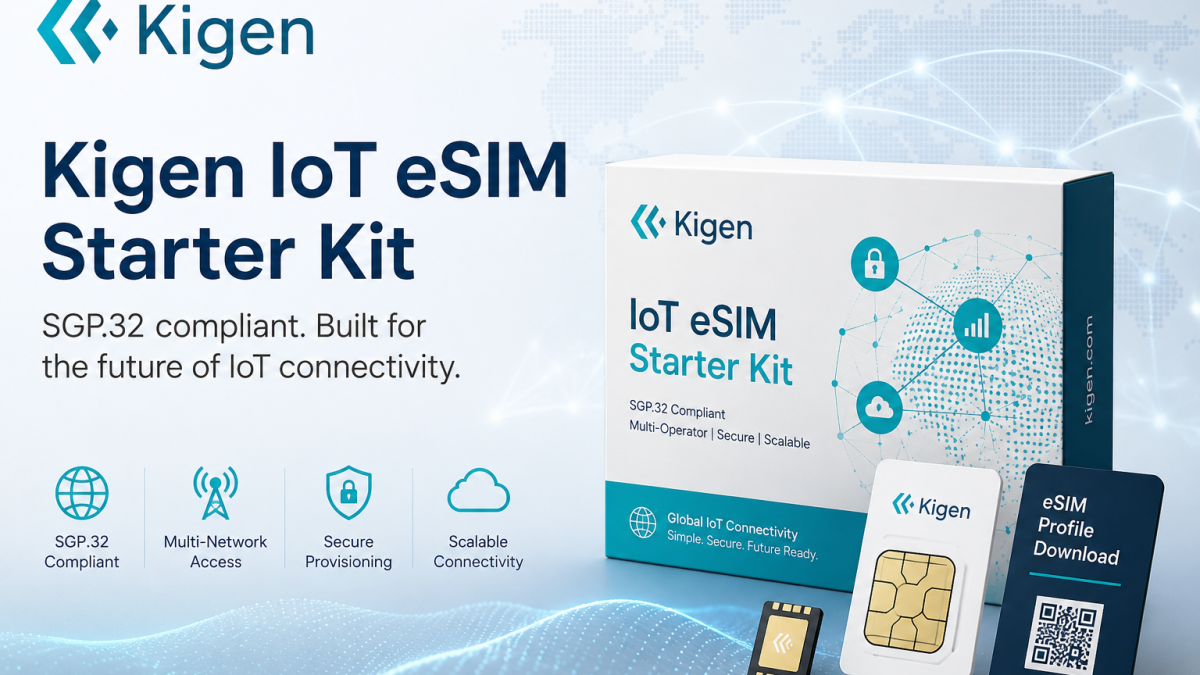
Kigen has opened access to its new IoT eSIM Starter Kit, giving qualified manufacturers, OEMs, ODMs, embedded developers, and enterprise IoT teams a practical way to test secure eSIM activation and remote SIM provisioning before moving into pilots or full-scale deployment.
Press release. This announcement was submitted to IoTPortal by Kigen and is published as received. The wording, claims, product names, and partner details are the company’s own.
Source: Kigen · Media contact: press@kigen.com · Read the original announcement
The kit brings together the components businesses need to evaluate SGP.32 in real operating conditions: 10 eSA-certified Kigen eSIMs, three months of access to SAS-certified Kigen eIM and Kigen Pulse, device-side development tools including Kigen C-SDK and IPAd, and profiles from 13 connectivity partners ready for activation. It is designed to shorten the path from technical evaluation to a repeatable operating model for connected products.
The GSMA SGP.32 standard has created a more flexible way to manage connectivity for IoT devices, including constrained, unattended, and remotely deployed equipment. However, the standard alone does not remove the practical work involved in bringing eSIM technology into a product portfolio.
Businesses still need certified eSIMs, a reliable eSIM IoT Manager, device-side integration, compatible connectivity profiles, and confidence that the different layers will work together. They also need to test profile downloads, activation flows, exception handling, remote lifecycle operations, and device behavior before committing large fleets to the field.
The Kigen IoT eSIM Starter Kit brings these elements into a single environment that helps businesses take confident strides toward real-world implementation and growth plans.
At launch, profiles are available from 1oT, floLIVE, Hologram, iBASIS, KDDI America, KORE, NuvoLinQ, Onomondo, Pangea Connected, Semtech, Skylo Technologies, Soracom, and Zariot. More MNOs and MVNOs are finalizing streamlined activation workflows with Kigen, while hundreds of additional operator profiles have already been tested for download and can be sourced separately.
This breadth matters because IoT businesses rarely operate within one simple connectivity model. A manufacturer may need a different provider for a new market or customer. An enterprise may want multiple network options to improve resilience. A product team may need to enter regulated markets with different local requirements, commercial terms, or profile availability.
Without a unified approach, each new provider can introduce additional integration, testing, onboarding, and maintenance work. Teams may need to establish separate operating processes, manage EIDs, validate profile behavior, resolve exceptions, and confirm interoperability across the device, eSIM, management platform, and network.
Kigen’s model is intentionally open. The company does not prescribe which connectivity provider a business must use. Instead, it provides a consistent eSIM foundation that allows customers to evaluate participating partners, bring their preferred connectivity provider, and expand their options as commercial or operational requirements change.
The Starter Kit also builds on more than 18 months of Kigen eIM trials and over 100 customer journeys moving toward commercial products. These engagements have provided direct insight into the realities of deploying eSIM across different modules, device architectures, network conditions, and operating environments.
Companies including Digi International, Evergy, floLIVE, Itron, NuvoLinQ, and Robustel have already announced work with Kigen’s SGP.32 technology across industrial systems, utilities, payment terminals, tracking, wearables, and other connected products. Those deployments have helped shape a kit focused not only on the first successful activation, but also on the controls and processes required after devices ship.
During the three-month evaluation period, teams can test remote profile activation and management, connectivity choice, high availability, network resilience, device-level controls, and lifecycle operations. They can also use Kigen Pulse and its APIs to assess how profile management could integrate into broader fleet and connectivity operations.
For product teams, the objective is operating confidence. A successful profile download is important, but it is only the beginning. At scale, businesses must know how devices behave during changes, how exceptions are handled, how connectivity can be recovered, and how providers can be introduced without redesigning hardware or rebuilding the management stack.
For OEMs and manufacturers, this can reduce the friction of designing products for multiple markets. For ODMs, it supports more reusable device designs. For enterprises, it creates a controlled way to compare providers, resilience options, and lifecycle processes before devices are deployed.
As intelligence becomes more distributed across meters, payment terminals, industrial equipment, vehicles, trackers, and autonomous systems, connectivity must be managed with the same discipline as enterprise software. Products need a secure, adaptable foundation that can support changing networks, markets, and customer requirements throughout their operational life.
The Kigen IoT eSIM Starter Kit gives businesses a clearer place to begin. The next wave of global IoT growth will not come from isolated devices or closed connectivity models. It will come from EV infrastructure that can expand across borders, payment systems and vending machines that remain connected wherever they operate, energy gateways and smart meters that can adapt over decades, and routers and asset trackers built for changing networks, regulations, and markets.
The flexibility promised by SGP.32 is now moving from specification to operational reality. The question is no longer whether this ecosystem can work, but how quickly businesses can prove what it makes possible for their own products.
Start today. Test the technology, activate the profiles, and discover how quickly you can move forward. Find out more at kigen.com/iot-esim-starter-kit.