Why the Network Is Ready, the SIM Is Ready, and the Bit in the Middle Isn’t
Reading time: 14 minutes | Last updated: November 2026
Key Takeaways
- SGP.32 readiness is a chain, not a checkbox. eSIM nirvana for IoT needs every link aligned: eUICC, eIM, operator profiles, IoT Profile Assistant (IPA), modem firmware and the device OS.
- The ends of the chain are ready. Certified eUICCs and eIMs are shipping, and operators are selling SGP.32 commercially.
- The middle is not. The device layer, where the IPA lives and the modem does the talking, is where SGP.32 readiness is still patchy, firmware-specific and only partly certified.
- The IPA decision is the question nobody puts in an RFP. IPAe needs modem BIP support that is not guaranteed. IPAd puts the software and the certification burden on the device maker.
- Most “eSIM routers” on the market are still SGP.22. Some are genuinely good at it. That is not the same thing.
- The modem is still upstream of the SIM. Same lesson as resilience, new standard.
Introduction: Everybody Is Asking the Wrong Layer
SGP.32 has had a good year. Operators have launched it, eIM vendors have certified it, and this week Kigen and Soracom were telling LinkedIn that SGP.32 support is now turning up as a requirement in automotive and enterprise RFPs. I do not doubt it. I have written about what that RFP shift means for buyers elsewhere.
But listen to how the readiness question gets asked. Is the SIM ready? Is the eIM ready? Have the networks switched it on? All fair questions. All about the two ends of the chain.
Earlier this year I argued that the cellular industry spent twenty years fixing the SIM while the modem, the antenna and the power supply caused most of the outages. SGP.32 is heading for the same trap. The clever bits at either end are largely done. The bit in the middle, the device itself, is where the work is left, and it is where most of us actually buy things.
So this guide does what IoT Index is for. It looks at SGP.32 from the hardware up: what each link in the chain needs, what we know, what we do not know, and how it plausibly comes together into the thing everyone is promising.
Part 1: What eSIM Nirvana Actually Looks Like
Strip the marketing off and the promise of SGP.32 for IoT is simple enough to write on a beer mat:
- One hardware SKU for every market, with no regional SIM variants.
- Ship it with a bootstrap profile so it connects out of the box, anywhere.
- Download the right operator profile remotely once the device knows where it lives, with nobody on site and no QR code.
- Switch operators over the air when coverage, price or regulation changes, for the whole life of the device.
- Change who manages the eSIMs, the eIM, without replacing hardware. That is the anti-lock-in promise, covered in detail under eIM portability.
- Do all of it on a battery-powered NB-IoT sensor as well as on a mains-powered 5G router.
That is nirvana. Every one of those bullet points depends on a different part of the stack working, and working with the parts made by everybody else.
Part 2: The SGP.32 Readiness Chain
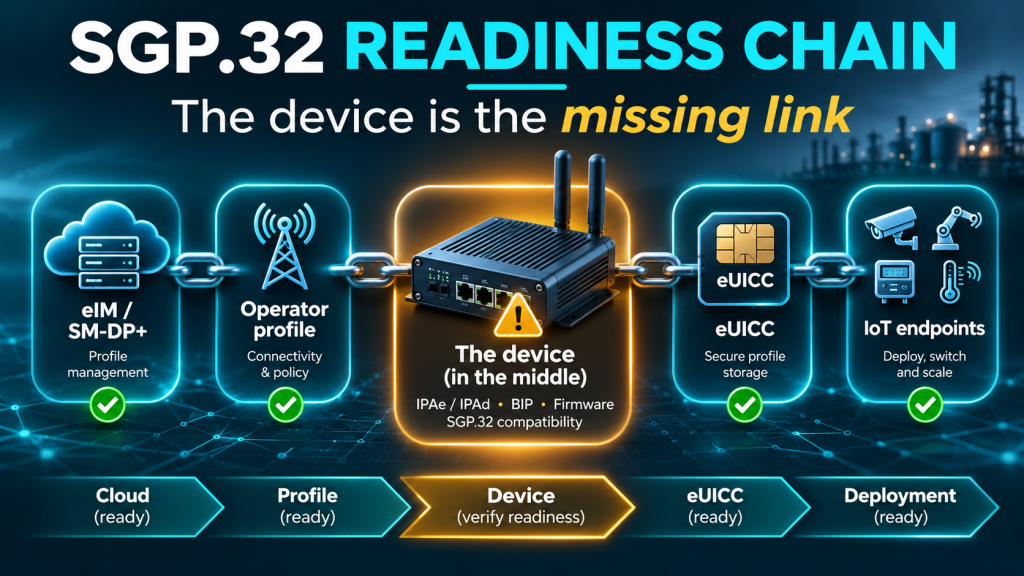
Here is the chain as it stands in November 2026, top to bottom.
  THE SGP.32 READINESS CHAIN  (Nov 2026)

  SERVER SIDE
  [ eIM - eSIM IoT Remote Manager ]   READY
  [ SM-DP+ - profile server       ]   READY
  [ Operator profiles             ]   GROWING
              |
  ---------- THE DEVICE ----------
  [ Device OS / router firmware   ]   MOSTLY SGP.22
  [ IPA - IPAe or IPAd            ]   THE FORK
  [ Modem firmware + BIP          ]   VARIES BY BUILD
  [ eUICC - the eSIM itself       ]   READY
  --------------------------------
  Device-side certification:          INCOMPLETE
Now the evidence behind each label.
| Link | Status | Evidence |
|---|---|---|
| eUICC | Ready | GSMA-certified SGP.32 eUICCs are shipping from Kigen and STMicroelectronics, with Thales, G+D and IDEMIA also supplying SGP.32 eUICCs. Kigen also has the first eSA-certified automotive eSIM supporting SGP.32 v1.3. |
| eIM | Ready | Certified eIMs are commercial from Kigen and others. Larger connectivity platforms such as Cisco, emnify and Soracom have added SGP.32 orchestration. |
| Operator profiles | Growing | Telenor IoT began commercial SGP.32 SIM deliveries in April 2026. Tele2 IoT, IDEMIA and Cisco launched an end-to-end service at MWC. Kigen lists 13+ activation-ready connectivity partners and says its automotive eSIMs work with 20+ networks ready for digital activation. |
| Device OS / router | Mostly SGP.22 | Most eSIM routers use SGP.22 with a proprietary management cloud. Native SGP.32 routers are the exception (see Part 4). |
| IPA | The fork | Either on the eSIM (IPAe) or on the device (IPAd). Each choice moves the risk to a different place (see Part 3). |
| Modem firmware | Varies by build | SGP.32 support depends on the exact module and the exact firmware build, and public compatibility matrices are rare. |
| Device certification | Incomplete | GSMA test specifications exist for the IPA, but the device-side certification route was still listed as “ongoing” in GSMA’s own applicability annex. |
Read that table from the top and it looks like a success story. Read it from the middle and it looks like a to-do list. Both are true, and which one you get depends on what you are buying.
Part 3: The IPA Fork, the Question Nobody Puts in an RFP
The IoT Profile Assistant is the small piece of software that sits between the eIM in the cloud and the eUICC in the device. It receives the instructions (“download this profile”, “enable that one”) and carries them out. SGP.32 lets it live in one of two places, and that choice decides which part of your hardware has to be ready. There is a deeper technical comparison on IPA-e vs IPA-d; here is the hardware buyer’s version.
Option A: IPAe, the IPA on the eSIM
The IPA runs inside the eUICC. The device does not need to know much about SGP.32 at all. That is the attraction, and it is why eSIM vendors like it: drop a capable eSIM into almost any modem and you are, in theory, done.
The catch is how the eSIM talks to the outside world. An IPAe has no network stack of its own, so it asks the modem to open a data connection on its behalf using BIP, the Bearer Independent Protocol from the SIM Toolkit. If the modem firmware does not support BIP properly, or has it switched off by default, the IPAe is stranded. It is a clever card in a deaf device.
How common is that? Simplex Wireless, which runs an eIM, started testing modules itself because, in its words on its compatibility page, it found BIP support to be “sporadic and not guaranteed”. That matches what I have seen. On many modules BIP is there but off by default, and on some it depends on the firmware build. I covered the AT-command side of this in SGP.32 modem compatibility.
Option B: IPAd, the IPA on the device
The IPA runs as software on the device: in the module firmware, on the router’s Linux OS, or in your own application on a microcontroller. It needs two things from the modem: a way to pass commands to the eUICC, and an ordinary IP data connection. No BIP required.
The catch here is ownership. Somebody has to write the IPAd, maintain it for the life of the device, and certify it. On Nordic’s developer forum, the answer to “does the nRF9151 support IPAd?” is essentially that IPAd is not a modem feature at all; it is an application, and it runs in your code. That is honest and correct, and it means the device maker inherits the job.
The certification paradox
Here is where it gets interesting. The usual pitch is that IPAe makes certification easier because the IPA comes pre-certified inside the eUICC. Kigen has made that argument publicly.
Yet Kigen’s own GSMA compliance confirmation for one of its IoT eUICCs, dated February 2026, carries a careful note: the product supports IPAe, but that feature is not covered by GlobalPlatform functional compliance testing, so the IPAe is not verified by the GSMA during the compliance process. I am not suggesting anything is wrong with Kigen’s IPAe. I am pointing out that “certified eUICC” and “certified IPA” are not the same claim, even on the same chip.
On the IPAd side, the GSMA has published a dedicated IPA test specification, SGP.33-2. But in the GSMA’s eSIM certification applicability annex (v2.6.3, July 2025), GCF certification for IoT devices with an IPA was still listed as “ongoing”, while the consumer equivalent was “active”. GCF said it would launch the programme during 2025. I could not find a clear public statement of where that stands now, which is itself telling.
So whichever fork you take, the device layer is where the certification story is least finished. The eUICC has a certificate. The eIM has a certificate. The bit in between is still being worked out.
Part 4: Where the Hardware Actually Stands
This is the bit IoT Index readers care about. Here is what I can verify from public sources as of early November 2026. Where a vendor has said nothing public, I say so rather than guess.
Routers and gateways
| Manufacturer | What exists today | What it actually means |
|---|---|---|
| Digi International | An SGP.32-compatible plastic eSIM accessory for existing routers (December 2025), plus the IX25 industrial router with SGP.32-compliant eSIM and a live bootstrap profile. | The closest thing to a shipping SGP.32 router family I can find. The accessory route is a retrofit: a Kigen plastic eSIM in a normal SIM slot. |
| Robustel | SGP.22 eSIM today, with Robustel’s own LPAd in RobustOS. SGP.32 roadmap using a Kigen eUICC and a Robustel IPAd. Kigen plastic eSIMs for retrofit. | Robustel’s own product articles say current eSIM routers are SGP.22-based and that SGP.32 should not be assumed. Refreshingly honest. |
| Teltonika Networks | SGP.22 eUICC across much of the RUT range, managed through Teltonika RMS, with bootstrap connectivity from Tele2 IoT. | A capable eSIM setup, and Teltonika openly positions it as SGP.22 compatibility with SGP.32-style remote control. But the management is proprietary, and I found no public announcement of native SGP.32 firmware. |
| Milesight | No public SGP.32 position that I could find. | Ask before you specify. |
Modules and chipsets
| Manufacturer | What exists today | What it actually means |
|---|---|---|
| SIMCom | SGP.32 firmware across its LTE Cat 1 bis modules (A7672, SIM7672, A7683E), and a completed IPA.d integration with G+D in March 2026, following earlier IPA.e work. | One of the most explicit public module commitments, covering both forks. |
| Quectel | SGP.32 IPA functionality on some modules, reportedly including the EG912U and EG915U. Its support forum has a steady stream of engineers asking which firmware enables SGP.32 on which module. | Possible on the right part, but the firmware build is the specification. No public matrix. |
| Telit Cinterion | At MWC 2026 it demonstrated its CMB100 embedded modem with its NExT eSIM doing SGP.32-ready profile download, swap and delete. | Demonstrated. Check module by module. |
| Nordic Semiconductor | nRF9160, nRF9151 and nRF9131 listed as supporting SGP.32. The IPAd runs in your application, not in the modem. | The chip will cooperate. You write, or buy, the IPA. |
The pattern is clear enough. The more explicit vendors talk about specific modules, specific firmware and a specific IPA mode. The vaguer ones say “eSIM-ready” and leave you to find out the rest. On a ten-year deployment, finding out the rest is your job, so do it before the purchase order, not after.
Part 5: What We Know, and What We Don’t
What we know
- The standard is mature. SGP.32 v1.2 is the certification baseline. v1.3 was published in May 2026, and the GSMA test specifications still sit at v1.2. Background on that is in the v1.3 explainer.
- The silicon is ready. Certified eUICCs ship in plastic, MFF2 and smaller packages from several vendors.
- The cloud is ready. Certified eIMs are commercial, and big connectivity platforms have bolted SGP.32 orchestration on.
- Operators have started. Commercial SGP.32 services launched across 2026, and activation-ready profile catalogues are growing.
- It works when someone has done the integration. The independent IoT Stars test in April 2026 moved live devices between connectivity providers over the air using Kigen’s eIM.
- Test tooling exists. Comprion has built interoperability test environments with Thales, G+D and, from September 2026, STMicroelectronics for IPAd testing.
What we don’t know
- When device-side certification is truly finished. How many IoT devices hold a GCF certification for their IPA, and which ones? I could not find a public list.
- Which module firmware builds support BIP reliably. Nobody publishes a cross-vendor matrix, and the people who need one most, router makers and integrators, mostly build their own.
- How eIM portability behaves in the field. The standard defines moving a device from one eIM to another. Public evidence of that happening between competing vendors on a production fleet is thin.
- How router management clouds and eIMs will coexist. If RMS, RCMS or Digi Remote Manager handles the router, and a separate eIM handles the eSIM, who decides which profile is active, and what happens when they disagree?
- Router vendor timelines. Several major vendors have SGP.32 on a roadmap. Few have put dates on it.
- How quickly profile catalogues fill out. “13+ partners” and “20+ networks” is a start. Nirvana needs the network you want, in the country you are in, to be on the list.
The questions worth asking, and my best answers
Is SGP.32 ready? At the ends, yes. In the middle, it depends on the exact device, module, firmware and IPA mode. “Ready” is now a property of a specific product, not of the standard.
Should I wait for native SGP.32 routers? Not necessarily. For a powered router that you can manage remotely, SGP.22 with a decent management platform does most of the job today. The bit you give up is independence: the profile switching lives in the vendor’s cloud, not in a portable eIM.
Is the plastic eSIM retrofit a real option? Yes, and it is underrated. A plastic SGP.32 eUICC with IPAe in an existing router’s SIM slot can bring SGP.32 to an estate that will never get native firmware, provided the modem supports BIP. Test that first.
IPAe or IPAd? IPAe if you want the least device engineering and can prove BIP works on your module. IPAd if you control the device firmware, want to avoid the BIP dependency, and can carry the certification and maintenance.
Part 6: How It All Comes Together
This is opinion, clearly labelled as such. But having watched SGP.02 and SGP.22 go through the same growing pains, I think the path to nirvana runs in roughly this order:
- Device certification closes. The GCF route for IoT devices with an IPA becomes routine, and module vendors start certifying named IPA builds rather than whole product families.
- Module datasheets get specific. They will state the SGP.32 version, the IPA mode and the BIP status for each firmware build. When that is normal, the middle of the chain becomes something you can specify instead of something you have to test.
- Router platforms make peace with the eIM. Router operating systems ship an IPAd natively, and management clouds either become eIMs themselves or hand that job to an independent one that the customer chooses. The ones that insist on owning the eSIM decision will meet resistance in RFPs.
- Profile catalogues become boring. Activating a new operator on a device becomes a menu choice, not a project. That is the point where switching operators actually starts happening at scale, and where the prices start to move.
- iSIM collapses two links into one. When the SIM moves into the modem chipset, the eUICC-to-modem handshake, and the BIP problem with it, largely disappears. The trade-off is that the chipset becomes the place the lock lives.
On timing, the analysts are broadly in step. Kaleido Intelligence has talked about a commercial ramp through 2026 and a tipping point around 2027 to 2028, and in 2025 forecast roughly 50 million SGP.32 eSIMs under management globally by 2027. Juniper Research expects 6.5 billion cellular IoT connections by 2030 and calls SGP.32 critical to that growth. Those numbers will happen faster if steps one and two above happen soon, and slower if they don’t.
Nirvana, in other words, is not waiting on the standard or the SIM. It is waiting on a few hundred unglamorous firmware builds, certification files and datasheet tables. The same, slightly less exciting work that decides whether any IoT deployment actually works.
Part 7: What to Do Now
- Ask for the part number and firmware build. Never accept “SGP.32-ready” for a product family. Get it for the exact module, firmware and router variant you are buying.
- Ask which IPA mode, and who certified it. IPAe or IPAd, and is there a certification behind the IPA itself, not just the eUICC?
- Prove BIP before you rely on IPAe. One test SIM and an afternoon with the AT commands will save you a fleet-wide surprise.
- Ask whether you can bring your own eIM. And whether the vendor’s management cloud will let you.
- Get the profile list in writing. Which operators, in which countries, can be activated on this hardware today?
- Bench-test before you buy at scale. Starter kits exist so you can break it on a desk rather than on a lamp post.
If you are writing this into a tender, the procurement side is covered in SGP.32 has moved into the RFP.
Conclusion: The Modem Is Still Upstream of the SIM
Every generation of cellular IoT has had the same plot. The industry builds something clever at the network end, the SIM gets smarter, the marketing gets louder, and the practical problems turn out to be in the device: the modem firmware, the settings nobody switched on, the certification nobody finished.
SGP.32 is a genuinely good standard, and the ends of the chain are in good shape. If you want the nirvana the industry is promising, stop asking whether SGP.32 is ready and start asking whether this device is ready. That is a question with a real answer, and it is the only one that matters on site.
Frequently Asked Questions
Is SGP.32 ready for IoT in 2026?
The standard, the certified eUICCs, the eIM platforms and the first operator services are all live. Device-level readiness varies: it depends on the specific module, its firmware, the IPA mode and whether the device side has been certified.
What is the difference between IPAe and IPAd?
Both are versions of the IoT Profile Assistant, the software that carries out eIM instructions on the eSIM. IPAe runs inside the eUICC and relies on the modem’s BIP support to reach the network. IPAd runs on the device, in module firmware, the router OS or the application, and needs no BIP but puts the development and certification work on the device maker.
Do I need BIP support for SGP.32?
Only if you use IPAe. The eSIM uses BIP to ask the modem to open a data connection. With IPAd, the device’s own software handles the connection and BIP is not required.
Are there any native SGP.32 routers?
A few. Digi offers SGP.32-compliant eSIM on its IX25 and an SGP.32-compatible eSIM accessory for existing routers. Most other eSIM routers, including popular Teltonika and Robustel models, currently use SGP.22 with proprietary or vendor management, with SGP.32 on the roadmap.
Is a Teltonika eSIM router an SGP.32 device?
Not natively. Teltonika routers with eSIM use SGP.22, with remote profile management through Teltonika RMS. That gives a lot of SGP.32-style convenience, but the management is proprietary rather than a portable SGP.32 eIM.
Can I add SGP.32 to routers I already own?
Often, yes, with a plastic SGP.32 eUICC that has an IPAe, fitted in the existing SIM slot. It only works if the router’s modem supports BIP, so test a sample before committing a fleet.
When will SGP.32 become mainstream?
Analysts point to a commercial ramp through 2026 and a tipping point around 2027 to 2028. In practice it will arrive when device-side certification and module documentation catch up with the eUICC and eIM layers.
About This Guide
This analysis is based on public vendor documentation, GSMA certification material and announcements available in early November 2026, read through the lens of hands-on experience with cellular routers and IoT SIMs in the field. Where a vendor has not said something publicly, this guide says so rather than guessing. If you are a manufacturer with a verifiable SGP.32 update, get in touch and the tables will be updated.
Related reading on IoT Index: The Real Reasons IoT SIMs Disconnect.