For years, Teltonika Networks has been best known for one thing: industrial cellular connectivity. Solid 3G, 4G and now 5G routers that turn unreliable mobile networks into something engineers can actually build systems on. Not flashy. Not consumer-grade. Just dependable, repeatable, and built for the real world.
But if you zoom out and look at where Teltonika is heading, something more interesting is happening.
Cellular routers are no longer the whole story.
What we are seeing now is Teltonika deliberately building out the LAN side of industrial IoT deployments. Ethernet switches. PoE infrastructure. Edge networking components that sit alongside routers rather than behind them. Products like the TSF000 industrial PoE+ switch are not one-offs. They are part of a broader push to own the full edge connectivity stack.
And that matters.
Teltonika’s Position in Industrial IoT
Teltonika didn’t arrive late to IoT. They were there early, when “M2M” still meant serial converters, clunky VPNs and fragile field installs. Their strength has always been understanding the environment where devices actually live:
- Remote sites with no fixed internet
- Cabinets with limited power and space
- Engineers who need devices to just stay online
- Systems that must run unattended for years
That background is important, because it explains why Teltonika’s move into networking hardware looks the way it does.
They are not chasing data centres or glossy enterprise IT. They are extending industrial edge connectivity, outward from the router.
The Shift from “Router-Only” Thinking
In early IoT deployments, the router was the centre of everything. One device, one SIM, maybe one Ethernet cable out to a single controller or camera.
That model doesn’t scale anymore.
Modern installations often include:
- Multiple PoE cameras
- Access points
- Sensors and controllers
- Edge compute devices
- Gateways and protocol converters
All of these sit on the LAN side of the router. And all of them need power, switching, and predictable network behaviour.
This is where Teltonika’s Ethernet switching range enters the picture.
Why Industrial Ethernet Switching Is Not a Commodity
At first glance, an Ethernet switch looks boring. Many people still think of switches as interchangeable boxes that move packets from A to B.
In industrial IoT, that assumption breaks quickly.
Switches at the edge must deal with:
- Limited cabinet depth
- Shared power supplies
- Harsh environments
- Continuous uptime expectations
- Installers who don’t want complexity
Teltonika’s approach reflects that reality.
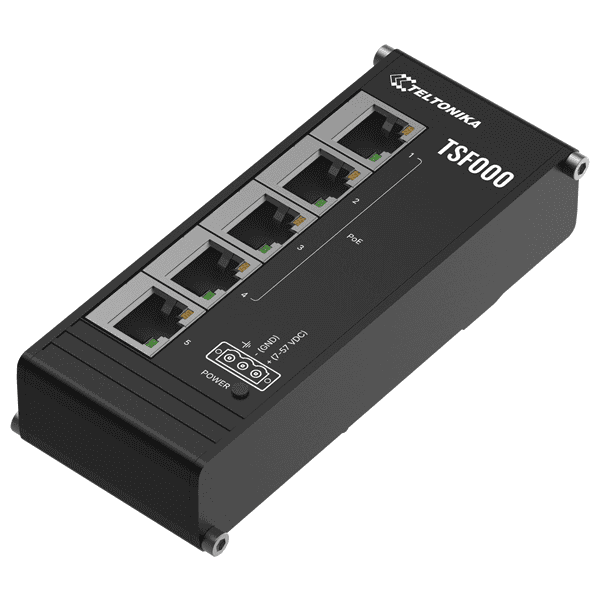
Products like the TSF000 are deliberately:
- Unmanaged, to reduce failure modes
- DIN-rail mounted, to fit industrial panels
- Low-profile, to coexist with routers and power supplies
- PoE-focused, because edge devices need power as much as data
This is not accidental. It is Teltonika designing for how IoT is actually deployed.
The TSF000 as a Strategic Product, Not Just a Switch
The TSF000 is a compact PoE+ Ethernet switch, but its significance goes beyond its specification.
It represents Teltonika acknowledging a simple truth:
Edge connectivity does not stop at the cellular modem.
In a typical deployment, the TSF000 sits:
- Between the router and multiple LAN devices
- Between a single power feed and several powered endpoints
- Between a remote site and the wider network architecture
By delivering both power and Ethernet from a single unit, it reduces:
- Cable clutter
- External power injectors
- Installation time
- Points of failure
That simplicity matters when deployments scale from tens to thousands of sites.
Building the Teltonika Ecosystem at the Edge
When you look at Teltonika’s product range today, a clear ecosystem is forming:
- Cellular routers provide WAN connectivity
- Ethernet switches distribute LAN connectivity
- PoE infrastructure powers edge devices
- RMS and APIs manage and automate everything remotely
- Edge computing capabilities handle local logic and data
This is no longer about selling a router in isolation. It is about enabling repeatable edge architectures.
In practical terms, this means integrators can design a standardised cabinet layout:
- One router
- One switch
- Known power budget
- Known cabling pattern
- Known remote management model
That consistency is gold in industrial IoT.
Edge Computing Needs a Strong LAN Foundation
Edge computing only works if the LAN is stable.
You can have the smartest application logic in the world, but if devices drop off the network or lose power, the system fails. By strengthening the LAN side, Teltonika is reinforcing the foundation that edge computing depends on.
The TSF000 supports scenarios such as:
- Local video processing
- On-site analytics
- Protocol translation
- Event-based automation
- Reduced backhaul traffic
All of these rely on reliable internal connectivity, not just a strong mobile signal.
Where This Matters in the Real World
This shift has practical implications across multiple industries.
CCTV and Security
PoE switches simplify camera deployments and reduce external power requirements. A single router and switch can support multiple cameras with predictable power budgets.
Smart Buildings
Lighting controllers, access systems and sensors increasingly rely on PoE and Ethernet. Compact switches allow these systems to scale without redesigning cabinets.
Industrial Automation
PLCs, HMIs and gateways often sit on the same LAN. A simple, robust switch keeps communication predictable and reduces troubleshooting.
Retail and Remote Sites
Kiosks, digital signage and payment systems benefit from compact, reliable LAN infrastructure that can be deployed quickly and supported remotely.
Transport and Infrastructure
Roadside cabinets, charging points and monitoring stations all benefit from low-profile networking hardware designed for constrained environments.
Why Innovation Here Actually Matters
Innovation in industrial IoT is not always about faster speeds or bigger numbers.
Sometimes it is about reducing complexity.
By extending into switches and PoE infrastructure, Teltonika is:
- Reducing vendor sprawl
- Improving compatibility between components
- Making deployments easier to replicate
- Lowering long-term support costs
This is quiet innovation. The kind that doesn’t make headlines but makes engineers’ lives easier.
Looking Forward: A More Complete Edge Stack
Teltonika’s move into industrial Ethernet switching should be seen as part of a longer-term trajectory.
As IoT systems become more distributed and autonomous, the edge becomes more important. Not just the WAN edge, but the LAN edge where devices interact locally.
Expect to see:
- Deeper integration between routers and switches
- Smarter power management
- More LAN-aware edge applications
- Stronger alignment between hardware and remote management platforms
The TSF000 is an early signal of that direction.
Final Thoughts
Teltonika is not abandoning its roots. Cellular connectivity remains core to what they do. But the company is clearly expanding its vision.
Industrial IoT is no longer just about getting online. It is about building robust, manageable, scalable edge systems.
Ethernet switches like the TSF000 may look simple, but they play a crucial role in that architecture. And by bringing them into the Teltonika ecosystem, the company is making a quiet but important statement:
The future of IoT is not just connected.
It is architected.