
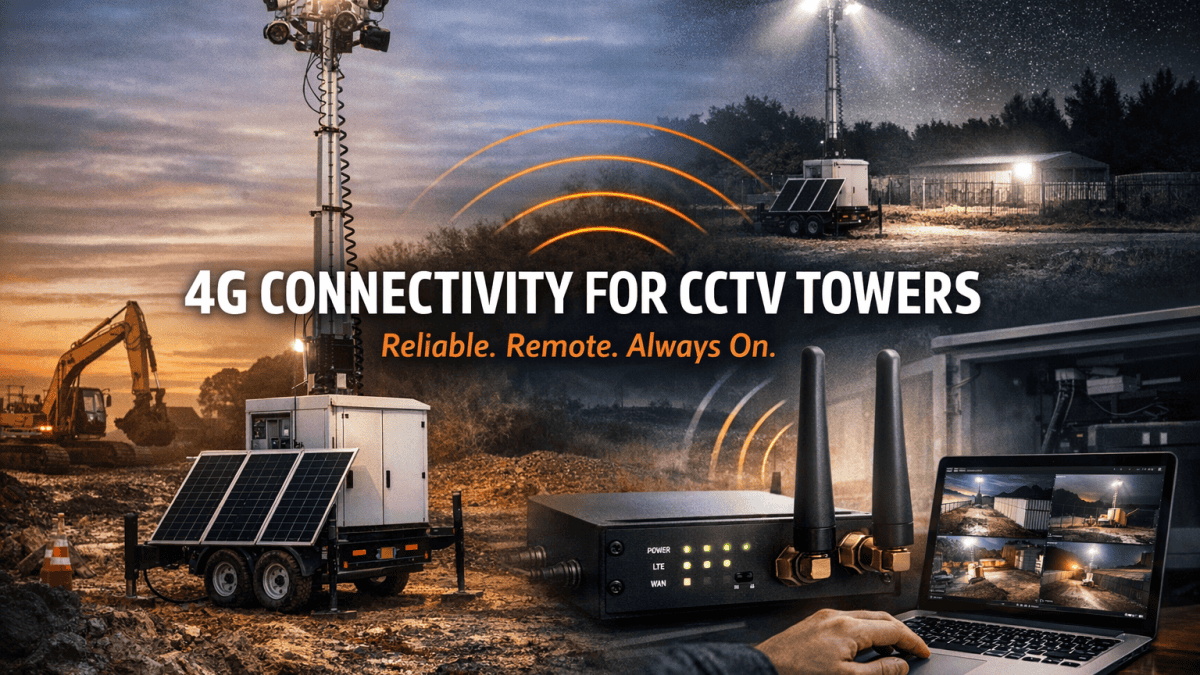
4G and 5G Connectivity for Deployable CCTV Towers: Architecture, SIMs, Antennas, and the Ideal Solution
A technical guide for CCTV tower manufacturers and installers – covering power budgets, PoE distribution, Cat-6 cabling, IoT SIM selection, antenna placement, and where the market is heading with eSIM and 5G RedCap.
A deployable CCTV tower needs more than a 4G router bolted to a mast. Power-conscious design, passive PoE distribution, multi-network SIM cards, correctly specified MIMO antennas, and integrated solar monitoring are all essential. This guide covers the full architecture – and maps the gap between what the market currently offers and what the ideal product looks like.
Contents
- Why connectivity on a CCTV tower is harder than it looks
- The power budget: solar, batteries, and consumption reality
- Powering cameras: PoE, passive PoE, and the 12V rail
- Why Cat-6 is the standard in UK CCTV tower deployments
- The connectivity unit: what it needs to do
- Cellular technology: why LTE Cat 6 and 5G are the right choices
- IoT SIM cards for CCTV towers
- Antenna selection and placement on a CCTV mast
- Remote access, VPN, and GPS
- The ideal product: a wishlist for manufacturers
- eSIM, eUICC, and SGP.32: the remote provisioning case
- 5G RedCap: the future of low-power CCTV connectivity
- Frequently asked questions
Why connectivity on a CCTV tower is harder than it looks
A deployable CCTV tower – the kind deployed on construction sites, temporary events, retail parks, and highways – looks like a straightforward connectivity problem. Put a 4G router in the box, give it a SIM, done. In practice, every aspect of that environment creates constraints that a standard office or vehicle router was never designed to handle.
The tower is solar and battery powered, often operating for days or weeks without any direct sunlight. The cellular connectivity unit draws from the same limited energy budget as the cameras themselves. The mast is exposed – rain, temperature extremes, vibration from wind loading. The site may be in a rural or semi-urban location with marginal cellular coverage from a single operator. And the entire system may be unattended for months at a time, with no engineer on call to swap a frozen router or failed SIM.
These constraints mean that a product designed specifically for this environment will outperform a repurposed office router in almost every measurable way – power consumption, reliability, remote management capability, and long-term operating cost. This guide covers the full architecture of what that product needs to look like.
The UK has approximately 15-20 manufacturers of deployable CCTV towers at meaningful scale, serving construction, highways, events, and retail. Most specify Victron solar management, Milesight or Hanwha cameras, and an increasingly diverse range of connectivity solutions – from 4G routers that were never designed for this use case, to purpose-built units beginning to appear from specialist suppliers.
The power budget: solar, batteries, and consumption reality
A deployable CCTV tower runs from a photovoltaic panel and a battery bank – typically 12V or 24V lead-acid or LiFePO4. The solar charge controller (most commonly a Victron SmartSolar MPPT in the UK market) manages charging and load management. The entire electrical system operates from the battery rail, and every component draws from a limited daily energy budget that shrinks to near-zero during extended overcast periods.
Understanding the power budget is the starting point for any connectivity design. A tower that runs four cameras, a connectivity unit, and associated electronics in the UK winter – where available solar energy can drop to 10-15% of peak summer capacity for days at a stretch – needs every component to earn its place on the load list.
Typical power budget for a 4-camera tower
| Component | Typical Draw | Daily Consumption (24h) | Notes |
|---|---|---|---|
| 4x IP cameras (passive PoE, 12V) | 4 x 8W = 32W | 768Wh | Dominant load. IR active at night increases draw. |
| 4G/5G router (always on) | 8-18W | 192-432Wh | Wide range depending on product and signal environment |
| 4G/5G router (sleep/wake managed) | 1-3W standby, 12W active | 80-120Wh | Purpose-built units only. Modem sleeps between events. |
| NVR (if fitted, 2.5″ HDD) | 10-15W | 240-360Wh | SSD NVR reduces this to 5-8W |
| Control/compute board | 3-6W | 72-144Wh | Raspberry Pi 5 or similar embedded compute |
| GPS, IMU, sensors | <1W | <24Wh | Negligible in most designs |
A 4G router running always-on at 15W adds up to 360Wh per day – equivalent to running another camera continuously. On a marginal winter day with 100-200Wh of solar input, the difference between an 8W and 15W router is the difference between keeping the system alive and draining the battery. Power management is not optional in this environment.
The sleep/wake architecture
The correct architecture for a solar-powered CCTV tower separates the always-on control layer from the power-hungry cellular radio. A low-power embedded computer (a Raspberry Pi 5 draws around 3-5W at idle, significantly less in a suspend state) manages all local functions – reading the Victron MPPT via VE.Direct, monitoring digital inputs, controlling camera power via relays, and logging GPS position. The cellular modem is powered up only when there is data to transmit or a remote management session is active.
This two-layer architecture – always-on control at low power, modem sleeping between transmission events – can reduce daily connectivity energy consumption from 360Wh to 80-120Wh. On a tower with a 200Ah battery at 24V (4,800Wh total), that difference represents days of additional autonomy during a UK winter.
Most off-the-shelf 4G routers have no mechanism for this. They run continuously, drawing 8-15W regardless of whether any data is being transmitted. A purpose-built connectivity unit with GPIO-controlled modem power is a meaningful design advantage.
Powering cameras: PoE, passive PoE, and the 12V rail
Cameras on a CCTV tower are almost universally powered over Ethernet – but there is an important distinction between IEEE 802.3af/at/bt PoE (which negotiates power delivery via a protocol handshake at 48V) and passive PoE (which injects a fixed voltage onto the cable without any negotiation).
Standard PoE switches are designed for 48V DC systems. A solar-battery tower operates from a 12V or 24V rail. Bridging that gap requires either a DC-DC boost converter to generate 48V for a proper PoE switch (adding cost, complexity, and inefficiency), or the use of passive PoE at 12V directly from the battery rail.
Passive PoE at 12V: why towers use it
Most IP cameras rated for outdoor or vandal-resistant use accept a wide input voltage range – commonly 12V DC or PoE 802.3af – because the camera’s internal PSU regulates to whatever the camera electronics need. In practice, most cameras happily accept 12V passive PoE injected onto the spare pairs of a Cat-6 cable (pins 4/5 positive, 7/8 negative in the standard passive arrangement).
This allows the tower to distribute camera power from its 12V or 24V battery rail directly, without any intermediate conversion. Each camera port on the connectivity unit gets a passive PoE injector, a relay to individually switch power, and a current sensor to detect fault conditions (a camera drawing zero current indicates failure; one drawing abnormally high current may indicate a short).
Passive PoE at 12V will power most bullet and turret cameras from Milesight, Hikvision, and Dahua that are rated for “12V DC or PoE” input. It will not work with cameras that require negotiated PoE power – check the camera datasheet for accepted input voltage before specifying. Any camera that lists only “PoE IEEE 802.3at” without a separate 12V DC input cannot be powered by passive 12V PoE.
Individual port switching via relay
One feature that separates a purpose-built tower connectivity unit from a standard PoE switch is per-port power switching. A relay on each camera port allows the control system to cycle power to a specific camera remotely – without affecting the other cameras, the router, or the rest of the system. In practice, a frozen or crashed camera that is not responding to network commands can be hard-rebooted from thousands of miles away in seconds.
Standard PoE switches have no remote per-port power cycling capability outside of SNMP-managed enterprise switches that were never designed for 12V rail operation. This is a concrete functional advantage of a purpose-built product.
System architecture overview
Why Cat-6 is the standard in UK CCTV tower deployments
Experienced UK CCTV tower manufacturers specify Cat-6 as standard for all internal and external cabling runs. This is not just a case of specifying the newer standard for its own sake – there are concrete technical reasons why Cat-6 outperforms Cat-5e in this specific application.
Cross-talk and PoE at distance
Cat-6 cable has significantly tighter pair twisting and thicker insulation than Cat-5e, which dramatically reduces alien cross-talk (interference between pairs from adjacent cables bundled together in a conduit). In passive PoE applications – where 12V is injected on the spare pairs and the data signal runs simultaneously on the other pairs – the physical separation of pairs in Cat-6 reduces the risk of the PoE voltage inducing noise onto the data pairs. At cable runs of 20-50m (typical for a CCTV tower with a run from the electrical cabinet to the camera housing at the top of the mast), this matters.
Higher power capacity for future PoE standards
Cat-5e is rated for carrying up to 60W per pair under 802.3bt (PoE++). Cat-6 handles the same load with lower resistance, which means less voltage drop and less heat generated in the cable jacket. In an IP65 enclosure in direct sunlight, heat management is not trivial. Specifying Cat-6 now also future-proofs against cameras that demand more power – thermal imagers and PTZ cameras with heater elements routinely draw 25-30W, which stresses Cat-5e at any meaningful cable length.
Robustness of outdoor-rated Cat-6 jackets
Outdoor Cat-6 cable – direct burial or UV-stabilised PVC jacketed – is physically more robust than equivalent Cat-5e in most product lines. The heavier gauge of Cat-6 conductors (typically 23 AWG vs 24 AWG in Cat-5e) is more resistant to damage during installation in conduit. For a product that is installed by different teams with varying levels of cable handling care, the physical durability margin matters.
RF environment on a CCTV mast
A CCTV tower with a 5G MIMO antenna array at the top is generating radio frequency emissions in close proximity to the cabling runs. Cat-6’s superior shielding characteristics – and the availability of F/UTP and S/FTP variants with foil shielding – provide meaningful additional isolation compared to Cat-5e in this RF environment. Unshielded Cat-5e running near SMA-connected 5G antenna cables can act as a receiving antenna for interference. The performance difference may not be significant in most installations, but for a manufacturer whose tower must perform consistently in marginal conditions, the margin is worth having.
For new CCTV tower designs, specify Cat-6 F/UTP with UV-stabilised outdoor jacket for all internal cabling runs. Terminate on panel-mount RJ45 sockets (Neutrik NE8FDP or equivalent) with IP-rated dust caps. The cost differential over Cat-5e is minimal at the cable lengths involved in tower applications – typically under £5 per port at component pricing.
The connectivity unit: what it needs to do
Current deployable CCTV towers typically assemble their connectivity from separate components: a 4G router, a PoE switch, a GPS tracker, a Victron display or separate monitoring device, and whatever digital IO capability the manufacturer has chosen to add. Each component has its own power supply, its own management interface, and its own failure mode. The total power draw is the sum of all these devices running simultaneously.
The case for a purpose-built connectivity unit is that a single device, designed specifically for this environment, can replace all of them – at lower total power consumption, with a unified management interface, and with integration that the separate-components approach can never deliver.
The minimum viable feature set
| Function | Why It’s Required | Current Solution (Typical) |
|---|---|---|
| 4G/5G cellular connectivity | Primary data link for video streaming and remote management | Standalone 4G router (always on, 8-15W) |
| Passive PoE distribution (4 ports) | Camera power from 12/24V rail without 48V conversion | Separate PoE switch (adds 5-10W and complexity) |
| Per-port camera power switching | Remote camera reboot without site visit | Not available in standard PoE switches |
| Victron VE.Direct integration | Battery state, solar yield, and load monitoring in one UI | Separate Victron display or no visibility at all |
| GPS position and theft alerting | Theft detection is now a standard requirement | Separate GPS tracker with separate SIM |
| Tilt / tamper detection (IMU) | Alerting on attempted tower movement or vandalism | Rare – usually absent |
| Digital inputs (door, PIR) | Cabinet tamper detection, perimeter PIR integration | Usually absent or added as a separate controller |
| WireGuard VPN | Secure remote access to camera streams and management interface | Dependent on router capability – often OpenVPN only |
| Modem sleep/wake management | Power saving – modem off when not transmitting | Not available on standard routers |
Cellular technology: why LTE Cat 6 and 5G are the right choices
The cellular category specification of the modem is the single most consequential technical choice in the connectivity unit. Get it wrong and the tower will fail to connect on sites where coverage is marginal – exactly the sites that need it most.
Why LTE Cat 4 is not enough
LTE Category 4 modems – which were the standard in most 4G routers until around 2020 – offer theoretical downlink of 150 Mbps but, critically, are limited to a single downlink carrier. In rural and semi-rural UK deployments, where coverage often comes from a single tower with congested spectrum, a Cat 4 modem cannot perform carrier aggregation. It is stuck on one band at a time. When that band is congested, performance drops. When there is no signal on the primary band, there is no fallback within the LTE layer.
LTE Cat 6 and carrier aggregation
Category 6 modems support 2x carrier aggregation (2x CA) in downlink – they can bond two LTE carriers simultaneously, doubling effective throughput and, more importantly, increasing the number of cells and spectrum blocks the modem can access. In a marginal coverage environment, this makes a material difference to reliability. A Cat 6 modem that can combine a weak signal on 800 MHz with a stronger signal on 1800 MHz will maintain a better connection than a Cat 4 modem limited to the weaker of the two. Theoretical peak for Cat 6 is 300 Mbps downlink, though real-world performance in a rural tower installation is typically 20-80 Mbps.
5G Sub-6 and why it matters now
5G NR Sub-6 GHz deployment in the UK has progressed rapidly since 2022. EE, Vodafone, O2, and Three have all extended their 5G footprints to major towns, arterial roads, and an increasing proportion of the semi-rural locations where CCTV towers are deployed. A 5G NR modem offers not only higher throughput but also improved spectrum flexibility – and 5G NR’s beamforming capabilities at 3.5 GHz can maintain a usable connection to a distant 5G NR cell where a 4G modem on the same band would have dropped out.
The Teltonika Calyx 5G HAT+ is one example of a 5G NR modem designed for integration into embedded systems – it provides 5G Sub-6 with 4x MIMO, GPIO-controlled power and reset, and a wide operating temperature range (-40 to +75 degrees Celsius) suitable for outdoor enclosures in UK conditions. It interfaces to a Raspberry Pi via the 40-pin GPIO header, which keeps the integration clean and allows the Pi to manage modem power directly.
For UK CCTV tower deployments, the modem must support the UK operator band plan. Key bands are: Band 20 (800 MHz, EE/Vodafone/O2 rural coverage), Band 3 (1800 MHz, widespread LTE), Band 1 (2100 MHz, 3G/LTE fallback), Band 42/43 (3.5 GHz, 5G NR), Band 7 (2600 MHz, dense area capacity). A modem that omits Band 20 will struggle in rural areas – this is the most important single band for UK rural deployment.
Relevant UK band support by LTE category
| LTE Category | Max DL | Carrier Aggregation | 5G NR | Rural UK Suitability |
|---|---|---|---|---|
| Cat 4 | 150 Mbps | None | No | Adequate, not optimal |
| Cat 6 | 300 Mbps | 2x CA DL | No | Good for most sites |
| Cat 12 | 600 Mbps | 3x CA DL | No | Excellent LTE performance |
| 5G NR Sub-6 | 1+ Gbps | NR CA + EN-DC | Yes | Best available, growing UK coverage |
| 5G RedCap (future) | 220 Mbps | Limited CA | Yes | Low power 5G – ideal for battery IoT |
IoT SIM cards for CCTV towers
The SIM card is the most overlooked component in a CCTV tower connectivity design. Most manufacturers specify a single-network SIM from a consumer or business mobile contract, which works until the tower is deployed to a site where that operator has marginal coverage. The result is a support call, a site visit, and a SIM swap – at significant cost relative to the price of a better SIM in the first place.
Multi-network IoT SIMs
A multi-network or roaming IoT SIM connects to whichever of the available UK networks provides the strongest signal at the deployment site. Unlike a locked consumer SIM, a properly configured multi-network IoT SIM will roam between EE, Vodafone, O2, and Three domestically, selecting the best available network automatically. For a device that may be deployed anywhere from a city centre construction site to a rural highways project, this is not a luxury – it is a requirement.
The distinction between a genuine multi-network SIM and a “preferred network” SIM is important. Some IoT SIM products have a preferred home network with fallback to others only when the primary network has no signal – this is better than a single-network SIM but still falls short of true multi-network behaviour where all networks are treated as equal options. For CCTV tower deployments, specify a SIM with genuine domestic multi-network operation.
Private APN and static IP
Many tower deployments benefit from a private APN – a dedicated access point name that routes traffic through the SIM provider’s network without touching the public internet. This has two practical advantages for CCTV towers. First, the device can be assigned a static IP address, making remote access straightforward without requiring a VPN or dynamic DNS workaround. Second, traffic between the tower and the control centre travels on a private network segment, reducing exposure to public internet threats.
For deployments where video is being streamed to a Video Management System (VMS) hosted in a private data centre or on a corporate network, a private APN is the cleanest architectural solution. The tower connects to the APN, traffic routes directly to the private network, and the VMS sees the camera streams as if they were on the local LAN. See IoT SIM Explained for a detailed treatment of APN types and private connectivity options.
Data consumption planning for CCTV towers
| Usage Pattern | Bitrate | Daily Data | Monthly Data |
|---|---|---|---|
| 4x cameras, continuous 720p H.264 to cloud VMS | 4 x 1 Mbps = 4 Mbps | 43.2 GB | ~1.3 TB |
| 4x cameras, motion-triggered upload only | Variable, avg 0.5 Mbps | 5.4 GB | ~160 GB |
| Local NVR + cloud thumbnails / alerts only | ~0.1 Mbps average | 1 GB | ~30 GB |
| Local NVR + on-demand remote viewing | Variable on demand | Variable | 50-100 GB typical |
The data consumption implications of continuous cloud streaming are significant enough to make local NVR storage the preferred architecture for most CCTV tower deployments. The tower records locally; the connectivity link is used for management, alerting, and on-demand access – not continuous video exfiltration. This reduces data costs by an order of magnitude and reduces the criticality of the cellular link from “must be up 100% of the time” to “must be up when needed.”
For UK CCTV tower deployments, specify a multi-network IoT SIM with genuine domestic multi-network roaming across all four UK MNOs, 50-150 GB monthly data allowance depending on architecture, and optional private APN with static IP for installations connecting to a private VMS. roamingsims.co.uk covers multi-network SIM options for UK IoT deployments in detail.
Antenna selection and placement on a CCTV mast
The cellular modem is only as good as the antenna system feeding it. A 5G NR modem connected to a poorly specified antenna at the wrong location on the mast can perform worse than a Cat 6 modem on a correctly specified antenna. In a marginal coverage environment, antenna design is not secondary to modem choice – it is equally critical.
MIMO and why 4×4 MIMO matters for 5G
Modern 5G NR modems support 4×4 MIMO (Multiple Input, Multiple Output) – four independent transmit and receive antenna chains that allow the modem to spatially multiplex data across the same frequency bandwidth. This provides both a throughput benefit (in strong signal conditions, 4×4 MIMO can approximately double throughput versus 2×2 MIMO) and a resilience benefit – if one antenna path is degraded, the others continue to function.
The practical implication for CCTV tower design is that the connectivity unit needs four separate antenna ports, and the installation needs four antenna elements with adequate spacing between them. The spacing requirement for effective MIMO is a minimum of half a wavelength at the operating frequency – at 3.5 GHz (5G NR n78 band), this is approximately 43mm. At 800 MHz (Band 20), it is approximately 187mm. Most CCTV mast installations have sufficient physical space to meet this requirement.
Antenna types for mast installation
| Antenna Type | Gain | Coverage | Best For |
|---|---|---|---|
| Omni (vertical dipole) | 2-5 dBi | 360 degrees horizontal | Urban / suburban sites with multiple cell towers visible |
| LPDA (log-periodic dipole array) | 7-12 dBi | Directional, ~60-80 degree beam | Rural sites with single known cell tower direction |
| MIMO panel (combined 4 elements) | 5-8 dBi per element | Semi-directional, wide beam | General purpose – clean installation, good MIMO spacing |
| Embedded / blade (behind radome) | 2-4 dBi | Omni | Vandal-resistant housings where aesthetics matter |
Placement on the mast
Antenna placement on a CCTV mast involves two competing constraints. Higher placement gives better line of sight to distant cell towers – the mast itself provides the elevation. But the CCTV cameras and their housings are also at height, and their metal structures can cause reflections and nulls in the antenna pattern. For a mast installation, the antenna elements should be placed above the camera housings where possible, or on the side of the mast most favourable to the direction of the serving cell tower.
The five SMA bulkhead connectors on the connectivity unit enclosure (four for the 5G modem, one for GPS) should be mounted on the top face of the enclosure where pigtail runs to external antennas are shortest. The GPS antenna benefits particularly from clear sky view – a magnetic base GPS antenna mounted on top of the enclosure with unobstructed sky view above will achieve lock much faster than one inside or below the mast structure.
For UK CCTV tower applications, the IoT Antenna Directory covers cellular and GPS antenna options including MIMO panel antennas and LPDA high-gain types suitable for mast mounting. Panorama Antennas and Taoglas produce panel MIMO antennas that cover 617 MHz to 6 GHz in a single housing, providing clean installation with correct MIMO element spacing.
Remote access, VPN, and GPS
WireGuard over OpenVPN for battery-constrained devices
VPN protocol selection matters more than it might appear in a power-constrained deployment. OpenVPN, the traditional choice for remote access on industrial routers, is CPU-intensive – it runs in userspace and requires significant processing per packet. WireGuard, the modern alternative supported by most Linux kernels since 5.6, runs in kernel space and is dramatically more efficient. On a Raspberry Pi or similar ARM-based compute board, the CPU load of maintaining an active WireGuard tunnel is a fraction of the equivalent OpenVPN connection. For a device that is trying to minimise power consumption during periods of low activity, this matters.
WireGuard also has faster handshake and reconnection behaviour, which is beneficial in the CCTV tower use case where the cellular link may drop temporarily (cell reselection, network congestion, brief signal loss) and needs to re-establish quickly when connectivity returns. The correct architecture is for the WireGuard tunnel to be established only when the modem is powered up, and torn down cleanly when the modem sleeps – this avoids keepalive traffic consuming data when no active session is needed.
GPS for asset protection
Tower theft is a real and recurring problem in the UK. A tower with GPS position logging can trigger an immediate alert if the unit is moved more than a defined radius from its last known position. Combined with tilt detection from an IMU (which identifies the moment the mast is lowered for theft), the system can send an alert before the tower has been removed from site – providing the response window that human intervention requires.
The u-blox NEO-M8N module is a widely used GPS/GNSS receiver for this application – it achieves 1-2m position accuracy, supports GPS, GLONASS, Galileo, and BeiDou, and draws under 30mA active. At 100mW on a system drawing 30-40W, GPS adds negligible power consumption while providing a theft deterrent capability that adds meaningful value to the product proposition.
The ideal product: a wishlist for manufacturers
No product currently on the UK market fully addresses all of these requirements in a single unit. The closest approaches assemble most of them from separate components at the cost of higher total power draw, more complex installation, and multiple management interfaces. The gap between what exists and what would be ideal is clear, and it represents a genuine product opportunity.
1. 5G NR modem with GPIO-controlled sleep/wake
The modem must be powerable on and off by the control system based on data demand – not running continuously. This single feature reduces daily power consumption by 100-200Wh compared to an always-on design.
2. Wide-input DC power: 9-36V (solar/battery native)
No 12V to 48V to 12V conversion chains. DC-DC buck converters from the battery rail directly to the compute board (5.1V) and camera PoE distribution (12V) with regulated output regardless of battery state.
3. 4-port passive PoE with per-port relay switching and current monitoring
Individual control and monitoring of each camera port. Remote reboot of a frozen camera without affecting the rest of the system. INA219 per-port current sensing to detect dead cameras and fault conditions.
4. Victron VE.Direct integration as standard
Battery voltage, state of charge, solar yield, and load current all visible in the same web UI as the camera feeds and connectivity status. This is the monitoring integration that Victron’s own ColorControl GX provides – but combined with the connectivity functions rather than as a separate device.
5. GPS, IMU, and digital IO built in
GPS with position logging and geofence alerting. 6-axis IMU for tilt and tamper detection. Three digital inputs (door, PIR, manual wake) and two digital outputs (siren, relay) – all managed by the same firmware stack as the cellular connection and power management.
6. Web UI visible over WireGuard with no cloud dependency
The management interface must be accessible over the VPN tunnel without routing through a cloud relay. A Node-RED or Flask-based local web interface, visible on the private WireGuard network, gives direct access to all telemetry without SaaS platform lock-in or recurring cloud service fees.
7. DIN-rail mounting with field-serviceable SIM access
Most UK CCTV towers already have DIN rail in the electrical compartment. A standard DIN-rail mount bracket allows the connectivity unit to fit the existing tower architecture without custom fabrication. SIM access without removing the unit from the DIN rail or opening the main enclosure is a practical requirement for field engineers.
8. Status indicators visible without a laptop
LED indicators for power, cellular signal, GPS lock, VE.Direct connected, and each camera port should be visible externally. A small OLED display showing battery percentage, signal strength, and IP address removes the requirement to connect a laptop for commissioning checks – saving meaningful time on first-install and service visits.
9. eSIM with remote profile switching (SGP.32)
An embedded SIM that can be remotely reprovisioned to a different operator profile without a site visit. Critical for long-duration deployments where operator coverage at a specific site changes over time. Discussed in detail in section 11.
10. 5G RedCap modem option for minimum-power variants
A reduced-complexity 5G NR modem offering lower power consumption than full 5G NR while maintaining 5G benefits – sufficient throughput for CCTV tower applications at a fraction of the power draw. Discussed in section 12.
eSIM, eUICC, and SGP.32: the remote provisioning case
Every tower that uses a physical SIM carries an inherent operational risk: if the operator providing that SIM loses coverage at the deployment site – due to a cell outage, spectrum refarming, or simply a change in the competitive landscape of UK MVNO pricing – the only remedy is a physical site visit to swap the SIM. For a tower on a six-month highway project two hours from the nearest depot, that is a meaningful cost.
eUICC and remote profile management
An embedded Universal Integrated Circuit Card (eUICC) is a SIM that holds multiple operator profiles and can switch between them under software control. The traditional M2M eUICC specification (GSMA SGP.02) allows profiles to be downloaded and switched remotely via an SM-DP+ (Subscription Manager Data Preparation) server, operated by the SIM provider. If operator A’s coverage degrades, the platform can push a profile switch command to the device, which activates operator B’s profile without any physical intervention.
For CCTV tower deployments, this transforms a potential site visit into a remote management action. The tower stays connected; the SIM platform handles the operator switch in the background. The requirement for this is that the connectivity unit’s SIM slot accepts an eUICC (MFF2 soldered format for outdoor environments, or a standard SIM slot accepting an eUICC form factor card), and that the cellular module firmware supports GSMA remote SIM provisioning commands.
SGP.32: IoT-specific eSIM management
GSMA SGP.32, ratified in 2023, is the IoT-specific eSIM architecture that removes some of the complexity of the M2M SGP.02 stack. It introduces a simplified eIM (eSIM IoT Manager) function that does not require the device to be connected at the moment of profile provisioning – the profile can be staged and downloaded opportunistically when the device next has connectivity. This is directly relevant to CCTV towers, which may have intermittent connectivity during low-battery states or network maintenance windows.
SGP.32 also simplifies the bootstrap profile mechanism – the device needs only a basic connectivity profile to pull down a full operational profile, rather than requiring the full M2M provisioning infrastructure from day one. For a product being deployed to dozens of sites with different operator preferences, the operational flexibility this provides is substantial.
For a deeper treatment of eUICC architecture and SGP.02 vs SGP.32, see euicc.co.uk.
New connectivity unit designs for CCTV towers should specify an MFF2 eUICC soldered to the PCB rather than a removable SIM holder. Soldered eUICC eliminates the mechanical failure mode of SIM tray contacts (a real problem in vibration-exposed mast installations) and is qualified for the operating temperature range of outdoor electronics. Combined with a multi-network IoT SIM provider supporting SGP.32 remote provisioning, this removes the physical SIM dependency entirely for the life of the product.
5G RedCap: the future of low-power CCTV connectivity
Current 5G NR modems – including the Teltonika Calyx HAT+ referenced in the prototype BOM – are full-feature 5G implementations designed for maximum throughput. They support 4×4 MIMO, 100 MHz channel bandwidth, and high peak data rates. All of that capability comes at a cost: power consumption that is higher than a comparable LTE Cat 6 modem, and a hardware cost premium that may be difficult to justify for applications that never need gigabit throughput.
A CCTV tower streaming four 1080p H.265 camera feeds uses at most 8-12 Mbps of uplink and rarely more than a few Mbps of downlink for management traffic. The full 5G NR feature set is architectural overkill for this application – and the modem’s power budget reflects that mismatch.
What RedCap changes
3GPP Release 17 introduced Reduced Capability (RedCap) NR – a new device class designed to bridge the gap between power-hungry full 5G NR and the low-throughput NB-IoT/LTE-M category. RedCap offers downlink rates up to 220 Mbps (more than enough for any CCTV tower application), uplink up to 100 Mbps, and dramatically lower device complexity and power consumption than full 5G NR – achieved by reducing MIMO layers to 2×2, limiting channel bandwidth to 20 MHz, and removing features like full carrier aggregation that are irrelevant for IoT applications.
The benefit for a solar-battery CCTV tower is concrete: a RedCap modem consumes meaningfully less power than a full 5G NR modem while maintaining 5G network access, 5G latency characteristics, and 5G NR coverage as operators continue to expand. It is 5G connectivity at a power budget closer to LTE Cat 6.
UK operator deployment timeline
As of early 2026, UK operators are in varying stages of RedCap deployment. The technology requires software updates to existing 5G NR base stations rather than new hardware at the cell level – operators with mature 5G infrastructure are better positioned to enable RedCap quickly. EE and Vodafone have both signalled RedCap support in their 5G roadmaps, with commercial availability expected to expand through 2026 and 2027. RedCap devices launched today are likely to find growing network support within their operational life on deployed CCTV towers.
For detailed coverage of RedCap’s UK status and the device ecosystem developing around it, see 5gredcap.co.uk.
For CCTV tower connectivity units being designed today for production in 2026-2027, specifying a RedCap-capable modem or designing with a modular modem slot that accepts RedCap hardware is worth the upfront consideration. A tower placed on a highways project in 2027 will still be deployed in 2029 or 2030 – by which point RedCap availability across the UK 5G network will be substantially wider than today.
Power consumption comparison: standard vs purpose-built
The following diagram illustrates the difference in daily energy consumption between a CCTV tower assembled from separate components and one using a purpose-built connectivity unit with sleep/wake management.
Frequently asked questions
What LTE category modem should I specify for a UK CCTV tower?
LTE Cat 6 is the minimum sensible specification for new installations in 2025-2026. Cat 6 supports 2x carrier aggregation, which materially improves performance and reliability on UK sites where the primary serving cell may be weak. Cat 4 modems, while still functional, cannot aggregate carriers and will deliver inferior performance on marginal sites.
For a product being designed today for a 3-5 year lifespan, 5G NR Sub-6 is the better investment – coverage is expanding rapidly and 5G NR modems operate in LTE fallback on sites where 5G is not yet available. The Teltonika Calyx 5G HAT+ is one example of a 5G NR module suitable for embedded CCTV tower applications.
Can I use a standard 4G router in a CCTV tower application?
A standard 4G router will provide basic connectivity but falls short in several important areas for this application. Most consumer and business 4G routers run continuously at 8-18W, which represents a significant fraction of a solar tower’s daily energy budget. They have no mechanism to sleep between data events.
Standard routers also have no integration with Victron solar monitoring, no per-port camera power switching, no built-in GPS or tilt detection, and no native support for the digital IO functions needed for door and PIR monitoring. These functions either go absent or require additional components that add further cost and power draw. For a production product, a purpose-built unit makes more sense than assembling from general-purpose components.
What is the difference between PoE and passive PoE for CCTV cameras?
Standard PoE (IEEE 802.3af, 802.3at, or 802.3bt) negotiates power delivery between the switch and the camera using a protocol handshake. Power is delivered at 48V DC and the camera’s internal PSU converts it to whatever the camera electronics require. This requires a 48V power supply on the switch side.
Passive PoE injects a fixed DC voltage (commonly 12V or 24V) onto the spare pairs of an Ethernet cable without any negotiation. The camera must accept this voltage directly – which most outdoor IP cameras do, as they are rated for “12V DC or PoE” input. In a 12V or 24V solar tower environment, passive PoE eliminates the need to boost battery voltage to 48V for a standard PoE switch, simplifying the power architecture and reducing losses.
Always verify camera compatibility before specifying passive PoE. Cameras marked “PoE 802.3at only” without a 12V DC rating cannot be powered by passive 12V PoE.
What is the best IoT SIM type for a UK CCTV tower?
A multi-network IoT SIM with genuine domestic roaming across all four UK MNOs (EE, Vodafone, O2, Three) is the correct specification for any CCTV tower that may be deployed to varied sites across the UK. Single-network SIMs create a structural vulnerability – if the operator has marginal coverage at the deployment site, there is no remedy short of a physical SIM swap.
For installations connecting to a private VMS or control centre, a private APN with static IP provides cleaner architecture and reduces exposure to public internet threats. SIM data allowance should be calculated based on the chosen video architecture – continuous cloud streaming requires hundreds of gigabytes per month, while local NVR with on-demand access can be managed on 50-100 GB monthly.
Why is Cat-6 cable specified rather than Cat-5e on CCTV towers?
Cat-6 provides better cross-talk rejection (important when PoE voltage and data signals share the same cable), lower resistance per unit length (relevant for passive PoE at distance), higher physical robustness in outdoor-rated variants, and better RF noise immunity in close proximity to cellular antenna cabling. The cost differential at the cable lengths used in tower applications is minimal.
Cat-5e will work in most CCTV tower installations and is not technically incompatible with passive PoE or standard IP camera operation. Cat-6 is the better engineering choice for a product expected to operate reliably for years in an outdoor, vibration-exposed, RF-active environment.
What is 5G RedCap and why does it matter for CCTV towers?
RedCap (Reduced Capability NR) is a 3GPP Release 17 device class that offers 5G connectivity at significantly lower device complexity and power consumption than full 5G NR. It provides downlink rates up to 220 Mbps – sufficient for any CCTV tower application – while consuming meaningfully less power than a full 5G NR modem.
For solar-battery CCTV towers, the power saving is the primary benefit. RedCap modems are expected to reach commercial availability in UK networks through 2026-2027 as operators enable RedCap support on their existing 5G NR infrastructure. Connectivity units designed today that can accommodate a RedCap modem (either by design or via a modular interface) will benefit from this transition without requiring a full product redesign.
What UKCA certifications are needed for a product with a 5G modem?
Any product incorporating a radio module (including a 5G cellular modem) requires UKCA and CE marks under the Radio Equipment Directive (RED) for legal sale in the UK and EU. The Teltonika Calyx 5G module carries its own CE/RED certification as a component, but integration into a finished product requires additional testing – the integrated unit must be tested for radio emissions, immunity (EN 55032 / EN 55035), and radio performance. Estimated cost is £3,000-£8,000 with a lead time of 8-16 weeks. IP65 ingress testing and RoHS/REACH material compliance are separate requirements. Budget for certification from day one of product development.