
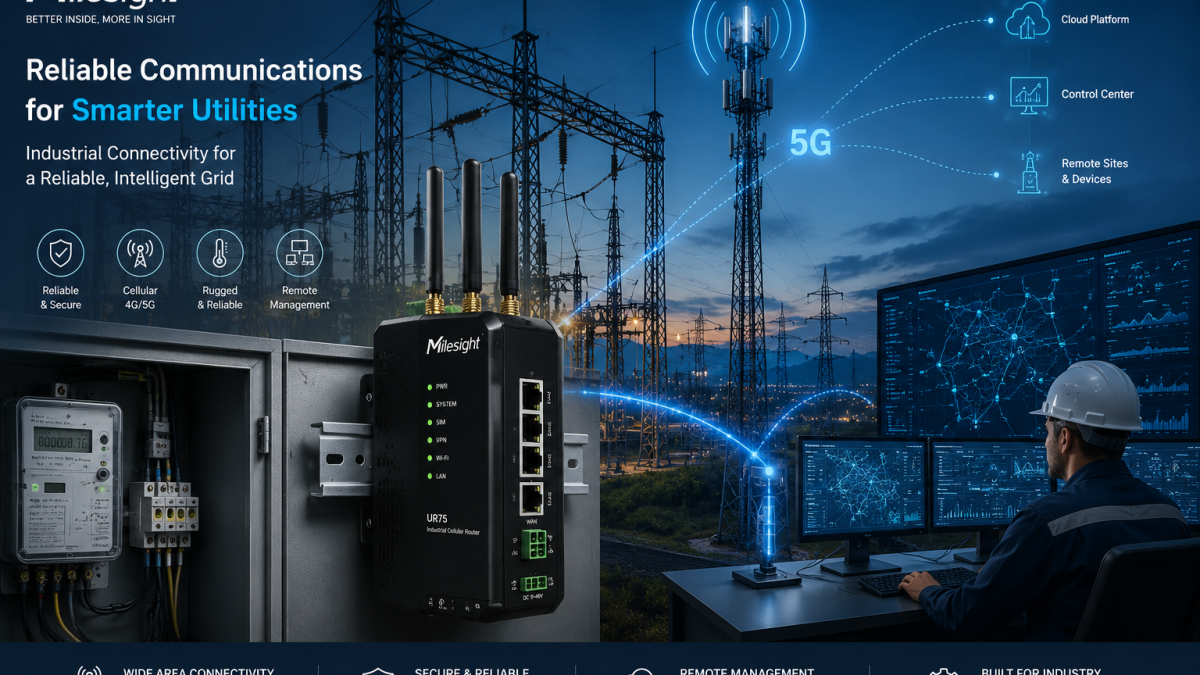
Reliable Data Communications for the Utility Industry – How Milesight Delivers
From secondary substations to utility-scale battery storage, grid operators need communications infrastructure that simply cannot fail. This guide covers how Milesight industrial hardware and platform tools meet those demands – with the resilience, security, and remote management that utility deployments require.
Why Utility Communications Cannot Fail
The utility sector operates under a constraint that very few industries share: the cost of a communications outage is not measured in inconvenience or lost revenue alone. When a secondary substation goes dark on the SCADA network, protection relays become unmonitored. When a battery energy storage system loses its control comms, grid operators lose the ability to dispatch, curtail, or protect the asset. When a wind farm collection network drops off a telemetry platform, the maintenance team is flying blind on turbine faults.
Regulators in the UK measure interruption minutes. Ofgem tracks customer interruptions and customer minutes lost as primary distribution network operator performance metrics. Every minute a fault is undetected because the comms network was down is a minute that counts against those figures. That context explains why utility procurement teams specify industrial-grade networking hardware and reject consumer or light-commercial equipment, regardless of price advantage. The tolerance for failure is effectively zero.
The same logic applies to cybersecurity. UK utility operators are in scope for the NIS (Network and Information Systems) Regulations and the NCSC Cyber Assessment Framework. BESS assets that can export to the grid are subject to the ENA’s Engineering Recommendations. These frameworks impose concrete technical requirements – network segmentation, encrypted communications, patch management, incident logging – that network hardware must support. Again, consumer-grade equipment does not make the cut.
24/7 Uninterrupted Comms
Field devices must stay visible to the control centre at all times. Dual-SIM failover across different mobile network operators is the baseline for any unattended site.
Long Operational Life
Utility assets run for 15-20 year cycles. Industrial routers and gateways are designed and rated for the same timescales – not consumer refresh cycles.
Regulatory Cybersecurity
NIS, CAF, and ENA requirements demand stateful firewalls, encrypted tunnels, network segmentation, and auditable change management as standard.
Centralised Management
Operating hundreds of field devices across a distribution network demands centralised provisioning, monitoring, alerting, and remote firmware management – not site-by-site access.
Cellular Connectivity for Secondary Substations and Grid-Edge Sites
The most cost-effective and rapidly deployable comms path for secondary substations, remote switching stations, and grid-edge BESS sites in the UK is cellular. Installing new fibre to a rural distribution substation can cost tens of thousands of pounds and take months to provision. A well-specified cellular router with dual SIM – on verified, independently tested mobile network operators – gets a site connected within hours and delivers a level of WAN redundancy that a single fibre connection structurally cannot match.
The key requirement at these sites is not raw bandwidth. DNP3 SCADA traffic over TCP, IEC 60870-5-104, and Modbus TCP are all modest in terms of data volume. What matters is tunnel stability, consistent low latency, and – critically – the behaviour of the failover mechanism when the primary WAN path goes down.
UR35 – Dual SIM 4G LTE with Serial SCADA Integration
The UR35 is the workhorse cellular router for unattended utility site deployment. It combines dual-SIM LTE resilience with the RS232 and RS485 serial interfaces that direct RTU and protection relay integration demands, in a DIN-rail mountable package rated for industrial environments.
- Dual SIM with automatic failover – configure on different MNOs for genuine WAN diversity, not just carrier redundancy
- RS232 and RS485 serial interfaces for direct RTU connection via Modbus RTU or DNP3 serial without a separate serial server
- IPsec IKEv2, OpenVPN, and WireGuard VPN with tunnel persistence across failover events
- Stateful firewall with per-interface rules and VLAN segmentation – SCADA traffic isolated from management plane from first boot
- Digital inputs and outputs for out-of-band alarm triggering – cabinet door open, temperature sensor trip, UPS on battery
- Operating temperature -40 to +70 degrees C – suitable for outdoor ground-mounted cabinets without active cooling
- SMS alerting on WAN path change, signal degradation, or device reboot for immediate NOC visibility
UR75 – Dual SIM 5G with Multi-WAN Aggregation
Where primary substation backhaul, BESS control systems, or high-availability aggregation points demand more than 4G can provide, the UR75 moves to 5G NR while retaining full 4G LTE fallback. It is also the right choice where a hybrid cellular-plus-Ethernet WAN topology is needed – for example, a leased line primary with 5G on hot standby.
- 5G Sub-6GHz NR with 4G LTE fallback – protects investment as 5G coverage extends across UK infrastructure corridors
- Dual SIM across 5G and 4G for maximum carrier flexibility as network operator coverage maps evolve
- Ethernet WAN port for hybrid fibre-plus-cellular or DSL-plus-cellular WAN architectures
- Multi-WAN load balancing and policy-based failover with configurable health check timers
- Full VPN suite – IPsec, OpenVPN, WireGuard, GRE – with site-to-site and hub-and-spoke topologies
- SNMP v1/v2c/v3 for integration into existing NOC monitoring infrastructure
- Remote management via Milesight DeviceHub – fleet-wide visibility, configuration push, and firmware management
For guidance on SIM selection, MNO verification, and multi-SIM strategy for utility deployments, see the industrial SIM cards section and the guide to multi-network SIM options for IoT and M2M.
Data Communications for Renewable Power Generation
Wind and solar sites present a networking challenge that is distinct from substation connectivity. Individual generation assets – turbines, inverter strings, power conversion systems, tracker controllers – are distributed across a site that may cover several square kilometres. Each needs to report generation data, fault codes, and control status back to a site-level SCADA or SCADA-equivalent platform. That platform then needs a reliable WAN path to the grid operator, the asset manager, or both.
The site collection network is typically a combination of wired Ethernet for fixed equipment – switchrooms, inverter skids, battery blocks – and some form of wireless connectivity for distributed assets where cable runs are impractical. Ring topologies are common in wind farm electrical design, and the data network often mirrors the ring architecture to provide resilience against a single cable fault isolating a section of the site.
Compact Cellular for Remote Generation Assets
UR32 – Compact Dual SIM 4G for Space-Constrained Installations
Turbine base cabinets, solar combiner enclosures, and remote monitoring kiosks often have very limited space for communications equipment. The UR32 delivers the same dual-SIM 4G resilience and serial interface capability as the UR35 in a significantly smaller form factor, without compromising on industrial ratings.
- Compact DIN-rail mount – suitable for installation alongside protection and control equipment in tight panel layouts
- Dual SIM with MWAN failover – primary and secondary MNO on standby with configurable switchover criteria
- RS232/RS485 serial port for Modbus RTU sensor integration – inverter data, tracker position, string monitoring
- Digital input for external alarm forwarding – cabinet temperature, door status, flood sensor
- Low power draw – relevant where the site communications cabinet is on a monitored auxiliary supply budget
- Same VPN and firewall capability as larger UR-series models
Distributed Sensor Monitoring with LoRaWAN
Beyond the SCADA and control layer, there is a growing requirement on renewable sites for dense environmental and condition monitoring – soil temperature and moisture sensors for ground-mounted solar, vibration monitors on turbine main bearings, equipment temperature logging on battery modules. Deploying Ethernet or cellular to each individual sensor point is impractical at scale. This is the problem LoRaWAN was designed to solve.
LoRaWAN operates on sub-GHz licence-exempt spectrum. A single gateway with a modest antenna installation can cover several kilometres of open ground, collecting data from hundreds of battery-powered sensors. The sensors themselves can run for years on coin cells or small solar cells. The data rates are low – suitable for periodic readings and alerts, not video or high-frequency waveform capture – but that is exactly what environmental monitoring requires.
UG65 / UG67 – Industrial LoRaWAN Gateways for Site-Wide Monitoring
The UG65 and UG67 act as the collection layer for LoRaWAN sensor networks across a generation site, aggregating data from end devices and forwarding to a central platform via wired Ethernet or cellular backhaul. The UG67 adds an integrated LTE modem, making it self-contained for locations where Ethernet infrastructure is not available.
- 8-channel LoRaWAN concentrator with support for Class A, B, and C devices across the full sensor range
- Coverage radius of 2-5km in open terrain – one gateway can cover a large solar field or wind farm collection area
- UG65: Ethernet backhaul for panel or switchroom mounting with existing network connection
- UG67: Integrated LTE modem as standalone cellular-plus-LoRaWAN unit for remote locations
- Built-in LoRaWAN network server for standalone local operation, or packet forwarding to cloud platforms
- IP67 enclosure for direct outdoor mounting on poles, turbine towers, or solar frame structures
- Supports Milesight sensor range including temperature, door/contact, current transformers, and vibration monitors
For a full overview of how LoRaWAN fits within a utility IoT architecture, including frequency planning and network server options, see the LoRaWAN technology guide.
The Management Layer: Milesight DeviceHub and Development Platform
Industrial hardware resilience solves the physical connectivity problem. Operating a distributed fleet of that hardware at scale – across dozens of substations, BESS sites, and generation assets – requires a management and integration layer that most utilities do not want to build themselves. This is where Milesight’s platform capabilities become as important as the hardware specification.
The two relevant components are DeviceHub – Milesight’s cloud-based device management platform – and the Milesight Development Platform, a low-code integration and application environment that allows operators to build monitoring dashboards, alert workflows, and data pipelines without writing infrastructure code from scratch.
DeviceHub provides centralised visibility and control of the full Milesight router and gateway estate. Key capabilities for utility fleet management include:
- Real-time device status across the full fleet – online, offline, signal strength, active WAN path, VPN tunnel state
- Remote configuration push – update firewall rules, VPN parameters, or APN settings across hundreds of devices without site visits
- Over-the-air firmware management with scheduled update windows and rollback capability
- Alert rules for connectivity loss, signal degradation below threshold, device reboot events, and WAN path changes
- Configuration templates for consistent and auditable provisioning of new sites – relevant to EPC contractors deploying BESS or solar sites at volume
- Audit log of all configuration changes – supports NIS compliance evidence requirements
For a detailed look at the Milesight Development Platform and how it can be used to build custom monitoring and integration applications on top of the hardware estate, see the full post: Milesight Development Platform – Building IoT Applications Without Starting From Scratch.
Cybersecurity – Built In, Not Bolted On
The NIS Regulations require operators of essential services – which includes electricity distribution and large-scale generation – to implement appropriate and proportionate technical and organisational measures to manage risks to network and information systems. The NCSC’s Cyber Assessment Framework translates this into four objectives: managing security risk, protecting against cyber attack, detecting cyber security events, and minimising the impact of incidents. These are not aspirational standards. They are the framework against which Ofgem and the relevant competent authorities will assess compliance.
Milesight industrial routers ship with the features this framework demands as standard capability, not optional add-ons requiring additional licensing.
Network Segmentation
VLAN support across all interfaces. SCADA traffic, management traffic, and corporate access kept on separate logical networks from initial deployment. Attack surface minimised by design.
Encrypted Tunnels
IPsec IKEv2, OpenVPN, and WireGuard all supported. SCADA and telemetry traffic travels encrypted between field site and control centre. No plaintext protocol exposure on the public cellular network.
Stateful Firewall
Per-interface and per-port firewall rules. Unused ports and services can be closed at first boot. Inbound access restricted to specific source IP ranges – typically the control centre VPN concentrator only.
Remote Patch Management
Firmware updates delivered via DeviceHub without site visits. Software currency maintained across a large distributed fleet – a requirement under both NIS and NCSC guidance on vulnerability management.
For a broader discussion of cellular security considerations in industrial and utility deployments, including SIM-level security and private APN options, see the security section and the guide to private APN for isolated IoT connectivity.
A Reference Architecture for BESS and Secondary Substation Sites
Pulling the hardware and platform elements together, a complete Milesight-based communications architecture for a utility-scale BESS site or secondary substation would typically be structured as follows.
Reference Architecture – BESS / Secondary Substation
- Primary WAN: Milesight UR35 or UR75 with SIM 1 on a primary MNO – LTE or 5G depending on local coverage – carrying an IPsec or WireGuard tunnel to the control centre or VPN concentrator. All SCADA and telemetry traffic flows through this encrypted tunnel.
- Secondary WAN: SIM 2 on a different, independently verified MNO on hot standby. MWAN-style policy routing monitors primary path health and switches within seconds. The VPN tunnel endpoint presented to the SCADA application remains stable throughout – no session interruption, no DNP3 master reconnect required.
- Optional third path: Ethernet WAN port connected to a DSL or leased line circuit for sites where dual cellular redundancy alone is insufficient for the criticality level. Three-path MWAN provides protection against both carrier-level and backhaul-level failure.
- Serial SCADA integration: RS485 on the UR35 for direct RTU connection via Modbus RTU or DNP3 serial, or local Ethernet to an IED Ethernet gateway where the RTU has an existing IP interface.
- UPS: 4-6 hour battery backup covering the router, any switches, and the RTU. Communications remain available through the supply interruption events that the cellular link was installed to report on – a circular dependency that UPS provision resolves.
- Environmental and access monitoring: Milesight LoRaWAN sensors for cabinet temperature, door contact, and flood detection where the site topology suits wireless sensor deployment. UG65 gateway in the main switchroom aggregates sensor data.
- Fleet management: All devices enrolled in Milesight DeviceHub. Comms-loss alerting configured with sub-60-second detection. Remote firmware management and configuration audit trail maintained for NIS compliance evidence.
This architecture supports the communications requirements of the ENA Engineering Recommendation for controllable BESS assets (ER G99 and the associated Tactical Solution framework) and provides the evidential basis for CSRB registration and NIS competent authority review. It can be deployed by a competent systems integrator within a single site visit for initial commissioning, with all subsequent management handled remotely.
Choosing the Right Milesight Router for Your Application
The UR-series covers a broad range of deployment scenarios. A quick selection guide for utility applications:
- UR32: Space-constrained cabinets, turbine base enclosures, solar monitoring kiosks – where physical footprint is the primary constraint and 4G LTE dual-SIM suffices
- UR35: Standard secondary substation, BESS site, or remote switching station deployment – the most widely deployed model in utility applications, balancing interface density with compact form factor
- UR75: Primary substation backhaul, high-availability aggregation points, hybrid fibre-cellular topologies, or sites requiring 5G capability for future-proofing
- UG65/UG67: Site-level LoRaWAN gateway for environmental monitoring, access monitoring, and condition-based maintenance sensor networks
Full specifications, ordering codes, and antenna options for all Milesight router models are covered in the Milesight industrial routers section. Antenna selection guidance for utility cabinet and outdoor pole mounting is in the antenna and RF guide.
Specifying Milesight for Utility Applications
Whether you are specifying connectivity for a single substation or a portfolio of BESS and generation assets, the pages below will have what you need.
Related reading