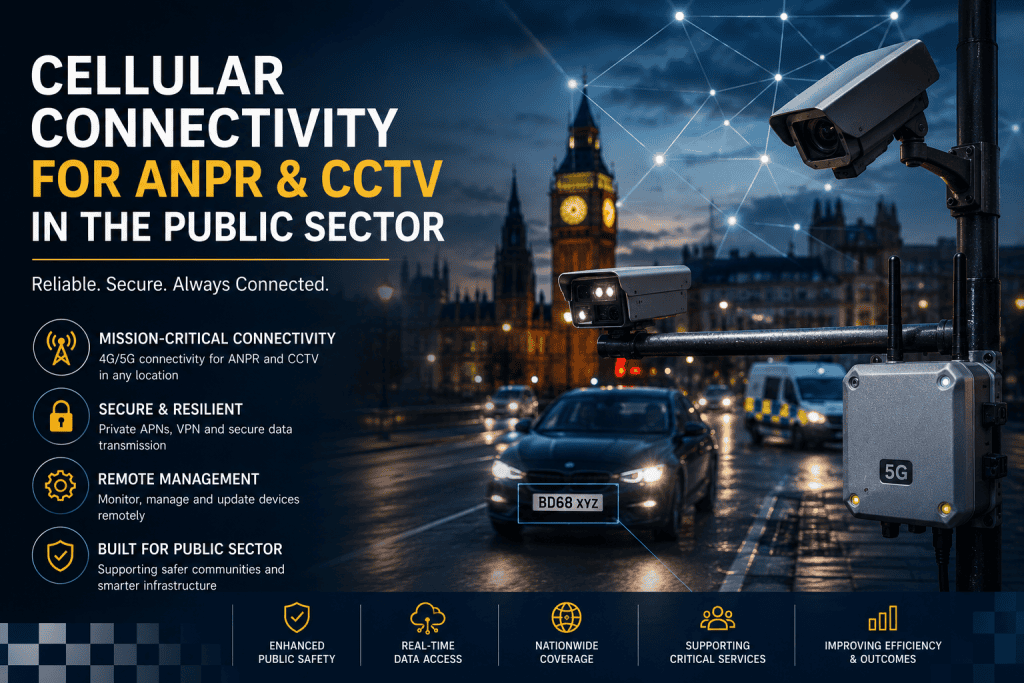
Public Sector / ANPR / CCTV / Smart Cities
4G and 5G Cellular Connectivity for ANPR and CCTV: The Complete Infrastructure Guide for Public Sector Deployments
ANPR cameras, CCTV systems, mobile surveillance towers, and traffic enforcement infrastructure all depend on reliable, secure data connectivity. For public sector organisations – police forces, local authorities, highways agencies, and their systems integrators – getting that connectivity right determines whether a camera estate operates as designed or becomes a management burden. This guide covers the connectivity architecture, hardware, and security considerations for cellular-connected surveillance infrastructure in 2025 and beyond.
Why Cellular Has Become the Default for ANPR and CCTV Backhaul
ANPR and CCTV camera deployments have traditionally relied on fixed network infrastructure – leased lines, ADSL, and increasingly fibre – for backhaul connectivity. That model works well for cameras in city centres or on established road infrastructure where network access points are available nearby. It does not work well for the growing proportion of ANPR and CCTV deployments that are remote, temporary, or in locations where installing fixed infrastructure is impractical or prohibitively expensive.
Cellular connectivity has closed that gap. 4G LTE is now available across the vast majority of UK road and motorway networks, with 5G coverage expanding rapidly on major routes and in urban areas. A cellular-connected camera requires no civil engineering, no wayleave negotiation, and no dependency on a telecoms provider’s installation schedule. The router goes in the cabinet, the SIM goes in the router, and the camera is online.
Beyond deployment speed, cellular offers something fixed connectivity cannot: inherent flexibility. A CCTV tower deployed for a major sporting event can be redeployed to a different location the following week. A temporary ANPR deployment for a road closure operation can be set up in hours and recovered when the operation ends. A fixed leased line cannot follow the camera. A multi-network IoT SIM can.
The shift from fixed to cellular backhaul has been underway for a decade – the Surrey Police and Surrey County Council joint ANPR and CCTV deployment, which used 3G/4G cellular connectivity to unify a county-wide camera estate across two organisations with different data requirements, demonstrated the model in 2018. Since then, 4G coverage has improved, hardware has matured, and 5G is now a practical option for high-bandwidth surveillance on major routes. The question for procurement teams today is not whether to use cellular but how to specify it correctly.
ANPR Connectivity: What the Data Pipe Actually Needs to Carry
Understanding what an ANPR system transmits over its cellular connection helps specify the router and SIM correctly. ANPR cameras generate several distinct data types, each with different bandwidth, latency, and reliability requirements.
ANPR reads and plate data
The core ANPR function – capturing, processing, and transmitting number plate read data – is relatively low bandwidth. A single ANPR read event typically comprises the recognised plate string, timestamp, GPS coordinates, camera ID, and a compressed still image of the vehicle. At typical traffic volumes, this generates a continuous but modest data flow – comfortably within 4G LTE capacity at even moderate signal levels. Where reads need to reach the National ANPR Service (NAS) or a police force data hub, the connection must be consistently available: a missed read during a connectivity gap is an operational failure.
Overview CCTV video feed
Many ANPR installations include a co-located CCTV camera providing a wider scene overview – capturing vehicle body, colour, occupants, and direction. This is where bandwidth requirements increase materially. A standard HD (1080p) CCTV stream at moderate compression requires 2-4 Mbps. An H.265-encoded stream can achieve comparable quality at 1-2 Mbps. Multiple cameras at the same location multiply this accordingly. 4G LTE with a strong signal comfortably supports two to four simultaneous HD streams; 5G removes bandwidth as a constraint entirely for most fixed camera sites.
Live monitoring vs recorded footage retrieval
The bandwidth requirement profile differs significantly between continuous live monitoring – where a control room operator views feeds in real time – and recorded footage retrieval, where footage is pulled back on demand following an incident. Live monitoring requires sustained bandwidth throughout the viewing period. Footage retrieval is a burst requirement – high bandwidth for a short period, tolerant of some delay. Understanding which mode dominates the traffic profile for a given deployment determines whether the cellular connection needs to be specified for sustained throughput or peak burst performance.
Management and configuration traffic
Remote management – firmware updates, configuration changes, health checks, and diagnostic access – adds a small but operationally critical data flow. This traffic needs to reach the router and camera even when the primary data path is congested or degraded. Specifying out-of-band management capability – where the management channel is separated from the data channel – ensures that a heavily loaded camera site can still be managed remotely without dropping live feeds.
Data pooling for multi-camera estates: For local authorities or police forces managing dozens or hundreds of cameras, data pooling across SIMs – where a single aggregated data allowance is shared across the camera estate – prevents individual cameras with atypical traffic patterns (live monitoring during a major incident, for example) from causing unexpected overages. This is a procurement point to raise with any IoT SIM provider when specifying connectivity for a multi-site camera estate.
Milesight Industrial Routers: The Case for a Unified Camera Estate Platform
One of the operational lessons from large public sector camera estates is the cost of heterogeneous hardware. When ANPR cameras, CCTV cameras, mobile towers, and fixed installations all run on different routers from different manufacturers, the management overhead – different firmware update cycles, different management interfaces, different VPN implementations, different support contracts – becomes significant at scale.
Milesight’s industrial cellular router range addresses this by providing a consistent platform across deployment types, from compact single-camera installations through to multi-port 5G routers powering large roadside cabinets. All models run common firmware, are managed through the same Milesight DeviceHub cloud platform and MilesightVPN remote access system, and share the same industrial-grade specifications: -40°C to +70°C operating range, IP30 metal housing, wide-voltage DC input (9-48V), and the full suite of VPN protocols including WireGuard, OpenVPN, IPsec, and GRE.
The Milesight router range for surveillance infrastructure
UR32 / UR32L
Compact 4G – Single Camera and CCTV Tower Deployments
The UR32 series covers simple, space-constrained installations – a single ANPR camera in a compact roadside housing, a CCTV tower with one or two cameras, or a temporary deployment where size and weight matter. Dual SIM, two Ethernet ports, wide-voltage DC input. The UR32L is the most compact option; the UR32 adds RS232/RS485 serial and DI/DO for integration with ancillary equipment such as traffic signals or barrier controllers.
UR35
4G Cat 12 Pro – Fixed Multi-Camera Cabinet Installations
The UR35 is the established mid-range Milesight 4G router for fixed infrastructure deployments. Five Ethernet ports, dual SIM, optional PoE output across all four LAN ports (4x 802.3af/at, covering 15-30W per port), RS232 and RS485, DI/DO, and optional GNSS. PoE output from the router itself eliminates the need for separate PoE injectors, reducing cabinet complexity and component count. The -40°C to +70°C operating range and IP30 hardened enclosure make it suitable for roadside cabinet installations across UK climate conditions.
UR75
5G SA/NSA – High-Bandwidth and Future-Proof Installations
The UR75 is Milesight’s flagship 5G industrial router. 5G Sub-6GHz with SA and NSA mode support, theoretical downlink of 4.67 Gbps, Wi-Fi 6 dual-band, dual SIM, RS232/RS485, DI/DO, and GNSS. The PoE variant (UR75-504AE-P-W2) adds 802.3af/at PoE output across all four LAN ports – 30W per port, 60W total – making it the correct choice for powering IP cameras, access points, or LoRaWAN gateways directly from the router. Node-RED support enables local data processing and protocol conversion without a separate edge server.
UF51
5G Outdoor – IP67 for Pole-Mount and Exposed Installations
The UF51 is Milesight’s outdoor-rated 5G router – IP67 ingress protection, -40°C to +70°C, designed for pole-mount or direct outdoor installation where a cabinet is absent or impractical. Relevant for exposed roadside ANPR positions, bridge-mounted cameras, or CCTV tower toppers where the router needs to sit outside a protective enclosure. Dual SIM, serial ports, DI/DO, and GNSS included.
The full UR75 specification – including the PoE variant detail and a comparison of 5G SA vs NSA mode implications for UK networks – is covered in the Milesight UR75 guide on IoTPortal.
CCTV Towers and Mobile Surveillance: The Temporary Deployment Challenge
Mobile CCTV towers and temporary surveillance deployments represent the most demanding use case for cellular connectivity infrastructure – not because the technical requirements are uniquely complex, but because they combine several constraints simultaneously: no fixed power, no fixed network, rapid deployment timelines, varied and sometimes challenging coverage environments, and the need for centralised management across an estate that changes composition regularly.
Power architecture for tower deployments
CCTV towers typically run on generator, mains temporary supply, or increasingly battery-plus-solar. The router needs to tolerate the power supply environment at the deployment site. Milesight routers accept 9-48V DC input, making them compatible with 12V and 24V battery systems common in tower deployments. Wide-voltage DC input also provides tolerance for the voltage variation that characterises generator and battery supply rather than stable mains.
Antenna specification for variable coverage environments
A tower deployed at a fixed roadside location has a known radio environment that can be surveyed before installation. A tower moved between operational deployments may encounter very different coverage conditions at each location. External antenna options – MIMO 4G/5G antennas on adjustable mounts – allow signal optimisation at each deployment site. Milesight routers use SMA connectors compatible with the full range of external antenna options, including high-gain directional antennas for sites with marginal coverage in one specific direction.
Remote management across a mobile fleet
A fleet of mobile towers, each at a different location, managed by a small operations team – this is the scenario where centralised remote management delivers its highest value. Milesight DeviceHub provides a single management interface across all deployed routers: live connectivity status, data usage per device, remote configuration, firmware updates, and alert notifications when a device goes offline or exceeds usage thresholds. Without this capability, managing a mobile tower fleet means physical visits to every site for every configuration change – an operational model that does not scale.
Dual-SIM resilience for unattended deployments
A CCTV tower in the field with no on-site staff cannot have its connectivity restored manually if the primary SIM loses signal. Dual-SIM routers with automatic failover to a second network operator maintain connectivity through single-MNO outages without any human intervention. For unattended deployments where the purpose is continuous surveillance coverage, connectivity resilience is not optional – it is a design requirement.
Connectivity Architecture for Public Sector Camera Estates
The Surrey Police and Surrey County Council model – a unified camera estate with shared connectivity infrastructure managed centrally – remains the reference architecture for public sector ANPR and CCTV deployments. The technology has moved on significantly since 2018, but the architectural principles remain sound: private network paths for sensitive data, fixed IP addressing for direct camera management, data pooling across the estate for cost efficiency, and a single management platform across all connected devices.
Private APN for police and law enforcement data
ANPR read data transmitted to police force systems or the National ANPR Service carries sensitive law enforcement information. Routing this over the public internet – even encrypted – is an unnecessary risk and may conflict with force information governance policies. A private APN creates a dedicated, isolated network path from each SIM card through the mobile core to the force data hub, bypassing the public internet entirely. Every camera on the private APN is assigned a fixed private IP address, is not publicly routable or discoverable, and can only communicate with authorised endpoints defined in the network policy.
Separate APNs for council traffic and police data
In shared infrastructure deployments where a local authority and police force share camera hardware but have different data governance requirements – as in the Surrey model – separate private APNs for the two traffic types provide network-level separation without requiring separate hardware. The council’s traffic management data goes via the council’s APN to the council’s traffic management platform. The police ANPR read data goes via the force’s APN to the force data hub. One router, two SIMs on two APNs, two isolated data paths. This is the architecture that makes collaboration between organisations with different information governance requirements operationally viable.
Fixed IP SIMs for camera management
Every router in the camera estate should have a fixed IP address on the management network. Fixed IPs enable direct access to each router’s management interface via VPN without DNS dependency, allow firewall allowlists based on known source and destination IPs, and make it straightforward to correlate connectivity health data with specific physical locations. Dynamic IP addressing in a large camera estate creates significant management complexity – tracking which SIM currently has which IP, maintaining VPN configurations for devices whose addresses change, and correlating monitoring alerts with physical locations.
MilesightVPN for secure remote access
Remote access to cameras and associated equipment behind a Milesight router – for configuration, diagnostics, or firmware updates – should go through an encrypted VPN tunnel, not a public internet management interface. MilesightVPN provides authenticated tunnelled access to any device in the router’s LAN, using an authentication code system that works regardless of whether the SIM has a fixed public IP. For a camera estate managed by a small IT team spread across multiple sites, this is the difference between being able to manage the estate remotely and having to physically visit each site for every maintenance task.
DeviceHub for fleet-wide management
Milesight DeviceHub provides centralised management across the entire router estate – live status, connectivity health, data usage per device, remote configuration, and bulk firmware updates. For a public sector camera estate that may run to dozens or hundreds of units across multiple locations and operational contexts (fixed roadside, CCTV tower, mobile deployment), a single management platform is not a convenience – it is a baseline operational requirement. The ability to push a firmware update to 200 routers simultaneously, or to receive an alert when any device in the estate goes offline, is what makes large-scale camera connectivity operationally manageable.
NASP Compliance and Connectivity: What the Standard Requires
The National ANPR Standards for Policing (NASP) set requirements for ANPR camera systems used in or contributing data to UK policing. While NASP focuses primarily on camera performance, image quality, and data handling standards rather than connectivity specification, the connectivity layer has direct implications for NASP compliance in several areas.
Data integrity and transmission security
NASP requires that ANPR read data is transmitted securely and that data integrity can be demonstrated. End-to-end encryption between the camera and the receiving platform – provided by VPN tunnelling combined with private APN connectivity – is the standard architecture for meeting this requirement. Any connectivity architecture that allows read data to traverse the public internet without encryption falls short of the security standard that NASP compliance implicitly requires for police data.
Audit trail and timestamping
NASP requires accurate timestamping of ANPR reads. GPS-derived time synchronisation on the router – available on Milesight routers with the optional GNSS module – provides accurate, network-independent time to cameras and associated equipment, ensuring that reads are timestamped correctly regardless of whether NTP access is available at a given moment.
System availability
Camera availability requirements under NASP create an implicit uptime requirement for the connectivity layer. A camera that is offline due to a connectivity failure is not contributing to operational coverage. Dual-SIM connectivity with automatic failover, combined with hardware watchdog functionality that automatically recovers the router from software faults, provides the availability foundation that NASP system requirements demand from the broader camera infrastructure.
5G for ANPR and CCTV: When Does the Upgrade Make Sense?
5G is not universally necessary for ANPR and CCTV connectivity – but there are specific deployment contexts where it changes what is practically achievable.
High-density multi-camera installations
A roadside installation with four or more cameras – ANPR, overview CCTV, incident detection, thermal – generating simultaneous HD streams represents a sustained bandwidth requirement that stretches 4G LTE under real-world conditions, particularly at sites with moderate rather than excellent signal. 5G’s significantly higher throughput removes bandwidth as a constraint, allowing the full camera complement to transmit simultaneously without compression compromises or prioritisation decisions.
Real-time AI analytics at the edge
Modern ANPR and CCTV systems increasingly run AI analytics at the edge – on the camera or a local edge compute device – generating structured event data rather than raw video streams for transmission. Where this analytics data needs to feed into real-time operational dashboards or incident management platforms with genuinely low latency, 5G SA (Standalone) mode’s lower network latency – typically sub-10ms compared to 30-80ms for 4G LTE – becomes operationally relevant.
Future-proofing a multi-year deployment
Camera infrastructure deployed in 2025 will likely be in service until 2035 or beyond. Camera resolutions will increase over that period. Analytics capabilities will expand. Bandwidth requirements will grow. A 5G router specified today – such as the Milesight UR75 – is not over-specification; it is future-proofing against a bandwidth trajectory that runs in one direction. The marginal cost difference between a 4G and 5G router is small relative to the total cost of a camera infrastructure deployment – and re-specifying connectivity hardware mid-life is significantly more expensive than getting it right at the outset.
Procurement Checklist: What to Specify for a Public Sector Camera Deployment
These are the connectivity infrastructure decisions that need to be resolved at procurement stage, before hardware is ordered and installations are scheduled.
- Fixed or cellular backhaul – or both? Where fixed connectivity is available and appropriate, a hybrid architecture with 4G/5G cellular failover provides maximum resilience without cellular cost for routine traffic.
- Private APN requirement? For any deployment carrying police or law enforcement data – ANPR reads, live feeds to police control rooms – private APN connectivity is the appropriate architecture. Confirm the SIM provider can deliver private APN with fixed IP at the required scale.
- Data pooling across the estate? For multi-site camera estates with variable per-site data consumption, pooled data across SIMs avoids overage on high-traffic sites while not over-provisioning low-traffic ones.
- PoE requirement? If the router needs to power cameras directly rather than using separate PoE injectors, specify a PoE-capable router variant (UR35 with PoE option, or UR75-504AE-P-W2) and confirm the per-port and total PoE budget against the connected camera power requirements.
- GNSS/GPS requirement? Mobile and temporary deployments benefit from GNSS for accurate location tagging and GPS-derived time synchronisation. Specify the GNSS option on the router if this is required.
- Management platform integration? Confirm how the router fleet will integrate with the organisation’s wider infrastructure monitoring. Milesight DeviceHub provides fleet management natively; SNMP and TR-069 support allows integration with existing network management platforms.
- Operating environment specification? Confirm the installation environment for each deployment type – cabinet, pole-mount, outdoor exposed – and match the router variant and ingress protection rating accordingly. The UF51’s IP67 rating covers fully exposed installations; IP30 covers enclosed cabinet deployments.
Frequently Asked Questions
What cellular connectivity do ANPR cameras need?
ANPR cameras transmit plate read data, still images, and often co-located CCTV video feeds over cellular backhaul. The core ANPR read data flow is modest in bandwidth terms – well within 4G LTE capacity – but video feeds from co-located CCTV cameras add material bandwidth requirements. For police ANPR data, private APN connectivity with fixed IP addressing is the appropriate architecture, keeping read data off the public internet and providing secure, addressable connections to each camera site.
Which Milesight router is best for ANPR and CCTV deployments?
For fixed multi-camera roadside installations, the Milesight UR35 (with optional PoE) is the established choice – five Ethernet ports, dual SIM, PoE output for powering cameras directly, RS485 for ancillary equipment integration, and a -40°C to +70°C operating range. For high-bandwidth or future-proof deployments, the UR75 moves to 5G with Wi-Fi 6 and a higher-specification PoE variant. For compact single-camera or CCTV tower installations, the UR32 series covers the application at lower cost. For exposed outdoor installations without a cabinet, the UF51 provides IP67-rated 5G connectivity.
What is a private APN and why do police forces use it for ANPR?
A private APN creates a dedicated mobile network path that keeps data off the public internet, routing it directly from the SIM card through the mobile core to the organisation’s own infrastructure. For police ANPR data, this means read data and plate images never traverse the public internet, devices are not publicly addressable or discoverable, and network-level controls can restrict communication to authorised endpoints only. It is the standard connectivity architecture for law enforcement data on cellular networks.
How do CCTV towers connect to cellular networks?
CCTV towers use an industrial cellular router – typically mounted in the tower’s equipment enclosure – connected to the cameras via Ethernet or PoE, with SIM cards providing the wide-area cellular data path. The router handles dual-SIM failover for connectivity resilience, VPN tunnelling for secure data transmission, and remote management access via a platform like Milesight DeviceHub. Wide-voltage DC input (9-48V on Milesight routers) makes the router compatible with generator, battery, and solar power systems common in tower deployments.
Is 5G necessary for ANPR and CCTV connectivity?
4G LTE is sufficient for the majority of current ANPR and single or dual camera CCTV deployments. 5G becomes relevant for multi-camera high-definition installations generating sustained bandwidth above 10 Mbps, for deployments running real-time AI analytics requiring sub-10ms latency, and for future-proofing infrastructure with a multi-year operational life. The Milesight UR75 provides 5G capability at a cost differential over 4G hardware that is modest relative to the total deployment cost.
Can a single router serve both council CCTV and police ANPR data?
Yes, using a dual-SIM router with separate SIMs on separate APNs – one for council traffic data and one for police ANPR data. Each SIM routes its traffic through the appropriate private APN to the relevant organisation’s infrastructure, providing network-level isolation between the two data flows while sharing a single hardware installation. This is the architecture used in several UK police and local authority collaboration models, including the Surrey deployment.