The last big signal blackspot in London is closing
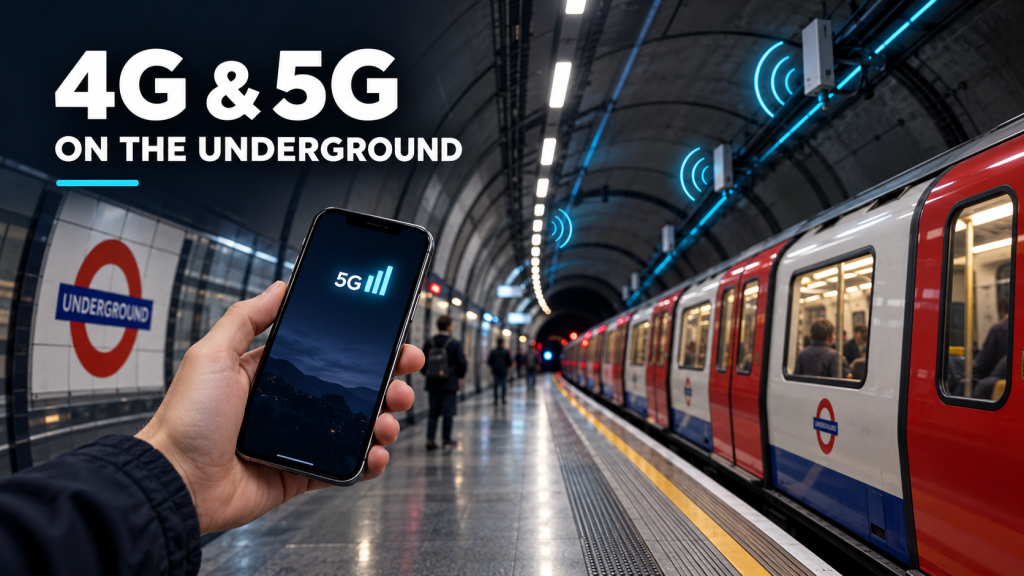
For most of its 160-odd years, the London Underground has been the one place in the capital where your phone simply gave up. That is changing fast. Transport for London (TfL) and its infrastructure partner Boldyn Networks are in the final stretch of putting 4G and 5G into every below-ground station and tunnel, with more than 60 per cent of the 121 below-ground Tube stations live by August 2026 and the whole network targeted for the end of the year.
It is two years later than first promised. The original goal was end of 2024. I am not going to knock them for that. Anyone who has tried to get a signal into a single basement plant room knows how quickly “a quick install” becomes three site visits, and this is 121 stations and miles of tunnel, built a few hours a night. The delay is part of the story, because the Tube is the most extreme version of a problem I have watched IoT engineers fight for 25 years: getting a radio signal somewhere the network was never designed to reach.
This piece starts with how the Tube is actually being done, then follows the same questions down into underground car parks, EV chargers, tunnels and mines. Who builds the coverage, who pays for it, how the signal gets there, and what happens to voice calls and connected devices once it does.
The short version: underground coverage never happens by accident. Every bar of signal below ground was put there deliberately by someone who paid for it. The Tube is the billion-pound version. A basement car park is the few-hundred-pound version. The physics is the same; what changes is who owns the radio.
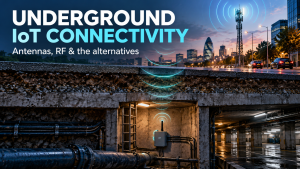
If you are here for the device-level detail (antenna placement, coax loss, manhole lids, IP and IK ratings), our underground IoT connectivity guide covers that in depth. This article is about the infrastructure above the device.
What is actually being built on the Tube
Boldyn holds a 20-year concession from TfL, signed in 2021, to build mobile infrastructure across the Underground, the DLR and the Elizabeth line. Coverage is also being extended to the underground sections of the DLR and the Windrush line between Highbury & Islington and New Cross.
The build is done in the hours when trains are not running. TfL and Boldyn say more than 600 engineers work through the night during engineering hours. Ticket halls and platforms come first, then the tunnels between stations, so passengers stay connected as the train moves rather than reconnecting at each stop.
Not every line is equal. The deep-level lines (Northern, Victoria, Piccadilly, Jubilee, Bakerloo) are tight tubes bored through London clay. The sub-surface lines (Circle, District, Metropolitan, Hammersmith & City) are shallower cut-and-cover tunnels, and some of their stations already had a little signal leaking down from the street. TfL had to run tests to make sure the new kit would not interfere with the sub-surface lines’ own systems before coverage could start there, which is one reason those lines came later.
The key design choice is that there is one system, not four. Every UK operator rides on Boldyn’s shared infrastructure, and Boldyn recovers its investment through access charges paid by the operators rather than each network funding its own underground build. That is the neutral-host model, and it is the template for almost every large shared space you will come across, from stadiums and shopping centres to hospitals and big car parks.
For me this settles an argument that has run for years. People talk about underground coverage as if the networks ought to provide it, the way they cover the high street. They will not, and frankly they cannot, because building below ground four times over for four operators never stacks up. The Tube works because one company built it once and charges everyone to use it.
Boldyn and TfL are also putting small cells on TfL street assets such as lighting columns to thicken coverage in busy areas above ground. The same company is building above and below the pavement.
Is it actually any good?
Early measurements suggest it is. Telecomlead reported median underground 4G signal strength of around -96 dBm, slightly better than the -98 dBm median above ground across London. That should not be a surprise: underground there is no competition from buildings, trees and weather, and the antennas are a few metres from your phone rather than a few hundred.
The same report is careful to say this does not prove the Underground is faster than outdoor 5G everywhere. Signal strength is not the same as capacity, and a packed Northern line carriage at 8.30am is a very different load from an empty platform at midnight. The real test is a wet Monday rush hour in January, and I would want to see those numbers before anyone declares victory.
The part nobody mentions: the emergency services
The passenger story gets the headlines, but the Underground build is also critical public-safety infrastructure. In April 2026 Boldyn was selected to deliver the 4G infrastructure for the Emergency Services Network (ESN) across the 137 below-ground Tube, DLR and Overground stations, with EE providing the ESN service.
That matters well beyond London. ESN is the planned replacement for the ageing Airwave radio system, and it runs over commercial 4G. Wherever ESN needs to work underground, someone has to build the coverage. The Tube shows that a single neutral-host system can carry public mobile networks and blue-light services in the same tunnels.
Do you need VoLTE underground?
Yes, and this is the part of the story I care most about, because it is where the Tube connects directly to every underground IoT project in the country.
The new Underground system is a 4G and 5G build. There is no 2G or 3G down there to fall back on, and nationally 3G has already gone. On a 4G-only network, an ordinary phone call has to be carried as Voice over LTE (VoLTE), or VoNR on 5G standalone. If the phone, the SIM or the network settings do not support VoLTE properly, the device shows full bars of 4G, browses happily, and cannot make or receive a call.
For passengers with older or imported handsets, that is an annoyance. Before the build, the only way to call from a platform was station Wi-Fi with Wi-Fi Calling switched on. For devices, it can be a safety problem. Think about everything underground that makes or receives voice calls:
- Lift emergency autodiallers in station and car park lift shafts
- Help points and emergency phones in underground car parks
- Alarm diallers in plant rooms and basements
- Barrier and pay station intercoms
Much of that kit was designed for analogue lines or 2G. Moving it onto cellular in a space that only has 4G and 5G means it must do VoLTE, and do it on the network it is actually connected to. A device that only supports VoLTE on one operator’s profile will fail silently if it roams onto another. I have seen this more times than I can count: a router or dialler that passes every data test on the bench, gets signed off, and then cannot make a call the first time someone actually needs it.
The trap: four bars of 4G tells you nothing about voice. Test an actual call from the installed position, on the SIM and network the device will use in service, before you sign anything off.
We cover why this happens in What is VoLTE?. For the deep detail, our sister site VoLTEsim covers the things nobody tells you about 4G calling and VoLTE in routers and IoT.
From the Tube to the car park
Most underground spaces will never get a Boldyn. A 300-space basement car park under an office block, a hospital multi-storey or a residential development is too small for a neutral host to build a full system on spec. So the owner, the tenant or the device installer has to solve it themselves.
Underground car parks are where this is getting urgent, because of what is being installed in them:
- EV chargers. A charger that cannot reach its back office cannot authorise a session, take payment or report faults. Most use a cellular modem, often with a single-operator SIM.
- ANPR and barrier systems. Ticketless parking depends on the camera talking to the cloud in real time.
- Pay stations and help points. Card payments need data; help points need voice.
- Ventilation, CO monitoring and lighting controls. Often part of the building management system.
- Lift autodiallers. Moving off analogue lines as the PSTN is withdrawn.
Each of those can be solved device by device, or the whole space can be given coverage. That is the real decision, and in my experience nobody makes it. The EV charger installer solves the chargers, the parking contractor solves the barriers, the lift company solves the lift, and the car park ends up with five separate workarounds and still no signal for the people using it.
Antennas, repeaters, outdoor routers or a full system?
There are broadly five ways to get a connection underground. They are not interchangeable, because they solve different problems. Some connect a device. Some connect people.
| Approach | What it connects | Operators | Who installs | Best fit |
|---|---|---|---|---|
| External antenna on the device | One device | Whatever the SIM uses | Installer | Short distance to usable signal |
| Outdoor router at street level, Ethernet or PoE down | Fixed devices on the cable | Whatever the SIM uses | Installer | Chargers, cameras, BMS, anything wired |
| Ofcom-compliant indoor repeater | Phones and devices in range | All operators on the bands it covers | Owner or installer | Small to medium spaces with a good donor signal nearby |
| Distributed antenna system or small cells | Everyone in the building | Usually all, by agreement | Neutral host or operator | Large venues and sites |
| Private LTE or 5G | Your own devices only | Your own network | Specialist integrator | Mines, tunnels, industrial sites |
Move the radio, not the RF
For fixed equipment, my default answer is to put an outdoor-rated router where the signal is good, at the top of the ramp or on an external wall, and bring Ethernet down to the kit. Coax loses signal with every metre; Ethernet does not care. With PoE, one cable carries power and data. I would rather run 60 metres of Cat6 than 15 metres of coax every time. Our guide to outdoor 5G routers covers the hardware side.
The limitation is that it only connects things on the cable. It does nothing for the driver trying to use a parking app at the bottom of the car park, or for a help point that needs voice from a mobile handset.
Repeaters are legal again, if you buy the right one
Repeaters have a bad reputation in the UK, much of it earned by cheap boosters sold online that interfere with the networks. I spent years telling customers not to touch them. But the rules changed, and I have had to update my own advice. In May 2022 Ofcom widened the range of static indoor repeaters people can buy and install without a licence. Before that, only repeaters that boosted one operator at a time were allowed. Now repeaters can boost more than one operator, provided they meet Ofcom’s technical requirements. Anything that does not meet them remains illegal.
Ofcom publishes a list of models it understands meet those requirements, having been tested by an accredited test house. It stresses this is not an endorsement. At the time of writing the list includes:
| Manufacturer | Models on Ofcom’s list |
|---|---|
| Huaptec (HiBoost) | Hi10-3S-Pro, Hi10-4S-Pro, Hi10-5S-Pro |
| Multiboost | Multiboost PRO UK, PRO Triple UK, PRO Dual UK |
| Nextivity (Cel-Fi) | G41-9E, Quatra 4000e, Connect C41, Quatra Evo |
| StellaDoradus Europe | StellaHome repeater SD-RP1002 |
| Wilson Connectivity | Wilson Pro 5143 U |
StellaDoradus, based in Waterford, is a good example of how these work in practice. Its UK kits amplify by frequency band rather than by operator, so a repeater covering a given band boosts every network using that band in the area. That makes a compliant multi-band repeater a genuine multi-operator option for a basement or car park, which a single-network device on a single-operator SIM can never be.
Check before you buy: Ofcom warns that adverts for illegal devices often claim they are approved. Check the model against Ofcom’s current list, buy from a reputable supplier, and if in doubt ask Ofcom’s market surveillance team before installing.
The catch underground is the donor signal. Ofcom says repeaters work best where there is a good outdoor signal to boost. At the bottom of a car park there usually is not, so the donor antenna has to go up to street level, and you are back to cable runs and penetrations. At that point it is worth asking whether the people in the space need coverage (repeater) or only the equipment does (outdoor router). Sometimes the answer is both.
When the space is big enough for someone else to build it
Large shopping centres, stadiums, hospitals and transport hubs are increasingly covered by distributed antenna systems or small cells, built by a neutral host or an operator. That is a commercial negotiation, not a product. If you are installing IoT kit in a venue that already has one, find out before you design your own solution. You may be able to use it, and you will certainly need to avoid interfering with it.
Single-operator SIMs are the hidden risk
There is a quiet interaction between the coverage approach and the SIM in the device. Below ground, coverage can vary enormously between operators, depending on which bands reach which corner and where the donor signal comes from.
- In a neutral-host space like the Tube, it does not matter much. Every network is carried.
- Behind a single-operator repeater, only that operator works, and a device on another network sees nothing.
- Behind a multi-operator repeater, the bands decide. A network whose signal only arrives on a band the repeater does not cover will still be missing.
A multi-network IoT SIM, or an eSIM that can switch profiles, gives an underground device a better chance of finding whichever network made it down the stairs. If I were specifying an EV charger for a basement tomorrow, a single-operator SIM would be the first thing I changed. Our sister site multinetworksim.com covers how those work.
Beyond the car park: tunnels, mines and the rest
Once you look for it, a surprising amount of the UK’s infrastructure sits below ground. Each case has its own owner and its own answer.
Road, rail and utility tunnels
Long, linear spaces are where cable along the length of the tunnel earns its keep, carrying coverage continuously rather than from a few antennas. It is the approach CERN took in the Large Hadron Collider tunnels, which we covered in how CERN keeps LHC tunnel monitoring connected. Tunnel operators generally care about emergency service radio and operational systems first, and public mobile coverage second.
Mines and quarries
Mining is where private networks make most sense. A mine needs coverage for its own vehicles, sensors, cameras and people, wherever the working face happens to be this month, and it has no interest in public subscribers. Private LTE and 5G, often using Ofcom’s shared access licences, give the operator control over coverage, capacity and security. Older sites still run on leaky feeder radio, and many will run both for years. Explosive atmospheres add another layer of rules, covered in our piece on connectivity in hazardous areas.
Basements and plant rooms
The commonest underground space of all, and the one that gets the least thought. Building management systems, boiler controls, fire panels and energy meters all live there. Coverage-enhanced LTE-M and NB-IoT will often reach where a phone shows nothing, because they trade speed for reach. See LTE-M: three IoT problems it was built to solve.
Utilities below the street
Water, sewer and gas networks are full of chambers that need a few bytes a day, reliably, for years. Some utilities are looking at private networks or low-band spectrum for exactly this reason. We look at the options in private cellular networks for utilities, and our sister site lte450.co.uk covers the 450 MHz argument.
Four questions to ask before you design anything
| Question | Why it decides the design |
|---|---|
| Does it need data, voice, or both? | Voice on 4G means VoLTE; test a real call, not just signal bars |
| Is it for devices, people, or both? | An outdoor router connects devices; a repeater or DAS connects people |
| One operator or all of them? | Decides between single-network kit, multi-operator repeaters, multi-network SIMs or a neutral host |
| Does someone already own the coverage? | A venue’s existing system may solve it, and you must not interfere with it |
The Tube is late, expensive and still not finished, and it is also one of the most impressive pieces of mobile infrastructure in Europe. Scale it down and you have every underground car park in the country. Somebody has to decide who the coverage is for, who pays for it, and whether the kit down there can still make a phone call when it needs to. Get those three answers first and the hardware choice usually makes itself.