Amazon Leo and IoT: What 396 Satellites Actually Mean for M2M Deployments
Amazon's constellation is real, Ofcom-approved and close to UK service. But the network that launches this year is not the one that will connect your IoT devices.
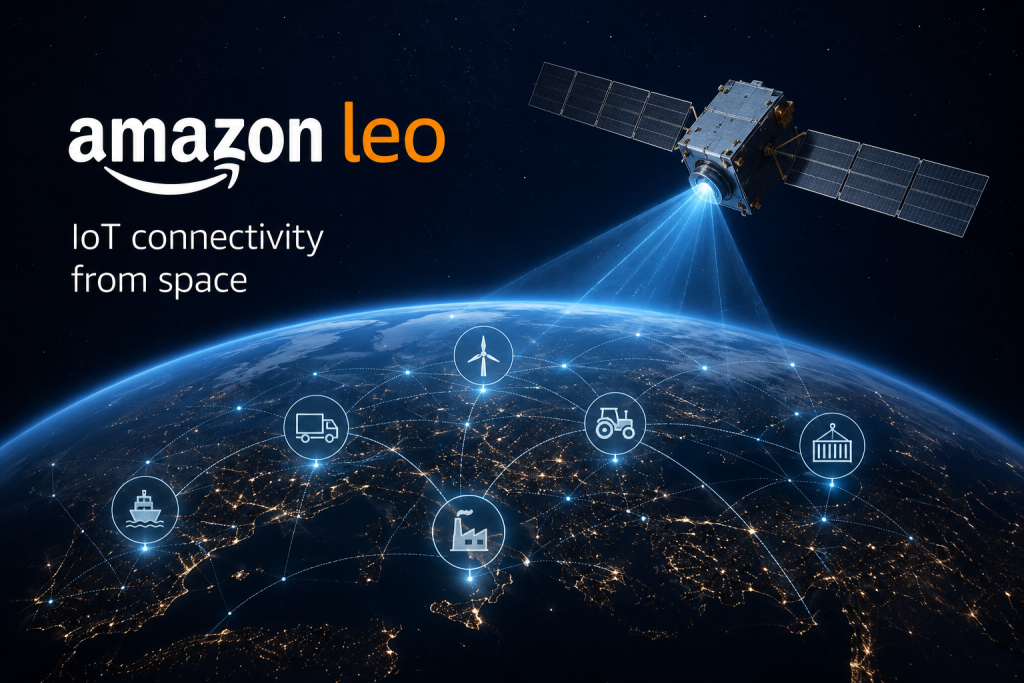
Amazon Leo, formerly Project Kuiper, is a Ka-band broadband constellation. It connects sites, not sensors. For IoT it is best understood as backhaul for remote gateways and routers. Direct-to-device connectivity for cellular endpoints arrives later, via Amazon's acquisition of Globalstar and its L-band and S-band spectrum, and will not be commercially meaningful before 2028.
What Amazon Leo is, and what it is not
Amazon retired the Project Kuiper name on 13 November 2025 and adopted Amazon Leo as the permanent identity of its low Earth orbit network. The constellation is licensed by the FCC for 3,236 satellites across three orbital shells at 590km, 610km and 630km. Following an Atlas V launch on 2 July 2026 carrying 29 satellites, Amazon reports 396 units in orbit. Starlink, for context, operates around 10,400.
That gap matters less than the architecture. Leo is a Ka-band system. Customer connectivity depends on a phased-array terminal with a clear view of the sky, and Amazon has published three: Leo Nano, Leo Pro and Leo Ultra, spanning an advertised 100 Mbps to 1 Gbps. Every one of those is a dish. None of them is a modem you solder onto a sensor board.
This is the single most common misreading of the Leo story in IoT circles. A constellation being in low Earth orbit does not make it a device network. The frequency band, the link budget and the antenna gain required at the endpoint decide that, and Ka-band at 27 to 30 GHz decides firmly against battery-powered endpoints.
Leo Nano is not an IoT module
The Nano naming invites the assumption that Amazon has built something for constrained devices. It has not. Nano is the entry-tier customer terminal in the broadband range. Treat it as a smaller dish, not as an alternative to an NB-IoT or LTE-M module.
Where Leo fits an IoT architecture today
The useful role is backhaul. Consider the deployments where cellular coverage is the binding constraint: reservoir telemetry in mid Wales, offshore and coastal assets, upland renewable sites, rail infrastructure in cuttings, temporary construction compounds. In each case the endpoints are fine. They speak Modbus, LoRaWAN or short-range cellular to a local gateway. What fails is the gateway's route to the internet.
A Leo terminal on a mast, feeding an industrial router's WAN port, solves that. The router keeps its cellular SIM as failover, or the reverse. This is the same design pattern engineers already build with Starlink, and it demands nothing new from the endpoint estate. If you are already running a dual-WAN industrial router, adding a second satellite provider is a procurement decision, not an engineering one.
What Leo adds is competitive tension. Ofcom granted Amazon approval to offer satellite internet in the UK in February 2025, followed by an NGSO gateway licence for a ground station at Bude in Cornwall, operating in Ka-band. An enterprise preview began in November 2025. Amazon has said UK service will roll out during 2026, initially constrained to certain latitudes and widening as the constellation fills. Two credible LEO providers in a market that has had one is worth more to buyers than any single spec sheet line.
| Layer | Amazon Leo today | What IoT actually needs |
|---|---|---|
| Spectrum | Ka-band, 27-30 GHz | Sub-6 GHz for endpoints |
| Endpoint | Phased-array terminal | Embedded module, chip antenna |
| Power | Mains or substantial DC | Battery, years of life |
| Payload | Broadband, Mbps to Gbps | Kilobytes per day |
| Role | Site backhaul | Device connectivity |
The Globalstar acquisition is the real IoT story
On 14 April 2026 Amazon announced a definitive merger agreement to acquire Globalstar for a reported sum in excess of $11.5bn. The stated purpose is to add direct-to-device services to future generations of the Leo network. Globalstar brings 24 satellites, but the satellites are not the asset. The asset is globally harmonised L-band and S-band MSS spectrum, already licensed across multiple jurisdictions.
That spectrum is what allows a satellite to talk to an unmodified handset, and by extension to a cellular IoT module. It is the same spectrum behind Apple's Emergency SOS via satellite since the iPhone 14. Under the agreement, Amazon Leo will power Apple's satellite services, with reporting indicating a 2028 start.
Acquiring licensed spectrum rather than pursuing new ITU allocations compresses a five to ten year regulatory timeline into a transaction. Globalstar's own investor materials describe the deal as accelerating direct-to-device rollout across consumer, enterprise, IoT and government segments. For once the corporate language points at something real.
The correct planning assumption for 2026 and 2027 is that Amazon Leo is a backhaul option. Treat Leo D2D as a 2028 and beyond capability. The merger is expected to close in 2027, and the D2D payloads ride on future satellite generations, not the 396 currently in orbit.
How this changes NTN planning
Anyone tracking non-terrestrial networks has spent two years watching 3GPP NTN standardisation, operator satellite partnerships and the emergence of NB-IoT NTN. The Amazon move does not invalidate that work. It adds a well-capitalised entrant that has chosen to buy spectrum rather than wait for it.
Practically, three implications follow for anyone specifying connectivity now.
First, do not delay a deployment waiting for satellite D2D. The endpoints you ship in 2026 will be retired before Leo D2D reaches useful density. Specify terrestrial cellular, use multi-network SIM where coverage is marginal, and revisit in three years.
Second, design gateways with WAN flexibility. A router that accepts an Ethernet WAN alongside its cellular interface keeps the satellite option open regardless of which constellation wins. Our router classifications guide covers the hardware tiers where this is standard.
Third, watch the spectrum, not the satellite count. The number of objects in orbit is the headline figure. The band they transmit in determines what can receive them.
Frequently asked questions
Can Amazon Leo connect IoT sensors directly?
No. Amazon Leo currently operates in Ka-band and requires a phased-array customer terminal. Direct connection to cellular IoT modules depends on the direct-to-device system built from Globalstar's L-band and S-band spectrum, which is not expected to be commercially available before 2028.
Is Amazon Leo available in the UK?
Ofcom approved Amazon Leo to offer satellite internet in the UK in February 2025 and later granted an NGSO gateway licence for a ground station at Bude, Cornwall. An enterprise preview began in November 2025. Amazon has stated wider service will begin during 2026, with coverage initially limited by latitude.
What is the difference between Amazon Leo and Project Kuiper?
They are the same programme. Amazon retired the Project Kuiper codename on 13 November 2025 and rebranded to Amazon Leo. The FCC licence, the 3,236 satellite constellation and the orbital shells at 590km, 610km and 630km are unchanged.
Should I choose Amazon Leo or Starlink for IoT backhaul?
As of July 2026, Starlink is the only LEO service with general commercial availability and mature terminal supply in the UK. Amazon Leo has regulatory approval but limited service. For deployments going live this year, Starlink is the practical choice. Re-evaluate on contract renewal.