Contents
- The need never changed
- Ding: the shop door that knew you had arrived
- The Teasmade: scheduled automation, British style
- X10, mains intercoms and powerline: the network in your walls
- The Clapper, the dog and the false positive
- Gateshead, 1984: the television becomes a terminal, and a target
- The Coke machine, the coffee pot and the toaster
- The serious side: alarms, telecare and telemetry
- 1999: somebody finally gave it a name
- Could you build a smart home in 1988?
- In 1985 the dog could break your smart home. In 2025, AWS did.
- What each generation was really solving
The history of IoT starts with a need that never changed
I have spent the better part of my working life connecting things to other things, mostly routers, modems and SIM cards in boxes bolted to walls in places nobody wants to visit. And the longer I do it, the more convinced I am that the history of IoT is not really a history of technology at all. It is a history of one sentence that people have been saying for a hundred years: I want that thing over there to do something, or tell me something, without me having to go over to it.
Everything else is implementation detail. A beam of light across a doorway, a clockwork alarm on a kettle, a pulse on the mains wiring, a clap, a finger command on a university mainframe, a GSM data call, an MQTT message to a cloud broker. Different decades, same sentence.
So rather than another "What is IoT?" explainer, I want to start an occasional series here called Before IoT, looking at the gadgets, hacks and unglamorous industrial systems that shaped the connected world we now take for granted. This first instalment is the overview: the greatest hits, what each one was really solving, and the surprisingly modern problems they ran into.
Ding: the shop door that knew you had arrived
1930s onwardsStart with the humblest sensor of all: the bell on a spring above a shop door. It is a mechanical event detector. The door moves, the bell rings, the shopkeeper in the back room knows someone has come in. No power, no wiring, and a failure mode everybody understood (the bell falls off).
The electric version arrived in the 1930s, when the photoelectric cell, or "electric eye", left the laboratory. General Electric was testing electric-eye automatic door openers for hospitals in 1931, and by the 1940s firms were selling compact photoelectric switches that shone a beam across a space to a mirror and back. Flip the same unit into intermittent mode and it worked like a doorbell, sounding a chime when a customer walked through the beam, or counting people and objects as they passed.

Look at what that box actually does: a sensor, a threshold, a relay, an output. Break the beam, close the contact, ring the chime. It is the same architecture as every footfall counter in every retail park today, except that the modern version usually has a time-of-flight or thermal sensor where the lamp used to be, and an MQTT publish where the chime used to be.
The part that did change is where the information goes. The 1940s chime told one person in one back room. The modern people counter tells a dashboard, which tells an area manager in another city how footfall compared with last Tuesday. That is the jump from automation to IoT in miniature: the event stops being local.
The Teasmade: scheduled automation, British style
1891 to the 1970sIf any object captures the British relationship with automation, it is the Teasmade. In December 1891 a Derby man called Samuel Rowbottom applied for a patent on an automatic tea-making apparatus driven by a clockwork alarm clock, a gas ring and a pilot light. Electric versions followed in the 1930s, and Goblin turned the idea into a household name, with the Teasmade reaching peak popularity in the 1960s and 70s.
The engineering is lovely. You set the alarm at night. At the chosen time the clock switches on the kettle element, steam pressure pushes boiling water through a tube into the teapot, and on the later models the shift in weight trips a switch that cuts the kettle and turns on the lamp and the alarm. Tea first, then wake-up. A timer, an actuator and a state change that triggers the next step.
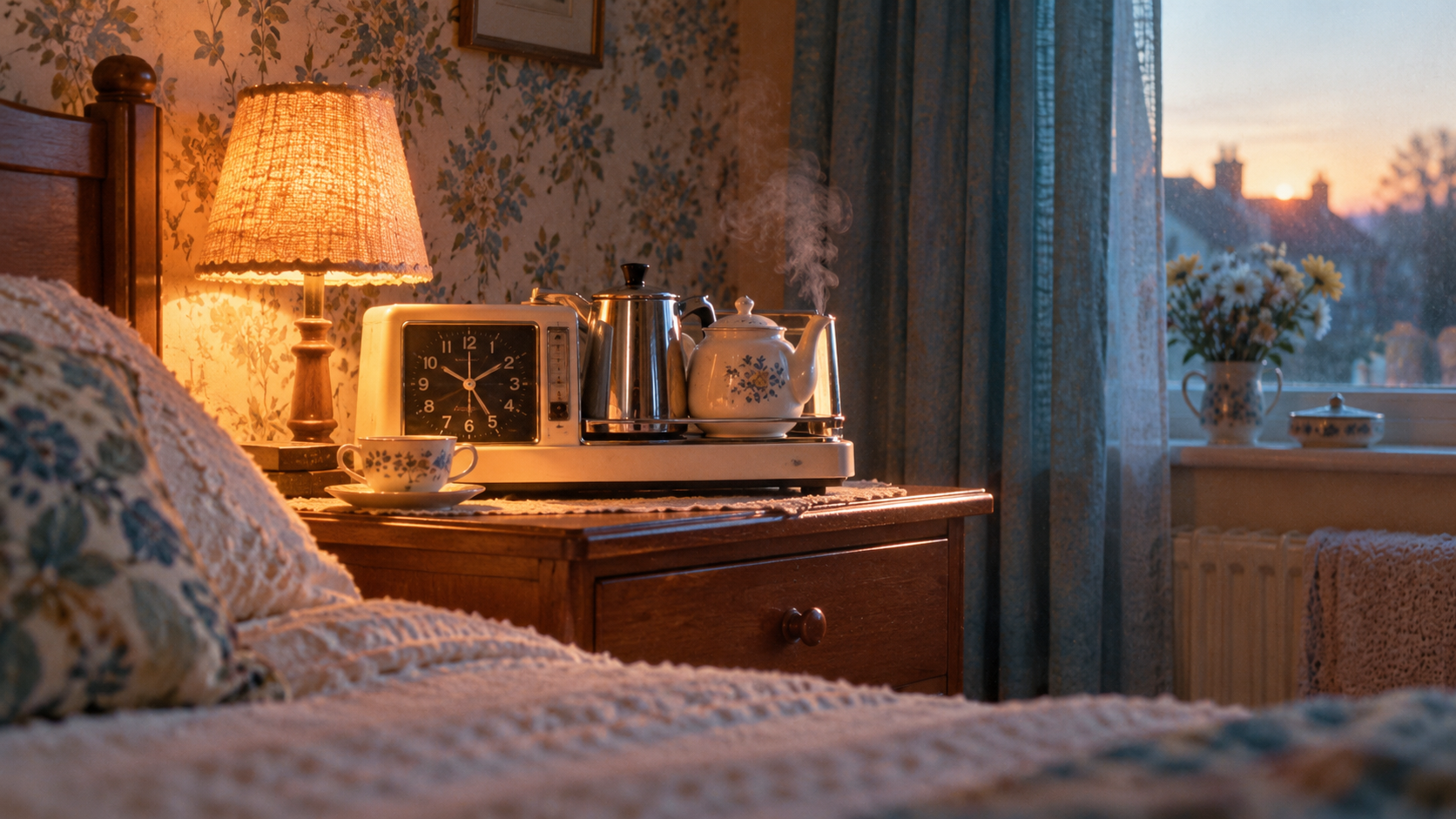
That is a scheduled automation rule, written in Bakelite and spring steel. Today we would write it as a routine in an app: at 06:45, switch on the smart plug, then fade the bedroom light up. The Teasmade did it with no network, no account and no firmware, and as far as I know it never once failed because a server in Virginia was having a bad morning.
Time-triggered automation is the oldest trick in the book and still the most reliable. A surprising amount of industrial IoT is a schedule with a network bolted on: read the meter at midnight, run the pump at off-peak, send the daily report at 06:00.
X10, mains intercoms and powerline: the network in your walls
1975Here is a fact I love telling people who assume the smart home is a Californian invention: the first general-purpose home automation network came from Glenrothes in Fife. A company called Pico Electronics, founded there in 1970, had made its name with single-chip calculator designs. In 1975 its engineers conceived a system for remote control of home appliances, and because it was their tenth project, they called it X10. Products started appearing in Sears and RadioShack in the US in 1978, through a partnership with the British turntable maker BSR.
X10 needed no new wiring, because it used the wiring every house already had. A controller injected short bursts of 120 kHz signal onto the mains at the moment the AC waveform crossed zero, which is the quietest point electrically. One bit per zero crossing. Each message carried a house code, lettered A to P, a unit code numbered 1 to 16, and a command such as on, off or dim. Plug a lamp module into the wall, set the two dials, and a timer or controller anywhere else in the house could switch it.
Buzz, talk, and the powerline adapter in your hallway
X10 was not the only thing riding on the mains. For years you could buy intercoms that needed no cable run at all: plug one unit into a socket in the kitchen and another in the workshop or the nursery, press the buzzer and talk. GE and Westinghouse were among the makers. They worked on the carrier-current principle: superimpose a radio-frequency signal on the house wiring and let the other unit pick it up from its own socket. The same idea ran whole student radio stations. A 1962 issue of Popular Electronics describes a university residence broadcasting AM over its mains wiring, with the signal stopping at the building's power transformer, which is exactly how the staff tracked down a pirate transmitter in one wing.

That transformer detail is the catch every powerline system shares. The signal goes where the wiring goes, so these intercoms were sold as most useful in homes and offices on a single electrical supply, and anything electrically noisy on the same circuit gets a say. If you ever heard a mains intercom crackle when an appliance switched on, you already understand powerline engineering.
Now look at the white plug-in adapters that so many of us use to get Ethernet to the far bedroom or the garden office. The HomePlug Powerline Alliance formed in 2000 and released HomePlug 1.0 in June 2001, at a peak physical rate of 14 Mbit/s. Powerline networking was standardised as IEEE 1901 in 2010, built on HomePlug AV, and HomePlug AV2 brought gigabit-class rates in 2012. Same copper, same sockets, and the same problem of sharing a wire designed for 50 Hz with signals millions of times faster. Same side effects too: powerline kit radiates, and in the UK the interference became a public argument, with GCHQ itself saying it could affect its monitoring of the radio spectrum.
From buzzing the workshop to networking the loft, the mains has been carrying information for most of a century. We just keep finding cleverer things to hide in it.
Strip away the beige plastic and X10 had everything we now associate with an IoT network: a physical layer, an addressing scheme, a command set, and devices from several brands that could talk to each other. What it did not have tells you just as much. There was no authentication, so anyone sharing the electrical supply could, in principle, send your house codes; filters were sold to stop signals leaking in and out. Most modules could not report back, so a controller sent "lamp on" and hoped. And it was slow, at around one bit per mains half cycle.
Every one of those weaknesses became a design goal for what came later. Security, acknowledgements and two-way status are exactly what Zigbee, Z-Wave, Thread and Matter set out to fix. Powering the endpoint from what is already there, as X10 modules did from the socket they sat in, is still the first question I ask on any remote job, and it is the theme of our guide to how to power remote IoT.
The Clapper, the dog and the false positive
Mid-1980sAnd so to the gadget that started this whole series. The Clapper is a sound-activated switch, and its origin story is far messier than the advert. It began as the Great American Turn-On, built on an acoustic switch patented in Canada in 1985 by Peter Liljequist and Kou Chen. It did not work very well. The marketer Joseph Pedott, whose Joseph Enterprises already sold Chia Pets, bought the rights and brought in the physicist Carlile Stevens and his colleague Dale Reamer to make it reliable. Renamed and relaunched with that unforgettable jingle, it became one of the most recognisable products of the decade. It was built for American sockets, so it is a US story, but the engineering lesson travels well.
The appeal is obvious. Clap twice, lamp on. No remote to lose, no instructions, nothing to learn. For an older person or anyone with limited mobility it was a genuine accessibility aid, and the company openly marketed it that way.

The problem is equally obvious to anyone who has owned one, or been in a room with one. The Clapper is not listening for a clap. It cannot know what a clap is. It listens for sharp sounds that arrive in the right pattern and timing, and anything that matches closely enough counts. A dog barking. A pan dropped on a tiled floor. Applause on the television. A slammed door. The bedside lamp comes on at 3am because the dog had a dream.
Before the Clapper, the clicker
The idea of commanding a device with a sound was already thirty years old when the Clapper arrived, and it came from the television. Zenith had sold a wired remote in 1950, aptly named Lazy Bones, with a cable trailing across the living room floor. In 1955 it tried light instead: the Flash-Matic was a torch you pointed at photocells in the corners of the screen. It worked, but changing light in the room could switch the set on or off by itself.
Then in 1956 Robert Adler's Space Command went back to sound. It had no batteries and no electronics at all. Pressing a button drove a tiny hammer onto an aluminium rod, each rod cut to ring at its own ultrasonic pitch, above human hearing. The television listened for those frequencies and treated each one as a command: on and off, mute, volume, channel. The click of the hammer is why a generation of people still call any TV remote "the clicker".
And it had the Clapper's problem first. Striking metal makes ultrasound, so in principle any metallic jingle near the set could be mistaken for a command, and accounts of the era describe a bunch of keys or loose change switching the television. Later ultrasonic remotes found another audience entirely: dogs and cats hear well into the ultrasonic range, so the household pet could hear the remote even when you could not.
Light, ultrasound and claps all failed the same way. Each receiver listened for a simple physical signature, and the real world kept producing that signature by accident. The fix that finally stuck, the coded infrared remote, did not get better hearing. It sent a pattern too specific to happen by chance. Modern IoT security and sensing still run on that idea.
That is a false positive, and it is the single most important engineering lesson in this entire history. The Clapper did event detection at the edge, with almost nothing between detection and action. Clap-like noise plus correct timing equals switch. Stevens and Reamer did improve it, adding a microchip that could tell different clap patterns apart so one unit could control two appliances (their patent was granted in 1996), but the fundamental limit remained: it was matching a pattern, not understanding an intent.
Forty years on, we are fighting exactly the same battle with far more computing power. A PIR sensor sees movement: intruder or the cat? A vibration sensor crosses its threshold: is the bearing failing, or did a forklift clip the frame? A camera with on-board AI sees a shape: person, shadow or wheelie bin? A voice assistant hears something that sounds a bit like its wake word in the middle of a TV drama. An industrial alarm fires because the plant is running in a perfectly legitimate but unusual state.
Modern IoT puts a great deal of intelligence between the microphone and the relay: filtering, classification, context, rules, and increasingly an AI model. That makes false positives rarer. It does not make them go away, and it raises a harder question the Clapper never had to answer: when a device decides on its own and gets it wrong, who owns the mistake? We went into that properly in our piece on edge AI failure ownership, and I would argue the Clapper is its spiritual ancestor.
The Clapper's problem was never hearing the clap. It was deciding whether the clap was meant for it. That is still the hardest problem in sensing.
One last Clapper detail, because it shows how old another modern headache is. In the 1990s an elderly user sued Joseph Enterprises, arguing she had hurt her hands clapping and that the product failed to warn her. Whatever you think of the claim, it is a very early example of a connected-home product discovering that the human using it is part of the system, and that the interface itself can be the failure point.
Gateshead, 1984: the television becomes a terminal, and a target
1974 to 1984Britain spent the 1970s and 80s quietly turning the television into a data terminal, and that story deserves more credit in any history of connected things. The BBC launched Ceefax on 23 September 1974, the world's first teletext service, carrying news, weather, sport and listings in spare capacity alongside the TV picture. It ran until the analogue switch-off on 23 October 2012. Anyone who waited for page 302 to come round again knows the feeling: a one-way data carousel, broadcast to everyone, picked up by whoever was listening. Engineers who work with broadcast telemetry and polling cycles will recognise that pattern instantly.
Then came two-way. In 1979 the English inventor Michael Aldrich connected a modified domestic television to a real-time transaction computer over an ordinary phone line, using videotex technology and a cheap chipset with a built-in modem and auto-dialler. In May 1984, as part of a Gateshead Council scheme to help housebound older residents, a 72-year-old grandmother called Jane Snowball sat in her armchair and used her television remote to order groceries from her local Tesco. She is now recognised as the world's first online home shopper.
I find Mrs Snowball's story genuinely moving, and very relevant to what we do. The technology was not built for early adopters. It was built because someone could not get to the shops, and it worked because it used things already in her home: the telly, the phone line and a remote control she already knew how to use. Aldrich later recalled that she loved it, but missed the chat at the shops. That is a lesson every telecare and assisted-living project has since had to relearn: automation can take the friction out of a task, and accidentally take the human contact out with it.
The television that knew where you were aiming
If teletext made the television talk back, the light gun made it feel like magic. Like a lot of people my age, I remember standing in front of a CRT with a plastic pistol and genuinely not understanding how the telly knew whether I had hit the duck. Home light guns go back further than most people think, with Nintendo and Magnavox both selling them in the early 1970s, but the one that lodged in everyone's memory was Nintendo's Zapper, launched in 1984 alongside Duck Hunt.

The trick is lovely, and it is backwards from what you would assume. The gun does not fire anything. It has a light sensor behind the barrel and a cable back to the console. When you pull the trigger, the game blacks out the whole screen for one frame, then draws a solid white box where each target is, one target per frame. The gun simply reports dark or light. If it saw light on the frame where the duck's box was drawn, you hit the duck. Every flash lasts a single refresh of the picture, so you never notice it happen.
Two details make it a proper IoT story. First, the black frame is a security check. The famous playground cheat was to aim at a light bulb and pull the trigger; a gun that only checks for light would score a hit every time, so games verify that the gun sees darkness when it should and light only when it should. That is challenge and response, decades before anyone applied the phrase to connected devices. Second, the whole system depends on timing. It counts on the image appearing at a known instant, which a CRT drawing its picture line by line delivered reliably. A modern flat panel processes the image first and adds a delay the game never expected, which is why the Zapper does nothing on most modern televisions. Change one component's latency and a perfectly designed system stops working. Anyone who has watched a field device time out after a firmware update will recognise that one.
The Coke machine, the coffee pot and the toaster
1982 to 1993If you ask an engineer for "the first IoT device", you will usually get one of three answers, and all three were born of thirst, hunger or idleness.
The Carnegie Mellon Coke machine, 1982
Graduate students in the computer science department at Carnegie Mellon University were tired of walking to the department Coke machine only to find it empty, or freshly loaded with warm bottles. So Mike Kazar, David Nichols, John Zsarnay and Ivor Durham fitted micro-switches to the machine's columns and wired them to the department's PDP-10. A program tracked how many bottles were in each column and how long they had been in there. Then they hooked it into the finger service, so typing "finger coke@cmua" from any connected computer, including anywhere on the ARPANET, told you whether a cold Coke was waiting. It went live in 1982, and it is routinely cited as the first internet-connected appliance.
The Trojan Room coffee pot, Cambridge, 1991
Nine years later and much closer to home, around fifteen researchers at the University of Cambridge Computer Laboratory shared one filter coffee machine in the corridor outside a room called the Trojan Room. Colleagues on other floors kept climbing the stairs to an empty jug. In 1991 Quentin Stafford-Fraser and Paul Jardetzky pointed a camera at the pot, fed it through a frame grabber on an Acorn Archimedes, and wrote software that put a small greyscale image on everyone's screen, updated about three times a minute. In November 1993, once browsers could show images, Daniel Gordon and Martyn Johnson put it on the web, and the coffee pot became one of the most watched objects on the early internet. The camera was switched off in August 2001 when the lab moved, and the pot sold on eBay for £3,350.

The internet toaster, 1990
At the Interop show in 1989, organiser Dan Lynch dared network engineer John Romkey to bring a toaster up on the net, promising it pride of place the following year. Romkey, working with Simon Hackett, rigged a Sunbeam Deluxe Automatic Radiant Control toaster so that power could be switched on over TCP/IP using SNMP, the same management protocol used for routers. The toaster had essentially one control: on. How dark the toast came out depended on how long the power stayed on. At Interop 1991 they added a small crane, also network controlled, to drop the bread in.
Notice the order. The Coke machine and the coffee pot only reported status; the toaster added control. Read came before write, and it still should. On any new deployment I would rather see a month of reliable telemetry before anyone is allowed to send a command.
The toaster also contains a detail I think about a lot. Romkey reused SNMP rather than inventing a toaster protocol. He treated the appliance as just another managed device on a network that already knew how to manage devices. That instinct, to use the standards and tooling the network already speaks rather than inventing a new silo, is exactly what good IoT design still looks like.
The serious side: alarms, telecare and telemetry
1957 to todayThe Coke machine gets the headlines, but if I am honest the real ancestors of the industrial IoT I work with every day are far less charming. They are alarm panels, warden call systems and telemetry outstations, and they have been quietly sending data over wires and radio links for decades.
Telemetry and SCADA
Utilities and pipeline operators were monitoring remote assets long before anyone said "connected". In the UK, Serck formed Serck Controls in 1959 to build electronic telemetry and telecontrol systems, and according to Schneider Electric, which now owns the business, it delivered its first pipeline SCADA system for Oil India in Assam in 1961. Pumping stations, reservoirs and substations reporting levels and alarms back to a control room over leased lines and radio: that is IoT in everything but name, and much of the vocabulary we still use, outstations, RTUs, polling, comes from that world.
Warden calls and telecare
Then there is the social side. Tunstall began in 1957 as a television repair shop near Doncaster, and grew into the company behind warden call systems that let older residents in local authority housing summon help. Tunstall says it was the first to send alarm calls over the public telephone network, and it launched the Piper Solo dispersed social alarm unit in 1982. The pendant on a cord, the base unit by the phone, the monitoring centre at the other end of the line: that is a sensor, a gateway and a cloud platform, built thirty years before cloud was a word.
Alarm diallers and Redcare
Intruder and fire alarms followed the same path. Panels gained auto-diallers that rang a monitoring centre, and BT Redcare spent more than thirty years as the UK's largest alarm signalling service, continuously monitoring the line so that a cut wire was itself an alarm. Its dual-path variant added a GSM link as a second route, which is where my own world comes in.
The cellular version of this story begins in the mid-1990s, when Siemens set up a team in 1995 to build a GSM data module, the M1, for machines rather than people; its successor business, now part of Thales, dates the M1 launch to 1996. Early uses were payment terminals, vehicle telematics and remote monitoring. When I started fitting GSM modems into cabinets, the job was usually to replace a phone line that was expensive, unreliable or simply not there. Today the SIM in the box can be reprogrammed remotely, as our IoT eSIM glossary entry explains, but the job is the same.
BT closed Redcare in 2025, and the UK's analogue phone network is in its final stretch, with the last PSTN lines scheduled to go in January 2027. Thousands of alarm diallers, telecare units, lift lines and telemetry outstations that have dialled out over copper since the 1980s and 90s are being moved to 4G and IP right now. If you manage any of them, the "before IoT" era is not history. It is your migration backlog.
1999: somebody finally gave it a name
1999For all of this history, the phrase itself is surprisingly recent, and British. Kevin Ashton, born in Birmingham, was working at Procter & Gamble in Egham, Surrey, trying to convince senior management to back RFID tags for tracking products through the supply chain. In 1999 he needed a title for his presentation that would get attention, so he linked his idea to the hottest word of the moment and called it "Internet of Things". He has said since that he wanted "internet" in there to get buy-in, and that "Internet for Things" would have made more grammatical sense.
His underlying point holds up remarkably well. Computers and the internet, he argued, knew almost nothing about the physical world except what people typed in, and people are slow, busy and inaccurate. Let things report on themselves. The CMU students had done precisely that for a Coke machine seventeen years earlier. Ashton gave it a name that could fit on a slide, and a name, it turns out, is what turns a collection of hacks into an industry.
Could you build a smart home in 1988?
Here is a fun exercise. Imagine a reasonably well-off, gadget-loving household in 1988, using only what you could actually buy. How smart could it get?
Lighting on a schedule
X10 lamp and appliance modules on a mains timer, so the lights come on at dusk and the house looks occupied while you are away.
Voice-free control
A Clapper by the bed, in houses with US sockets, and an infrared remote for everything with a screen.
Security that phones home
PIR sensors on an alarm panel with an auto-dialler calling a monitoring centre over the phone line.
Morning routine
A Teasmade on the bedside table, a programmable timer on the central heating, and the radio alarm.
Media automation
A VHS recorder with a timer, programmed (eventually) to catch the late film while you sleep.
Remote access
An answering machine you could ring from a phone box to hear your messages, and Ceefax for the news, weather and football scores.
X10 even sold an interface that let a home computer run the whole lot from a schedule. Seen through 1988 eyes, that house is astonishing. It has scheduled automation, remote presence simulation, monitored security, a personal media recorder and remote access to its own messages. What it cannot do is tell you anything about itself while you are out, combine its parts into one view, or be controlled from anywhere. The bits were all there. The joining-up was not.
And here is the uncomfortable flip side. Almost everything in that 1988 house worked when the phone line was down and kept working for decades. Plenty of the gadgets bought in 2016 are already bricks, because the company behind them shut a server.
In 1985 the dog could break your smart home. In 2025, AWS did.
I could not write this piece without the punchline. The Clapper's failure mode was annoying but local. The dog barks, the lamp comes on, you clap twice and go back to sleep. Nothing outside your bedroom could stop it working.
On 20 October 2025, a major outage in Amazon Web Services' US-East-1 region took down a huge range of services for several hours, and a lot of homes found out exactly how far away their light switches really were. Alexa stopped responding and Ring doorbells went offline. Most memorably, owners of Eight Sleep's cloud-dependent smart bed covers found their beds stuck at whatever setting was last active, with some overheating, until the company pushed out an "outage mode". Meanwhile, homes built around local control, such as Zigbee or Matter devices run from a local hub like Home Assistant, carried on as normal.
That comparison is a little unfair, and I know it. The cloud path buys you things the Clapper never could: control from anywhere, status you can trust, schedules that adapt, and a record of what happened. But it also shows the trade we have made without always noticing. Every step between the switch and the lamp is another thing that can fail, and in a cloud-first design most of those steps are owned by someone else.
In industrial IoT we learned this the hard way, which is why every serious deployment I see is built to keep doing its job when the backhaul drops: local logic on the router or gateway, buffered data, a safe default state, and the cloud as a supervisor rather than a single point of failure. The Teasmade and the X10 timer would have approved. Our AIoT security guide picks up the same argument for devices that now make their own decisions.
What each generation was really solving
If you strip the nostalgia out, every step in this story solved one problem and quietly created another. That is the real history of IoT, and I think it is the most useful way to read it.
| Era | Example | Problem it solved | Problem it created |
|---|---|---|---|
| 1930s to 40s | Electric-eye door chime | Knowing someone arrived without watching the door | Beams broken by the wrong things |
| 1930s to 70s | Teasmade, heating timers | Doing a task at a set time unattended | No awareness of whether anyone needed it |
| Then and now | Mains intercoms, powerline adapters | Talking and networking with no new cable | Range tied to one supply; radio interference |
| 1975 | X10 | Controlling appliances with no new wiring | No security, no acknowledgement, slow |
| 1950s to 80s | TV clicker, The Clapper | Getting up to reach the switch | False positives from the dog and the TV |
| 1980s | Videotex, Ceefax | Information and transactions without leaving home | Less human contact; one-way data |
| 1984 | NES Zapper light gun | Pointing at a screen as an input | Spoofing with a light bulb; tied to CRT timing |
| 1957 to 1990s | Telecare, alarm diallers, telemetry | Help and alerts over distance, around the clock | Dependence on copper lines now being retired |
| 1982 to 1993 | Coke machine, coffee pot, toaster | Checking status remotely before walking over | Everything on the network became reachable |
| Mid-1990s | GSM M2M modules | Connecting machines with no phone line | SIM, coverage and network sunset management |
| 2010s to today | Cloud smart home, IIoT platforms | Control and visibility from anywhere, at scale | Cloud dependency, lock-in, security exposure |
Read down the right-hand column and you get a pretty good checklist for designing an IoT system in 2026. False positives, security, acknowledgement, network retirement, lock-in and single points of failure. None of them are new. All of them were already biting somebody before the phrase "Internet of Things" existed.
So, did we make turning the lamp on easier?
After forty years, it is a fair question. In 1985 you clapped twice. In 2026, depending on your setup, you might unlock a phone, open an app, wait for it to reach a server, pick a room, pick a device and tap a button. Sometimes progress takes the scenic route.
But the honest answer is that turning the lamp on was never the hard part. What we actually gained is everything around it: knowing the lamp is on when you are not there, knowing the pump has stopped before the reservoir runs dry, knowing Mrs Snowball's groceries are on their way, knowing the pendant alarm was pressed and someone is already answering. That is the part worth building well, and the lesson from every gadget in this story is the same. Keep the essential action local and simple, make the clever bits optional, and design for the dog.
In the next instalments of Before IoT I want to go deeper into the systems that really built this industry: pagers, vending and utility telemetry, alarm diallers, early vehicle trackers and the GSM M2M modems that so many of us cut our teeth on. If you have a story, a photo of an old outstation or a dusty X10 module in a drawer, I would genuinely like to hear about it.
Frequently asked questions
What was the first IoT device?
There is no single agreed answer. The Carnegie Mellon University Coke machine, connected to the department network and the ARPANET in 1982 so students could check stock remotely, is most often cited as the first internet-connected appliance. John Romkey's internet toaster, controlled over TCP/IP at the Interop show in 1990, is often called the first internet-controlled device.
Who coined the term Internet of Things?
Kevin Ashton, a British technologist born in Birmingham, used the phrase as the title of a 1999 presentation at Procter and Gamble about using RFID tags to track products in the supply chain. He later co-founded the Auto-ID Center at MIT.
What was X10 home automation?
X10 was a home automation protocol conceived in 1975 by Pico Electronics of Glenrothes, Scotland. It sent short 120 kHz bursts over ordinary mains wiring at each zero crossing of the AC waveform, addressing devices by a house code from A to P and a unit code from 1 to 16. Products went on sale in the US from 1978.
Why did The Clapper turn on when the dog barked?
The Clapper did not recognise claps as such. It listened for sharp sounds arriving in a particular pattern and timing, so other sharp noises such as barking, dropped objects or applause on television could match closely enough to trigger it. This is an early example of a false positive in sensing.
Is the history of IoT older than the internet?
Yes. Remote sensing and control long predates the internet, from photoelectric door chimes in the 1930s and utility telemetry in the 1960s to X10 in 1975, telecare alarms over the phone network and the first cellular M2M modules in the mid-1990s. The internet added a common network and, from 1999, a name.