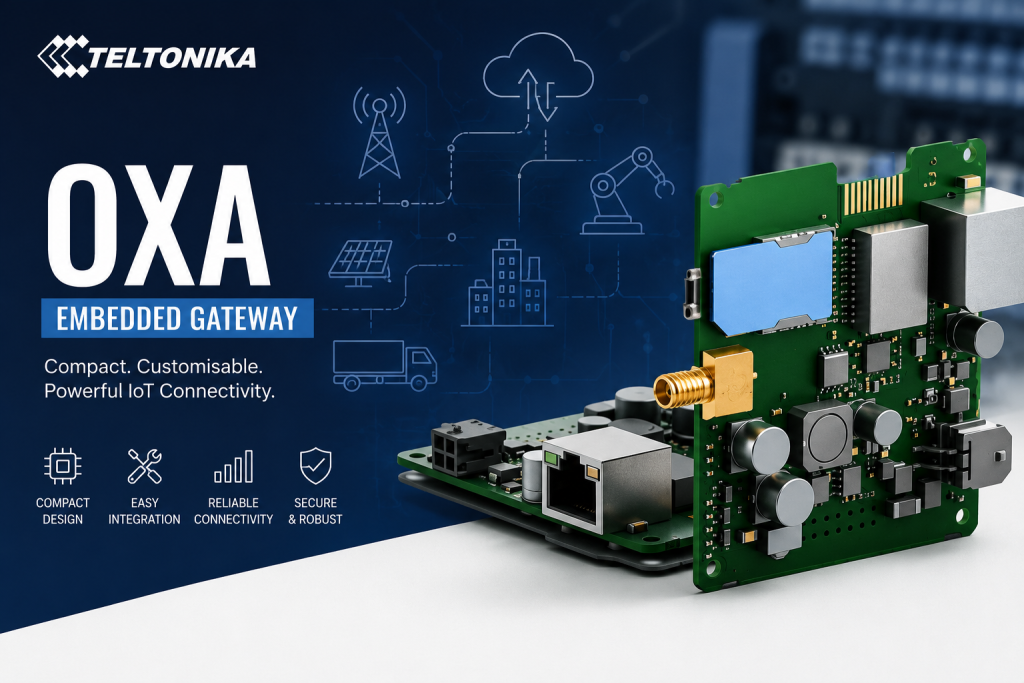
Teltonika Oxa: the embedded LTE Cat 4 gateway built for OEM integration
The Oxa is Teltonika’s compact embedded IoT gateway, designed to build cellular connectivity straight into your own hardware. At 70 x 18.2 x 67.7 mm and 36 grams, it carries the full RutOS feature set, Gigabit Ethernet, and RMS remote management in a footprint small enough to sit inside a barrier, a charger, or an access control box.
Most cellular gateways arrive in a box. You mount the box, cable it, power it, and design your enclosure around it. That is fine for a standalone deployment, but for a manufacturer building connectivity into their own product it is wasted space, wasted cost, and a mechanical headache. The Teltonika Oxa answers that problem. It sits in Teltonika’s embedded systems line rather than the boxed router range, and there is no casing material listed on its datasheet, because the Oxa is meant to be integrated inside host equipment rather than mounted alongside it.
What makes it useful is not just the small size. It is that the Oxa runs RutOS, Teltonika’s OpenWrt-based operating system, out of the box. You get the same networking stack, industrial protocols, VPN suite, and security features found across the RUT and TRB ranges, on a device you can design into your own product. That is the difference between an embedded gateway and a raw cellular module: the firmware and certification risk has already been solved.
Specifications at a glance
| Group | Detail |
|---|---|
| Cellular | 4G LTE Cat 4, up to 150 Mbps down / 50 Mbps up. 3G fallback up to 21 / 5.76 Mbps, 2G. 3GPP Release 11 |
| SIM | 1 x Mini SIM (2FF), 1.8 V / 3 V. Single SIM |
| Ethernet | 1 x RJ45, 10/100/1000 Mbps (Gigabit), auto MDI/MDIX |
| Processing | ARM Cortex-A7 1.3 GHz, 128 MB DDR2 RAM, 512 MB SPI flash |
| Operating system | RutOS (OpenWrt-based Linux). SDK, Package Manager, custom firmware branding |
| Industrial protocols | Modbus TCP (client/server), DNP3 (TCP), DLMS/COSEM (TCP client), BACnet/IP router, OPC UA (client/server), Modbus MQTT Gateway, Data to Server (HTTP/S, MQTT, Azure MQTT). All IP-based, no serial ports |
| VPN | OpenVPN, IPsec, WireGuard, GRE, L2TP, PPTP, DMVPN, SSTP, ZeroTier, Stunnel, Tinc |
| Cloud and management | RMS, TR-069, ThingWorx, Cumulocity, Azure IoT Hub, AWS IoT Core, SNMP v1/v2/v3, MQTT, JSON-RPC, Web API (beta) |
| I/O | 1 x digital input, 1 x digital output on the power connector, plus I/O juggler event logic |
| USB | 1 x virtual network interface via micro USB |
| Antenna | 1 x SMA for mobile |
| Power | 4-pin DC, 9 to 30 VDC, reverse polarity and surge protection. Passive PoE via LAN1 (Mode B, not 802.3af/at/bt). Under 5 W |
| Environment | Operating temperature -40 °C to 75 °C |
| Dimensions and weight | 70 x 18.2 x 67.7 mm, 36 g |
The Oxa is a single-SIM, IP-only device. There is no dual-SIM failover and no RS232 or RS485, so every industrial protocol runs over TCP. If your application needs serial equipment or dual-SIM redundancy, look at the RUT956 or RUT986 instead. If it needs a small, embeddable Cat 4 board with a Gigabit port, this is the one.
Why board-level integration matters
The commercial case for the Oxa becomes clear once you have costed a real embedded project. Building your own connectivity from a bare cellular module means designing the RF layout, sourcing and integrating the modem, writing and certifying the firmware, and carrying the regulatory approvals yourself. That is months of engineering and a long list of ways to introduce field failures.
Starting from a boxed gateway instead means paying for a housing you then have to fight to fit inside your own enclosure, plus mounting hardware you do not need. Neither route is efficient for volume production.
The Oxa splits the difference. You get a production-ready, pre-certified cellular platform with field-proven RutOS firmware, in a 36 gram footprint you can design straight into your own product. The engineering risk and the wasted enclosure space both disappear.
Cat 4 is the right modem tier for this class of device. It is cheap, globally supported, and low power. The category ceiling of 150 Mbps down is far more than embedded telemetry, control, and verification traffic will ever use, and real-world speeds of 60 to 80 Mbps on a strong cell leave plenty of headroom. Under 5 W of power draw and a -40 to 75 °C operating range mean the board copes with sealed enclosures and outdoor cabinets without special provision.
The lead use case: access control at gates and barriers
Teltonika launched the Oxa alongside a clear reference application, and it is a good one: automated access control at gates, turnstiles, and barriers.
Modern access points validate credentials in real time, whether that is an NFC card, a mobile app, or a ticketing terminal. The problem is rarely the reader. It is the connectivity. Trenching Ethernet or fibre out to a perimeter gate, an isolated entrance, or a barrier in the middle of a car park is slow and expensive. Ground works, permitting, and labour inflate the budget and stretch the timeline before a single credential is ever read.
Cellular removes that dependency, and the Oxa lets integrators embed it inside the slim chassis of the barrier or the controller box. A visitor taps a card, the credential is passed to the internal controller, routed over LTE Cat 4 to a cloud database for verification, and the unlock response returns in milliseconds. No trench, no fibre, no bulky router eating enclosure space. Because it runs RutOS, that credential traffic travels inside an OpenVPN, WireGuard, or IPsec tunnel behind the built-in firewall, so authentication data is protected across the public network.
Where else the Oxa fits
Access control is the headline, but the combination of a compact embeddable board, Gigabit Ethernet, digital I/O, and a full set of TCP industrial protocols opens up a wide spread of applications. Here are the ones where the Oxa is a natural fit.
EV charging
Charge point operators need every unit online for OCPP back-office communication, remote firmware updates, and payment authorisation. Embedding the Oxa inside the charger enclosure gives each unit its own cellular backhaul managed through RMS, with the digital I/O available for enclosure door tamper or contactor status.
Vending, kiosks, and unattended retail
Telemetry, cashless payment, and stock reporting all depend on a reliable connection inside a machine that has no wired network nearby. The Oxa slots into the cabinet, keeps the payment terminal online over an encrypted tunnel, and reports machine state through Data to Server.
Building automation and BMS
The Oxa includes a BACnet/IP router. That makes it directly useful for building management integration where a remote plant room, riser, or outbuilding needs to join the wider BMS over cellular rather than structured cabling. OPC UA client and server support extends the same reach to modern automation controllers.
Smart metering and utility sub-metering
DLMS/COSEM client support over TCP is built for utility meter data exchange. For sub-metering across a site, or gathering meter data from a location without fixed-line access, the Oxa acts as the cellular collection point feeding a head-end system.
Solar PV and renewable monitoring
Inverters and site controllers that expose Modbus TCP can be polled directly by the Oxa and forwarded to a monitoring platform via Data to Server or MQTT. Note the IP-only limit here: an inverter that only offers Modbus RTU over RS485 will need an external serial-to-Ethernet converter, or a serial-equipped gateway such as the RUT956.
CCTV, ANPR, and perimeter security
Cameras and number-plate recognition units at a gate, compound, or remote site can share the Oxa’s Gigabit LAN port and cellular uplink. The same encrypted tunnel that protects access control traffic keeps the video and event data segmented from the public internet.
Machine builders and industrial OEMs
Any equipment manufacturer who wants to ship a connected product without developing connectivity in-house can design the Oxa into the machine. RutOS handles the networking, RMS handles the fleet, and the digital I/O gives a simple hook for machine status, alarms, or a remote reset line.
Remote I/O and alarm monitoring
Even on its own, the digital input and output with I/O juggler logic turn the Oxa into a small remote monitoring node. A door contact, pump running signal, tank level float, or intrusion alarm can trigger an email, SMS, or RMS event, with an output available to drive a relay or indicator in response.
RMS at the board level
A distributed estate of embedded gateways is only manageable if you can see and update every unit remotely. Building on RutOS pays off a second time here. Every Oxa is compatible with the Teltonika Remote Management System, so an operator running dozens or hundreds of connected devices gets a single view of the whole fleet.
Through RMS, administrators can monitor connectivity in real time, push mass configuration changes, roll out firmware updates across the estate, and troubleshoot individual devices without a site visit. For access control, EV charging, or metering spread across many locations, removing the truck roll is often the difference between a solution that scales and one that does not. For teams standardised on a hyperscaler, native connectors for Azure IoT Hub and AWS IoT Core sit alongside RMS, including zero-touch provisioning through the Azure Device Provisioning Service.
Where the Oxa sits in the Teltonika embedded range
Teltonika’s compact and embedded gateway line has grown quickly. The TRB140 offers Cat 4 and Gigabit Ethernet in an ultra-small cased communicator. The TRB160 steps up to Cat 6 with USB Type-C power and data. The Calyx brings cellular connectivity to the Raspberry Pi ecosystem as a HAT+. The Oxa is the natural choice for manufacturers who want that TRB feature set as an embeddable board rather than a finished unit.
If your project is a one-off cabinet install, a cased TRB is still the pragmatic pick. If you are designing connectivity into a product you will build in volume, and every millimetre and every pound of bill-of-materials cost matters, the Oxa is the more sensible starting point.
Specifications sourced from the official Teltonika Oxa datasheet. Real-world cellular throughput depends on signal quality, cell load, and carrier aggregation availability, and will be below the Cat 4 category maximum. Confirm current pricing, stock, and ordering codes before quoting.


