The car that gets better after you buy it
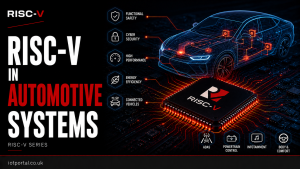
RISC-V and software-defined vehicles is where the automotive story stops being about chips and starts being about a new kind of product. Once the car is consolidated onto central compute, the hardware becomes a fixed platform and the features become software, delivered and improved over the air for years. RISC-V’s job is to be the durable engine underneath that never becomes the bottleneck.
Hardware once, software forever
The automotive post ended with the car consolidated onto a few powerful compute units. This is what that unlocks. For a hundred years a car was as good as it would ever be the day you drove it off the forecourt, its functions frozen in the hardware. The software-defined vehicle inverts that. The hardware is defined once at build, and the features live in software that can be added, fixed and improved throughout the vehicle’s life.
The scale of this is easy to underestimate. A modern software-defined vehicle programme runs to somewhere between one and three hundred million lines of code, which makes a car one of the largest software engineering efforts in any industry. That forces carmakers to adopt the version control, continuous integration and automated testing that the software world takes for granted, and to think of the vehicle as a platform rather than a finished object.
The stack that makes it possible
Decoupling software from hardware needs middleware, and the industry has largely standardised on AUTOSAR Adaptive for the job. Crucially, it runs on a POSIX-based operating system, which in practice means the same embedded Linux foundation this series covered earlier, now sitting at the heart of a car. It uses service-oriented communication rather than fixed signals, so functions offer and consume services like microservices in the cloud, and a new feature can be slotted in without disturbing everything around it.
That service-oriented design is what makes proper over-the-air updates possible. Where the older Classic AUTOSAR needed a full replacement of the software, Adaptive can reload individual modules, so a car can gain one new capability without a wholesale re-flash. This is the embedded-Linux capability from earlier in the series, promoted to the driver’s seat.
The shift in one line: for a century a car was as good as it would ever be the moment you bought it. A software-defined vehicle is the opposite, its hardware fixed at build but its software, and therefore the car itself, improving for years afterward. That is a genuinely new product category, and it needs durable, updatable compute underneath.
Over the air, and the risk that comes with it
Over-the-air updates are the headline SDV capability, and also its sharpest danger. The update pipeline is a direct line into every vehicle a manufacturer has sold, so if that channel is compromised, an attacker can push malicious code to an entire fleet at once. Regulators noticed. UN R156 now requires carmakers to run a formal Software Update Management System, proving that every update, whether pushed over the air or applied in a workshop, is delivered safely, traceably and without breaking the vehicle’s type approval.
Securing that channel is not optional, and it rests on exactly the foundations covered in RISC-V security: a hardware root of trust and secure boot, so a vehicle only ever accepts an update that is cryptographically proven to be genuine. The openness of RISC-V helps rather than hinders here, because a security case built on a published architecture can be audited rather than taken on trust.
The old car versus the software-defined one
| Aspect | Hardware-defined car | Software-defined vehicle |
|---|---|---|
| Features | Fixed at manufacture | Added and improved over time |
| Updates | A recall or a workshop visit | Over the air, modular |
| Compute | Many fixed-function ECUs | Central compute plus zonal controllers |
| Software model | Signal-based, monolithic | Service-oriented, updatable |
| Lifecycle value | Declines from day one | Can rise after purchase |
That last row cuts both ways, it should be said. The same mechanism that delivers a genuine new safety feature also enables the subscription heated seat. The technology is neutral; what carmakers do with it is a separate argument.
Why RISC-V, specifically
The compute at the centre of a software-defined vehicle has to do three awkward things at once: be powerful enough for the software, cheap enough to build at volume, and supportable for the fifteen-year-plus life of the platform. An open, scalable ISA answers all three, but the sharpest argument is economic. Reusing one shared instruction set, one software ecosystem and one set of tools across a vehicle’s whole compute estate cuts the duplicated re-engineering and re-certification that otherwise runs to tens of millions of dollars per platform. That keeps the money, and the control, with the carmaker rather than a chip vendor.
That is the software-defined vehicle as the automotive expression of this entire series: intelligence moving into the device, the device becoming updatable, and open silicon giving the maker control over its own destiny. It is the argument the RISC-V and IoT cornerstone has been building toward, now weighing two tonnes and doing seventy on the motorway.
Last updated 23 August 2026. Sources: software-defined vehicles decouple features from hardware, delivered and updated over the air across the vehicle’s life, with programmes running to 100-300 million lines of code, per industry analysis, 2026; AUTOSAR Adaptive (POSIX/Linux-based, service-oriented, OTA-capable) is the SDV middleware standard per AUTOSAR and Elektrobit; over-the-air updates are regulated by UN R156, which requires a Software Update Management System, per UNECE; reusing one shared open RISC-V ISA across a vehicle’s compute can reduce duplicated re-engineering and re-certification costs otherwise running to tens of millions of dollars per platform, per RISC-V International.