Pairing a rugged 5G and Wi-Fi 6 router with software-defined mesh networking sounds like a well-equipped router with an app bolted on. The interesting part is what the combination makes possible when the machines, the ground and the radio paths refuse to stay still.
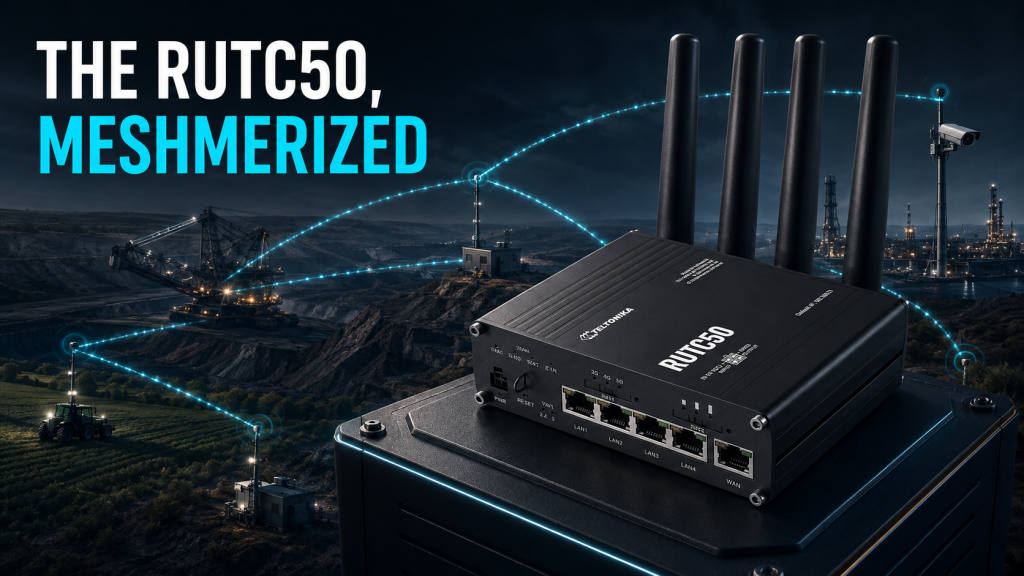
Meshmerize has added Teltonika’s RUTC50 to its supported industrial mesh hardware, combining a rugged 5G and Wi-Fi 6 router with software-defined mesh networking. The result is a node that connects local equipment, relays traffic for other nodes and finds new paths as machines move or radio links fail. It is aimed at mines, farms, construction sites, tunnels and mobile CCTV, not fixed offices. The RUTC50 supplies the radios, cellular backhaul and edge compute; Meshmerize supplies the dynamic network on top.
What has actually been announced
Meshmerize says the Teltonika RUTC50 is now available as a Meshmerize-enabled platform, describing it as a strong price-to-performance option for an industrial 5G and Wi-Fi 6 mesh router. The important word is platform. Meshmerize is a software-defined solution designed to run on compatible commercial hardware, so adding the RUTC50 gives integrators a recognisable, readily available industrial router to build mesh nodes from, rather than a proprietary radio appliance for every point in the network.
The RUTC50 brings the hardware: 5G with 4G and 3G fallback, dual-band Wi-Fi 6, five Gigabit Ethernet ports, GNSS, industrial protocols, an edge-compute environment and a rugged enclosure. Meshmerize adds a different job on top: it lets the router join a dynamic industrial mesh in which nodes talk directly to one another, relay each other’s traffic and reroute around movement, obstructions, interference or a failed link. That is the story behind the announcement, and it is a more useful one than another speed figure on a datasheet.
First, this is Meshmerize, not Meshtastic
The names are easy to muddle, but the two solve very different problems. Meshtastic is an open-source, off-grid communications project that normally uses low-power LoRa radios. It is popular with hobbyists, hikers and preparedness communities for long-range text and telemetry without a mobile network, trading speed for range and battery life.
Meshmerize is commercial industrial mesh networking software. It describes itself as a wireless mobile ad hoc network, or MANET, and targets high-bandwidth, low-latency machine communications on Linux-based networking hardware. Its world is robots, autonomous vehicles, drones, mining equipment and agricultural machinery. Both pass traffic through a mesh, but a Meshtastic node might relay a short message over kilometres, whereas a Meshmerize installation may need to hold live video, control traffic and sensor data together while the vehicles and the nodes themselves are moving.
What is an industrial mesh network?
In a conventional Wi-Fi installation, client devices connect to access points, those access points connect to a wired network, and carefully positioned infrastructure provides overlapping coverage. That model works well in offices, homes and many fixed industrial sites. It struggles when the environment itself keeps changing.
A quarry vehicle disappears behind a rock face. A combine moves beyond the useful range of one fixed access point. Steel shelving, containers and earth-movers create and move radio shadows. A construction site that was open ground in March is divided by concrete in June. Running fibre or Ethernet to every access point may be too expensive, too slow or simply impossible.
In a mesh, participating nodes forward traffic for one another. A device does not need a direct radio path to the fixed gateway; its traffic can travel through nearby nodes until it reaches one with a usable link to the destination or backhaul. If a route deteriorates, the network chooses another. Meshmerize goes beyond extending an SSID through a line of static access points: it describes a multipath routing system that keeps alternative paths ready as conditions change, with nodes talking to access points and to each other. According to Meshmerize, its roaming design can cut failover from more than three seconds to under 10 milliseconds. That is a vendor figure, and real results will depend on radio conditions, hardware, traffic and design, but it points at the problem being solved: not better Wi-Fi for email, but keeping operational traffic flowing while machines move.
Meshmerize versus ordinary Wi-Fi mesh
The word mesh is now attached to everything from home broadband kits to municipal networks, which has nearly drained it of meaning. A home mesh eliminates dead spots and lets phones roam between fixed access points in a building that changes slowly, where a brief interruption goes unnoticed. Industrial mobility is less forgiving: a robot or supervised vehicle may produce continuous traffic, the path between nodes can change from moment to moment, interference can be severe, and not every access point has a permanent wired backhaul.
Meshmerize’s stated differentiators include device-to-device communication rather than dependence on a fixed access point, multipath routing with alternative routes ready as conditions change, fast roaming to reduce handover interruptions, relaying around radio shadows, wireless expansion without cabling every point, support for hundreds of nodes in suitable designs, and the ability to select a route over Wi-Fi, Ethernet or cellular.
RutOS already includes 802.11s wireless mesh on supported Teltonika devices, where a router can act as a mesh gateway or node. So this is not the first time a Teltonika router has formed a mesh. Meshmerize’s pitch is a more specialised stack for highly mobile, rapidly changing networks, where fast rerouting, machine-to-machine relaying and larger dynamic topologies matter. Whether that extra capability is needed depends entirely on the application.
Why the RUTC50 is a sensible host
An industrial mesh node needs more than a Wi-Fi radio. In the field it may have to serve local equipment, process data, build secure tunnels, report its position and choose between several routes to the outside world. The RUTC50 covers most of those roles in one device.
| Capability | What the RUTC50 provides |
|---|---|
| Cellular | 5G Sub-6 (SA and NSA) up to 3.4 Gbps, with 4G Cat 20 and 3G fallback |
| SIM | Dual SIM with auto-failover; eSIM on the eSIM order-code variant |
| Wi-Fi | Concurrent dual-band Wi-Fi 6 (2.4 and 5 GHz) with MU-MIMO, up to 512 clients |
| Wired | Five Gigabit Ethernet ports for cameras, controllers and computers |
| Compute | Dual-core ARM Cortex-A53, 1 GB RAM, 8 GB flash, native Docker on the RUTC series |
| Location | GNSS for position-aware applications on moving assets |
| Industrial | RutOS with Modbus TCP, DNP3, DLMS and MQTT; VPN, firewall, VLAN and RMS |
| Build | Aluminium enclosure, IP30, -40 to +75 degrees C, DIN-rail or wall mount |
GNSS locates a router on a vehicle or movable asset. Industrial protocols integrate operational equipment. Docker container support lets selected work stay local instead of shipping every raw data point or video stream to the cloud. Consolidating those roles into one device can cut the number of separate boxes in a cabinet or vehicle, which means simpler wiring, lower power draw, less installation and fewer points of failure. It also makes the price-performance argument more plausible, because the fair comparison is not one router against another, but the RUTC50-based node against the several appliances it may replace.
One honest caveat on cost. Meshmerize had not published public RUTC50 bundle pricing in the material available when this article was prepared, so the phrase about avoiding a traditional premium still needs a quotation behind it. Buyers should compare complete project costs, including licences, antennas, installation, network design, management and support, not hardware prices alone.
Where it could be used
The clearest applications are operations where the network environment itself moves or changes.
Mining, quarrying and tunnelling
Open-cast mines and tunnels are large, change shape and contain heavy obstructions, while fixed cabling is awkward and vulnerable. Mesh-equipped routers on vehicles and at strategic fixed points can relay telemetry, dispatch data, environmental sensors, worker communications and CCTV around terrain and machinery. A node with usable 5G or 4G can provide cellular backhaul for others that cannot see the mobile network. The application still has to be engineered: mesh does not repeal the laws of radio, and every relay consumes airtime and adds latency.
Agriculture
Large farms rarely resemble an office campus. Coverage is patchy, assets move over wide areas, and activity shifts with the season. RUTC50 nodes could connect machinery, cameras and local sensors, with the mesh carrying traffic towards a farm building, fibre point or cellular gateway. It is most interesting where several moving machines work the same area, because each node contributes to the network rather than acting as an isolated cellular router.
Temporary CCTV and surveillance
Running cables to cameras across construction sites, events and yards can cost more than the cameras. A wireless mesh can link camera clusters and relay towards one or more backhaul points. The RUTC50’s 5G capacity helps with video, but bandwidth planning is essential: ten cameras do not become cheap to backhaul because the word 5G appears on the box. Edge applications help by recording locally, filtering events or sending lower-bandwidth streams until full footage is requested.
Oil, gas, energy and construction
Remote energy sites and evolving construction projects combine metal structures, moving equipment and areas where new cable is disruptive. A rugged mesh can extend communications to temporary equipment and vehicles while using Ethernet where a backbone already exists, with nodes repositioned as work areas move. The same logic extends to emergency, defence and disaster-response networks, each of which adds its own security, spectrum and certification requirements.
Any deployment in a hazardous area needs correctly certified equipment and installation design. The standard RUTC50’s industrial temperature range and aluminium enclosure do not make it ATEX or IECEx certified. Confirm the right certified hardware for the zone before designing anything into an explosive atmosphere.
Does every node need its own SIM?
Not necessarily. A true mesh means a node without its own internet connection can pass traffic to another node that has Ethernet, fibre, satellite or cellular backhaul. Some RUTC50 units can act as 5G gateways while others mainly provide local Ethernet, Wi-Fi and mesh relay. Fitting cellular to several nodes does add resilience, though: if one gateway loses coverage or fails, another can provide an alternative exit. The right balance depends on data usage, coverage, licence cost, power, topology and the consequences of an outage.
It helps to separate two kinds of redundancy. Mesh resilience creates alternative local paths between devices and gateways. WAN resilience creates alternative connections from the site out to the internet or remote services. A mesh can stay perfectly connected internally while its only 5G gateway has failed; equally, a router can have two excellent mobile connections while an isolated camera cannot reach it. A resilient design considers both sides.
What a buyer should ask
The announcement is a promising combination, not a network design. Before specifying it, an integrator should establish:
- Which exact RUTC50 hardware and RutOS versions are certified for the current Meshmerize release.
- Whether Meshmerize is supplied as a factory image, an installable package or a managed bundle.
- How the software is licensed: per node, annually, permanently or by project.
- What node count has been validated for the intended traffic profile.
- What throughput and latency to expect after one, two or more wireless hops.
- Whether both Wi-Fi bands can serve clients and mesh backhaul at once, and how channels should be planned.
- How Meshmerize, RutOS and any containers are updated without breaking compatibility.
- How the topology is monitored, and whether alerts integrate with existing network tools.
- What happens when a node loses power, cellular coverage or one Wi-Fi radio.
- Who owns first-line support when router, mesh software, mobile service and application come from different suppliers.
Antennas deserve early attention too. A rugged router buried in a metal vehicle cab still has a poor radio environment. Correctly selected and positioned external antennas for 5G, Wi-Fi and GNSS often decide whether an otherwise clever design works reliably.
The real value of a Meshmerize-enabled RUTC50
The most useful way to see this product is as a compact industrial network node with three layers. The first is local connectivity: Wi-Fi 6 and Gigabit Ethernet connect cameras, controllers, sensors and computers. The second is dynamic site networking: Meshmerize lets nodes relay traffic and adapt routes as machines move or radio paths change. The third is wide-area connectivity and computing: 5G, 4G, Ethernet WAN and edge applications connect the local operation to remote systems while processing selected workloads on site.
For a fixed cabinet that needs one cellular connection, that stack is overkill, and a simpler industrial router will do the job more cheaply. For a moving or rapidly changing operation, it is far more interesting. Mining fleets, autonomous machines, temporary CCTV, large agricultural sites and evolving construction projects are exactly where a conventional access-point plan becomes expensive or fragile.
Meshmerize is not replacing 5G with Wi-Fi, and the RUTC50 is not replacing proper network design. The combination gives the system more ways to keep traffic moving, and in difficult industrial environments that flexibility can be worth more than the headline speed on the box. The open questions are commercial and operational: exact pricing, licence structure, supported configurations, management integration and independently demonstrated performance at scale. Answered convincingly, the meaningful achievement would not be another 5G router, but lowering the cost of a resilient network where the ground, the machines and the radio paths refuse to stay still.