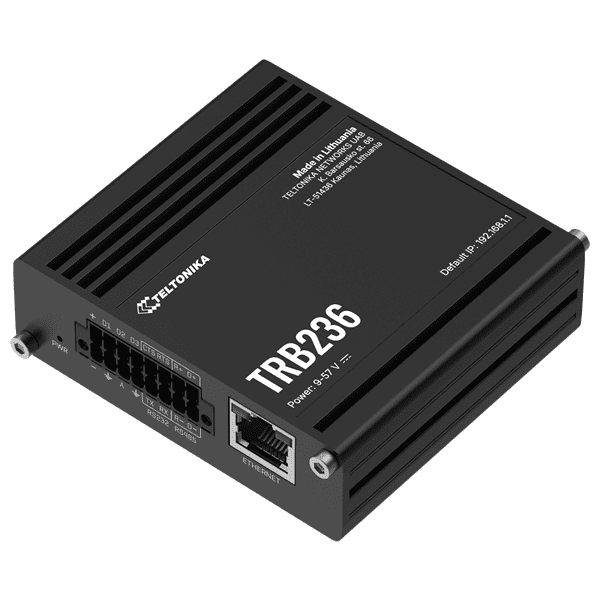
Teltonika TRB236: LTE 450 Industrial Gateway for Utility and Remote IoT Deployments
Teltonika has launched the TRB236, an industrial IoT gateway built around the 450 MHz band. It delivers LTE Cat 1 or Cat 4 connectivity with dual SIM, RS232/RS485 serial interfaces, and configurable I/O – targeting utility operators and remote industrial sites where standard cellular coverage fails.
The Teltonika TRB236 is an industrial LTE 450 gateway launched in EMEA in April 2026. It supports LTE Cat 1 with 2G fallback or LTE Cat 4 with 3G fallback across the 450 MHz band, with Ethernet, RS232, RS485, and configurable digital I/O for connecting legacy field equipment. Dual SIM with eSIM support and the RMS management platform make it a direct option for utility operators running private LTE 450 networks.
What Is LTE 450 and Why Does It Matter for Industrial IoT?
LTE 450 refers to LTE deployments using the 450 MHz frequency band – specifically Band 31 and Band 72. The physics of low-frequency radio propagation gives 450 MHz a significant range and in-building penetration advantage over the 700-2600 MHz bands used by mainstream public LTE networks. A single 450 MHz cell can cover vastly more ground than its higher-frequency counterparts, and the signal propagates into basements, substations, and dense infrastructure where standard cellular fails.
This makes LTE 450 the connectivity standard of choice for critical national infrastructure in several European markets – particularly utilities. Water treatment plants, electricity substations, district heating networks, and remote metering infrastructure that once relied on legacy CDMA450 or TETRA networks have been migrating to LTE 450 private networks over the past decade. The TRB236 is designed specifically for that migration.
LTE 450 networks are well established across Germany, Austria, Scandinavia, and parts of Eastern Europe as utility-grade private network infrastructure. Several European energy transmission operators run licensed 450 MHz spectrum for grid monitoring and SCADA integration. For UK deployments, equipment compatibility with LTE 450 has historically been a gap – the TRB236 addresses the hardware side of that.
Why Not Cat M1 or NB-IoT?
NB-IoT and LTE-M (Cat M1) operate on standard public network frequencies and are optimised for low-data, low-power applications: sensors, meters, and small-packet telemetry. They are not designed for the sustained, higher-throughput connectivity that industrial SCADA, remote access sessions, or real-time monitoring of substation equipment requires. LTE Cat 1 and Cat 4 on 450 MHz gives operators significantly more bandwidth while retaining the coverage advantage of the low frequency band. The TRB236 sits in that gap: more capacity than LPWAN, with the coverage characteristics that standard 4G bands cannot match in remote or dense environments.
TRB236 Overview
The TRB236 is the latest addition to Teltonika’s TRB gateway range – compact, DIN-rail-mountable industrial gateways with cellular connectivity and a selection of wired interfaces. Where earlier TRB models targeted mainstream LTE bands, the TRB236 is built specifically for LTE 450 private and utility networks.
At launch in April 2026, the TRB236 is available across EMEA in two modem configurations. The Cat 1 variant pairs LTE 450 Cat 1 with a 2G GSM fallback, providing a backup path where 2G coverage remains available. The Cat 4 variant steps up to LTE 450 Cat 4 and falls back to 3G UMTS – useful in markets where 3G on the 450 band or adjacent frequencies remains live. The choice of variant depends on which fallback path is available in the target deployment geography.
TRB236 ships in two modem configurations: LTE Cat 1 with 2G fallback, or LTE Cat 4 with 3G fallback. Both operate across the 450 MHz band. Select based on which fallback technology is available at the target site – if 2G is being decommissioned in the region, Cat 4/3G is the safer long-term choice.
Key Specifications
The table below summarises the primary technical parameters of the TRB236. As with other TRB-series gateways, the focus is on a compact footprint with a targeted set of industrial interfaces rather than the broader routing feature set found in the RUT range.
| Parameter | Detail |
|---|---|
| Product family | TRB Gateways (Teltonika Networks) |
| Cellular band | LTE 450 (450 MHz – Band 31 / Band 72) |
| LTE category (Cat 1 variant) | LTE Cat 1 with 2G (GSM) fallback |
| LTE category (Cat 4 variant) | LTE Cat 4 with 3G (UMTS) fallback |
| SIM | Dual SIM + eSIM support |
| Ethernet | 1x Ethernet port |
| Serial interfaces | RS232, RS485 |
| Digital I/O | Configurable digital inputs and outputs |
| Industrial protocols | Modbus, DNP3, and wider RutOS protocol support |
| Operating system | RutOS (OpenWrt-based) |
| Remote management | Teltonika RMS (Remote Management System) |
| Availability | EMEA – April 2026 |
Detailed hardware specifications including power input range, operating temperature, dimensions, and certifications will be published in the TRB236 datasheet and wiki documentation as they become available post-launch.
Industrial Interfaces: Bridging Legacy Equipment to IP
The TRB236’s interface set is designed for one primary task: connecting legacy serial and I/O field equipment to IP networks over LTE 450. This is the core problem in utility IoT deployments. Most remote infrastructure in substations, pumping stations, and metering points was built before IP connectivity was a design consideration. RTUs, PLCs, and meters typically communicate over RS232 or RS485 using Modbus or DNP3. Getting that data to a SCADA or cloud platform requires a gateway that terminates the serial connection and forwards data over cellular IP.
Ethernet
Standard 10/100 Ethernet port for IP-connected field devices, local switches, or connecting existing Ethernet-based industrial equipment to the LTE 450 uplink.
RS232
Point-to-point serial for connecting individual devices: flow meters, RTUs, legacy modems, or any equipment using the RS232 standard. Useful where only one device needs to be bridged.
RS485
Multi-drop serial bus for Modbus RTU and similar protocols. Allows a single TRB236 to poll multiple field devices on a shared bus – typical in substation, metering, and HVAC applications.
Digital I/O
Configurable digital inputs and outputs for alarm signalling, actuator control, door/tamper detection, and status monitoring without a separate I/O module.
RutOS includes serial gateway functionality that maps RS232 and RS485 traffic to TCP/UDP sockets, enabling Modbus TCP-to-RTU conversion without additional middleware. This reduces the infrastructure footprint at remote sites and simplifies integration with cloud SCADA platforms.
Dual SIM and eSIM: Connection Continuity
The TRB236 carries two physical SIM slots plus eSIM support. In practice, this gives operators several operational configurations. The most common for utility deployments is a primary LTE 450 private network SIM for day-to-day connectivity, with a public network SIM on a separate carrier as backup WAN. If the private LTE 450 network becomes unavailable – planned maintenance, cell fault, or signal issue at a specific site – the gateway automatically switches to the backup SIM and maintains connectivity for monitoring and remote access.
SIM switching can also be configured on a priority or signal-strength basis via RutOS. This is relevant where LTE 450 coverage is not uniform across an entire deployment geography and some sites may intermittently fall back to public LTE.
For utility operators running private LTE 450 infrastructure, pairing the TRB236 with a multi-network roaming SIM on the backup slot gives resilience against both private network outages and public network single-operator failures. See our guide to multi-network IoT SIM selection at iotsims.co.uk for further detail on SIM selection for critical infrastructure deployments.
RMS and RutOS: The Teltonika Ecosystem Advantage
One of Teltonika’s durable competitive advantages is the depth of its software ecosystem. RutOS – the OpenWrt-based operating system across the full TRB, RUT, and RUTX range – provides a consistent interface for configuration, monitoring, and protocol handling regardless of the hardware model. Engineers familiar with any Teltonika gateway can configure the TRB236 without relearning a new platform.
The Remote Management System (RMS) adds centralised fleet management: remote configuration, firmware updates over the air, connection monitoring, and alerting. For utility operators managing hundreds of remote assets across a wide geography, RMS reduces the need for site visits to address firmware or configuration issues. Remote access via RMS also means that LTE 450 connectivity at a remote pumping station can be used to reach the connected RTU directly, without a separate VPN appliance.
RMS is a subscription-based service. New Teltonika devices typically include a period of free RMS credits. For large-scale utility deployments, Teltonika offers enterprise licensing arrangements. Factor RMS costs into total deployment cost when comparing against competing gateways that include cloud management at no recurring charge.
Target Applications
The TRB236 is positioned for environments where mainstream public LTE coverage is unreliable or unavailable, and where connecting legacy serial equipment to IP is a primary requirement. The clearest fit applications are:
Water and Wastewater Utilities
Remote pumping stations, booster stations, and treatment works are often sited away from population centres and in locations where above-ground 4G coverage is marginal. Underground or basement plant rooms compound the problem further. LTE 450 penetration characteristics address both issues. The RS485 interface allows direct connection to pump controllers and flow meters running Modbus RTU, with data forwarded to SCADA over LTE 450.
Electricity Distribution
Secondary substations and ring main units require remote monitoring for fault detection, load balancing, and switching operations. Many existing RTUs in this space communicate over RS232 or RS485. The TRB236 provides the LTE 450 uplink and serial interface termination in a single compact device suitable for installation in a substation cabinet.
District Heating and Heat Networks
Heat meter data aggregation and remote valve control in district heating networks share the same connectivity and interface requirements as water infrastructure. LTE 450 private networks operated by energy utilities in Nordic and German markets are an established deployment context for this type of gateway.
Remote Infrastructure Monitoring
Any remote asset – pipeline monitoring, telecom tower infrastructure, rural environmental monitoring – that requires reliable connectivity in areas of poor public cellular coverage and has existing RS232 or RS485 equipment is a potential fit for the TRB236.
Market Positioning and Competitive Context
The LTE 450 industrial gateway market is a specialist segment. Direct competitors named at the TRB236 launch include the Advantech ICR-2437, the Insys MRX2 LTE450, and the Garderos R-7628. All three are established industrial gateway platforms with LTE 450 capability and similar interface sets.
Teltonika’s primary positioning argument is price-to-feature value combined with the breadth of the RutOS and RMS ecosystem. The TRB range sits below the Advantech and Insys products on unit cost in most European markets, while offering equivalent core functionality for the serial gateway and remote monitoring use case. For integrators already deploying Teltonika routers on the IP infrastructure side of a project, adding TRB236 gateways at the field device layer avoids introducing a second management platform.
The eSIM inclusion is worth noting. Physical SIM logistics at scale – particularly for utility deployments spanning hundreds of remote sites – is a genuine operational cost. eSIM-capable hardware gives operators the option to provision SIMs remotely and switch profiles without a site visit, which has meaningful value when the nearest engineer is 60 km away. For more on eSIM and eUICC capability in industrial IoT, see euicc.co.uk.
The TRB236 is available to order across EMEA from April 2026 through Teltonika’s authorised distributor network. Contact your regional Teltonika distributor or the Teltonika Networks website directly for pricing and lead times.
Related reading


