BT IoT SIM and EE IoT SIM: full pricing, and the buyer’s checklist to judge it by
Search “BT IoT SIM” or “EE IoT SIM” and you get a tidy configurator quoting you six quid a month and hurrying you to checkout. Here is the whole commercial picture it does not show you, the EE network case that justifies the premium, and, more usefully, the twelve-point checklist you should hold BT, and every other provider, against before you buy anything.
Bottom line: BT’s IoT SIMs are premium, EE-anchored and gated for volume. The EE-only SIM is £5.50 a month for 1GB, the multi-network version £6.00, both behind a minimum spend of roughly £100 a month. Whether that is right for you is not a price question, it is a fit question, and fit is decided by the twelve checks further down. Read the BT breakdown first, then use the checklist to judge it.
What BT actually charges
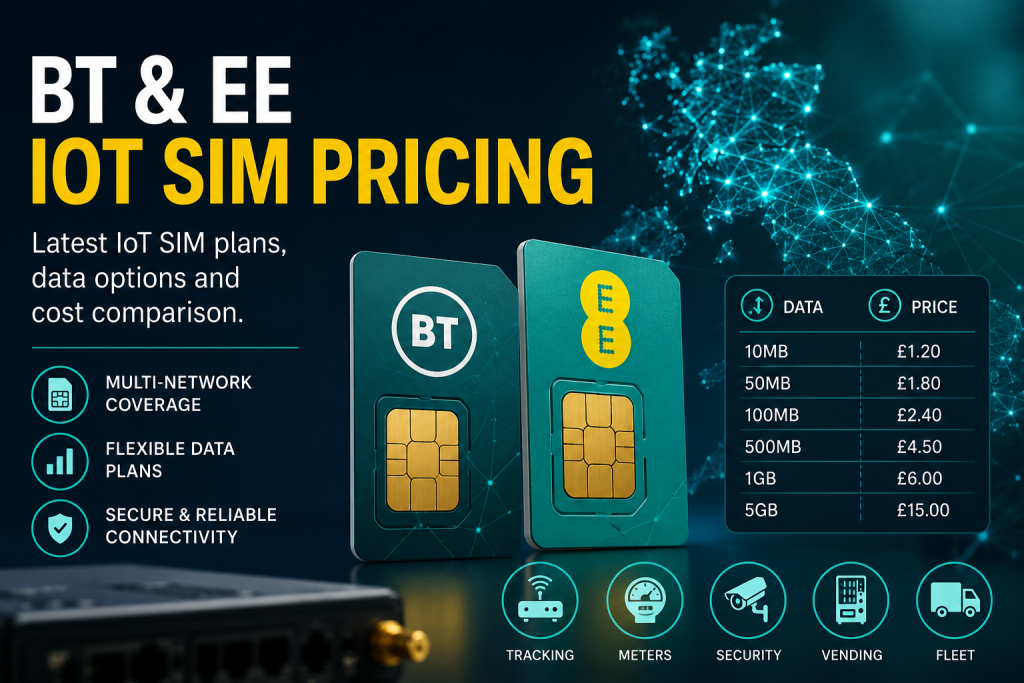
BT Business sells three IoT products: the UK EE IoT SIM (EE network only), the UK Multi-Network IoT SIM (EE primary, with failover to other UK networks), and a Low Power NB-IoT SIM for static, low-bandwidth devices. Here is the headline pricing for a 1GB bundle, from the live ordering journey. Note that the multi-network option carries a small premium, and the contract term makes no difference to the monthly price at all. Twelve months or sixty, you pay the same.
| Product | Networks | UK coverage | 1GB / SIM / month | One-off SIM | Term effect |
|---|---|---|---|---|---|
| UK EE IoT SIM | EE only | 97% | £5.50 | £2.00 | None |
| UK Multi-Network IoT SIM | EE primary + UK failover | 99% | £6.00 | £2.00 | None |
The £2.00 SIM charge applies to every form factor, Mini 2FF, Micro 3FF, Nano 4FF or the solderable Chip MFF2. No premium for the embedded chip, which is refreshing. Replacement SIMs are the same rate.
The catch nobody mentions up front: BT will not accept an order worth less than roughly £100 a month including VAT. At the entry 1GB rate that is around fourteen SIMs before they will take your money, or fewer if you pad the total with bigger data bundles. Want to run a handful of devices? You are pointed at a free trial instead. It is a wholesale product wearing a self-service coat, and the minimum spend is where that shows.
The rest of the price guide, which nobody reads
The monthly SIM price is the friendly bit. The generic charges schedule is where an unwary buyer gets a surprise, particularly around private APNs and account set-up.
| Charge | Price |
|---|---|
| SIM card (any form factor) | £2.00 |
| SIM activation | £0.50 |
| Suspension lifting fee | £3.00 |
| Standard account set-up | £2,500.00 |
| Standard Private APN set-up | £1,000.00 |
| Standard Private APN monthly | £300.00 |
| Bespoke report (per report) | £1,000.00 |
| Transfer or novation | £500.00 min, or £25.00 per SIM, whichever is greater |
A private APN with fixed addressing, which plenty of serious deployments genuinely need, costs a grand to set up and £300 a month thereafter on top of your data. Perfectly normal enterprise numbers, but not ones you see on the configurator, and they dwarf the SIM pricing that draws people in.
Pay-as-you-use traffic rates
BT bills on what you use rather than a fixed all-you-can-eat rate, which it frames as a virtue: no paying for headroom you never touch. Fair enough. But look at the data overage rate.
| Traffic type | Rate |
|---|---|
| Packet-switched data (PSD) | £0.25 per MB |
| Voice | £0.10 per minute |
| SMS | £0.03 per message |
Do the sum: £0.25 per MB is roughly £256 per gigabyte once you leave the bundle. Your in-bundle gigabyte costs £6. Your out-of-bundle gigabyte costs the thick end of £256. A forty-fold penalty for guessing your data profile wrong, so size your bundles with care and watch your alerts. Data is rounded per session in KB increments, and every byte contributes to your minimum spend. Hold that number in mind, because pricing model is Check 6 below and it matters more than any headline rate.
Powered by EE: is the premium earned?
The whole pitch rests on EE, and on the numbers it is a strong hand. EE has taken the RootMetrics UK overall network crown in every test period since the second half of 2013, which the testers put at twelve years running. In the most recent H2 2025 study, published in early 2026, EE posted a UK-wide median download speed of 110.8 Mbps, more than twice its nearest rival. The independent umlaut test for 2026 handed EE its top “Very Good” grade for the eleventh consecutive time, and Opensignal’s January 2026 UK report put EE top for both download speed experience and reliability. When BT says the SIM connects to “the UK’s best network”, that is the settled finding of three separate benchmarks, not marketing puff.
So if your devices sit still in a well-served area, the EE-only SIM at £5.50 is the network you would probably pick anyway. The multi-network variant is the more interesting product: it lifts population coverage from 97% to 99% by falling back to another UK operator when EE is unavailable. But BT keeps EE as the primary and only roams when it has to, which is sensible given EE’s ranking but is not the same as a fully democratic, non-steered SIM that always hunts for the strongest signal regardless of operator. Worth understanding that distinction before you assume the two behave identically, and it is Check 1 below.
One tell that the product is showing its age: BT’s 2023 price guide still lists “5G, 4G and 3G” access. Read that as 5G and 4G today. UK 3G has effectively gone, which brings us neatly to the reason this whole guide exists.
So should you actually buy it?
Now you know what BT charges and what EE buys you. The harder question is whether it is the right SIM for your deployment, and you do not answer that by staring at a price. BT is premium and EE-anchored with a high entry floor. The specialists undercut it and often hand you four networks by default. For a straight roaming comparison, RiteSIM lists 1GB a month across the EU including the UK at £4.50, guaranteeing at least two operators in every country.
| BT UK EE IoT SIM | BT UK Multi-Network | RiteSIM (roaming) | |
|---|---|---|---|
| Networks | EE only | EE primary + UK failover | Min 2 operators per country |
| Geography | UK | UK | EU inc UK |
| 1GB / month | £5.50 | £6.00 | £4.50 |
| Entry barrier | ~£100/mo inc VAT min | ~£100/mo inc VAT min | Contact / lower |
On the face of it a specialist is cheaper and covers more ground. What BT gives you in return is the single best-performing UK network, a management portal, and connectivity bought from the operator that owns the network rather than a reseller on top of it. Which of those matters more depends entirely on your deployment. The only honest way to choose between BT and the rest is to hold every option against the same set of questions. Here they are.
What this checklist actually solves
An IoT deployment lives or dies on connectivity, and connectivity is the part buyers understand least. A consumer plan assumes a human holding a phone in a town, who complains the moment the signal drops. An IoT device is a water meter in a chamber, a tracker in a lorry, a sensor on a hillside. Nobody is holding it, and nobody notices it has gone quiet until the data stops and someone dispatches a van.
The checklist solves the four ways that goes wrong. Devices that fall silent because they are stuck on one network in a spot it does not reach. Bills that balloon because the pricing model was never understood, see BT’s £256 gigabyte above. Deployments that break in year three because the radio technology got switched off, the operator merged, or the traffic was surfacing on the wrong side of the North Sea. And estates that cannot be managed or moved because the platform is thin and the contract is a trap. Work the list and you buy connectivity that quietly does its job for a decade. Skip it and you buy a future site visit.
The backstory: why this got harder
Three things have reshaped UK IoT connectivity in the last two years, and every one is a reason to buy more carefully.
First, the old radio floor has gone. The UK 3G shutdown is now substantially complete, with the last operator networks retired through spring 2026. 2G is next: EE begins its switch-off from 2029, VodafoneThree follows around 2030, and the government backstop for full 2G retirement is 2033. Any SIM whose fallback plan is “it can always drop to 2G or 3G” is planning around infrastructure being dismantled.
Second, the operator map has been redrawn. The Vodafone and Three merger completed in mid-2025 to create VodafoneThree, now the largest UK network by customers with around 27 million subscribers. Four mobile networks are now three commercial groups. A SIM locked to a single operator profile is exposed to whatever that operator decides next.
Third, buyers have noticed that connectivity is a security surface, not just a utility. Between the UK NIS Regulations, the incoming Cyber Security and Resilience Bill, and sector rules like PCI DSS for payment devices, the connection is increasingly the thing an auditor asks about. It is usually the weakest link unless it was designed properly from the start.
The checklist
Twelve checks. Print it, or paste it into your next supplier call, BT included. The right-hand column is the bit that keeps you out of trouble.
| # | Check | What to ask the provider | Why it matters |
|---|---|---|---|
| 1 | Coverage & networks | Which UK networks, and is roaming steered or non-steered? | Non-steered hunts for the strongest signal; steered forces a preferred network first, and can leave you weak where it is weak. |
| 2 | IP breakout location | Where does my data surface, and can I have UK or local breakout? | A foreign-homed roaming SIM can hand you an overseas IP and an extra latency hop. See the diagram below. |
| 3 | Fixed IP / private APN | Do you offer fixed IP, private APN and VPN? Set-up and monthly cost? | Essential for secure inbound access to routers, CCTV and controllers. Often the largest hidden line item, as BT’s £1,000 plus £300 a month shows. |
| 4 | Radio technology | 4G, 5G, LTE-M, NB-IoT? Is a 2G or 3G fallback still assumed? | 3G is gone and 2G is going. Specify LTE-M, NB-IoT or 4G for anything meant to last. |
| 5 | Form factor & eUICC | Which form factors, and is it eUICC with remote provisioning? | eUICC lets you swap the operator profile over the air, with no van and no ladder. |
| 6 | Pricing model | PAYG, pooled or flat? What is the overage rate? Fees for inactive SIMs? | Pooling and overage decide whether next month’s bill is predictable or a lottery. |
| 7 | Minimum spend & contract | Is there a monthly minimum? Contract length and exit terms? | A minimum spend can price a small deployment out before it starts, see BT’s £100 floor. |
| 8 | Management platform | Self-serve portal? API and webhooks? Real-time usage and alerts? | You cannot manage, or bill back, an estate you cannot see. |
| 9 | Security controls | IMEI lock, SMS and voice barring, traffic filtering, private routing? | The connection is a regulated attack surface. Controls should be layerable, not bolt-on. |
| 10 | Support & ownership | Named contact? UK support? Are you the network owner or a reseller? | Who you escalate to, and how many hops sit between you and the core, decides fix times. |
| 11 | Roaming footprint | Which countries, and how many operators guaranteed per country? | Two or more operators per country is the difference between resilience and a single point of failure. |
| 12 | Longevity & exit | Can I move SIMs, or transfer keys over the air, to another provider? | Over a ten-year device life you will want the option. Lock-in is a design flaw, not a feature. |
Check 1: steered vs non-steered roaming
Most UK IoT SIMs offer access to some or all of EE, VodafoneThree and O2. The word that matters is not “multi-network”, it is “steered”. A steered SIM has a preferred network and sits on it even when a stronger signal is available next door, only jumping when the preferred network fails outright. A non-steered SIM is democratic: it attaches to whichever network is strongest wherever the device happens to be. For a static sensor in good coverage the distinction is academic. For a moving asset, or a device in a marginal location, non-steered is what keeps the data flowing. This is exactly where BT’s multi-network SIM sits on the spectrum: EE-primary with failover, rather than fully non-steered. Ask the question explicitly, because the marketing rarely volunteers the answer.
Check 2: where does your data actually surface?
This is the check almost nobody makes, and it produces the most baffling support tickets. A roaming IoT SIM has a home network, and by default your traffic is hauled back to that home network’s core before it reaches the internet. So a SIM built on a Netherlands operator, and several popular UK-facing “roaming” SIMs are, will present a Dutch public IP and add a leg across the North Sea to every packet, unless the provider offers local UK breakout.
Does it matter? It depends entirely on the application. If your platform geolocates by IP, enforces country-based access rules, or is latency-sensitive, a foreign breakout can quietly break things in ways that take days to diagnose. If you just need a sensor to POST a reading every hour, a Dutch IP is neither here nor there. The point of the checklist is that you decide this on purpose, not discover it after go-live. Ask three questions: what public IP will my devices present, where does the traffic break out, and can I have UK or local breakout if I need it?
Worked example: several well-priced UK-facing roaming SIMs are built on a Netherlands operator core. Cheaper headline rate, genuinely good non-steered roaming, but out of the box your traffic can surface with a Dutch IP. Many such providers do offer UK breakout on request or via a private APN. The mistake is assuming a UK-only IP by default. Confirm it in writing before you build your access rules around it.
Check 5: form factor, eSIM and eUICC (the one everyone conflates)
Three different ideas get jammed under the word “eSIM”, and untangling them saves real money.
| Term | What it actually is | When you want it |
|---|---|---|
| 2FF / 3FF / 4FF | Removable SIM sizes: Mini, Micro, Nano. A physical card in a tray. | Standard kit, easy field swaps, retrofit into existing routers. |
| MFF2 (chip SIM) | A solderable chip mounted to the board. A form factor, nothing more. | Sealed units, high vibration, extreme temperatures, tamper resistance. |
| eUICC | A SIM, of any form factor, that can hold multiple operator profiles and be reprovisioned over the air. | Long-life or multi-market deployments where you may need to change operator without a site visit. |
| eSIM | Loose shorthand, usually meaning an MFF2 chip that is also eUICC. Confirm both. | When you genuinely need embedded plus remote provisioning, not just one of the two. |
The trap is buying an MFF2 chip and assuming it can change networks over the air. It can only do that if it is also eUICC, running remote SIM provisioning. The two often ship together, but not always. For anything with a ten-year horizon, eUICC is the feature that future-proofs you against exactly the mergers and spectrum retirements in the backstory above. The newer SGP.32 standard is bringing proper remote provisioning to constrained IoT devices, and it is worth asking whether a provider supports it.
Check 6: the pricing model matters more than the price
A low price per megabyte tells you almost nothing. What decides your bill is the model. Pay-as-you-use suits spiky or unpredictable traffic and avoids paying for headroom you never touch, but a punishing overage rate can turn one misbehaving device into a nasty invoice, and BT’s 25p per megabyte, roughly £256 a gigabyte, is a fair warning of how sharp that edge can be. Pooled data spreads a shared allowance across the whole estate, so the quiet SIMs subsidise the busy ones and the total stays predictable. Flat or fixed rate is simplest to forecast but you pay for the ceiling whether you reach it or not. Then check the fiddly bits that quietly add up: activation fees, a fee for suspended or inactive SIMs, minimum spend, and the overage rate expressed per gigabyte rather than the friendlier-looking per megabyte.
Match the SIM to the job
Once the checklist is answered, the shortlist usually picks itself. As a rough starting map:
| Use case | Best fit | Why |
|---|---|---|
| Moving assets, vehicles, trackers | Non-steered multi-network, 4G | Signal changes constantly; you want the strongest network at every point. |
| Static meters and sensors, low data | NB-IoT or LTE-M | Deep-indoor reach and long battery life for infrequent, small payloads. |
| CCTV, routers, remote access | Fixed IP, private APN, multi-network | Secure inbound connection and resilience where an outage is expensive. |
| Payment and regulated devices | Private APN, VPN, IMEI lock | The connection is in audit scope; controls must be layerable. |
| Multi-country or export products | eUICC with remote provisioning | One hardware SKU, provisioned per market, changeable over the air. |
Quick answers (for the people in a hurry)
How much is a BT or EE IoT SIM?
On BT Business, the EE-only IoT SIM is £5.50 a month for 1GB and the UK Multi-Network IoT SIM is £6.00, both with a £2.00 one-off SIM charge and a minimum order value of roughly £100 a month including VAT. Contract length does not change the monthly price.
What is a multi-network IoT SIM?
A SIM that can attach to more than one mobile network, either steered toward a preferred network with others as fallback, or non-steered so it always uses the strongest available. It removes the single point of failure of a SIM locked to one operator.
Steered or non-steered, which is better?
Non-steered for anything mobile or in marginal coverage, because it always chooses the strongest network. Steered can be fine for a static device sitting in strong coverage on the preferred network. BT’s UK Multi-Network SIM is EE-primary with failover, closer to the steered end.
Does an IoT SIM give me a UK IP address?
Not automatically. Roaming SIMs often break out at their home network, so a SIM homed overseas can present a foreign IP unless the provider offers UK or local breakout. Always confirm the breakout location.
eSIM or eUICC, what is the difference?
“eSIM” usually describes an embedded MFF2 chip. “eUICC” describes the capability to hold multiple operator profiles and be reprovisioned remotely. You often want both, so confirm both rather than assuming the word “eSIM” covers it.
Do I still need 2G or 3G fallback?
No. UK 3G is essentially gone and 2G is scheduled out through 2029 to 2033. Specify LTE-M, NB-IoT, 4G or 5G for anything you expect to keep running.
BT pricing sourced from BT’s UK Multi-Network IoT SIM Price Guide v1.2 (effective 1 July 2023) and the live BT Business ordering flow; correct at time of writing and subject to change. Network performance data from RootMetrics UK (H2 2025), the umlaut/connect Mobile Network Test UK 2026, and Opensignal (January 2026). Comparison pricing from RiteSIM’s published rates. Breakout behaviour described here is a general characteristic of home-routed roaming SIMs; confirm specifics with any provider in writing. Independent editorial analysis, not affiliated with or endorsed by BT Group, EE or any operator named.