When Will 4G Be Switched Off in the UK? The Answer Is More Complicated Than You Think
Everyone knows when 3G ended and roughly when 2G will follow. Almost nobody is asking what happens to 4G. Here is what the Government, Ofcom and the operators have actually said, and why LTE has quietly become the hardest network in Britain to switch off.
If you have arrived here after searching for when will 4G be switched off, we can give you the short version straight away, because it is refreshingly simple:
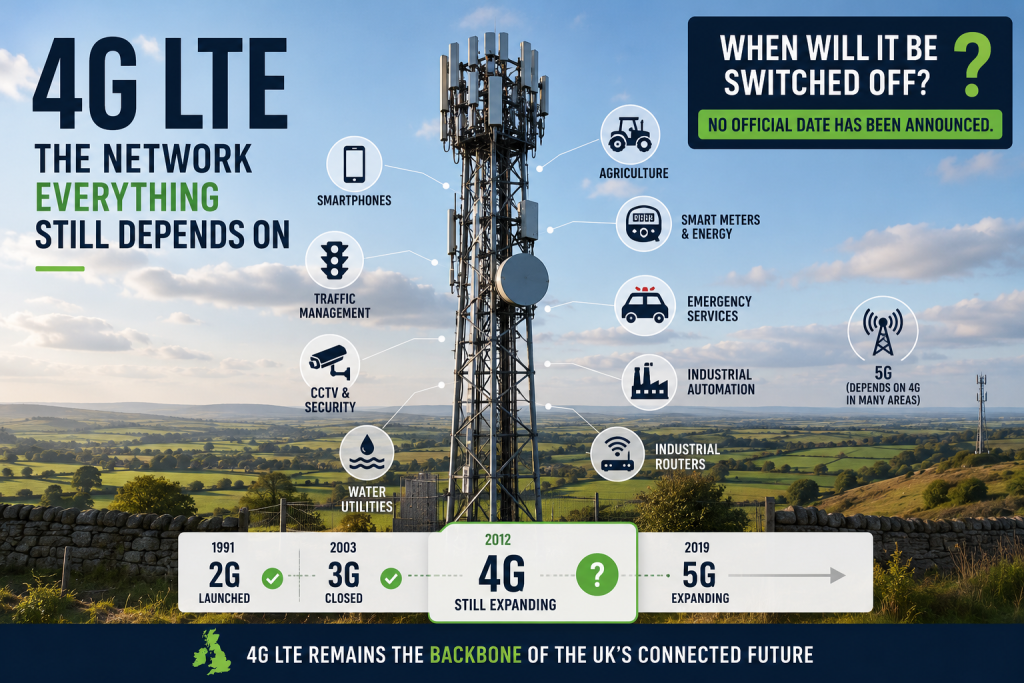
There is no announced date for a UK 4G switch-off. Unlike 2G and 3G, neither the Government, Ofcom nor any of the four mobile operators has published a timetable for retiring 4G LTE. As of 2026, every credible signal points the other way: the UK is still building new 4G, not dismantling it.
That is the answer to the search query. Everything below explains why it is the answer, and why it is likely to stay the answer for a very long time. Because the interesting story here is not that a date is missing. It is why a date is missing when the equivalent dates for 2G and 3G were published years in advance.
Why everyone assumes 4G must be next
The logic feels obvious. 2G is being wound down. 3G has effectively gone. So 4G must be the next domino to fall:
2G → 3G → 4G → 5G → 6G
It is a tidy mental model, and it is wrong. Mobile generations do not replace each other like software updates. They overlap, often for decades, because retiring a network is not a technology decision, it is a national logistics and safety exercise involving millions of devices.
Look at how the UK timeline has actually played out, and one detail jumps out. The lifespans are getting longer, not shorter.
| Generation | UK launch | Status in 2026 |
|---|---|---|
| 2G (GSM) | 1991-92 | Being retired. EE from May 2029, Vodafone during 2030, all operators off by 2033 at the latest |
| 3G (UMTS) | 2003 | Effectively switched off. Virgin Media O2 completed the last areas in early 2026 |
| 4G (LTE) | 2012 | Core national infrastructure. Still being expanded with public money |
| 5G | 2019 | Growing, but mostly urban. Standalone 5G still years from nationwide coverage |
| 6G | ~2030 (expected) | Standards work only. No commercial network |
2G launched more than three decades ago and is only now being phased out. On that trajectory, the idea that 4G, the newest of the “legacy” workhorses, is about to disappear starts to look implausible.
There genuinely is no official 4G switch-off date
This is worth dwelling on, because it is easy to assume the information is simply buried somewhere. It is not. Search the publications of Ofcom, the Department for Science, Innovation and Technology, Mobile UK, the House of Commons Library, EE, Vodafone, Three or Virgin Media O2, and you will find detailed material on 3G retirement, 2G sunset planning, voice migration and emergency calling.
What you will not find is a single sentence beginning “4G will be switched off in”. No operator has announced a date. No regulator has proposed one. No Government policy sets one.
That absence is not an oversight. It is evidence. If LTE retirement were coming within the next decade, planning would already be public, because the connected devices that depend on it have working lives measured in ten to twenty years. The silence tells you the industry does not consider the question live.
The UK is still spending public money building 4G
The strongest argument against an imminent shutdown is not technical. It is financial. The Shared Rural Network is one of the largest telecoms infrastructure programmes in recent UK history, a roughly £1.3bn deal between the Government and all four operators to push 4G coverage to 95% of the UK landmass.
This is not a paper commitment. Coverage has been going live on a monthly basis, and is scheduled to continue through to 2027. Since the programme began, 4G coverage from all four operators combined has climbed from around 66% of the UK to over 81%, an increase roughly the size of Wales and Northern Ireland put together. Separately, £184m is going into upgrading the Extended Area Service masts that also underpin emergency coverage.
Ask yourself the obvious question. Why would the Government and the operators jointly spend well over a billion pounds building and upgrading thousands of 4G masts, deep into rural Britain, if the plan was to switch that same technology off a few years later? It makes no commercial or political sense. The money is the argument.
Much of today’s 5G still runs on 4G
Here is the part most people miss. The assumption is that 5G replaces LTE. In reality, a large amount of UK 5G is Non-Standalone (NSA), which means:
- your phone connects to a 5G radio for speed
- 4G LTE provides the signalling and mobility management
- 4G LTE remains part of the core connection
Your handset can display a 5G icon while leaning on 4G infrastructure to do half the work. Only Standalone (SA) 5G removes that dependency, and Standalone is still a work in progress. In 2026 it is live from EE, Vodafone (marketed as 5G Ultra) and O2, but only in selected places. Three had not launched it at the time of writing. Around three-quarters of the UK population can reach some 5G signal, yet the 5G footprint remains a fraction of the 4G one on every network. VodafoneThree is targeting 99% Standalone population coverage by 2030 and 99.96% by 2034, which tells you how far off ubiquity really is.
Turn LTE off today and you would take a great deal of today’s “5G” down with it. That single fact makes 4G structurally harder to retire than 3G ever was.
Every voice call now rides on LTE
Most people associate 4G with mobile data. Since 3G switched off, it also carries the majority of Britain’s phone calls, using Voice over LTE (VoLTE). With circuit-switched 2G and 3G voice disappearing, LTE has become the default voice network for the country.
The eventual successor is Voice over New Radio (VoNR), which runs on Standalone 5G. But VoNR needs that Standalone coverage to be near-universal before it can carry the nation’s voice traffic, and as we have just seen, that is a 2030s job at the earliest. Until then, no LTE means no reliable mobile voice. You do not switch that off casually.
The emergency services are moving onto 4G, not off it
If you want proof that the UK is betting on LTE for the long haul, look at the Emergency Services Network (ESN). This is the 4G LTE network, built on EE’s infrastructure, that will replace the ageing TETRA-based Airwave system used by police, fire and ambulance services.
ESN involves well over a thousand new 4G masts and tens of thousands of upgraded sites, carrying mission-critical voice, video and data over LTE. The programme is running years behind its original schedule, with a live date now pushed to around mid-2028 and full transition not expected to complete until roughly 2030. A country does not spend a decade and billions of pounds moving its blue-light communications onto 4G, then announce a switch-off date for the same technology. The emergency services are, in effect, a national guarantee that core LTE stays lit.
Millions of IoT devices depend on LTE, and so do LTE-M and NB-IoT
For industry, 4G matters more today than it ever has. Across the UK, millions of connected devices run on LTE: industrial routers, remote telemetry, water and electricity infrastructure, traffic management, ANPR, CCTV, digital signage, agricultural sensors, payment terminals, vending, EV charging and smart buildings. Unlike phones, these systems often stay installed for ten to fifteen years, frequently in remote locations where a replacement means sending an engineer to site.
The smart meter rollout makes the point neatly. As 2G and 3G retire, millions of meters, on the order of seven million in southern England and Wales alone, are being migrated onto a 4G network rather than off it.
Then there is the detail almost everyone forgets. LTE-M and NB-IoT are LTE technologies. They are the low-power, wide-area members of the 4G family, built for long battery life, deep indoor coverage and cheap connected devices, and they are exactly where many smart meters and industrial sensors are heading as the older networks close. Switching off LTE would not just affect traditional 4G broadband. It would pull the rug from under entire IoT ecosystems. Reassuringly, both LTE-M and NB-IoT have industry longevity commitments stretching well into the 2030s, so they are not technologies at risk of sudden obsolescence.
So what eventually replaces mid-tier LTE?
This is where the future genuinely gets interesting rather than alarming. The 5G-era successor to mid-range LTE IoT is 5G RedCap (Reduced Capability, defined in 3GPP Release 17), and its leaner sibling eRedCap (Release 18), which is positioned as the eventual successor to the LTE Cat-1 and Cat-1bis categories that sit inside millions of today’s deployments.
But note the catch. RedCap and eRedCap both require a Standalone 5G network to run on. eRedCap modules only began shipping in 2026, with volume availability expected from 2027, and the GSMA is explicit that these are not drop-in replacements for LTE-M and NB-IoT. In other words, the migration path away from 4G IoT exists, but it depends on the very Standalone 5G coverage that is still years from being everywhere. The bridge to the future is being built, but the old bridge cannot be demolished until the new one reaches the other side.
Could the UK actually switch off 4G at all?
This is the better question, and it is a different one from “when”. Line up everything that currently depends on LTE:
- the majority of the nation’s voice calls, through VoLTE
- large parts of today’s 5G, through Non-Standalone architecture
- the Emergency Services Network
- rural coverage built with public money through the Shared Rural Network
- millions of industrial IoT devices, meters and trackers
- LTE-M and NB-IoT, which are 4G
- a growing base of private LTE networks in factories, ports and utilities
LTE was originally sold as the bridge between 3G and 5G. Somewhere along the way it stopped being the bridge and became the foundation. Almost everything else is now built on top of it. That is precisely why no operator will give you a switch-off date: not because they are hiding it, but because nobody credibly knows.
What a 4G “sunset” will probably actually look like
Forget the idea of a single headline announcing that 4G has been turned off. That is not how this ends. What is far more likely is a slow evolution spread over many years:
- spectrum gradually refarmed from 4G to 5G where demand justifies it
- fewer LTE carriers in dense urban areas as Standalone 5G takes the load
- LTE retained as the coverage and fallback layer, especially rurally
- LTE-M and NB-IoT continuing to serve massive IoT for years
- certain bands quietly retired long before the technology as a whole
It will look less like the 3G switch-off and more like the long, quiet disappearance of the old PSTN telephone network: a gradual erosion that ends one day, decades from now, without anyone ever having circled a date on a calendar. The better engineering question is not “when will 4G die” but “how much of 4G has to survive for everything else to keep working”. Right now, the answer is: most of it.
What this means if you are buying 4G kit in 2026
For businesses specifying long-life connectivity, the practical takeaway is straightforward. A quality industrial 4G router or LTE-based IoT device bought today is very unlikely to be stranded by a network switch-off within its service life. When choosing equipment, the sensible things to weigh are LTE-Advanced support, LTE-M capability where relevant, a solid software-update policy, eSIM and eUICC support for future flexibility, and the manufacturer’s long-term support track record, rather than raw headline speed.
Should you buy 4G or 5G? It depends entirely on the application. 5G earns its place where high throughput, low latency or growing bandwidth demand are genuine requirements. For a great deal of industrial IoT, telemetry, monitoring, remote access, SCADA and environmental sensing, 4G is not merely adequate, it is often the better choice, because LTE coverage remains broader and more consistent than 5G in most of the country.
The honest final answer
So, when will 4G be switched off in the UK? Nobody knows, because no timetable exists, no consultation has been published and no operator has committed to a date. Every piece of available evidence points the opposite way. The Government is still funding LTE expansion. Operators are still investing in it. Businesses are still deploying it. The emergency services are moving onto it. And millions of existing devices depend on it every single day.
4G will not last forever. Eventually spectrum will be refarmed and newer architectures will dominate. But unlike 2G or 3G, the retirement of LTE is unlikely to arrive as a single announcement. It will be a gradual evolution measured in decades, and for now, 4G remains one of the most important technologies in the UK’s communications landscape, with no end in sight.
Sources: Ofcom; Department for Science, Innovation and Technology (DSIT); House of Commons Library; Mobile UK; Shared Rural Network / Digital Mobile Spectrum Limited; UK Government 2G and 3G Switch-off Charter; Emergency Services Mobile Communications Programme (GOV.UK); EE; Vodafone; VodafoneThree; Virgin Media O2; Three UK; 3GPP; GSMA; GSA. Coverage figures and rollout dates reflect the position as of 2026 and will be reviewed annually.


