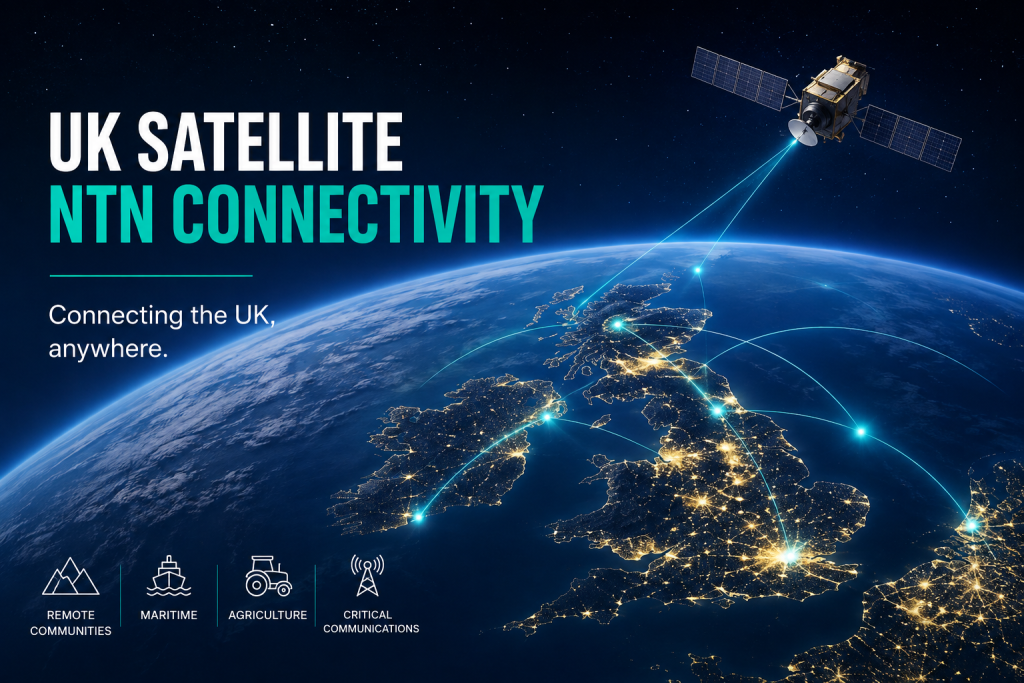
Satellite connectivity in the UK is not one market but three, joined by a supply chain that runs from orbit to the office comms cupboard. This reference maps the whole chain: the constellations, the network operators, the IoT connectivity providers, the resellers and integrators who actually sell to end users, the hardware, and which applications each fits. Current as of August 2026.
“Satellite” in UK connectivity covers three different things: 3GPP NTN, where a cellular device reaches a satellite on one SIM for small data; satellite broadband, where a dish delivers real megabits from a LEO or GEO constellation; and bonding, where an aggregator fuses cellular, satellite and fixed into one resilient link. Behind each sits a supply chain of satellite operators, wholesale network operators, mobile networks, IoT connectivity providers, resellers and integrators. This piece names the companies at every tier, maps them to applications by sector, and shows where satellite competes with 4G rather than complementing it.
What this covers
- Three markets that get muddled
- The satellite connectivity value chain
- Layer 1: 3GPP NTN providers
- Layer 2: satellite broadband providers
- Layer 3: bonding and managed resilience
- The hardware layer
- Applications by sector
- How it competes with 4G
- UK timeline to watch
Three markets that get muddled
Before any provider list is useful, the categories have to be separated, because a company selling one is routinely mistaken for a company selling another. There are three layers, and they answer different questions.
The single most common error is treating Layer 1 and Layer 2 as the same. A 3GPP NTN service does not give you office broadband. A Starlink dish is not NB-IoT. Layer 1 extends coverage for machines and phones that need to send a little; Layer 2 is the dish on the roof that runs the building; Layer 3 stitches everything together so no single failure takes a site down. Keep them apart and the rest of this reference falls into place.
The satellite connectivity value chain
No single company takes a signal from orbit to your office. A chain of specialists does, and understanding who does what explains why you rarely buy from the satellite operator directly. From space to site, the chain runs like this.
OneWeb is the clearest example of the chain in action: it does not sell to end users at all. It works through distribution partners, telecom providers and managed integrators, and behaves like an enterprise circuit rather than a consumer product. So a UK business does not “buy OneWeb” – it buys from Clarus, NSSLGlobal or another partner who buys from Eutelsat.
Layer 1: 3GPP NTN providers
These are standards-based non-terrestrial networks, where a satellite authenticates a SIM the way a foreign operator does and the device roams to it. It splits into IoT-NTN for machines, carrying small telemetry over NB-IoT or LTE-M, and direct-to-device (D2D) for ordinary phones, currently messaging and limited data. For the mechanics, see our non-terrestrial networks explainer.
The NTN network operators
Skylo is a wholesale NB-NTN operator that does not own satellites; it runs a standards-based network over partners such as Viasat and is the layer behind many single-SIM hybrid services, with millions of devices already connected. Sateliot operates its own LEO constellation for 5G NB-IoT NTN built on 3GPP Release 17, has raised significant funding to expand it, and reaches customers through connectivity partners. OQ Technology, based in Luxembourg, runs an S-band LEO constellation for 5G NTN aimed at both IoT and unmodified phones. Alongside these, Viasat and Iridium are bringing their own narrowband NTN IoT services to market during 2026, and AST SpaceMobile supplies the satellites behind VodafoneThree’s direct-to-device plans.
The UK mobile operators
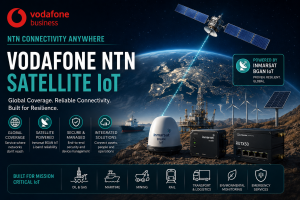
O2 (Virgin Media O2) launched O2 Satellite via Starlink Direct to Cell in February 2026, the first consumer direct-to-cell service in Europe, offering messaging and limited data on supported phones for a few pounds a month, currently up to the 58th parallel. VodafoneThree is running UK customer trials of a space-based 4G and 5G service through its AST SpaceMobile joint venture (SatCo) from summer 2026, and separately offers NB-IoT NTN for machines through Skylo on a single Vodafone SIM. EE/BT is so far focused on satellite broadband for fixed premises rather than direct-to-device.
The UK IoT connectivity providers
This is the tier that puts NTN in the hands of a business running machines. Eseye, a UK IoT connectivity specialist, has partnered with OQ Technology and with Sateliot to extend its AnyNet single-SIM platform to satellite, letting devices roam automatically between cellular and satellite on Release 17. Wireless Logic, the largest European IoT connectivity aggregator, and its Com4 brand have partnered with Sateliot for hybrid cellular and satellite IoT. Caburn Telecom supplies multi-network IoT SIMs to UK deployments, and global platforms such as emnify, Monogoto, Pod Group, Tele2 IoT and Ground Control all offer, or are adding, satellite fallback on a single SIM.
| Provider | Tier | What it offers | UK status |
|---|---|---|---|
| Skylo | NTN network | Wholesale NB-NTN behind many single-SIM hybrid services | Wholesale |
| Sateliot | NTN network | Own LEO NB-IoT NTN constellation, sold via partners | Wholesale |
| OQ Technology | NTN network | S-band LEO 5G NTN for IoT and D2D | Wholesale |
| O2 (Virgin Media O2) | MNO | O2 Satellite via Starlink Direct to Cell | Live |
| VodafoneThree | MNO | AST SpaceMobile D2D; Skylo NB-IoT NTN on one SIM | Trials 2026 |
| Eseye | IoT connectivity | AnyNet single SIM with OQ and Sateliot satellite roaming | Available |
| Wireless Logic / Com4 | IoT connectivity | Managed IoT connectivity with Sateliot satellite extension | Available |
| Caburn, emnify, Monogoto, Pod, Tele2, Ground Control | IoT connectivity | Multi-network IoT SIMs, adding satellite fallback | Available |
The pattern to notice: mobile operators and IoT providers sell the front end, while Skylo, Sateliot and OQ supply the network underneath. A single SIM with the right roaming agreements unlocks any of it, which is why the SIM, not the satellite, is usually the real decision. For the single-site version of this, see our guide to adding satellite backup to an existing 4G router.
Layer 2: satellite broadband providers
This is the layer most people mean by “satellite for the office.” A terminal delivers genuine broadband from a constellation. The constellations are the infrastructure; UK businesses almost always buy through a reseller, installer or managed provider that handles hardware, install and support.
The constellations
| Constellation | Orbit | Positioning | Status |
|---|---|---|---|
| Starlink (SpaceX) | LEO | Largest constellation, over 6,000 satellites; consumer and business, widely available now, fastest to deploy | Live |
| Eutelsat OneWeb | LEO + GEO | Around 648 LEO satellites; strictly B2B and government, SLA and guaranteed bandwidth, sovereign European angle | Live (B2B) |
| Viasat | GEO (Ka-band) | Established GEO broadband and VSAT heritage; higher latency, wide reach | Live |
| Amazon Leo | LEO | Formerly Project Kuiper; Ofcom-approved, UK a priority market; enterprise beta running, terminals up to about 1 Gbps | Commercial mid-2026 |
| Avanti (Hylas) | GEO (Ka-band) | UK-based GEO operator, wholesale and enterprise beams | Live |
How you actually buy it
Starlink and OneWeb sit at opposite ends of the buying model. Starlink sells directly and through authorised resellers, and can be self-installed, which is why it dominates on speed and simplicity. OneWeb does not sell to end users at all; it reaches sites through distribution partners and managed integrators, and behaves like an enterprise circuit that drops into an existing WAN. Amazon Leo is entering enterprise-first, with UK partners lining up ahead of commercial launch.
UK resellers, installers and managed providers
Clarus Networks, through its CLEO division, is a UK OneWeb distribution partner and Starlink authorised reseller that also carries Amazon Leo, serving construction, civil engineering, energy, utilities, healthcare and maritime; it delivered OneWeb to Papa Stour in Shetland under the UK government’s Very Hard to Reach programme. NSSLGlobal is a long-established UK satcom provider serving maritime, enterprise, defence and government, and delivers OneWeb to the UK Foreign, Commonwealth and Development Office for embassies and missions worldwide. Brdy is a Starlink authorised reseller that also carries OneWeb, aimed at business, land-mobility and maritime. Satworks is a nationwide Starlink installation partner. Freedomsat (Bentley Walker) is a multi-technology provider with deep VSAT heritage, and Konnect delivers Eutelsat capacity to rural homes and businesses. EE uses Starlink to fill rural fibre gaps for homes, farms and coastal properties.
For business buyers the meaningful choice is often Starlink versus OneWeb. Starlink is the volume play: fastest to deploy, consumer-plus-business, buy direct or self-install. OneWeb is enterprise-first, built around service level agreements, guaranteed bandwidth, fixed IP and MPLS that drop into an existing SD-WAN, with a European, non-US data angle that matters for government and regulated sites. Amazon Leo is arriving as a third option with AWS integration.
Layer 3: bonding, hybrid WAN and managed resilience
This is where “how does it compete with 4G” usually resolves into “it works with 4G.” Rather than pick one link, an aggregator bonds several. Comms365, whose sat365 LEO service sits alongside its bonded internet, private SD-WAN and multi-network 4G/5G SIMs, is a clear UK example. Clarus Networks and Click Telecom offer similar managed hybrids, typically bonding a LEO satellite link with a multi-carrier 4G/5G router so no single failure takes a site offline.
Underneath much of this sits Peplink and its SpeedFusion technology, which combines cellular, satellite and fixed links into one bonded connection with automatic failover and bandwidth aggregation. When a UK integrator quotes “bonded 4G plus Starlink,” this is usually the engine. The pattern that is emerging fastest is LEO satellite bonded with multi-carrier cellular and, increasingly, private 5G, so a remote site gets a fibre-like experience with no single point of failure.
The hardware layer
The chain only works because the silicon and the boxes exist. On the module side, NTN-capable chips are arriving: the Quectel BG770A-SN combines LTE Cat M1, NB-IoT and NB-IoT NTN with GNSS in one module, and Nordic Semiconductor’s nRF9151 has already achieved chip-to-cloud communication over Sateliot’s network. Sony Altair and u-blox are also active in NTN-capable silicon.
On the connectivity box side, Teltonika, Peplink and Sierra Wireless supply the routers that manage failover and bonding, with Sierra’s AirLink range able to take a satellite receiver over Ethernet as an additional WAN. For broadband terminals, Intellian, Kymeta and Hughes build the flat-panel and dish antennas that OneWeb and other constellations rely on. The direction of travel is integration: hybrid cellular and NTN modems inside a single device, and single terminals that present plain Ethernet to whatever router is already on site.
Applications by sector
The right layer depends entirely on what is being connected and how much data it needs. A livestock tracker and a site office are not the same problem. This is the whole market, sector by sector.
| Sector | What gets connected | Typical need | Best-fit layer |
|---|---|---|---|
| Agriculture | Soil and crop sensors, livestock trackers, machinery | Tiny telemetry over huge, unserved areas | Layer 1 IoT-NTN; Layer 2 for farm broadband |
| Utilities and energy | SCADA, substations, meters, remote plant | Resilient telemetry and site backhaul | Layer 1 for assets; Layer 2 or 3 for sites |
| Construction and civil engineering | Site offices, cameras, plant, welfare units | Rapid primary broadband, no fixed line | Layer 2 LEO; Layer 3 bonded |
| Maritime and offshore | Vessels, rigs, crew welfare | Broadband far from any tower | Layer 2 LEO (Starlink, OneWeb) |
| Transport and logistics | Fleets, containers, trailers, cold chain | Tracking and telemetry beyond coverage | Layer 1 IoT-NTN |
| Broadcast and events | OB trucks, pop-up venues, festivals | High bandwidth, temporary, anywhere | Layer 2 LEO; Layer 3 bonded |
| Retail and hospitality | Remote sites, pop-ups, failover for tills | Primary or backup broadband | Layer 2 or 3 |
| Healthcare and remote care | Clinics, telecare, mobile units | Resilient connectivity, continuity | Layer 2 or 3; Layer 1 for devices |
| Government, defence, emergency | Diplomatic missions, resilience, disaster response | Sovereign, secure, guaranteed | Layer 2 OneWeb via NSSLGlobal |
| Environmental and scientific | Weather, hydrology, remote monitoring stations | Tiny telemetry, zero infrastructure | Layer 1 IoT-NTN |
Where the volume is
Two patterns dominate the UK market. The high-value broadband deals are in construction, energy, maritime, broadcast and government, where a site or vessel needs real bandwidth in a place fibre will never reach, and a managed LEO or bonded solution is worth paying for. The high-volume IoT story is in agriculture, utilities, logistics and environmental monitoring, where enormous numbers of low-cost devices each need to send a few hundred bytes from places with no mobile signal, and single-SIM NTN fallback is the unlock. The two rarely compete; they are different budgets and different buyers inside the same organisation.
How it competes with 4G
Four uses cover almost everything a UK site or fleet needs, and each has a different relationship with cellular. As primary broadband where there is no fibre, LEO now genuinely competes with, and often beats, 4G fixed-wireless on speed and latency: this is the one case where satellite is a straight substitute. As backup, satellite’s value is being a diverse path that does not depend on terrestrial infrastructure at all, so when fibre and 4G both fail it stays up. In bonding, satellite complements 4G rather than competing, with the router blending links for cost and resilience. And for IoT, Layer 1 is not a broadband play at all; it extends cellular coverage for machines that just need to keep reporting.
| Dimension | 4G / 5G cellular | LEO satellite broadband | 3GPP NTN (IoT) |
|---|---|---|---|
| Typical throughput | Tens to hundreds of Mbps | 100 Mbps to 1 Gbps | A few hundred bytes per message |
| Latency | Low | Low for LEO, high for GEO | Seconds |
| Coverage | Populated areas | Anywhere with sky view | Anywhere with sky view |
| Cost model | Low, per SIM or line | Higher, hardware plus airtime | Very low, tiny data |
| Best role | Primary and low-cost | Primary where no fibre, or backup | Coverage of last resort for machines |
| Relationship to 4G | The baseline | Substitute or backup | Extension, not a rival |
The UK timeline to watch
These are the dated markers that will move first. We will revisit them and flag what has changed in a follow-up.
This is the fastest-moving corner of connectivity. Constellation sizes, coverage limits (O2 Satellite’s 58th-parallel line in particular), pricing and partnerships change month to month. Every dated claim here is current as of August 2026 and should be confirmed with the provider before you rely on it.
How to choose, in short
Match the layer to the question. If a machine keeps losing coverage and only needs to report, you want Layer 1 IoT-NTN on the right SIM, bought through an IoT connectivity provider such as Eseye or Wireless Logic. If a site has no decent fibre or 4G, you want Layer 2 LEO broadband, Starlink for speed and simplicity or OneWeb through a partner such as Clarus or NSSLGlobal for SLAs and sovereignty. If downtime is unacceptable, you want Layer 3 bonding that keeps cellular in the mix and adds satellite as the independent path. The mistake to avoid is buying a broadband dish for an IoT coverage problem, or expecting an NTN service to run an office.
Frequently asked questions
Is satellite broadband the same as NTN?
No. NTN (non-terrestrial networks) is the 3GPP standard that lets ordinary cellular devices reach a satellite on one SIM, mainly for small data or phone messaging. Satellite broadband, such as Starlink or OneWeb, uses a dedicated dish to deliver real megabits and is a separate market. They are often confused because both involve satellites.
Who actually sells satellite connectivity to UK businesses?
Rarely the satellite operator directly. For broadband, resellers and managed providers such as Clarus Networks, NSSLGlobal, Brdy, Satworks and Comms365 install and support it. For IoT, connectivity providers such as Eseye, Wireless Logic and Com4 sell managed SIMs with satellite fallback. OneWeb in particular sells only through partners, never direct to end users.
Which UK mobile operators offer satellite?
O2 (Virgin Media O2) launched O2 Satellite via Starlink Direct to Cell in February 2026. VodafoneThree is running direct-to-device trials from summer 2026 through its AST SpaceMobile venture, and Vodafone separately offers NB-IoT NTN for machines using Skylo on a single Vodafone SIM.
What is the difference between Starlink and OneWeb for business?
Starlink has the largest constellation and is the fastest, simplest route to high-speed satellite broadband, sold direct and through resellers to consumers and businesses. Eutelsat OneWeb is enterprise and government first, built around service level agreements, guaranteed bandwidth, fixed IP and SD-WAN integration, with a European non-US data angle, and it is only available through distribution partners.
Can satellite replace 4G or fibre for office broadband?
LEO satellite broadband can serve as primary connectivity where fibre is absent and 4G is weak, often matching or beating 4G fixed-wireless on speed and latency. For sites that already have some connectivity, satellite is more commonly added as a backup or bonded path rather than a full replacement.
Does satellite compete with 4G or complement it?
Both, depending on the layer. LEO broadband competes with 4G where it becomes the primary link. In most business cases, though, satellite complements 4G through bonding and failover, and 3GPP NTN for IoT extends cellular coverage rather than rivalling it.