The factory does not care about hype
RISC-V industrial IoT is where the architecture’s least glamorous virtues become its most valuable. A factory does not buy a processor because it is exciting. It buys reliability, functional safety, a fifteen-year support horizon, and the freedom not to be held hostage by a single chip vendor. That is a very RISC-V-shaped shopping list.
Why longevity is the real argument
Consumer electronics lives for eighteen months. Industrial equipment lives for decades. A control system going into a plant today may still be running, and still needing spare parts and security patches, in 2045. That single fact reshapes the whole buying decision, because the scariest words in an industrial engineer’s vocabulary are “end of life notice” from a chip supplier.
This is where an open instruction set stops being a philosophical nicety and becomes a procurement strategy. Because RISC-V is a standard rather than a product, a design is not chained to one vendor’s roadmap. If a supplier discontinues a core, the architecture carries on and another vendor’s compatible part can step in. That is precisely why Bosch, Infineon, NXP and STMicroelectronics banded together to form Quintauris, a venture built to turn that architectural openness into production-grade, long-lifecycle industrial and automotive silicon.
The industrial argument in one line: tie your product to one vendor’s proprietary core and you are hostage to their roadmap and their decision to discontinue it. An open ISA with several IP sources means the architecture outlives any single supplier. For kit that has to be supported for twenty years, that is not a nice-to-have, it is the whole decision.
Clearing the functional-safety gate
Industrial and safety-critical systems live or die by functional safety, and the umbrella standard is IEC 61508, which grades a system’s integrity on a scale of Safety Integrity Levels from 1 to 4. Its sector cousins, ISO 26262 for automotive, IEC 62304 for medical, the EN 50128 family for rail, all descend from it. Historically this was a moat around established architectures, because unvalidated open-source toolchains simply are not acceptable to a safety auditor.
RISC-V is now clearing that gate. IAR’s functional-safety edition of its RISC-V toolchain is certified by TÜV SÜD to IEC 61508 and ISO 26262, giving safety-system builders the validated tools the regulations demand. Infineon deploys RISC-V lockstep cores as safety monitors inside its automotive parts, where two cores run in step and cross-check each other to catch faults. The honest position is that Arm still holds a deeper history of certifications and qualified silicon, so RISC-V is climbing credibly into safety-critical work rather than owning it outright. But the door is now open, and it was firmly shut only a couple of years ago.
Predictive maintenance: the job everyone actually deploys
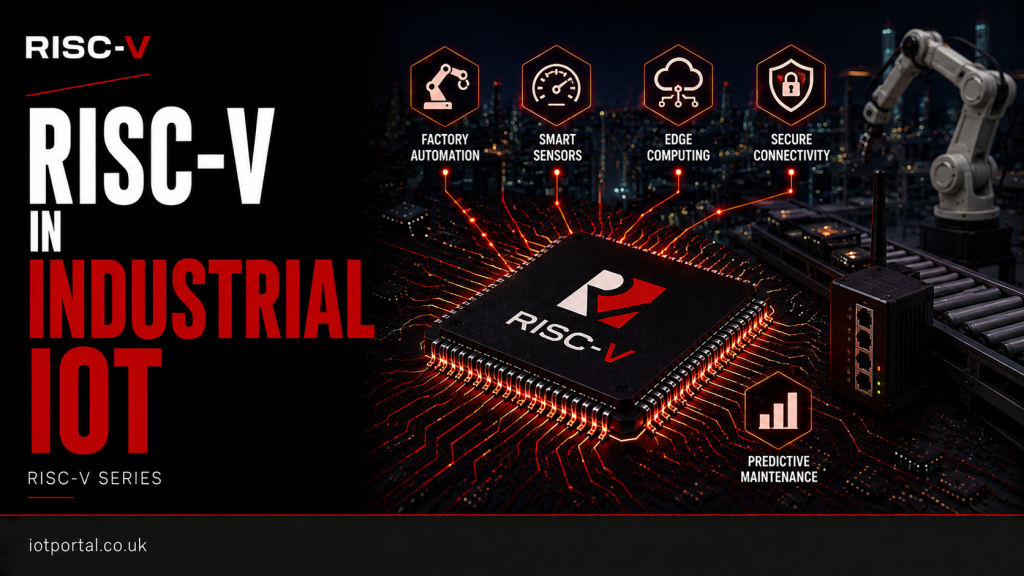
Ask an industrial IoT buyer what they want and the answer is usually the same: tell me a machine is about to break before it breaks. Predictive maintenance is the workhorse application, and it maps perfectly onto the tools this series has already covered. A sensor watches a motor’s vibration, current draw or acoustic signature, a tiny model learns what healthy looks like, and it raises a flag the moment the signature starts drifting toward a fault. That is TinyML anomaly detection doing exactly what it was built for, on the machine, sending only the alert.
The real-time control that sits alongside that sensing leans on the same deterministic behaviour discussed in RISC-V for robotics, and the whole thing has to be locked down, because a compromised sensor on a production line is a serious matter. That security foundation is the subject of RISC-V security, and it is non-negotiable in an operational-technology setting.
What industry demands, and how RISC-V answers
| Industrial demand | Why it is hard | RISC-V answer |
|---|---|---|
| Long lifecycle | Support horizons of 15 to 20 years | Open ISA, multiple IP sources, no single-vendor lock-in |
| Functional safety | IEC 61508 SIL certification is demanding | Certified tooling, lockstep safety cores |
| Determinism | Control loops must meet deadlines | Real-time cores, safety islands |
| Security | Critical infrastructure is a target | Auditable root of trust, PMP, secure boot |
| Cost at scale | Thousands of nodes per site | No royalty, right-sized custom silicon |
Connecting and running the fleet
A predictive-maintenance sensor is worthless if you cannot get its alerts off the plant floor and cannot manage a few thousand of them. Connectivity at that scale means remote provisioning, because nobody is walking the site to configure each node by hand. The SGP.32 eSIM provisioning standard is built for exactly this, letting an operator bring an entire industrial fleet online and switch its network profiles over the air.
On top of that sits the platform that turns raw alerts into something a maintenance team can act on. An IoT platform such as ThingsBoard ingests the telemetry, drives the dashboards, and runs the rules that escalate a drifting signature into a work order. Local intelligence on open silicon, secure identity, managed connectivity and a platform to make sense of it all: that is industrial IoT as a working system, and it is the argument the RISC-V and IoT cornerstone has been driving at throughout.
Last updated 23 August 2026. Sources: IEC 61508 functional safety standard (Safety Integrity Levels 1 to 4) with sector variants including ISO 26262 (automotive) and IEC 62304 (medical) per IEC and Renesas; IAR Embedded Workbench for RISC-V functional-safety edition certified by TÜV SÜD to IEC 61508 and ISO 26262 per IAR Systems; Infineon integrates RISC-V lockstep safety cores in its AURIX line and RISC-V in PSoC 6 per Infineon; Quintauris, founded by Bosch, Infineon, NXP and STMicroelectronics, provides production-grade RISC-V reference platforms for automotive, embedded and IoT per Quintauris, 2026.