Some routers look clever on a datasheet and fall apart in the field. The Teltonika RUT956 does the opposite. It is not about chasing 5G bragging rights. It is about giving you a solid, industrial 4G router that just stays online in cabinets, kiosks, vehicles and plant rooms.
This post goes in depth on what the rut956 actually offers, where it fits best, how it works with Teltonika RMS, and which industries it serves. At the end, there is a section on the Teltonika RUT906 as a lower cost alternative that keeps a very similar feature set for tighter budgets.
What Is The Teltonika RUT956?
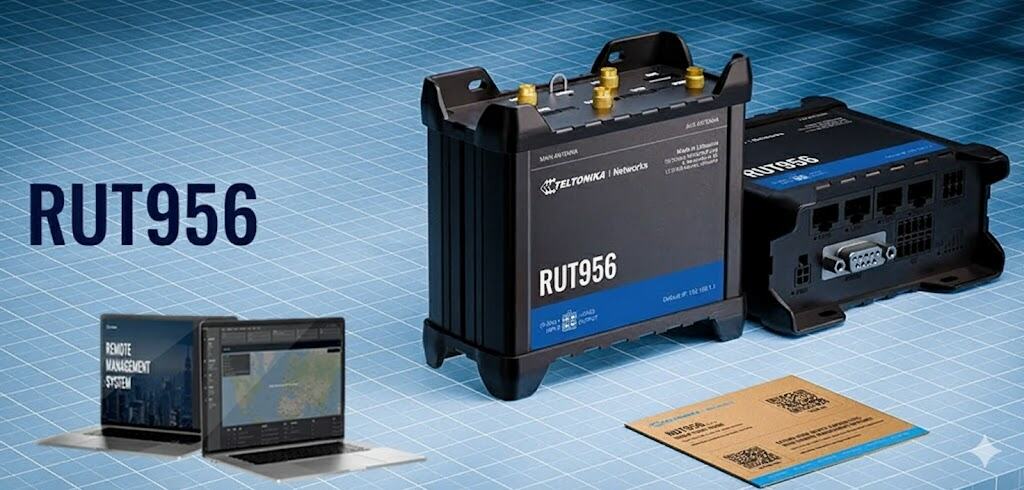
The Teltonika RUT956 is an industrial 4G LTE router that combines cellular, WiFi and wired Ethernet with dual SIM failover, GNSS and industrial interfaces such as RS232, RS485 and digital I/O.
In practical terms, the rut956 gives you:
- 4G LTE Cat 4 mobile connectivity
- Dual SIM with automatic failover
- 2.4 GHz WiFi access point and client
- 1 x WAN and 3 x LAN Ethernet ports
- RS232 and RS485 serial ports
- Digital input and digital output
- GNSS (GPS and other constellations)
- Teltonika RutOS firmware and full RMS support
That mix of connectivity and control means the same box can act as router, serial gateway, simple controller and remote access point for your entire site.
Hardware Overview – Why RUT956 Keeps Showing Up In Designs
On paper, the rut956 sits in Teltonika’s mid range. In reality, it is the router that keeps reappearing in project designs because it does the fundamentals properly and does not need babysitting.
Key Hardware Highlights
- 4G LTE Cat 4 modem
Up to 150 Mbps downlink and 50 Mbps uplink in ideal conditions. In the real world you will see less, but it is more than enough for CCTV, SCADA, EV chargers, remote access and office backup. - Dual SIM with failover
Two physical SIM slots, one radio. RutOS handles failover based on signal level, ping targets, data usage or other rules. If one mobile network falls over, the RUT956 can switch to the other. - Ethernet layout that makes sense
One configurable WAN port and three LAN ports. For many cabinets you simply drop the router in, plug in the NVR, PLC, switch or controller and it becomes the main WAN edge. - 2.4 GHz WiFi
WiFi 4 on 2.4 GHz. Nothing glamorous, but reliable enough as an engineer access SSID, a local hotspot in kiosks, or client mode where you need a wireless backup or bridge. - Serial and I/O for industrial work
RS232, RS485, digital input and digital output. That is exactly what you want for small SCADA panels, metering, BMS, alarm contacts, relay outputs and similar jobs. - GNSS for positioning and timing
GNSS lets you track mobile assets, geotag data, or use GPS time as part of your control and logging strategy.
The result is a single rugged device that can sit in a roadside cabinet, EV charger, solar combiner box, factory panel or vehicle and handle most of the connectivity on its own.
RutOS – The Real Reason Engineers Like rut956
The hardware makes the RUT956 flexible. The firmware is what makes it valuable.
Teltonika’s RutOS is a Linux based operating system tuned for industrial networking. On the rut956 you get the full feature set, including:
- Multiple VPN protocols: IPsec, OpenVPN, WireGuard and more
- Stateful firewall, NAT, port forwarding and policy based routing
- VLAN support for network segregation
- Hotspot features, captive portal and access control
- Modbus TCP and Modbus RTU support
- MQTT client and gateway functionality
- Options for BACnet, DNP3 and OPC UA in industrial projects
- TR-069, SNMP and other management protocols
- Event rules linked to I/O, SMS, network status and timers
In practice, you can make the rut956 act as:
- A pure IP edge router into a private APN or corporate VPN
- A Modbus serial to TCP gateway
- An MQTT publisher feeding a cloud IoT platform
- A field device in building automation or energy networks
- A secure VPN endpoint back into a central firewall
Most of it is done via the web GUI, which matters when your installers are practical engineers rather than full time network specialists.
Teltonika RMS – Managing RUT956 Fleets Properly
If you only deploy one router, you can live without a management platform. Once you have more than a handful of rut956 units in the field, Teltonika RMS becomes the obvious way to keep control.
What RMS Gives You
- Central inventory of all deployed RUT routers and gateways
- Live online/offline status, signal levels and usage graphs
- Remote access to the web GUI and CLI without touching inbound ports
- Bulk firmware updates and configuration templates
- Secure access to devices behind the router using RMS Connect
- RMS VPN Hub for quick, managed VPN topologies
A typical pattern looks like this:
- RUT956 connects out to the mobile network using a private or dynamic IP IoT SIM.
- The router establishes an outbound encrypted connection to RMS.
- You log into RMS over the internet and reach the router and downstream devices through RMS tools or RMS VPN.
You do not need public IP SIMs, you do not expose router GUIs to the internet and you do not turn every site into a one off VPN project.
If you already have your own VPN core, the rut956 can still run IPsec or OpenVPN back into your network. RMS is simply another tool in the stack, not a lock in.
Industries And Applications For RUT956
Teltonika builds the RUT956 as a general purpose industrial router. The reason it sells so well is that it fits across many verticals without needing different hardware every time.
Industrial Automation And SCADA
- RS232 and RS485 for PLCs and RTUs
- Modbus bridging between serial and TCP
- Integration with SCADA servers over VPN or private APN
- Small pump stations, boreholes, process skids and local panels
Anywhere you have serial field devices and a need for central visibility, rut956 is an easy drop in.
Energy And Utilities
- Solar farm inverters and site controllers
- Battery storage systems
- Substations and switchgear monitoring
- Smart metering concentrators and aggregator panels
Dual SIM and GNSS help in remote sites, and digital I/O gives you simple alarm and control in the same box.
Smart City, Roadside And Transport
- ANPR and traffic camera cabinets
- Variable message signs and digital signage
- Roadside telemetry, environmental sensors and weather stations
- Mobile CCTV trailers, service vans and utility vehicles
Here, the mix of dual SIM, WiFi, GNSS and I/O means you can cover both fixed and mobile installations with the same platform.
Retail, Kiosks And Enterprise Edge
- 4G failover for branches and small offices
- Pop up retail and kiosks
- Segregated networks for POS devices and store systems
VLANs and firewall rules let you keep payment traffic away from general LAN traffic while still using one router.
Security And CCTV
Probably the most common real world use:
- NVR and camera backhaul over 4G
- Remote support for installers and monitoring centres
- VLAN separation between cameras, NVR and engineer ports
- I/O for simple alarm contacts and triggers
Get the SIM and antenna right and the RUT956 is a very dependable CCTV backhaul unit.
SIM And Antenna Choices For rut956
The rut956 will only ever be as good as the connectivity and RF you give it. Two areas often get rushed: SIM choice and antenna placement.
SIM Strategy
For serious industrial work:
- Use multi network roaming IoT SIMs where uptime matters and site locations vary.
- Consider private APN or private IP SIMs if you are running your own central VPN core.
- For RMS centric setups, a standard industrial data SIM on a major UK network is often fine, using RMS VPN Hub for access.
The main point is to keep control of how you reach the router. Avoid relying on inbound public IP and random port forwards if you can help it.
Antenna Strategy
The stock magnetic antennas are fine for test benches, close to windows and very simple jobs. For real deployments:
- Use external LTE antennas mounted where signal is strongest, not where the router is convenient.
- Keep LTE cable runs short and use low loss cable types.
- Match antenna type to the bands you actually care about in your country.
- Consider directional antennas for remote or fringe locations.
On many sites, the limiting factor in performance is not the rut956 hardware but poor antenna design or lazy placement.
When RUT956 Is The Right Choice
Use Teltonika RUT956 when:
- You need dual SIM resilience on 4G Cat 4
- You require both RS232 and RS485 for industrial integration
- GNSS is either required or very useful
- You want a router that speaks the common industrial protocols
- You plan to manage a fleet of routers properly via RMS
- You want something that has been deployed at scale in real industrial environments
For most IoT and M2M projects that do not need 5G, the rut956 is a very safe default.
Teltonika RUT906 – Lower Cost Alternative To RUT956
There are plenty of cases where the RUT956 feature set is ideal, but the project is under heavy price pressure. That is where the Teltonika RUT906 comes in.
What Is The RUT906?
The RUT906 is a cost optimised industrial 4G router that aims to offer a very similar feature set to the rut956 at a lower hardware cost. It sits in the same application space.
Typical characteristics include:
- 4G LTE Cat 4 connectivity
- Dual SIM with failover
- Similar Ethernet port layout
- RS232 and RS485 availability
- GNSS support
- Digital I/O for basic control and monitoring
- The same RutOS firmware family and RMS compatibility
From an installer’s point of view, deploying RUT906 often feels very similar to deploying RUT956. Same style of GUI, same RMS integration, same basic wiring principles.
When To Choose RUT906 Over rut956
Choose Teltonika RUT906 instead of rut956 when:
- You want almost the same functionality but at a lower price point
- You are doing a large national or international roll out where every unit cost matters
- Your application is standard industrial IoT, telemetry, CCTV, energy or smart city where 4G Cat 4 is perfectly adequate
- You want to standardise on one platform and still have access to RMS, VPN and industrial protocol features
From a solution design perspective, the decisions become:
- Do you need any specific advantage from the rut956 hardware that the rut906 does not offer?
- Does your customer or internal standard require a particular product code?
- Does the cost saving on RUT906 justify switching, based on your volumes?
If the answer is that you simply need a solid industrial 4G router with dual SIM, serial ports, GNSS, I/O and RMS, the RUT906 is a serious alternative.
Simple Positioning
You can think of them like this:
- RUT956
- Longstanding reference router in the Teltonika industrial range
- Very widely deployed and well understood by integrators
- Ideal where budget allows you to stick with the more established option
- RUT906
- Cost optimised for volume projects
- Very similar practical use cases and deployment patterns
- Designed for projects where price per unit is under close scrutiny
In many tenders and project reviews, the real world conversation becomes: “Do we pick rut956 or rut906 for this rollout, and can we mix them if needed?”
RUT956 FAQ
Does the Teltonika RUT956 support dual SIM failover?
Yes. The RUT956 has two SIM slots and supports automatic failover between them. You can trigger failover based on ping tests, data usage, connection loss or other rules.
Is the RUT956 good for CCTV?
Yes. The rut956 is widely used for remote CCTV and security. It provides reliable 4G backhaul, VLANs for separating cameras and NVRs, VPN support for secure access and RMS for remote management.
Can I connect serial equipment to the RUT956?
Yes. The router includes both RS232 and RS485 interfaces, so you can connect PLCs, RTUs, meters and other industrial devices directly and use Modbus or other serial protocols.
Does RUT956 have GPS or GNSS?
Yes. The RUT956 supports GNSS and ships with a dedicated GNSS antenna. This is useful for asset tracking, mobile installs and adding location data to telemetry.
Do I need a public IP SIM to access rut956 remotely?
No. You can use Teltonika RMS and RMS VPN Hub to access the router and devices behind it over outbound encrypted connections. This avoids the need for public IP SIMs and port forwarding.
Does the RUT956 have WiFi?
Yes. The router includes 2.4 GHz WiFi. It can act as a hotspot for local devices or operate in client mode to join an existing WiFi network.
Is RUT956 suitable for EV chargers and energy sites?
Yes. The feature set fits EV chargers, solar farms, battery systems and other energy projects very well. Dual SIM, serial ports, I/O and RMS support make it a strong choice in that space.
Can I use external antennas with RUT956?
Yes. The rut956 uses standard connectors for LTE, WiFi and GNSS. You can upgrade to higher gain or outdoor antennas to improve performance, especially where signal is poor at the router location.
How does RUT906 compare to RUT956?
RUT906 is effectively a lower cost alternative with a similar feature set. Both cover dual SIM 4G, industrial interfaces and RMS support. RUT956 is the more established choice, while RUT906 is attractive for cost sensitive volume projects.
Which one should I standardise on, RUT956 or RUT906?
If budget allows and you want the most established option, standardise on rut956. If unit price is critical and you are comfortable with the newer cost optimised platform, RUT906 gives you a very similar deployment model at lower cost. Many integrators will use both, depending on project requirements.