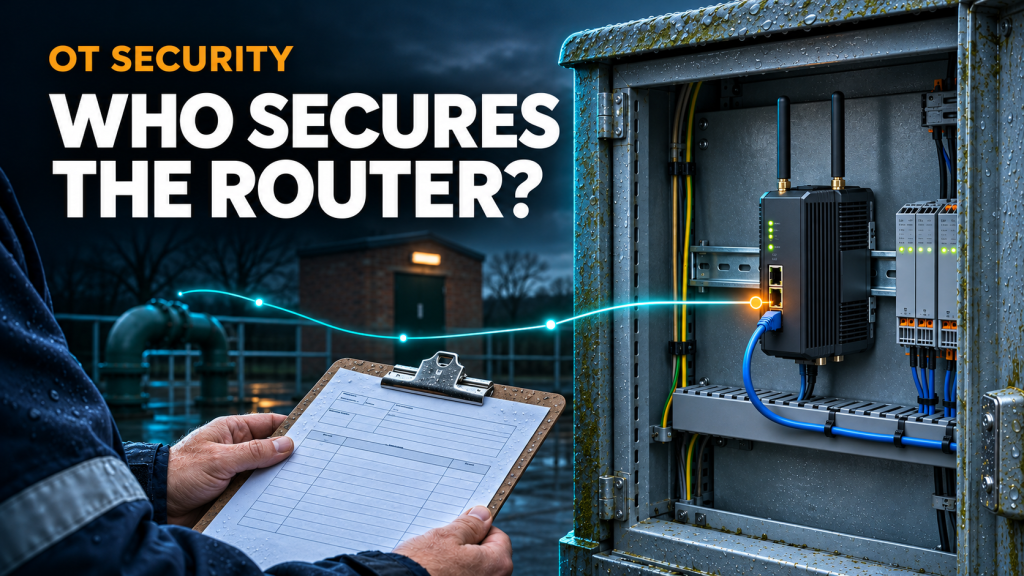
Somewhere near you there’s a cellular router in a grey steel cabinet. It was fitted in 2019, it carries the telemetry for a pumping station, a solar site or a set of car park barriers, and nobody has touched it since the engineer visit that put it there. Nobody is quite sure what firmware it’s on. The admin password is on a label inside the door. The SIM is on a contract that renews itself. And nobody has given cellular router security a second thought since the day it went in.
That router is operational technology now, whether anyone calls it that or not. It sits between a controller that moves real things and a network other people can reach. Ask the companies involved who is responsible for its security, and you’ll get five answers, each pointing at somebody else.
So let’s work from the cabinet outwards, starting with the question that actually matters to whoever signed the order.
Eighteen months later, an advisory lands
This is the sale I see more than any other. A customer orders a router and a SIM. The reseller ships both, maybe slots the SIM in, and that’s the transaction. No configuration, no security advice, no management contract. The customer, their electrician or someone from the IT firm plugs it in, it connects, and everyone moves on.
Eighteen months later the manufacturer publishes a security advisory and a firmware update. Who hears about it? Who can get into the router to apply it? And who pays to put it right?
Here’s how it usually breaks down. I’m not a lawyer, and the contract can move almost any of this, which is rather the point:
| Task | Who arranges it | Who does it | Who pays |
|---|---|---|---|
| Producing the fix | Manufacturer | Manufacturer | Manufacturer. Within a support period that falls under the CRA’s full requirements, security updates must be free of charge. |
| Telling the customer | Manufacturer, if it knows who the customer is. Often it doesn’t. | A reseller that kept serial numbers, if it chooses to | Nobody, which is why it often doesn’t happen |
| Applying the update | Asset owner, unless a managed service contract says otherwise | Whoever the owner engages, or the owner | Whatever the contract says. With no contract, the owner. |
| Getting to the device | Asset owner | Remotely, if remote management was set up. Otherwise someone in a van. | Usually the owner. A single call-out can cost more than the router did. |
| Replacing a device past its support end date | Asset owner | Installer or owner | Owner |
| Fixing a hole left by poor configuration | Asset owner | Whoever is engaged to fix it | Depends on who was paid to configure it and what they agreed to deliver |
The fix is free. Everything needed to get the fix onto the device costs money. In a box-and-SIM sale, nearly all of that lands on a customer who may not even know the advisory exists.
I don’t think resellers who sell kit without services are doing anything wrong. Plenty of customers know exactly what they’re doing and don’t want to pay for help. But two habits should be normal. Say plainly on the quote what isn’t included: configuration, patching and monitoring. And keep serial numbers against customer accounts so advisories can be forwarded, because that costs almost nothing and it’s how a manufacturer’s warning reaches a field it can’t see.
Is cheapest always best?
On the day of purchase, almost always. Over the life of the device, rarely. The price on the quote is the only cost anyone compares, and it’s often the smallest one.
Take two quotes for the same router. One is forty quid cheaper because it’s a box and a SIM. The other includes a documented, hardened configuration and remote management. The first time an advisory lands, the cheap one needs a site visit to patch, and that single call-out has eaten the saving. Across fifty sites it stops being a rounding error, and that’s before you count downtime or an awkward conversation with an auditor.
That doesn’t make the dearest quote right. It means comparing what you’re actually buying: the hardware, how much support it has left, the configuration, remote access, and who you call when the advisory lands. If a quote is cheap because those things are missing, you haven’t saved money. You’ve moved the bill to later and handed it to whoever is on call that night.
The SIM: reachable is not the same as exposed
The SIM decides a lot of this before anyone opens the router’s web page. As we covered in our recent pieces on public IP SIMs, a public address makes the router reachable from the internet. Whether its admin page is actually exposed depends on two things the SIM doesn’t control: whether WAN management is listening, and whether the firewall lets it through. Closing those is configuration, and in a box-and-SIM sale nobody was paid to do it.
A private APN removes the public address, which is a real improvement. But it creates a network shared with every other SIM on that APN, and that matters more than most people realise.
Poland: what overlapping responsibility looks like in practice
CERT Polska’s follow-up report on attacks against the Polish energy sector is the clearest example I’ve seen. The attacker got into a wind farm’s network through an internet-facing FortiGate VPN without multi-factor authentication. That network included a Teltonika RUTX50 cellular router, and its logs show repeated SSH logins through December. The reporting doesn’t establish how the attacker got the router’s credentials, or whether any product vulnerability was involved.
The router sat on a private APN that didn’t adequately isolate its clients, so from one site the attacker could scan devices at another. From 18 December 2025 they found a WAGO PFC200 controller at a combined heat and power plant, with its web interface reachable across the APN and still on default admin credentials. SSH wasn’t enabled on it by default; the logs suggest the attacker switched it on after getting in. On 29 December Siemens PLCs were put into STOP mode and password-locked, shutting down the steam turbine and water treatment. Staff restored operations quickly and CERT Polska reported no impact on the roughly 50,000 residents served.
What’s proven is enough: devices on the private APN could reach one another, and a controller’s web interface was reachable across it with factory credentials. No firmware update fixes either of those. They belong to whoever designed the APN, whoever commissioned the controller, and whoever owns the site.
Would the CRA’s reporting duty have been engaged? It covers severe incidents affecting a product’s security as well as exploited vulnerabilities, so possibly. But whether it applied depends on facts nobody had at the time, and the people who could fix the actual problems weren’t the manufacturers.
Make APN isolation a test, not an assumption. At handover, use another SIM on the same APN and check it cannot reach this site’s management interface. Record the result, and record which systems are allowed through and why. If your SIM provider can’t tell you how client isolation works on your APN, ask in writing.
What the rules actually say
With that picture in mind, here’s where the regulation lands.
CRA reporting, since 11 September 2026. Article 14 of the EU Cyber Resilience Act requires manufacturers to report actively exploited vulnerabilities and severe incidents affecting the security of their products. Reports go through ENISA’s Single Reporting Platform to the national CSIRT acting as coordinator and to ENISA. The manufacturer owes an early warning within 24 hours of becoming aware and a notification within 72 hours. The final report is due within 14 days of a corrective or mitigating measure being available for an exploited vulnerability, or one month after the 72-hour notification for a severe incident.
The installed base counts. The reporting duty reaches in-scope products already placed on the EU market, not just new ones. The wider requirements arriving on 11 December 2027 generally apply to products placed on the market from that date, and to older products only if they’re substantially modified. So the cabinet’s location, and where that router was first sold, both matter.
Support periods. For products under the full requirements, five years is the general minimum, shorter only where the product is expected to be used for less time, and longer where it’s reasonably expected to stay in use longer. The end date must be given, at least as a month and year. Industrial routers routinely do ten years in a cabinet, so the useful question at purchase is how much support is left on the day you take delivery.
Routers are Class I “important” products, so from December 2027 a manufacturer can only self-assess if it applies the relevant harmonised standards; otherwise a third party has to be involved.
Northern Ireland is more complicated than it’s often presented. Some CRA provisions already apply there under the Windsor Framework, but wider application depends on a decision by the UK-EU Joint Committee. Separately, the cyber requirements for radio equipment under the RED delegated regulation (the EN 18031 family) have applied in the EU and Northern Ireland since 1 August 2025.
PSTI in the UK. Since 29 April 2024, consumer connectable products must avoid universal default passwords, publish a way to report vulnerabilities and publish a minimum support period, with duties on manufacturers, importers and distributors. It grew out of the 2018 Code of Practice for consumer IoT security. Plenty of industrial kit sold business-to-business sits outside it, but sensible vendors publish PSTI statements anyway. Note what a statement doesn’t prove: the regime allows passwords defined by the user, so it can’t tell you a particular router shipped with a unique one.
The Cyber Security and Resilience Bill extends the 2018 NIS Regulations to medium and large managed service providers, data centres, large load controllers and designated critical suppliers. Its Lords third reading was scheduled for 2 November, after two government defeats at report stage, and it now returns to the Commons to consider the Lords amendments. If you remotely manage customers’ routers at scale, read the managed service provider definition carefully. You may become the regulated party.
Asset owners already have duties of their own: NIS for operators of essential services (NIS2 in the EU), PCI DSS where card payments cross a cellular link, and IEC 62443 where industrial sites specify it.
Who carries what
These obligations don’t all carry the same force, and that’s where a lot of confusion starts. Some are law, some are standards a customer chooses to specify, and some exist only if they’re written into a contract.
| Role | Legal duties | Standards and contract | Where it tends to fall apart |
|---|---|---|---|
| Manufacturer | CRA: secure design, vulnerability handling, support period, reporting. PSTI for consumer products. | IEC 62443-4 if the customer requires it | Doesn’t know where its devices are or how they were configured |
| Importer (first to bring it into the EU) | CRA: verify conformity and documents, pass on vulnerabilities, notify authorities of significant risk | Supply terms | Grey imports with no paperwork and no identifiable importer |
| Distributor or reseller | CRA: check marking and documents, tell the manufacturer about vulnerabilities, tell authorities and users if the manufacturer stops trading. PSTI: don’t supply non-compliant consumer products. Rebranding or substantial modification can make it the manufacturer. | Whatever the quote and terms promise | Box-and-SIM sales with no record of who bought what |
| Installer or integrator | Little product law; general duties under whatever service was agreed | IEC 62443 integration role where specified; the job specification | Default credentials, WAN management left open, a handover that’s a label inside the door |
| Connectivity provider | Telecoms security duties of its own | APN design, IP addressing and isolation as contracted | Client isolation assumed rather than configured and tested |
| Managed service provider | In scope of the UK Bill if medium or large; NIS2 supply chain duties in the EU | Service levels, patching and monitoring as contracted | One shared admin login across a whole fleet |
| Asset owner | Sector rules: NIS, PCI DSS and others | Accountable for the risk under IEC 62443; sets requirements for everyone else | Assuming the SIM provider or installer “has security covered” |
The most useful idea in IEC 62443 is that roles are not organisations. One company can be product supplier and integrator at once; one role can be split across three companies. The asset owner is expected to write down who does what. Most cellular deployments I see have never had that conversation.
Cellular router security: what the box itself should do
A cellular router on a remote site is a physical object that strangers can walk up to, and that changes the threat model.
- Physical access. A locked cabinet is the start, not the end. Console ports, USB ports and a reset button that restores factory credentials are all ways in for someone with a screwdriver and ten minutes. Disable what you don’t use, and check what a factory reset actually does on your model.
- The SIM. A removable SIM on an open tariff is a data allowance, and possibly a route onto your private APN, for whoever pockets it. Lock SIMs to the device IMEI where the provider supports it, and alert when a SIM appears in different hardware. Soldered eSIMs help here.
- Firmware integrity. Signed firmware and secure boot stop a tampered image being loaded, whether by an attacker or a well-meaning engineer with a file off a forum.
- Credentials. Unique per device or forced to change at first login, changed again at commissioning, stored somewhere other than the inside of the door, and never shared across an estate.
- Management plane. Nothing listening on the WAN that doesn’t need to be. Management over a VPN such as WireGuard or IPsec, through a platform with multi-factor login and an audit trail.
The estate problem is the hundredth router, not the first
One router configured carefully is rarely the issue. The issue is hundreds of devices across dozens of sites, fitted by different installers in different years, on different firmware and different contracts. Security degrades quietly at that scale, in predictable ways:
- No asset register. You can’t patch, monitor or report on what you can’t list. Serial, model, firmware version, SIM, site, installer and support end date, for every device.
- Firmware drift. The oldest firmware sits on the sites nobody visits. Bulk updates from a management platform turn a support period into actual protection.
- End-of-life hardware still in service. When a model leaves support, it doesn’t leave the cabinet. Flag end dates early enough to budget replacements.
- Flat connectivity. Every site on one APN with nothing stopping site A talking to site B. Convenient for the installer, and exactly what turns one compromised site into several.
- Nobody watching. Unusual data usage, a SIM turning up in different hardware, traffic to new destinations, repeated failed logins. Cheap signals to collect. The hard part is who gets the alert at three in the morning, and whether they can act on it.
Buying hardware that won’t become your problem in year seven
- How much support is left? Ask for the support end date, and work out how much remains on the day you take delivery, not the day the model launched.
- Where’s the security advisories page? Look for a published disclosure policy and a history of advisories. A vendor that has never published one either writes perfect code or isn’t looking. I know which I’d bet on.
- How are updates delivered? How often, whether security fixes come separately from new features, and whether firmware is signed and verified at boot.
- How is the first password set? Unique per device, or forced to change at first login. Ask directly; don’t infer it from a compliance statement.
- Conformity documents for your market. The declaration of conformity that matches the marking for where it’s going: CE for the EU and Northern Ireland, UKCA or CE for Great Britain.
- A PSTI statement, as its own check, where the product is in scope or the vendor publishes one anyway.
- An SBOM on request, again as a separate question. Vendors who can’t produce one will struggle with vulnerability handling.
- Remote management that works at scale. Multi-factor login, role-based access, an audit log and bulk firmware pushes.
- Can the SIM be locked to the hardware? Either by the provider or with a soldered eSIM.
And buy through the authorised channel. A marketplace “bargain” can be a grey import with no declaration of conformity, an ex-demo unit on old firmware, or a unit whose support clock started long before it reached you. Ask any reseller whether they keep serials against your account and forward advisories, and whether they rebrand or load their own firmware. If they do, they’ve probably become the manufacturer under the CRA.
When something goes wrong: run both tracks
The operator and the manufacturer have different jobs when something goes wrong, and neither should wait for the other.
My take: a one-page handover table beats a fifty-page policy
The fix isn’t more regulation. It’s writing down, before the engineer visit, who owns each part of each deployment. One table will do. For every row, put a named owner, a deputy, a contact route and the evidence that it was done:
| Item | Usually owned by | Evidence it was done |
|---|---|---|
| Asset register entry (serial, firmware, SIM, support end date) | Asset owner | Register updated at handover |
| Credentials changed and stored | Installer, then asset owner | Credential vault entry; nothing on the cabinet door |
| WAN management closed, remote access via VPN only | Installer | Configuration export and an external reachability check |
| APN isolation tested | Connectivity provider and installer | Test from another SIM recorded; allowed paths listed |
| Advisories forwarded | Reseller or MSP | Serial linked to customer account; named recipient |
| Patching, including who approves the maintenance window and the rollback plan | Asset owner or MSP | Change record with version before and after |
| Monitoring and alerts | Asset owner or MSP | Alert routes tested; 24/7 contact named |
| Isolating a site, including who can authorise it without leaving the plant unsafe | Asset owner | Isolation procedure agreed with operations |
| Escalating to the manufacturer | Reseller, installer or owner, as agreed | Manufacturer security contact on file |
If the answer in most rows is “the customer”, fine. But the customer should know that before signing, not discover it the first time an advisory lands.
Cellular router security across an estate isn’t as complicated or as expensive as people fear. But there are no guarantees, so assume something will get through and have the technology, people and process ready for it. If you can’t name the person who’d ring the manufacturer about an exploited router on your estate tonight, you don’t have a reporting process. You have a hope.
Cellular router security: quick answers
Who is responsible for securing a cellular router in an OT deployment?
Responsibility is shared. The manufacturer is responsible for the product’s security design, vulnerability handling and updates. The installer is responsible for the configuration they were paid to deliver. The connectivity provider is responsible for the SIM, APN and network path. The asset owner is accountable for the overall risk and for deciding who does what, ideally in a written handover.
Who pays to patch a router after a security advisory?
Under the CRA, the manufacturer must supply security updates free of charge during the support period for products under its full requirements. Applying the update, including any site visit, is normally paid for by the asset owner unless a managed service contract covers it.
Does the Cyber Resilience Act apply to routers already installed?
The CRA’s reporting duty, in force since 11 September 2026, covers in-scope products already placed on the EU market. The wider requirements from 11 December 2027 generally apply to products placed on the market from that date, or to older products that are substantially modified.
Is a private APN secure for OT?
A private APN removes public internet exposure, but devices on the same APN may be able to reach each other unless client isolation is configured. Test it at handover from another SIM on the same APN, and record which traffic is allowed.
Sources: European Commission, CRA reporting obligations; ENISA, Single Reporting Platform factsheet; CERT Polska, energy sector incident follow-up report; Help Net Security, report on the CERT Polska findings; GOV.UK, PSTI product security regime; GOV.UK, Regulation (EU) 2022/30 factsheet; UK Parliament, Cyber Security and Resilience Bill; ISA Global Cybersecurity Alliance, IACS roles and responsibilities; NCSC, secure connectivity principles for OT. This article is general information, not legal advice.