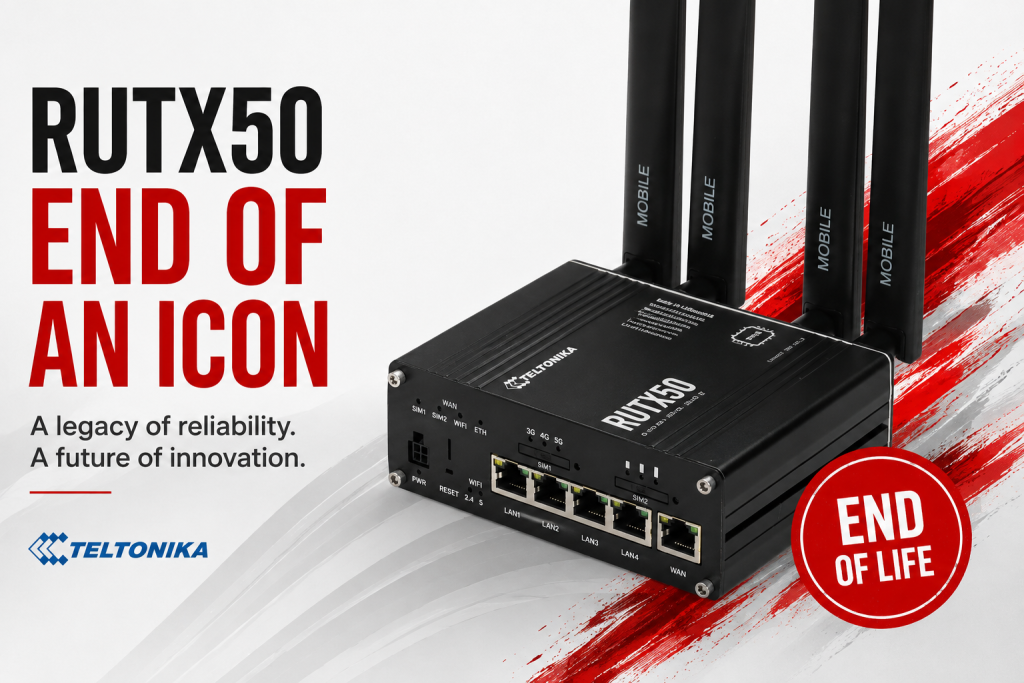
The end of an icon: how the RUTX50 started Teltonika’s 5G story
Teltonika’s first industrial 5G router is on its way out. Its retirement is not a fault or a stumble, it is the moment a single pioneering box grew into a full 5G range that now stretches from pocket-sized RedCap to Wi-Fi 7 home broadband. Here is the arc, from one router to a whole grid, by way of the working life that made it a default.
The first of its kind
When the RUTX50 arrived, it was Teltonika’s first industrial 5G router, and for years it was the default 5G workhorse across UK and European deployments. Five Gigabit Ethernet ports, dual SIM, integrated eSIM, GNSS, digital I/O, USB, Cat 20 LTE fallback and the full RutOS software stack: it was the box you specified when you wanted 5G and did not want to think too hard about it. A generation of installers standardised on it.
Three things, in particular, made it easy to deploy anywhere. It handled 5G SA and NSA automatically, connecting to whatever architecture the network presented and picking up lower latency where standalone cores existed. Its eSIM shipped with a bootstrap profile, so a unit could go into a sealed enclosure or a remote cabinet and pull down an operator plan over the air with no physical SIM pre-staged. And when 5G was not there, the Cat 20 modem fell back to LTE at up to 2.0 Gbps, faster than most dedicated 4G routers, which mattered on the five- and ten-year deployments where the network in year three is never the network at install.
Now it is entering end of life, and it is not going alone. The whole RUTX series is being retired, because Qualcomm has discontinued the CPU platform the range was built on. That is a supply-chain decision upstream of Teltonika, not a reflection on the hardware. Anything running in the field keeps running, and the support window is long.
RUTX50 end-of-life timeline
End of ordering: 3 February 2027. End of production: 3 August 2027. End of support: 3 August 2032. Named replacements: RUTM50 and RUTC50. A unit installed today therefore has firmware and security cover for roughly six more years, so there is no rip-and-replace panic, only a reason to point new standardisation at a successor.
A working life across British industry
The reason the RUTX50 earned its icon status is the sheer spread of jobs it quietly did. Teltonika’s own application library runs to dozens of scenarios, and in the field the box turned up in far more places than most installers first imagined. A few recurring stories tell you why.
Where the line never reached. Greenfield construction sites, remote poultry and agricultural buildings, campervans and mobile offices all share one problem: no fixed broadband, often for the whole life of the project. The RUTX50 became the standard answer, DIN-rail mounted in a site distribution board or a vehicle, taking 5G or Cat 20 backhaul, feeding Modbus data from generators and ventilation controllers up to cloud platforms, and surviving unheated buildings down to -40C on a wide 9-50 V DC input.
When the pictures had to move. Broadcast-grade uplink is where 4G quietly gives up in a crowd, and the RUTX50’s 5G uplink headroom made it a fixture at temporary venues: pitside telemetry for EV motorsport, 4K live streams from fields with no infrastructure, grassroots sports clubs streaming matches for absent supporters. Dual-SIM failover kept streams alive through a network wobble, and channel bonding through Bondix or MWAN3 aggregated several connections when one was never quite enough.
Keeping critical systems talking. Because it was one of the few routers at its price to support 5G SA, it found a home in deterministic, protocol-heavy environments: smart-grid protection and SCADA over a sliced network, port automation across cranes and AGVs, warehouse robotics and WMS platforms. DNP3, Modbus TCP, IEC 61850 and OPC UA all rode the same 5G WAN, with VLAN segmentation keeping operational and IT traffic apart on a single box.
Public safety and moving people. Its dual-network resilience and built-in GNSS suited work where dropping out is not an option, from first-responder command vehicles and event safety teams to bus passenger Wi-Fi and fleet tracking, all managed centrally through Teltonika RMS with firmware pushed over the air. E-mark certification is why it kept turning up bolted into vehicles.
The quiet everyday job. And for thousands of ordinary sites it simply sat as the fixed-line failover behind the payment terminals and the VoIP, VRRP holding a hot standby ready, ping-reboot watching the uplink. That same capability, pointed the other way, is what makes a 5G router a primary broadband service in its own right. For rural premises and anywhere the fibre never came, the RUTX50 has been a mainstay of 5G fixed wireless access, turning the signal outside the window into the connection inside the building.
From one router to a range
The interesting part of the RUTX50’s exit is what has grown up in its place. Where there was one flagship, there is now a deliberate grid, each model built for a different corner of the market rather than a wall of near-identical badges. The four that inherit the RUTX50’s industrial territory are worth knowing by name.
The RUTM50 is the direct like-for-like successor and the new mainstream workhorse: five ports, GNSS, Wi-Fi, and 5G Sub-6 running up to 3.4 Gbps down. The catch for European buyers is that it launched FCC-certified for the US and Canadian markets first. An EMEA and EU variant is expected to land in the September to October 2026 window, which is the piece the region has been waiting on before it can treat the RUTM50 as a straight swap.
The RUTM51 is the budget full-size option: same five-port body, but a lower LTE Cat 12 fallback and no GNSS. It has also been genuinely hard to get hold of, with part shortages keeping it scarce for much of its life so far, so it has never quite become the default it might have been.
The RUTM30 is the compact, cost-first model: two Gigabit ports, dual SIM plus eSIM, Cat 19 fallback, and the same 5G ceiling in a smaller shell. It is the one to reach for where footprint and price matter more than a full port count.
The RUTC50 is the compute-forward member of the family and, in practice, the UK replacement available right now. Docker support, Wi-Fi 6, five Gigabit ports, GNSS, eSIM and dual physical SIM, all driven by a dual-core ARM Cortex-A53. It is the model that pushes the range past “router” and into edge computing.
| Model | Role | Notable spec | GNSS | Status |
|---|---|---|---|---|
| RUTX50 | The retiring flagship | 5x GbE + USB, Cat 20 fallback | Yes | EOL, orderable to Feb 2027 |
| RUTM50 | Mainstream successor | 5x GbE, up to 3.4 Gbps, Wi-Fi 5 | Yes | US/Canada now, EMEA expected Sep-Oct 2026 |
| RUTM51 | Budget full-size | 5 ports, Cat 12 fallback | No | Available but supply-constrained |
| RUTM30 | Compact, cost-first | 2x GbE, dual SIM + eSIM | Yes | Available |
| RUTC50 | Edge compute | Docker, Wi-Fi 6, ARM Cortex-A53 | Yes | Available, the current UK replacement |
Beyond the industrial box
The other half of the story is the shapes 5G is now taking that the RUTX50 never covered. The OTD500 pushes the range outdoors, an IP-rated 5G unit built for construction sites, rural broadband and events where the signal has to be caught outside rather than piped in.
At the other end of the spectrum sits Altos (model CAP700), Teltonika’s move into the living room. It is a 5G Wi-Fi 7 fixed wireless access router aimed at homes, home offices and small businesses, with 5G SA/NSA backhaul, multi-gigabit throughput and a 2.5GbE port, but still running RutOS and managed through RMS underneath. It is consumer-friendly on the surface and industrial in the plumbing, which is a neat summary of where Teltonika is heading.
5G reaches down: RedCap
If the RUTX50 opened 5G at the top of the range, RedCap is opening it at the bottom. Teltonika’s first cellular RedCap 5G routers, the RUT271 and RUT976, bring 5G’s low latency to price and power budgets that used to mean 4G. Both use 5G Sub-6 SA and fall back to LTE Cat 4, with real-world throughput around 223 Mbps on RedCap and 150 Mbps on 4G.
The RUT271 is the compact one, two ports and up to fifty connected devices, effectively the RedCap answer to the old RUT241. The RUT976 is the full-size sibling, four ports, RS232 and RS485 serial, GNSS and up to a hundred devices, the RedCap counterpart to the RUT956. Between the two, 5G stops being a premium tier and starts being something you can put on a solar site, a sensor cluster or a telemetry endpoint without overpaying for throughput nobody needs.
Naming note. The RedCap pair is the RUT271 and the RUT976. There is no RUT971, so if you see that number floating around a spec sheet, it is a typo for one of these two.
The end of an icon, the start of an era
It is tempting to read an end-of-life notice as a product simply running out of road. The RUTX50’s story is the opposite. It was the single box that proved industrial 5G, and it proved it the hard way, on building sites and farms, in broadcast trucks and command vehicles, behind payment terminals and out on rural premises with no fibre for miles. In the years it spent doing that job, it seeded a whole generation: a mainstream successor, a budget model, a compact model, an edge-compute model, an outdoor unit, a Wi-Fi 7 home router, and a pair of RedCap devices carrying 5G down to the cheapest end of IoT.
One router became a range. That is not a device fading out, it is a device that did its job so well the market outgrew it. The RUTX50 is bowing out exactly as it should, with more and better 5G behind it than in front of it when it launched.
End-of-life dates per Teltonika Networks’ EOL notice for the RUTX series. Use cases reframed from Teltonika’s application library. Model specifications correct at time of writing and vary by hardware revision and region. The RUTM50 EMEA/EU launch window is indicative and not yet confirmed on Teltonika’s public product pages.


