
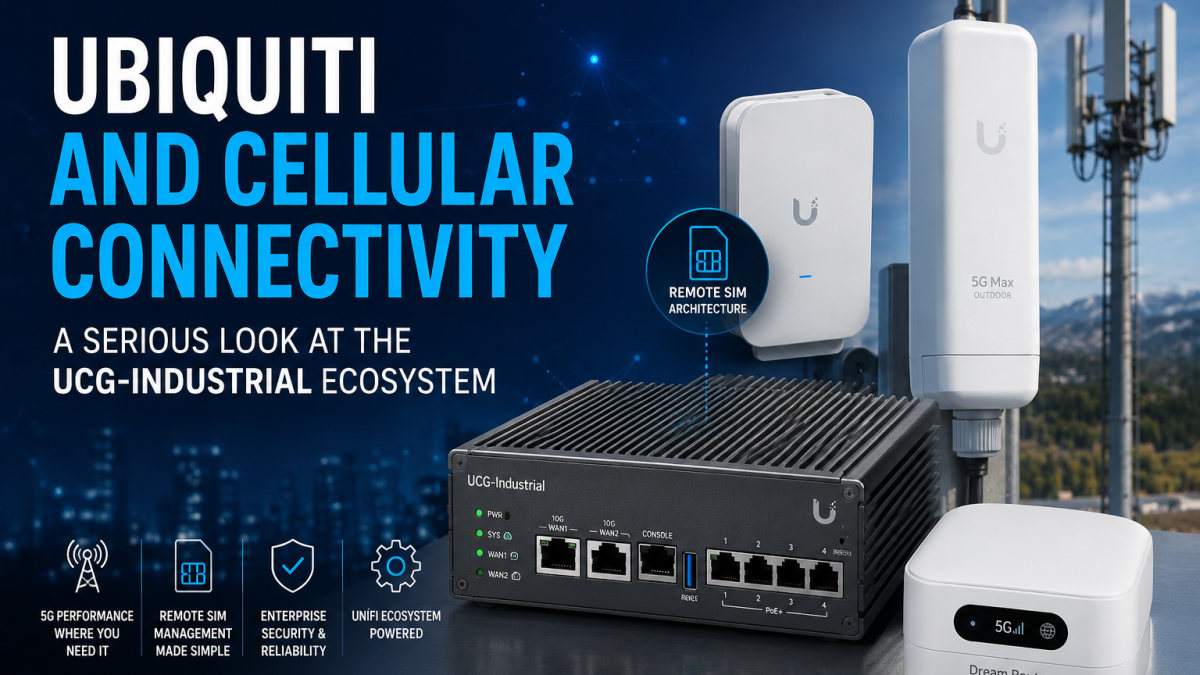
Ubiquiti and Cellular Connectivity: A Serious Look at the UCG-Industrial Ecosystem
Ubiquiti has built cellular integration properly into its own hardware stack: dedicated outdoor 5G modems, a Remote SIM architecture, and a gateway with a built-in 5G modem. This is the technical assessment that connectivity professionals need before specifying any of it.
For a broader overview aimed at construction companies and rural businesses considering 5G fixed wireless access as a broadband solution, see the 5G FWA overview at 5gfwa.co.uk. This piece covers the technical and architectural considerations in depth.
The UCG-Industrial: What It Is and What It Is Not
The UniFi Cloud Gateway Industrial (UCG-Industrial) is a fanless 10GbE gateway built for demanding environments. Its key specifications are worth noting clearly:
- Dual 10GbE WAN ports
- Up to 350W total PoE output
- MicroSD storage for local UniFi apps
- Fanless, ruggedised enclosure
- Extended operating temperature range
- No moving parts
- Runs UniFi OS across all console types
- No per-device licensing overhead
- Multi-site management via UniFi
- Consistent interface across hardware
- SIM slots for Remote SIM architecture only
- No standalone cellular modem built in
Important distinction: The UCG-Industrial is not a standalone cellular gateway. The onboard SIM slots exist exclusively for use with Ubiquiti’s outdoor 5G modem hardware via the Remote SIM architecture. This matters when comparing it against specialist cellular routers from vendors such as Teltonika or Milesight.
The 5G Outdoor Modems: U5G-Max and U5G-Max-Outdoor
Ubiquiti’s cellular hardware for pairing with the UCG-Industrial comes in two forms:
UniFi 5G Max (U5G-Max)
A compact PoE-powered 5G modem that connects to the gateway over a single 2.5GbE Ethernet cable carrying both data and power. The gateway treats it as a virtual WAN interface, enabling dual-WAN failover or load balancing directly through the UniFi interface. Both nano-SIM slots are supported, or one nano-SIM combined with one eSIM.
UniFi 5G Max Outdoor (U5G-Max-Outdoor)
The external deployment variant. IP67-rated with a built-in directional antenna array, designed to be mounted where the signal is strongest: outside the building, on a wall, or on a mast. It connects to the gateway via a single outdoor-rated PoE cable. Performance ratings are 3.4Gbps downlink on 5G NSA and 1.4Gbps on 4G LTE fallback. Dual SIM support matches the indoor unit: two nano-SIMs, or one nano-SIM with one eSIM.
The Remote SIM Architecture: What It Solves and What It Does Not
The SIM slots on the UCG-Industrial support Remote SIM provisioning for the outdoor modems. The principle is straightforward: SIM cards live in the indoor gateway unit while the outdoor modem handles the radio work at the location that gives the best signal.
For installed outdoor deployments, this is a meaningful operational improvement. Accessing an outdoor cellular modem mounted on an external wall or rooftop to swap a physical SIM card is exactly the kind of task that gets deferred, completed under time pressure, or requires a scheduled site visit. Remote SIM removes that friction by keeping the cards accessible indoors.
Be precise about what Remote SIM is: This is not the same as the GSMA’s RSP (Remote SIM Provisioning) standards for eUICC. It is a physical architecture. SIM cards are still plastic nano-SIMs, still tied to a single carrier profile, and still require a physical swap when you change carrier. The “remote” element is the physical location of the SIM slot relative to the modem, not the provisioning model.
eUICC, SGP.32, and the Right Long-Term Answer
The deeper answer to SIM management in remote and hard-to-access cellular deployments is eUICC: embedded SIM technology that decouples the SIM profile from the physical hardware.
With eUICC, carrier profiles are provisioned, switched, and managed over the air. No physical card. No site visit. No scheduled access window. For an outdoor 5G modem mounted at height, or for any deployment where physical access is costly or impractical, eUICC eliminates the SIM management problem at the protocol level rather than working around it with physical architecture.
SGP.32 extends this specifically to IoT and M2M devices. It defines a lightweight IoT Remote SIM Provisioning architecture designed for constrained devices and large-scale deployments: exactly the profile of remote outdoor cellular modems, CCTV connectivity nodes, utility monitoring hardware, and similar applications.
Recommendation for new deployments: For greenfield projects in 2025 and 2026, specify hardware with SGP.32 eUICC support where possible. The Remote SIM approach Ubiquiti has implemented is a sensible bridge for existing hardware and for deployments where physical SIM cards remain the operational norm. For new builds, specify eUICC from the start and avoid remediation cost later.
The Dream Router 5G Max: A Different Product for a Different Problem
The UDR-5G-Max is a desktop all-in-one gateway with a built-in 5G modem, aimed at smaller deployments where a single device needs to handle everything. Key specifications:
- Built-in 5G modem (no separate unit)
- 3.4Gbps downlink on 5G NSA
- Dual SIM: nano-SIM + nano-SIM/eSIM hybrid
- 10G SFP+ WAN port
- Four 2.5GbE LAN ports
- Tri-band Wi-Fi 7 BE10700
- Full UniFi OS
- Supports Network, Protect, Access, Talk
- On-device touchscreen for setup
- Priced at $499
eSIM caveat on the UDR-5G-Max: The hardware supports one nano-SIM and one nano-SIM/eSIM hybrid slot. The eSIM capability is present in hardware, but direct eSIM activation through the UniFi platform was listed as a future software update at launch. For deployments where eSIM carrier switching is operationally important, verify the current software status before specifying this device.
Ubiquiti vs Specialist Cellular Vendors: An Honest Comparison
The question connectivity professionals will reasonably ask: how does the UCG-Industrial plus U5G-Max-Outdoor compare to a dedicated industrial cellular router from Teltonika, Milesight, or similar? The honest answer is that they are solving related but different problems.
| Capability | Ubiquiti UCG-Industrial | Teltonika / Specialist Cellular |
|---|---|---|
| Ecosystem management | Unified (routing, Wi-Fi, CCTV, access) | Router-focused; separate NVR/AP management |
| Per-device licensing | None | RMS subscription per device (Teltonika) |
| Multi-WAN failover | Yes, via UniFi interface | Yes, MWAN3 with granular policy control |
| Industrial protocol support (DNP3, Modbus) | Not natively | Yes, deep support |
| SCADA / protocol persistence across failover | Limited | Supported with correct configuration |
| Custom APN / multi-carrier SIM policy | Basic | Granular control |
| Industrial temperature certifications | Extended range, not operator-certified industrial | Yes, on relevant models |
| Remote management platform | UniFi (mature, multi-site) | RMS (Teltonika), deep cellular diagnostics |
| Target deployment | Managed IT environments, MSP, commercial | Industrial, utility, critical infrastructure |
Where Ubiquiti has a genuine advantage is ecosystem consolidation. A single platform managing routing, wireless, surveillance, access control, and 5G connectivity with no per-device licensing is commercially compelling for the right deployment profile. MSPs managing small-to-medium commercial sites benefit directly from that model.
Where specialist cellular vendors retain an advantage is in protocol flexibility, industrial certifications, and granular WAN management. Teltonika’s MWAN3-based failover, RMS remote management, and support for specific industrial protocols go considerably deeper than what UniFi’s multi-WAN implementation offers. For SCADA connectivity, utility automation, critical infrastructure, or any application where the cellular connection itself needs fine-grained policy control and protocol persistence, dedicated cellular hardware remains the correct choice.
Ubiquiti’s 5G ecosystem is built for managed IT environments where cellular is one WAN option among several. Specialist cellular vendors build for deployments where the cellular connection is the application, not the infrastructure. Both have a place. The mistake is deploying one where the other is appropriate.
Use Cases: Where This Hardware Makes Sense
- MSP-managed commercial sites UCG-Industrial with U5G-Max or U5G-Max-Outdoor, managed centrally through UniFi alongside the rest of the client estate. 5G as primary or failover WAN, PoE cameras and APs on the same gateway, Remote SIM for SIM management without site visits. Strong commercial model for standardised multi-site deployments.
- Construction and temporary sites The Dream Router 5G Max as a deployable unit. 5G primary, SIM failover, Wi-Fi 7 for the site office, PoE for cameras. Single device, fast setup, easy relocation. The on-device touchscreen reduces the support burden for non-technical personnel on site.
- Rural branch offices on 5G FWA Where fixed broadband is inadequate or unavailable, the Dream Router 5G Max as primary connectivity delivers enough throughput for most SME workloads, with the UniFi platform providing the management and security layer. See also: 5G FWA for rural businesses.
- Remote monitoring sites with existing UniFi infrastructure Adding the U5G-Max-Outdoor to an established UniFi deployment provides 5G WAN redundancy with Remote SIM provisioning, integrated into the existing management platform without a separate cellular management system.
- Where not to deploy this Critical infrastructure requiring protocol-level SCADA connectivity management, DNP3 or Modbus persistence across WAN failover, operator-certified industrial temperature ratings, or fine-grained multi-carrier policy control. Those deployments need dedicated cellular hardware from vendors who build specifically for those requirements.
Summary Assessment
Ubiquiti has built a cellular-capable ecosystem that is well-engineered for its intended market. The Remote SIM architecture is a practical solution to a real operational problem. The Dream Router 5G Max is one of the most complete 5G FWA products at its price point. The UniFi platform’s management model is a genuine commercial advantage for MSP and multi-site deployments.
The limitations are real: this platform is built for managed IT environments, not cellular-primary industrial applications. But they are limitations of scope rather than quality. Ubiquiti is not trying to replace Teltonika in a BESS substation. It is building the best gateway platform for commercial and semi-commercial environments that happen to need 5G connectivity.
For new outdoor 5G deployments, the eUICC question belongs in the hardware specification conversation regardless of vendor. Remote SIM is a good operational bridge. SGP.32 eUICC is the correct long-term architecture. Understanding that distinction now avoids remediation cost later.