Milesight UR41 Review: The Compact 4G Router Changing How IoT Gets Deployed
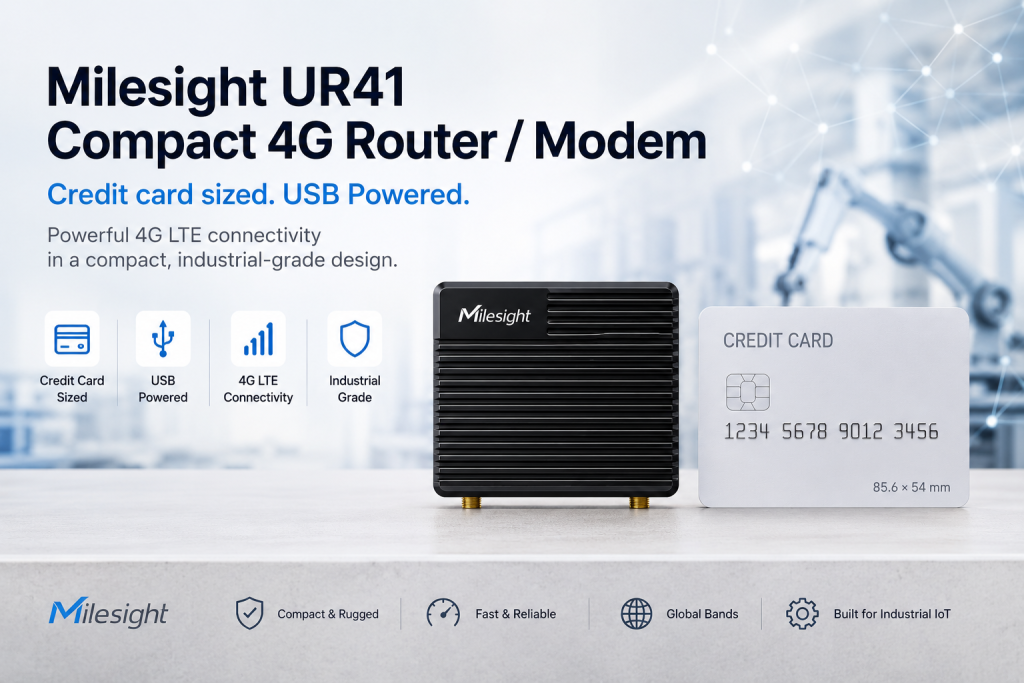
Some products arrive and quietly make you rethink your defaults. The Milesight UR41 is one of them. A 4G LTE router the size of a credit card – thicker, obviously, but only just – that runs on USB power, ships with GPS, handles serial devices, and connects straight into a proper device management and API platform. This is a review worth reading if you deploy IoT connectivity at scale, or even just occasionally.
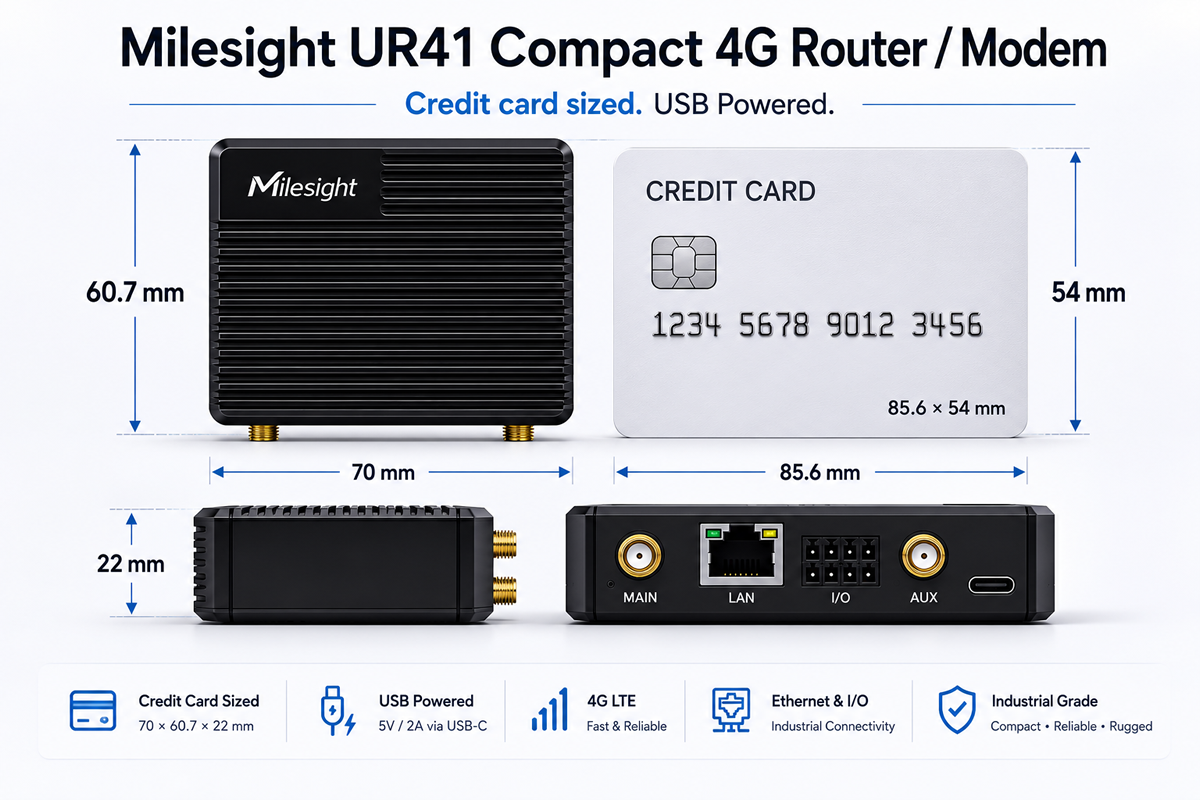
Quick verdict: The UR41 is a serious industrial router in a genuinely small package. USB-C power opens up deployment options that bulkier hardware simply cannot match. The Milesight Development Platform adds enterprise-grade management and API integration at no extra cost. If you are embedding connectivity into equipment, vehicles, vending machines, or any scenario where space and power are constraints, the UR41 belongs on your shortlist.
Why Compact 4G Routers Are Having a Moment
There is a shift happening in industrial IoT connectivity. The traditional approach – a DIN rail router in a control cabinet, mains powered, sized for a 1990s telecoms rack – works fine in a traditional control room. It does not work when your device is a vending machine, a roadside sensor enclosure, a vehicle-mounted controller, or any embedded product where the connectivity module has to disappear into the design.
USB power is the catalyst for this shift. When a router can run off a standard 5V USB supply – the same supply that already exists in most embedded electronics – the whole calculus changes. No separate PSU. No mains wiring. No oversized enclosure. Just a USB cable and a SIM.
The UR41 was built for exactly this reality. It is not a cut-down toy. It is a full industrial router with DI, DO, serial, Ethernet, GPS, and VPN – squeezed into a footprint your hand can cover entirely. Milesight has been building industrial cellular hardware for years, and the UR41 shows that experience. Nothing feels compromised.
Hardware – What You Are Actually Getting
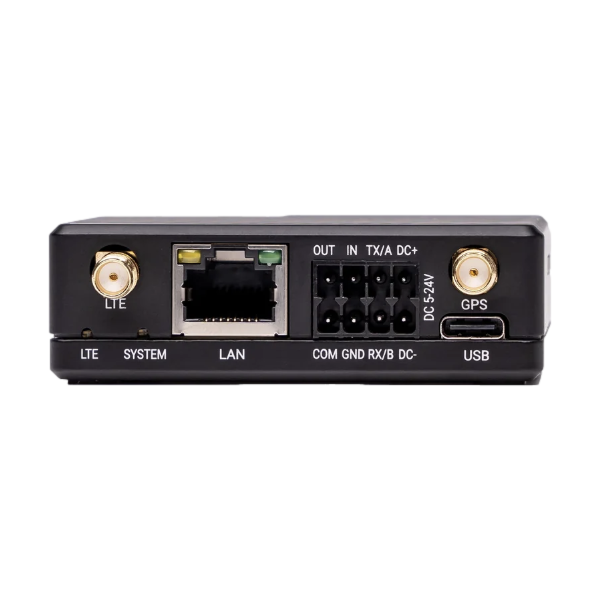
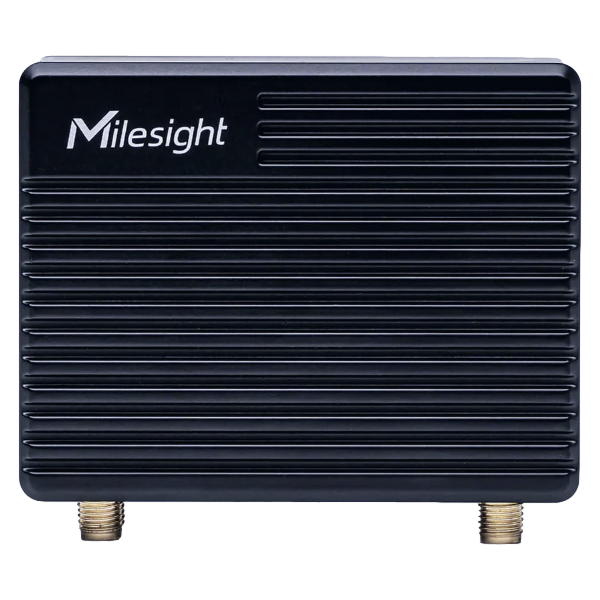
The physical design is straightforward. A ribbed aluminium shell – black anodised, built to IP30 – with the antenna connectors on top and all the IO on the rear edge. Pick it up and it feels solid, not cheap. The metal enclosure doubles as a heatsink, which matters for sustained throughput.
The Ports That Matter
Two SMA antenna connectors. MAIN for cellular, AUX for GPS (on the standard UR41). Both centre-pin SMA female, 50 ohm. The supplied magnetic cellular antenna is adequate for most installs. The GPS antenna is specific to the UR41 variant – the UR41L omits it.
One RJ45 LAN port. 10/100 Mbps, full or half duplex auto-sensing, 1.5kV RMS Ethernet isolation. Single port is the right call for a device this size. If you need more Ethernet ports you need a different router – the UR35 or UR75.
Serial port – RS232 or RS485, software switchable. 3.5mm terminal block, baud rates 300 to 230400 bps, RS485 has a built-in 120 ohm termination resistor switch. This is the interface that earns its money on industrial deployments – connecting to PLCs, RTUs, meters, sensors, and legacy serial equipment.
DI and DO – galvanically isolated. One digital input (dry contact), one digital output (wet contact, 0.3A at 30VDC max). These handle alarm monitoring, relay triggering, and event-driven logic without needing additional hardware. Galvanic isolation is non-negotiable in industrial environments and Milesight has not cut that corner.
USB Type-C port. Dual purpose: 5V/1A power input and USB 2.0 data for debug and network supply. This is the headline feature for embedded and space-constrained deployments. No separate power connector required if you have a USB source.
2-pin terminal block power input as well. 5V to 24VDC, with surge protection and reverse polarity protection. Useful for fixed installations where you want a screw terminal connection rather than USB.
Nano SIM slot (4FF). Single SIM, ejector tool included. The UR41L has one SIM, no Multi-APN. The standard UR41 adds Multi-APN, letting it present different APN connections simultaneously – useful when one device needs to communicate with multiple network services or private APNs.
Key Specifications at a Glance
Connectivity and Software Features
The hardware is compact but the software stack is not. Milesight has implemented a proper industrial feature set – this is not a consumer router with an industrial label stuck on it.
VPN Support
IPsec, OpenVPN, GRE, L2TP, PPTP, DMVPN, WireGuard, and ZeroTier are all supported. That covers every serious VPN scenario – from traditional site-to-site IPsec tunnels through to modern mesh VPN with WireGuard or ZeroTier for zero-config connectivity. For a router this small, the breadth of VPN support is impressive.
Serial Protocol Handling
The serial port is not just a transparent pipe. The UR41 supports transparent TCP/UDP forwarding, Modbus TCP and RTU client modes, Modbus gateway (RTU to TCP bridging), and DLMS client. If you are connecting electricity meters, PLC equipment, or any Modbus device, the UR41 handles the protocol conversion internally. No separate Modbus gateway required.
GPS and GNSS
The UR41 (not UR41L) includes a dedicated GNSS antenna connector supporting GPS, GLONASS, Beidou, Galileo, and QZSS. Positioning accuracy of 2.5m CEP in open air. Location data can be pushed via NMEA0183 over serial, MQTT, TCP, or UDP. This makes the UR41 a credible choice for light vehicle tracking, asset management, or any application where connectivity and location need to travel together.
Power Management
The UR41 has a genuine power-saving architecture. Standby mode draws 6.3mA at 12V – well under 80mW. The device can wake from standby on schedule, SMS, DI trigger, or remote command. For solar-powered or battery-backed deployments where power budget is tight, this is a serious advantage over routers that idle at several watts.
Security
Access control lists, DMZ, port mapping, MAC binding, SPI firewall, DoS and DDoS protection, IP and domain filtering. AAA authentication via Radius, TACACS+, and LDAP alongside local authentication with multiple user authority levels. WAN failover via VRRP. Hardware watchdog with automatic recovery. The security posture is appropriate for enterprise and industrial deployments, not an afterthought.
Where the UR41 Makes Sense
Vending Machines and Kiosks
USB powered from the machine’s existing supply. Small enough to mount inside any cabinet. Serial port connects to the payment controller or vending logic. Remote management handles firmware and config updates without a site visit.
Robotics and Automation Equipment
Fits inside equipment enclosures where a standard DIN rail router would not. Low power draw. Serial interface to robot controllers and PLCs. WireGuard VPN for secure remote access to the automation network.
Remote Sensor and Monitoring Nodes
DI triggers on alarm conditions. Serial connects to environmental sensors or data loggers. GPS tracks the location of mobile or semi-permanent monitoring stations. Standby mode preserves battery life between readings.
Vehicle and Fleet Applications
GPS built in. USB or 5-24VDC power from vehicle supply. Compact enough to mount behind panels. Sends position and telemetry data over 4G LTE. Integrates with Modbus-based vehicle diagnostic hardware via RS485.
Smart Energy and Metering
RS485 connects directly to smart meters and energy monitoring equipment. Modbus gateway mode eliminates the need for separate protocol converters. DO output can trigger contactors or load switches. Low idle power preserves energy budgets on solar or battery-backed sites.
OEM Embedded Connectivity
Equipment manufacturers embedding 4G connectivity into products. Small enough to integrate without redesigning the enclosure. USB power keeps the BOM simple. Milesight Development Platform API allows the OEM application to interact with the router programmatically.
Milesight Development Platform – Remote Management and API Integration
The hardware story is compelling on its own. The platform story is what separates the UR41 from a basic 4G router purchase.
Milesight Development Platform is a cloud-based device management and integration platform. It handles the full lifecycle of the router fleet – provisioning, configuration push, OTA firmware updates, monitoring, and alerting – from a single interface. The UR41 connects to it via the router web GUI under System > Device Management. The platform is free to use for most deployments, with a Professional tier for larger enterprise requirements.
What the Platform Covers
Centralised Device Management
Add, configure, and monitor all UR41 units from one dashboard. Bulk configuration push and auto-provisioning from templates on first connection.
OTA Firmware and Config Updates
Schedule and push firmware updates and configuration changes across the full fleet without physical access to each device.
Alerting and Event Management
System startup, reboot, network up/down, DI state changes, and custom thresholds all generate alerts that can trigger notifications or webhooks.
Role-Based Access Control
Multi-level user authority, team management, and external collaboration permissions. Suitable for multi-tenant or multi-client deployments.
RESTful API
Full REST API for device management: add, query, configure, and monitor devices programmatically. Integrate the router fleet into your own application or platform.
Real-Time Webhooks
Event-driven notifications push device data and state changes to your application in real time. No polling required.
The API and webhook capability is the feature that OEM integrators and platform builders care about most. Third-party applications can use the Milesight Development Platform RESTful API to add, manage, and configure devices programmatically – and receive real-time event data via webhooks. This means the UR41 can be embedded inside a larger IoT application without the end user ever needing to touch the Milesight portal directly. The application handles provisioning, monitoring, and configuration through the API. That is a serious capability to include alongside a compact router at this price point.
DeviceHub remains in parallel as the more established management platform, particularly suited to straightforward fleet management without the API integration layer. MilesightVPN handles secure remote access separately. All three are available to UR41 users.
UR41 vs UR41L – Which One?
The UR41L is the lite variant. Same physical hardware, same industrial build, different modem specification and some features removed. Here is a clean comparison.
| Feature | UR41 | UR41L |
|---|---|---|
| 4G LTE Category | Cat 4 (150 Mbps DL / 50 Mbps UL) | Cat 1 (10 Mbps DL / 5 Mbps UL) |
| 3G WCDMA fallback | Yes | No |
| GPS / GNSS | Yes – GPS, GLONASS, Beidou, Galileo, QZSS | No GPS antenna connector |
| Multi-APN | Yes | No |
| Regulatory | CE + FCC | CE only |
| Power consumption (data link, 12V) | 226 mA | 157 mA |
The short answer: buy the UR41 unless you have a specific reason to save on power or the throughput difference is irrelevant. The GPS alone justifies the standard model for most IoT deployments – and Cat 4 headroom prevents the modem from becoming a bottleneck as applications grow. The UR41L makes sense for very power-constrained battery deployments where GPS is not required and Cat 1 speeds are sufficient.
What It Is Actually Like to Use
Setup is straightforward. Connect power and LAN, navigate to the web GUI, insert the SIM, configure the APN, and the router is online. The web interface is clean and logically structured. VPN configuration requires some familiarity with the relevant protocol but nothing unusual. Serial and DI/DO configuration is in a dedicated section and clearly labelled.
CLI access via SSH and Telnet is available for those who prefer scripted configuration or want to manage a fleet of units from a central system without the DeviceHub. SNMP v1/v2/v3 and TR069 cover legacy NMS integration.
The physical size takes a moment to adjust to. When you pull the UR41 out of the box, it feels almost too small to be a proper industrial router. The ribbed metal shell reassures you. The IO connectors feel solid. The SIM tray is a standard Nano SIM ejector-tool design – fiddly if you are doing it frequently, perfectly adequate for the typical deploy-once use case.
Antenna performance is typical for a single-antenna design. The supplied magnetic cellular antenna provides adequate signal for most deployments. For installations with marginal signal or specific RF requirements, the SMA connector accepts any compatible external antenna – including roof-mounted, high-gain, or MIMO configurations if you add an external LTE modem or upgrade antenna separately.
The power savings are measurable and meaningful. At 6.3mA standby on a 12V supply, the UR41 draws under 76mW in its lowest power state. A 10,000mAh battery pack provides theoretical standby duration measured in weeks, not hours. For solar-powered remote monitoring this is a genuinely useful figure.
Frequently Asked Questions
Summary – Is the UR41 Worth It?
The UR41 earns its reputation as a category-defining compact router. Milesight has not simply miniaturised a router – they have made deliberate engineering choices that make the UR41 genuinely better suited to embedded and compact deployments than a larger device. USB power is the headline feature but it is the combination of USB power, GPS, serial IO, DI/DO, industrial temperature range, low standby consumption, and the Milesight Development Platform API that makes this a router worth serious consideration.
The free device management platform is the sleeper feature. Most competing hardware at this price point asks you to bolt on third-party management tools or build your own. The Milesight Development Platform – with its REST API, webhooks, OTA updates, and centralised configuration – comes with the device and works on day one. For OEM integrators embedding connectivity into products, the API integration capability is worth as much as the hardware itself.
It is not perfect. Single SIM limits redundancy. Single Ethernet port limits local network complexity. IP30 means it needs to live inside an enclosure in dirty or wet environments. The DIN rail kit is an optional add-on that arguably should be in the box for a device marketed at industrial deployments. But none of these are deal-breakers for the scenarios the UR41 is designed for.
If you deploy IoT connectivity regularly and you have not yet tried a compact USB-powered router in your toolkit, the UR41 is the one to start with.
Buy the Milesight UR41
Available from Routerstore, official UK Milesight reseller. The UR41 with 4G Cat 4, GPS, and full industrial IO ships with magnetic cellular antenna, GPS antenna, wall mounting kit, and 8-pin terminal block.
View the UR41 on Routerstore