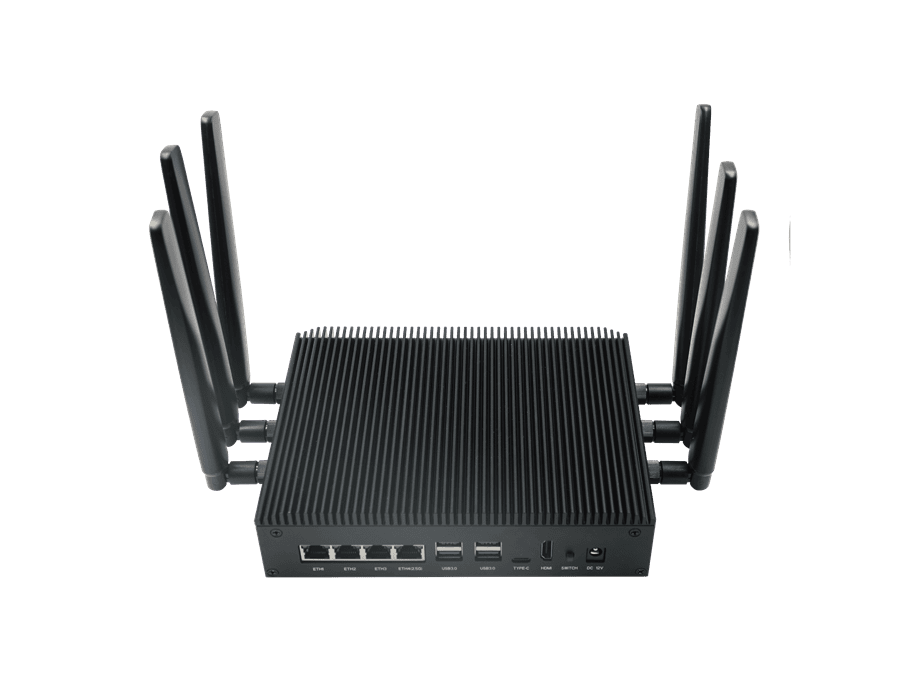
Quectel QB560D: A 5G Edge Computing Box with 14 TOPS – and What That Number Actually Means
Quectel has launched the QB560D, a compact 5G edge computing box built around the Qualcomm QCM6490 platform. It ships with 14 TOPS of AI compute, Ubuntu OS, and a full industrial interface set. Here is what the hardware offers and why the TOPS figure is the metric you need to understand.
What Is the QB560D?
The QB560D is Quectel’s new multi-mode 5G edge computing box – a self-contained unit designed to run workloads at the network edge rather than offloading processing to the cloud. It is built on Quectel’s own SG560D smart module, which uses the Qualcomm QCM6490 or QCS6490 64-bit octa-core processor alongside an Adreno 643 GPU.
The device runs Ubuntu OS and is aimed at applications where local AI inference, video analytics, or intelligent control logic must operate without depending on a round-trip to a data centre. Target verticals listed by Quectel include smart retail, smart parks, safety and security monitoring, and industrial automation.
It is available in two variants: QB560D-CN (cellular, for regions including the UK and Europe) and QB560D-WF (Wi-Fi only).
Full Specification Summary
The core hardware is derived from the SG560D module platform, which Quectel has used across several product lines. The QB560D wraps it in an enclosure suited to fixed industrial deployment rather than embedded integration.
| Parameter | QB560D Specification |
|---|---|
| Platform | Qualcomm QCM6490 / QCS6490 |
| CPU | 64-bit octa-core (Kryo 670), 1.9-2.7 GHz |
| GPU | Qualcomm Adreno 643 |
| AI Compute | 14 TOPS total / 12 TOPS NPU |
| Video | 4K H.265 / H.264 encode and decode |
| OS | Ubuntu (built-in) |
| 5G Cellular | 5G Sub-6 GHz, NSA and SA (3GPP Release 15), LTE Cat 18, 3G fallback |
| Wi-Fi | Wi-Fi 6E with DBS, IEEE 802.11ax, 2×2 MU-MIMO |
| Bluetooth | 5.2 |
| Interfaces | HDMI, Ethernet, UART, USB, DP over USB, RS-232, RS-485 |
| Dimensions | 200 mm x 154.7 mm x 51.3 mm |
| Operating Temp | -35°C to +75°C |
| Variants | QB560D-CN (cellular) / QB560D-WF (Wi-Fi only) |
Quectel quotes 14 TOPS “comprehensive computing power” and 12 TOPS “edge computing power”. The 12 TOPS figure refers specifically to the on-chip NPU (Neural Processing Unit) – the hardware block optimised for AI inference workloads. The remaining compute comes from the CPU and GPU working in combination. For most IoT AI tasks, the 12 TOPS NPU figure is the one that matters.
What Is TOPS and Why Does It Matter for Edge AI?
TOPS stands for Tera Operations Per Second. One TOPS means one trillion mathematical operations executed every second. The metric specifically describes the throughput of AI-focused hardware – primarily Neural Processing Units (NPUs) – for inference workloads: taking a trained AI model and using it to make decisions, classify objects, or detect anomalies in live data.
TOPS became the standard AI performance metric after Movidius (acquired by Intel in 2016) used it to describe the performance of their early machine vision processors. Since then it has become the go-to benchmark across NPU, GPU, and AI accelerator comparisons.
What the maths actually looks like
Most AI operations in neural networks are multiply-accumulate (MAC) calculations – the basic arithmetic of matrix multiplication at large scale. NPUs are built around arrays of MAC units running in parallel. The TOPS figure is calculated roughly as: 2 x (number of MAC units) x (clock frequency), divided by 10 to the power of 12.
A chip with 1,000 MAC units at 1 GHz delivers approximately 2 TOPS. The QCM6490 at 12 TOPS NPU is doing considerably more parallel work than that – the Qualcomm architecture combines MAC depth with reduced-precision computation (INT8 and lower) to maximise throughput within tight power budgets.
TOPS is a theoretical ceiling, not a guaranteed throughput
The TOPS number represents peak theoretical performance under ideal conditions. Real-world inference throughput depends on several factors: model architecture, software framework efficiency, quantisation precision (INT8, FP16, FP32), thermal headroom, and memory bandwidth. Two devices with the same TOPS can perform differently on the same workload depending on how well the software stack maps to the hardware.
That said, TOPS is still a useful comparative signal. If one device offers 12 TOPS NPU and another offers 4 TOPS, the first has significantly more headroom for complex inference tasks – provided the software takes advantage of it.
TOPS NPU – Contextual Comparison (as of April 2026)
Approximate values. TOPS figures reflect manufacturer NPU ratings. Actual inference performance varies by workload and software stack.
What 12 TOPS enables in practice
For industrial IoT and smart infrastructure deployments, 12 TOPS NPU headroom is sufficient for several concurrent AI tasks. Typical workloads at this compute level include: real-time object detection from multiple camera streams (YOLOv5/v8 scale models), licence plate or asset identification, anomaly detection on sensor time-series data, and basic natural language command processing.
Where 12 TOPS becomes a constraint is in running very large vision models (high-parameter transformer architectures) or high-resolution multi-camera inference at speed. For those workloads, NVIDIA Jetson Orin class hardware at 40+ TOPS is the relevant tier. The QB560D sits in the mid-range – more capable than a standard cellular router or gateway, considerably less power-hungry than a Jetson-class platform.
The Connectivity Stack
The QB560D is not just an edge compute box with cellular bolted on. The connectivity is derived from the SG560D module – Quectel’s own 5G smart module – and is a full implementation of 5G NSA and SA modes under 3GPP Release 15, with LTE Cat 18 fallback and 3G support.
LTE Cat 18 supports downlink speeds up to 1.2 Gbps via carrier aggregation and 4×4 MIMO, which is relevant in high-throughput video backhaul scenarios. 5G SA mode eliminates the LTE anchor dependency that NSA requires, giving lower latency and access to 5G standalone network slicing where operator support exists – though as of early 2026, 5G SA deployment across UK mobile networks remains limited to certain urban areas and operators.
Wi-Fi 6E adds the 6 GHz band alongside 2.4 GHz and 5 GHz. The DBS (Dual Band Simultaneous) capability means the device can operate on two bands concurrently rather than switching between them. For edge deployments where the QB560D acts as both a local processing node and an access point or uplink aggregator, this matters for throughput and interference management.
UK operators including EE, Three, and Vodafone have rolled out 5G SA in limited areas as of 2025-2026. For most QB560D deployments outside major cities, 5G NSA or LTE Cat 18 will be the active mode. Verify SA coverage with your operator and SIM provider before designing around SA-specific capabilities such as network slicing or sub-10ms latency guarantees.
Interface Set and Industrial Suitability
The QB560D’s interface list is what distinguishes it from a general-purpose mini PC with a 5G modem. RS-232 and RS-485 serial interfaces put it in direct conversation with industrial sensors, PLCs, meters, and legacy control systems – equipment that is common in utilities, manufacturing, and infrastructure deployments and has no Ethernet or USB connectivity.
HDMI and DisplayPort over USB outputs, combined with 4K H.265/H.264 encode and decode capability, position the device for digital signage, security monitoring dashboards, or HMI (human-machine interface) applications where a local display is needed alongside the edge compute function.
The operating temperature range of -35°C to +75°C is industrial-grade. For comparison, most consumer-grade hardware is rated to 0°C minimum. This extends the deployment envelope to outdoor enclosures, transport applications, and environments without climate control.
| Interface | Relevance for IoT Deployment |
|---|---|
| RS-232 / RS-485 | Legacy sensor, meter, and PLC connectivity – common in utilities and industrial automation |
| Ethernet | Local network integration, switch connectivity, wired backhaul |
| USB | Peripheral attachment, firmware management, debug access |
| HDMI / DP over USB | Local display output for dashboards, signage, or HMI use cases |
| UART | Low-level serial for embedded module communication |
| 5G / LTE (cellular) | Primary WAN uplink in QB560D-CN variant |
| Wi-Fi 6E | Local wireless aggregation or secondary uplink |
Use Cases and Where the QB560D Fits
Quectel positions the QB560D for smart retail, smart parks, smart safety, and industrial applications. These are broad categories, but the hardware characteristics point to a more specific profile: deployments that require local AI inference on video or sensor data, a 5G uplink for backhaul or remote management, and integration with legacy serial-interface equipment.
Smart infrastructure and surveillance
A single QB560D can ingest camera feeds locally, run object detection or classification inference on-device, and report only events (rather than raw video) upstream via 5G. This reduces backhaul bandwidth significantly compared to streaming full video to a central server for processing. The -35°C operating floor supports outdoor enclosure deployment in UK climate conditions.
Industrial edge gateways
The combination of RS-485, UART, and Ethernet with a capable NPU enables a hybrid role: protocol translation and data aggregation from legacy field devices, combined with on-device analytics before data is forwarded to cloud or on-premise SCADA systems. Ubuntu OS with Qualcomm’s Linux BSP provides a reasonably mature software environment compared to RTOS-only devices.
Mobile and semi-fixed deployments
The cellular connectivity and industrial temperature range make the QB560D viable for vehicle-mounted or temporary infrastructure deployments – smart construction sites, temporary event infrastructure, or mobile inspection platforms where a fixed network connection is not available.
For UK deployments using the QB560D-CN cellular variant, a multi-network IoT SIM with private APN support is the right choice for most applications. This provides network resilience and keeps device traffic off the public internet. For deployments requiring remote access and management over 5G, a SIM with static or private IP allocation is advisable. See our guide to IoT SIM selection for a full breakdown.
Assessment
The QB560D is a coherent hardware proposal for a specific class of edge AI deployment. The QCM6490 platform is proven – it is the same silicon used across Quectel’s QSM560DR SBC line and several competitor products – and the 12 TOPS NPU is sufficient for mid-complexity inference without requiring the cost and power overhead of a dedicated GPU compute module.
The industrial interface set (RS-232, RS-485) combined with cellular connectivity and Ubuntu OS makes it notably more practical for real-world field deployments than many edge AI devices that are optimised for developers rather than installers. The -35°C to +75°C range is a genuine differentiator for UK outdoor applications.
The TOPS headline is a useful first-order comparison signal but should be treated with appropriate caution. Actual inference throughput on specific workloads will depend on how well the Qualcomm AI stack – and the application software sitting on top of it – utilises the NPU hardware. Quectel’s software ecosystem for the SG560D platform is functional but less mature than NVIDIA’s Jetson SDK for higher-end deployments. For teams already working with Qualcomm IoT or Snapdragon Spaces tooling, the learning curve is lower.
Pricing and UK distribution channel have not been confirmed at the time of publication. As of April 2026, the QB560D is listed on Quectel’s product pages as current but availability through UK distributors is unconfirmed – contact Quectel directly or check with authorised UK resellers.


