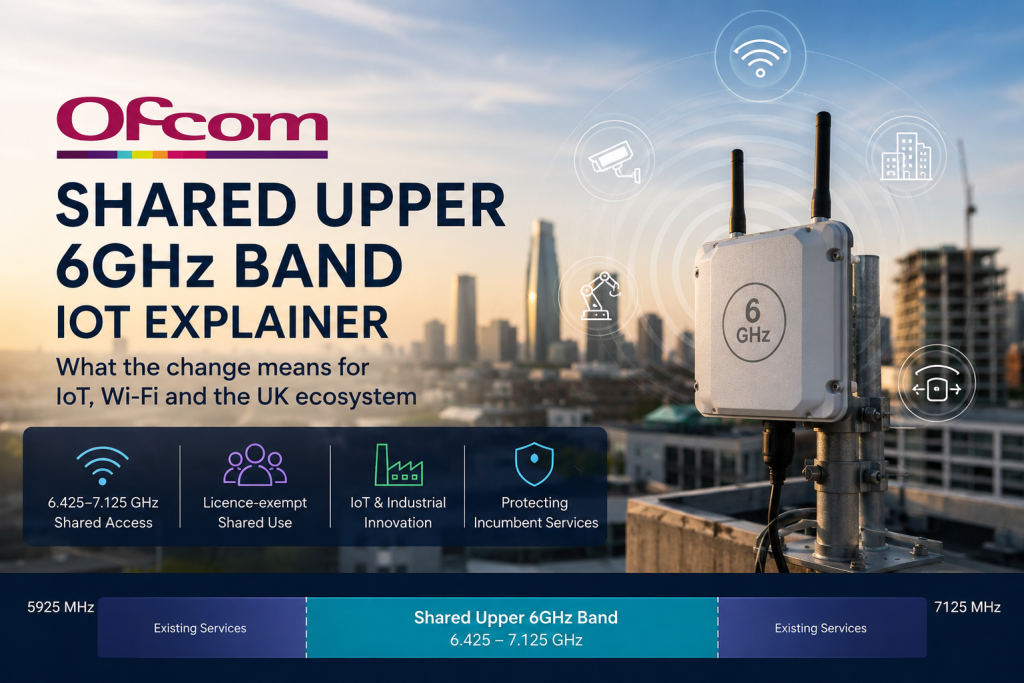
Ofcom Adopts Shared Upper 6 GHz: What the UK’s Wi-Fi and Mobile Compromise Means for IoT
On 20 July 2026, Ofcom confirmed it will let Wi-Fi and mobile networks share the Upper 6 GHz band, making the UK the first country in Europe to commit to hybrid sharing. Here is what was actually decided, how the coexistence machinery works, and why it reshapes the planning assumptions for enterprise, industrial and IoT networks over the next decade.
The decision, in plain terms
After more than two years of vision documents, consultations and industry workshops, Ofcom has stopped proposing and started deciding. Its 20 July 2026 statement confirms that the Upper 6 GHz band (6425 to 7125 MHz) will be opened to both licence-exempt Wi-Fi and licensed mobile broadband, operating side by side under a structured sharing framework. It is a genuine regulatory first for Europe, and it settles one of the most contested spectrum questions of the decade.
The headline is deceptively simple: Wi-Fi goes first, mobile follows in the 2030s, and a digital coordination system keeps the two from colliding. But the detail is where the significance lies, particularly for anyone designing networks that depend on reliable, low-latency wireless in dense environments. This is not a consumer broadband footnote. It is a structural change to how a large, valuable slice of UK airwaves will be governed for the next twenty years.
It is also worth being precise about what is now settled and what is not. The sharing model itself, the band split, and the basis on which Wi-Fi can operate are decided. The mechanism for licensing mobile in specific parts of the country is still being finalised, with a separate statement expected in autumn 2026. So this is a firm decision on the architecture, with the mobile plumbing still being fitted.
First, the spectrum geography
The 6 GHz band spans roughly 5925 to 7125 MHz and sits between the familiar 5 GHz Wi-Fi range and the much higher millimetre-wave bands used for dense urban 5G. It is prime “mid-band” real estate: high enough to carry very wide channels and enormous capacity, low enough to still be useful indoors and across a reasonable distance. That combination is exactly why both the Wi-Fi and mobile industries have spent years fighting over it.
The band divides into two halves. The Lower 6 GHz portion (5925 to 6425 MHz) was released for Wi-Fi back in 2020 and already underpins Wi-Fi 6E and Wi-Fi 7 in UK homes and offices. As part of this same round of decisions, Ofcom has also agreed to expand Lower 6 GHz beyond low-power indoor use, allowing higher-power and outdoor Wi-Fi under coordination, on a licence-exempt basis. That alone is a meaningful upgrade for campus and outdoor enterprise deployments.
The Upper 6 GHz portion (6425 to 7125 MHz) is the 700 MHz that has been in dispute, and it is the subject of the new sharing decision. Historically it has carried fixed point-to-point microwave links, fixed satellite services, radio astronomy, wireless production cameras and, notably, passive environmental sensors. Sharing it between two competing technologies without disrupting those incumbents is the hard problem Ofcom has just taken on.
6G is not 6 GHz. These two terms cause endless confusion. “6G” refers to the sixth generation of mobile technology, a future standard still being defined. “6 GHz” is a specific band of radio frequency. Some 6G services may eventually run in the 6 GHz band, but the two are not the same thing, and conflating them leads to badly wrong assumptions about timelines and capability.
The split: 160 MHz for Wi-Fi, 540 MHz for mobile
Rather than hand the whole 700 MHz block to one side, Ofcom has carved the Upper 6 GHz band in two at 6585 MHz, creating a “prioritised band split.” Each technology gets a portion where it has priority, but neither gets an exclusive lock on the airwaves.
The lower 160 MHz (6425 to 6585 MHz) is the Wi-Fi priority portion. It becomes available on the same licence-exempt basis as Lower 6 GHz. That covers low-power indoor use, the very low-power category used by devices such as mobile hotspots and augmented-reality glasses, and higher-power outdoor use where the equipment operates under coordination. For the Wi-Fi world this is an immediate, uncontested extension of the spectrum it already knows how to use.
The upper 540 MHz (6585 to 7125 MHz) is the mobile priority portion. This is where mobile operators will eventually deploy for capacity in busy locations. Crucially, Wi-Fi is not shut out of this half. Wi-Fi devices are permitted non-prioritised access to the mobile portion too, but only when they operate under coordination, so they can be moved aside in the specific places and channels where mobile later switches on. In effect Wi-Fi gets early and broad use of the whole band, on the understanding that it yields gracefully once mobile arrives.
| Segment | Range | Priority | Access basis | Realistic timing |
|---|---|---|---|---|
| Lower 6 GHz | 5925 to 6425 MHz | Wi-Fi | Licence-exempt; higher-power and outdoor under coordination | Live now, higher-power use expanding |
| Upper 6 GHz (Wi-Fi priority) | 6425 to 6585 MHz | Wi-Fi | Licence-exempt; indoor, very low power, and coordinated outdoor | Wi-Fi from around end of 2026 |
| Upper 6 GHz (mobile priority) | 6585 to 7125 MHz | Mobile | Sub-national mobile licences; Wi-Fi permitted only under coordination | Mobile after 2030; coordinated Wi-Fi sooner |
The timing gap is the single most important practical fact here. Existing low-power Wi-Fi should be able to use the Wi-Fi priority portion from around the end of 2026. Mobile, by contrast, will not realistically use its portion until after 2030, held back by the lack of network and device hardware, the need to define licensing areas, and the time incumbents need to migrate. Wi-Fi therefore gets a multi-year head start to seed the market.
Automated Frequency Coordination: the referee in the middle
None of this works without a coordination layer, and that layer is Automated Frequency Coordination, or AFC. It is the mechanism that makes “sharing” more than a hopeful word. Understanding it is essential to understanding the whole decision.
AFC is, in essence, an air-traffic-control system for radio. It is a cloud-hosted database that knows the location and operating parameters of protected services and of higher-power shared-band equipment. Before a standard-power or outdoor access point can transmit, it queries the AFC system, declares where it is, and receives back a list of channels it may use and the power it may use them at. If a protected incumbent, or later a mobile deployment, is nearby, the AFC service tells the access point to avoid those channels or to turn down its power. The device only transmits within the envelope the database allows.
Ofcom is establishing this as a managed market rather than a single national system. It has set out a multi-phase registration process through which third parties can apply to become approved AFC service providers in the UK, similar to the approach already adopted in the United States and Canada. That means AFC will be delivered by commercial operators working to Ofcom’s rules, not by the regulator running a monolithic database itself.
For low-power indoor Wi-Fi in the Wi-Fi priority portion, no AFC query is required; that use is unrestricted within its portion, exactly as Lower 6 GHz works today. AFC only becomes mandatory when you want more, either higher power and outdoor operation, or any access into the mobile priority portion. In other words, the more capability you want to unlock, the more you accept a live dependency on an external coordination service.
Why sharing is genuinely hard
It is worth being honest about the engineering. The reason regulators historically kept mobile and Wi-Fi in separate bands is that they interfere badly when their channels overlap in the same place. A high-power mobile base station and a nearby indoor access point trying to use the same frequencies can each cripple the other’s throughput. Industry trials of Upper 6 GHz coexistence have repeatedly shown severe performance degradation for both sides where channels are not properly separated, which is precisely why the band split and the coordination requirement exist.
Then there are the incumbents already living in the band, who cannot simply be ignored. Upper 6 GHz still carries a substantial number of fixed microwave links operated by a range of licensees, including broadband and telecoms operators, and Ofcom will need to manage their clearance or protection in the areas earmarked for mobile. The band is also used by fixed satellite services, by radio astronomy, which requires extremely low interference thresholds in a specific sub-range, and by wireless cameras used in programme-making and live events.
One incumbent category deserves special mention for an IoT audience: passive environmental sensing. Parts of the 6 GHz range are used for scientific measurements such as sea-surface temperature, which feed weather forecasting and climate monitoring. These passive sensors cannot simply retune or negotiate; they detect faint natural emissions and are vulnerable to interference from active transmitters. Protecting them is one of the constraints shaping how and where the band can be used, and it is a reminder that “empty” spectrum is rarely actually empty.
The dependency nobody used to have. The moment your higher-power or outdoor wireless relies on AFC, an external cloud service sits in the path of your radio planning. Channels and power ceilings can change as coordination data updates. Critics compare this to the long-standing frustration with radar-detection back-off on certain 5 GHz channels, where equipment retreats unpredictably. For consumer use this is a nuisance. For deterministic industrial and operational-technology networks, it is a design constraint that has to be planned for, not discovered in production.
Why this matters for IoT, industrial and enterprise networks
This is where the decision stops being a policy story and becomes an infrastructure story. The environments Ofcom repeatedly named as beneficiaries, sports stadiums, factories, hospitals, railway stations and universities, are not consumer living rooms. They are exactly the high-density, device-dense settings where IoT, operational technology and private networking are growing fastest, and where existing 2.4 GHz and 5 GHz capacity has run out of room.
The most immediate benefit is clean, wide-channel Wi-Fi for enterprise and industrial estates. Wi-Fi 6E and Wi-Fi 7 can run 160 MHz channels in 6 GHz without the legacy congestion that clogs the older bands. For a smart factory running dozens of automated guided vehicles, real-time machine-vision inspection, and thousands of sensors, the difference between a congested 5 GHz network and a clean 6 GHz one is the difference between best-effort and near-deterministic behaviour. Extending that spectrum with the new Wi-Fi priority portion, and with higher-power outdoor use across the wider band under coordination, gives network designers materially more headroom for dense operational-technology traffic.
The second, less obvious opportunity is on the mobile side, through the way Ofcom is licensing it. Mobile in Upper 6 GHz will be authorised sub-nationally, in defined high-density areas, with a local, first-come-first-served licensing arrangement outside those areas. A local licensing regime in valuable mid-band spectrum is the kind of mechanism that can enable private and neutral-host mobile networks, not just national operator coverage. For a large industrial campus, port, hospital or logistics hub that wants its own high-capacity private cellular layer for mission-critical connectivity, sub-national 6 GHz could eventually become a route to spectrum that was previously out of reach. That is a genuinely strategic prospect for the IoT sector, even if it is a decade out.
The third implication is a planning one. AFC introduces a new operational dependency into serious wireless design. Enterprise access points and industrial gateways that want to use higher-power or full-band operation will need native 6 GHz radios and integrated AFC client capability, plus the software agility to shift channels as coordination rules change by location. RF planning for a factory or campus can no longer assume a fixed, self-determined channel map in the shared portions of the band. It has to be designed around what the coordination system will actually permit at that site, and around the possibility that a future mobile deployment nearby changes the picture.
What network planners should do now. Treat 6 GHz capability and AFC support as procurement criteria for new enterprise and industrial wireless kit, not optional extras. Map which of your sites fall inside likely high-density mobile areas, because those are where coordinated Wi-Fi behaviour and future mobile activity will be most dynamic. And for any deployment that demands determinism, keep a coordination-independent low-power indoor layer in the Wi-Fi priority portion as your stable baseline, using the coordinated higher-power band as capacity headroom rather than as the foundation.
The international picture: why the UK went its own way
Ofcom’s decision is best understood against what the rest of the world has done, because the UK has deliberately chosen a middle path between two opposing camps.
The United States took the decisive early step, designating the entire Upper 6 GHz range for Wi-Fi back in 2020. That head start has produced a substantial device and chipset ecosystem built around Wi-Fi use of the full band, with the major silicon vendors all supporting it. Europe, by contrast, leaned the other way: a key European spectrum advisory body recommended in late 2025 that mobile operators be given priority access to the bulk of the Upper 6 GHz band, disappointing the Wi-Fi industry.
The UK has refused to pick a single winner. By splitting the band and layering coordinated sharing on top, Ofcom has tried to give the Wi-Fi ecosystem the early access and device momentum it wants, while preserving a licensed mobile capacity path for the 2030s and the eventual move toward 6G. Wider European harmonisation of a similar sharing approach is expected around 2028, and the UK’s model is likely to influence that debate. Being first gives the UK a genuine chance to shape the standards, the AFC frameworks and the vendor roadmaps that everyone else will eventually adopt.
There is a device-ecosystem wildcard here too. Upper 6 GHz mobile has more traction in some markets, notably China, but adoption today is effectively zero, while Wi-Fi silicon for the band is mature and shipping. Whether UK mobile in this band ever reaches meaningful device scale depends heavily on choices made by global handset and chipset makers, not just on Ofcom’s licensing. That uncertainty is real, and it feeds directly into the criticism of the plan.
The critics are not wrong
A responsible explainer should present the strongest objections, not just the official case, and there are two serious ones.
The first is that mobile operators may be securing the band defensively rather than because they urgently need it. The argument runs that operators are not yet fully using the spectrum they already hold, that most data demand occurs indoors over Wi-Fi anyway, and that reserving 540 MHz for mobile use that will not materialise until the 2030s effectively fences off spectrum that Wi-Fi could put to work now. On this reading, the “sharing” framing is a polite way of parking valuable airwaves. Given the momentum of the Wi-Fi device ecosystem and the near-total absence of mobile devices for the band, sceptics doubt mobile will ever reclaim much of it in practice.
The second objection is technical and goes to the heart of the coexistence machinery. Mandatory coordination, critics warn, risks making the higher-power band awkward for real-world Wi-Fi in the same way that radar-avoidance rules made certain 5 GHz channels unpopular, because equipment that unpredictably backs off is hard to rely on and hard to diagnose. If AFC proves clumsy in practice, the higher-power and full-band use that the coordination is supposed to unlock could see limited uptake, leaving the low-power indoor portion doing most of the real work.
Both critiques point to the same underlying truth: the value of this decision will be proven or disproven in deployment, not on paper. Ofcom has chosen a pragmatic compromise, and compromises by definition leave nobody able to fully exploit the band in every location. Whether hybrid sharing delivers depends on how well AFC works, how the incumbent migration is handled, and whether device makers actually build for both sides of the split.
What to watch next
For anyone tracking this for planning purposes, the near-term signals are clear. Ofcom is expected to publish its final statement on the mobile high-density areas in autumn 2026, which will confirm where and how sub-national mobile licences are awarded, and by extension where coordinated Wi-Fi behaviour will be most active. The registration of AFC service providers will proceed in parallel, and the arrival of credible commercial AFC operators is the practical trigger for higher-power and full-band Wi-Fi to become usable in earnest.
On a longer horizon, watch the device roadmaps, because silicon support is the real gatekeeper for everything on the mobile side. Watch the European harmonisation process expected around 2028, which will determine whether the UK’s model becomes a regional template or an outlier. And watch the incumbent migration, because how smoothly fixed links, satellite users and passive sensors are protected or relocated will tell you a great deal about how disruptive the transition really is.
The bottom line for the IoT and networking community is that a large, high-value band has just been opened, on terms that reward planning and punish assumptions. Wi-Fi gets a real capacity boost it can start using soon. Mobile gets a long-dated option on urban capacity and a foundation for future services. And a coordination layer that most enterprise networks have never had to think about becomes a design input for anyone deploying serious wireless in dense environments. The organisations that treat 6 GHz capability, AFC readiness and high-density-area exposure as live design questions today will be the ones best placed to exploit the multi-gigabit wireless frontier of the 2030s.
Sources include Ofcom’s 20 July 2026 statement on expanding access to the 6 GHz band, its January 2026 statement and further consultation, and its April 2026 high-density-areas consultation, alongside contemporaneous reporting from ISPreview, techUK, Computer Weekly and Telecoms.com. Band ranges, the 6585 MHz split, and timing reflect Ofcom’s published position as of July 2026. Deployment timelines and the mobile licensing approach remain subject to Ofcom’s autumn 2026 statement.


