IoT News
Thales, Singtel and Bridge Alliance Launch Multi-Operator IoT eSIM Network
Four Asia Pacific operators can now be managed through one platform, letting enterprises deploy connected hardware across borders without swapping a single SIM.
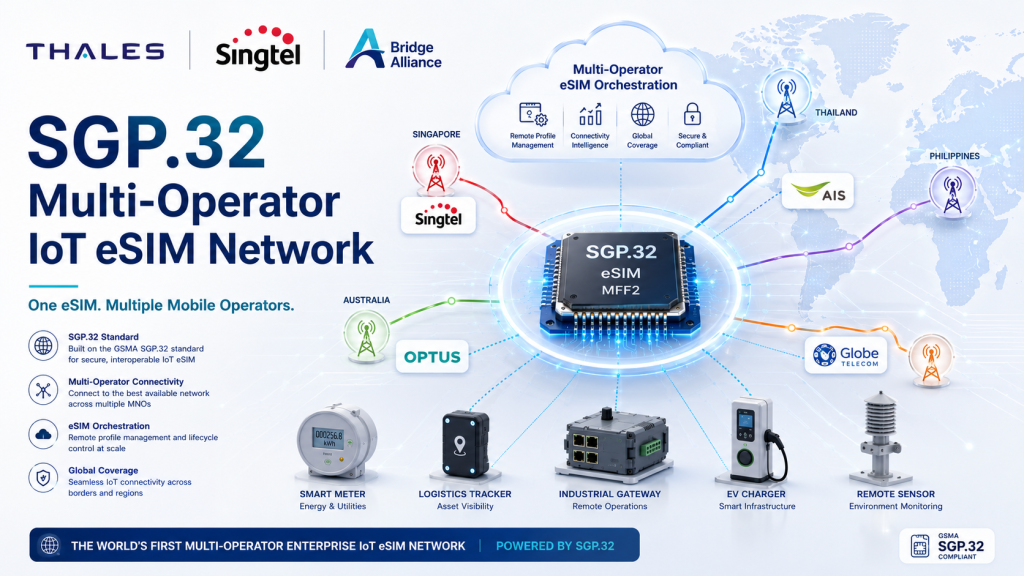
Enterprises rolling out cellular hardware across multiple countries have a new option. On 13 July, Thales, Singtel Group and the Bridge Alliance launched what they call the world’s first multi-operator enterprise IoT eSIM connectivity network. The service brings four national operators together under a single management platform, so a fleet of routers, gateways or meters can be provisioned and monitored across markets from one place.
Key facts
- Live operators are the Bridge Alliance members Singtel, Optus (Australia), AIS (Thailand) and Globe Telecom (Philippines), with further members to follow.
- Built on Thales’ end-to-end IoT eSIM solution and the GSMA’s SGP.32 remote provisioning standard.
- Interoperability testing across all four operators is complete; the platform is described as ready for commercial deployment across Asia Pacific.
- Automatic fallback and recovery are included for resilience; target use cases are connected vehicles, smart metering, retail payments and infrastructure hardware.
What it means for deployments
The practical benefit is aimed squarely at hardware operators. A device carrying a compatible eUICC ships without a fixed home network, then receives the right local operator profile over the air once it reaches its destination. For anyone who has managed a multi-country estate of gateways or smart meters, that removes two familiar headaches at once: no per-market SIM logistics, and no engineer dispatched to swap a card when a device moves or a network needs changing.
It also changes the procurement conversation. Instead of negotiating and integrating a separate connectivity contract in every territory, an enterprise can lean on one platform spanning the participating networks, with the option to switch the active operator per device as coverage or commercial terms dictate.
Part of a wider shift
The launch lands in the middle of a busy few months for operator collaboration. Verizon’s Global IoT Orchestration, pulling in Bell Canada, Telenor IoT and Singtel, has been commercial since early 2025, and in the same fortnight Telefonica Tech launched a comparable multi-operator eSIM with Thales on its Kite platform. Multi-operator eSIM is arriving from several directions at once, which puts the Bridge Alliance’s “world’s first” framing into perspective.
Our opinion
The common thread across all three launches is SGP.32. A decade ago the industry had alliances such as the Global M2M Association and the IoT World Alliance that could have delivered exactly this and did not, because an alliance is a membership list, not a mechanism. The standard is what finally supplies the mechanism, and neutral orchestration vendors such as Thales, which sits behind both this platform and the Telefonica one, supply the switchboard.
For enterprises the takeaway is practical. The technical question of moving an eSIM between networks is now settled. The question left to judge is whether operators who compete for the same accounts can sustain consistent provisioning and support across every market for the full life of a device. That is the part worth watching over the next year, not the launch-day headline.
For a fuller breakdown of how SGP.32 makes multi-operator provisioning work under the bonnet, and where these platforms are heading, we have covered the standard in detail on our sister site.