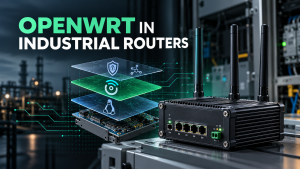
In industrial IoT, connectivity problems rarely come from a lack of speed. They come from inconsistent global hardware, limited space and power, fragile remote access methods, and devices that become difficult to manage the moment they are deployed.
Teltonika’s latest industrial routers, the RUTM16 and the RUTM20, are clearly designed with those realities in mind. Rather than chasing headline specifications, both devices focus on predictable operation, deployment flexibility, and long-term manageability.
These are not minor refreshes or niche variants. They are deliberate additions to the Teltonika portfolio, aimed at integrators, OEMs, and solution providers working with real-world constraints at scale.
A shared foundation: global, manageable, predictable
Although the RUTM16 and RUTM20 target different deployment scenarios, they share a common architectural foundation.
Both devices feature:
- Dual physical SIM support combined with eSIM capability
- The full RutOS operating system, including firewalling, VPNs, VLANs, QoS, and traffic control
- Native compatibility with Teltonika’s Remote Management System (RMS)
This matters more than it might first appear. Dual SIM and eSIM support allows connectivity strategies to be designed around resilience, supply-chain stability, and regional flexibility rather than being locked to a single operator or SKU. RutOS ensures consistent behaviour across Teltonika devices, reducing engineering overhead and simplifying support. RMS enables secure remote access and fleet management without relying on exposed services or public IP addressing.
These routers are built for managed deployments that must scale, not isolated installations that rely on local access.
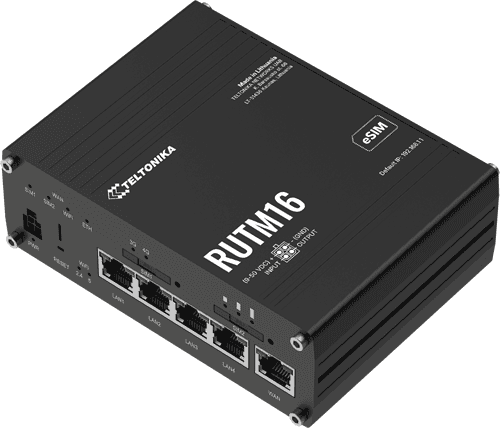
RUTM16: a global LTE Cat 6 workhorse for complex edge networks
The RUTM16 is designed for environments where LTE remains the most practical and cost-effective connectivity option, but where network requirements look more like enterprise IT than consumer broadband.
At its core is a Telit LTE Cat 6 modem, selected for its wide global band support and long-term availability. This makes the RUTM16 particularly well suited to international projects where hardware consistency over many years is a requirement rather than a nice-to-have.
Designed for demanding applications
The RUTM16 is aimed at integrators working across sectors such as:
- Robotics and automation
- CCTV and surveillance
- Transport and fleet connectivity
- Roadside and street infrastructure
- RV and mobile workspace installations
- POS systems and office backup connectivity
In these environments, stability, segmentation, and remote visibility are far more important than peak throughput figures.
Enterprise-style networking without extra hardware
One of the defining characteristics of the RUTM16 is its networking flexibility.
With five Gigabit Ethernet ports, the router can act as a compact edge switch, reducing the need for additional networking hardware. Advanced VLAN support allows clean separation between operational systems, management access, and third-party devices, helping integrators meet security and compliance requirements without complicating installations.
USB expansion adds further flexibility, allowing the router to adapt to a wide range of deployment scenarios without increasing cabinet size or complexity.
Wireless built for movement, not marketing
Dual-band Wi-Fi 5 with Mesh and Fast Roaming support ensures stable wireless connectivity in mobile or dynamic environments. This is particularly important in vehicles, temporary installations, or facilities where client devices frequently move or reconnect.
Rather than focusing on the latest Wi-Fi generation numbers, the RUTM16 prioritises predictable behaviour and reliability in real-world conditions.
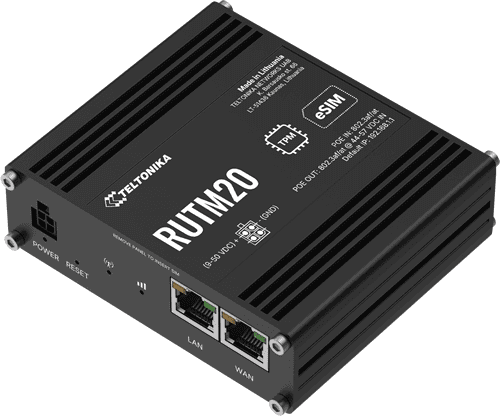
RUTM20: compact 5G connectivity where space and power are limited
The RUTM20 addresses a different but increasingly common challenge: delivering secure 5G connectivity in installations where physical space, power availability, and wiring complexity are tightly constrained.
This router is aimed squarely at system integrators, solution providers, and OEMs building compact, repeatable systems rather than bespoke network cabinets.
Built for space-constrained deployments
Typical RUTM20 use cases include:
- Digital signage enclosures
- POS and kiosk systems
- Transport and vehicle-mounted installations
- Industrial control panels
- Compact AV and IoT deployments
In these scenarios, traditional industrial routers are often too large or require power arrangements that complicate installation and maintenance.
The RUTM20’s compact enclosure allows it to be installed where larger devices simply will not fit, without sacrificing the core features expected from an industrial router.
Practical 5G, not oversized hardware
The RUTM20 uses a global Telit 5G modem to deliver high-speed cellular connectivity in a form factor suited to real installations. Integrated Wi-Fi 5 supports local access, commissioning, and client connectivity where required.
Crucially, the RUTM20 runs the same RutOS platform as larger Teltonika routers. This avoids the fragmentation that often occurs when compact devices run cut-down or proprietary software and allows mixed fleets to be managed consistently.
PoE passthrough that simplifies real installations
One of the most practical features of the RUTM20 is its active PoE in and PoE out with passthrough support.
This enables single-cable installations that can power both the router and downstream devices such as displays, cameras, or controllers. Fewer power supplies mean cleaner cabinets, faster deployments, and fewer components that can fail over time.
For AV systems, digital signage, and modular IoT installations, this can significantly reduce installation time and long-term maintenance effort.
Built for remote-first operations
Both the RUTM16 and RUTM20 are designed on the assumption that physical access will be limited, expensive, or undesirable once deployed.
Through Teltonika’s remote management ecosystem, integrators can securely:
- Access devices without exposing services to the public internet
- Monitor connectivity, signal quality, and uptime
- Push firmware updates and configuration changes remotely
- Manage large fleets of devices across regions and industries
This remote-first approach reflects how modern IoT, AV, and industrial systems are actually operated: distributed, long-lived, and expected to run with minimal on-site intervention.
A deliberate expansion of the Teltonika ecosystem
The RUTM16 and RUTM20 are not replacements for existing Teltonika routers. Instead, they fill clearly defined gaps in the portfolio.
The RUTM16 strengthens Teltonika’s global LTE offering for integrators who need enterprise-style networking behaviour over cellular links. The RUTM20 delivers practical, deployable 5G connectivity in space- and power-constrained environments where traditional hardware is impractical.
Together, they reinforce Teltonika’s approach to industrial connectivity: hardware designed around real deployment constraints, backed by consistent software and long-term manageability, rather than short-lived specifications or marketing-driven design.
Related reading