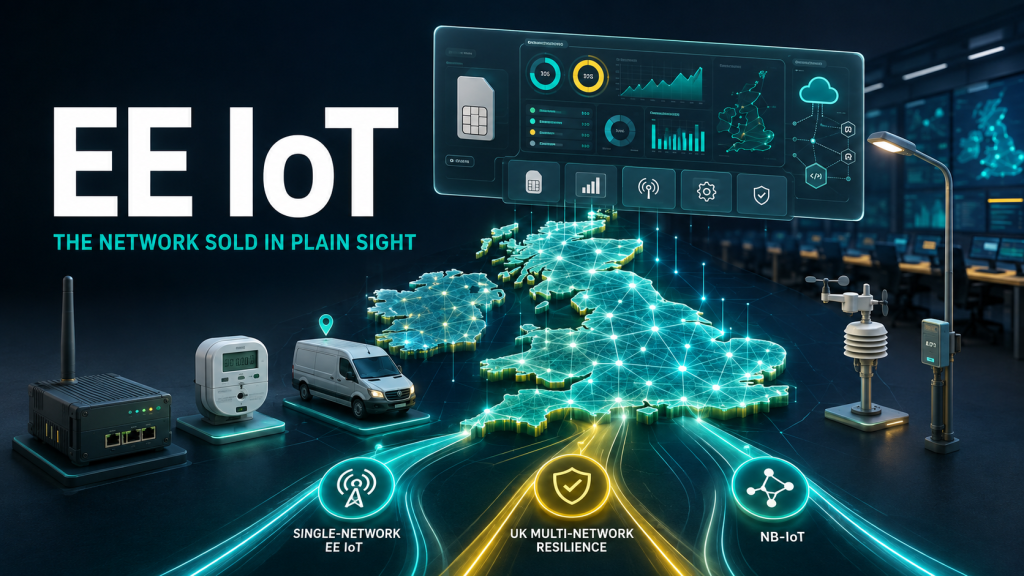
EE IoT: How BT Sells the UK’s Best-Rated Network as a Packaged IoT Business
Where O2 keeps one of Britain’s largest IoT estates almost invisible, BT and EE do the opposite. They package the EE network into a directly marketed IoT service, with named SIM products, a management portal, device accreditation and a large partner channel. This is how EE IoT actually works, and how to buy it.
EE is BT Group’s mobile network and one of the three UK network groups. Unlike O2, BT markets its IoT business openly: a managed service on the EE network, three defined SIM products, a self-service portal with APIs, IoT device accreditation, and a well-developed direct and partner channel. Of the three UK groups, EE and BT are arguably the most straightforward to actually buy IoT connectivity from.
What this covers
- EE, BT and the three-network market
- Who actually runs EE IoT
- The three EE and BT IoT SIM products
- The BT IoT Portal and management layer
- Coverage, network position and 2G shutdown
- LTE-M, NB-IoT and low-power on EE
- The channel and partner model
- EE inside multi-network IoT SIMs
- EE, BT and SGP.32
- O2, Vodafone and EE compared
- What it means if you are buying
EE, BT and the three-network market
EE is the mobile network of BT Group, and one of the three mobile network groups that now make up the UK market: Vodafone, EE and Virgin Media O2. When the IoT industry talks about multi-network connectivity in the UK, these three are the physical networks a SIM can actually run on. The old four-operator market has consolidated, and EE, sitting inside BT, is one of the three.
We have written elsewhere about how O2 runs one of Britain’s largest IoT estates while barely marketing it. BT and EE are the useful contrast. Rather than leave IoT as an unbranded wholesale layer, BT Business packages the EE network into a clearly presented IoT connectivity service, sells it directly through BT Business, and also pushes it hard through partners and resellers. If O2 is the invisible giant, EE is the network sold in plain sight.
That difference is not cosmetic. It changes how easy the network is to research, compare and buy, and it is a large part of why EE and BT feature so prominently when businesses go looking for IoT connectivity. This piece explains the structure behind EE IoT, the products, the portal, the coverage claims, the channel model, and how it all compares with the other two UK groups.
Who actually runs EE IoT
The first thing to untangle is the branding, because EE IoT is really a BT and EE proposition. EE is the network. BT Business is the organisation that markets, sells and supports the IoT service that runs on it. On BT Business’s own description, BT and EE have been developing IoT solutions for over 20 years, which is a longer continuous IoT story than the current branding suggests.
In practice, a buyer meets the service as an integrated BT and EE offer: EE provides the radio network and the coverage headline, and BT provides the connectivity management, the portal, the accreditation programme, the enterprise support and the commercial wrapper. The pages a business lands on may carry EE branding, BT Business branding, or both, but the underlying proposition is one managed IoT connectivity service on the EE network.
This matters because it explains why EE IoT feels more complete than a pure mobile-operator IoT page. It is backed by BT’s enterprise and public-sector machine: account management, security services, fixed and mobile convergence, and a large partner channel. IoT is presented as one part of a broader BT Business connectivity portfolio, not as a standalone curiosity.
The three EE and BT IoT SIM products
The clearest sign that BT treats IoT as a real product line is that it publishes three distinct IoT connectivity options, each aimed at a different job. For a buyer, this is genuinely useful, because it maps neatly onto the three most common IoT connectivity requirements: single-network performance, multi-network resilience, and low-power endurance.
| Product | Best suited to | Networks | Coverage (BT figure) |
|---|---|---|---|
| EE IoT SIM | Devices needing throughput, voice or mobility on a single strong network | EE 2G, 4G and 5G | 97% population |
| UK Multi-Network IoT SIM | Resilience-critical devices, national infrastructure, lone-worker safety | EE primary, with backup to other UK networks | 99% population |
| NB-IoT | Static, low-data sensors needing very long battery life | EE narrowband IoT | 97% population |
The EE IoT SIM is the flagship single-network option. BT quotes data speeds up to 250 Mbps on 5G, supports voice and SMS, and positions it for both static and moving devices. This is the product for anything that needs performance or mobility on the network EE has spent years marketing as the strongest in the country.
The UK Multi-Network IoT SIM is the resilience option. It runs primarily on EE but falls back to other UK partner networks when EE is unavailable, which lifts the quoted coverage to 99% and makes it BT’s recommended choice for critical national infrastructure and emergency or lone-worker scenarios where a dropped connection is not acceptable. This is BT selling multi-network resilience directly, rather than leaving it to third-party aggregators.
The NB-IoT option is the low-power play. It uses narrowband IoT for fixed, hard-to-reach, low-data assets, with BT quoting battery life of up to 15 years and very low data rates suited to meters, environmental sensors and similar standalone devices. BT also references eSIM for remote onboarding and rugged IoT SIM form factors for harsh environments.
Most operators make you work out which flavour of connectivity you need. BT presents the three main IoT connectivity patterns as named products with published coverage figures. That does not mean the figures need no scrutiny, coverage always depends on your exact sites, but it does make EE and BT unusually easy to shortlist and compare.
The BT IoT Portal and management layer
A SIM is only half of an IoT connectivity service. The other half is the platform that manages it, and here BT has a clearly named, self-service system: the BT IoT Portal, also referred to as a dedicated BT Control Centre. This is the single console through which a business monitors and manages its IoT estate.
On BT’s published specification, the portal is reached through a dedicated login and needs only an internet connection. Once authenticated, staff can manage the entire SIM base: provisioning appropriate to the SIM lifecycle, activation and suspension, monitoring and diagnostics, and control of spend and roaming. For larger or more automated deployments, BT exposes APIs so a business can integrate connectivity management directly into its own IT systems, taking on responsibility for managing subscription states programmatically.
BT also runs an IoT device accreditation programme. It can provide a list of IoT Accredited Devices that have passed network assurance testing to confirm that the SIM and device behave correctly against network protocols. For anyone who has fought a device that misbehaves on a particular network, a vendor-maintained accredited-device list is a practical, real-world advantage.
Taken together, the portal, the APIs and the accreditation programme are what separate a managed IoT connectivity service from simply selling data SIMs. It is the same category of capability that O2 offers through Smart Connect, but BT presents it more openly and ties it into a broader enterprise support structure.
Coverage, network position and 2G shutdown
EE’s marketing rests heavily on network quality. EE promotes itself as the UK’s best network on the basis of independent RootMetrics testing, a claim it has repeated across many years of reports, and it was the first UK operator to launch 5G. BT’s partner material describes EE as the UK’s number one mobile and number one 5G network, and EE has publicly targeted expanding 5G to a large majority of the UK landmass by 2028.
These are, of course, the operator’s own figures and its own framing, and the RootMetrics award is a testing result rather than an endorsement. A buyer should treat coverage headlines as a starting point and confirm real performance at their actual deployment sites, because national percentages tell you very little about one rural depot or one basement plant room.
One forward-looking point matters for IoT specifically. BT has committed to shutting down its 2G network from May 2029, as part of the wider UK move to retire legacy mobile technology, and it is focusing future investment on 4G and 5G. Any long-life IoT deployment that still relies on 2G fallback, and many older devices do, needs to plan for that transition now. This is the EE and BT version of a story playing out across all UK networks, and it is one of the strongest current reasons to favour 4G, LTE-M or NB-IoT capable hardware for new builds.
LTE-M, NB-IoT and low-power on EE
Low-power wide-area connectivity is where the UK networks made different bets, and it is worth understanding if you are choosing between them. The two standardised low-power cellular technologies, LTE-M and NB-IoT, suit different jobs. LTE-M offers higher throughput, lower latency, mobility and voice, which suits tracking, alarms and moving assets. NB-IoT trades throughput for deep indoor reach and very long battery life, which suits static, low-data sensors.
BT and EE market NB-IoT prominently as their headline low-power option, with the up-to-15-year battery framing and a focus on fixed, hard-to-reach assets. That is a different emphasis from O2, which led on LTE-M. For a buyer, the practical consequence is the same as it is across the market: the low-power technology an operator promotes shapes which devices fit it best, so you should match the module and the technology to the network rather than assume any low-power SIM behaves like any other.
As with every operator, the existence of a product page does not settle coverage, provisioning, roaming and device support for your specific deployment. Before committing an LTE-M or NB-IoT fleet to any UK network, including EE, get written confirmation of current coverage and supported bands at your sites, the exact SIM provisioning process, and the accredited or tested device list. The low-power picture changes faster than marketing pages are updated.
The channel and partner model
The most distinctive thing about EE and BT in IoT is how actively they sell through others. Alongside direct BT Business sales, BT and EE run a substantial partner and channel operation, and they recruit partners openly.
There are several routes. The EE Partner Network, or indirect partners programme, gives partners access to EE and BT devices, plans and dedicated support so they can sell under their own relationships. BT Business runs an authorised partner channel with dedicated account managers and a partner channel team. And BT Wholesale operates a Partner Plus programme that gives resellers access to the EE network so they can offer EE-powered 4G and 5G connectivity to their own customers. Specialist resellers and connectivity aggregators have joined these programmes to add EE alongside the other UK networks in their portfolios.
EE is sold directly by BT, and resold by a large channel of partners who wrap it in their own service.
This dual model is the crux of the EE IoT story and the reason it appears so widely. A business might buy EE IoT connectivity straight from BT Business, or it might buy it from a specialist IoT provider, a managed service provider or a communications reseller who runs EE underneath their own portal, pricing and support. Both are legitimate routes, and they suit different buyers. Direct gives you BT’s scale, portal and enterprise support. A good partner can give you sharper commercials, a friendlier portal, multi-network options across EE, O2 and Vodafone, and hands-on help for smaller or more specialised deployments.
The lesson for a buyer is that the badge on the SIM does not tell you the whole story. An EE-based IoT service can reach you through BT directly or through any number of partners, and the difference in price, support and flexibility between those routes can be significant.
EE inside multi-network IoT SIMs
Because EE is one of the three UK network groups, it is one of the networks a multi-network or multi-IMSI IoT SIM can select. A multi-network SIM is designed to connect to the strongest available UK network rather than lock to one, and in the UK that pool now means Vodafone, O2 and EE. So a business using a multi-network SIM through an aggregator is very likely using EE as one of its underlying networks, whether or not it thinks of itself as an EE customer.
BT itself sells a multi-network product, the UK Multi-Network IoT SIM, that leads on EE and falls back to other UK networks. Independent aggregators do the reverse, treating EE as one of several networks their SIMs can roam onto. Either way, EE is rarely absent from a serious UK multi-network proposition, because leaving out the network that markets itself as the country’s best-rated would be a hard omission to justify.
For anyone weighing single-network against multi-network, the trade-off is straightforward. A single EE IoT SIM gives you the performance and simplicity of one strong network. A multi-network SIM gives you resilience if that network has a local gap or outage, at the cost of some complexity and, often, price. The right answer depends entirely on how much a lost connection costs you.
EE, BT and SGP.32
SGP.32 is the GSMA specification for remote SIM provisioning built specifically for IoT. It lets an operator or platform add, switch and remove operator profiles on a device over the air, across a fleet, without physical access. The certification baseline is the SGP.32 version 1.2 specification, with a version 1.3 published in 2026; live deployments today are built against the version 1.2 baseline.
Through 2025 and into 2026, SGP.32 moved from specification into commercial deployment, with early live delivery from the likes of Telenor IoT and a growing set of eSIM management platforms and certified hardware. The UK network groups, EE, the combined Vodafone and Three business, and Virgin Media O2, are each described as building SGP.32-native offerings on top of their networks, at various stages of readiness.
BT and EE are well placed here. They already promote eSIM for remote IoT onboarding, they run a mature management portal with APIs, and they have the enterprise and channel structure to take a packaged offering to market. As of 2026, though, there is no fully detailed, publicly named BT or EE SGP.32 IoT product to point at in the way the specialist eSIM platforms describe theirs. It is a capability clearly on the roadmap rather than a finished shelf product, and it is one of the areas most worth watching as the standard matures.
For a deeper, term-by-term treatment of the standard itself, see the dedicated SGP.32 reference and the eUICC and eSIM standards library.
O2, Vodafone and EE compared
Put the three UK network groups side by side and they turn out to have strikingly different personalities in IoT. This is the single most useful thing to understand about the UK market, because it tells you where to look depending on what you want.
| Network group | IoT personality | How you buy | Public IoT visibility |
|---|---|---|---|
| EE and BT | Openly packaged, enterprise-backed, channel-heavy | Direct from BT Business or through a large partner channel | High |
| Vodafone | Global, branded, platform-led | Direct, recognisable global IoT proposition | High |
| O2 and Virgin Media O2 | Very large estate, wholesale-led, lightly marketed | Often through partners and aggregators | Low |
Vodafone built a global IoT brand with a named platform. O2 built an enormous IoT estate and left it mostly unbranded behind wholesale partners. BT and EE did something between the two: they took a strong UK network and wrapped it in a clearly marketed, enterprise-grade IoT service that they sell directly and, just as deliberately, through a wide partner channel. None of the three is simply better than the others. They fit different buyers, and knowing which is which saves a lot of time.
What it means if you are buying
If EE is on your shortlist, a few practical points follow from all of this. First, decide which of the three product patterns you actually need: single-network performance, multi-network resilience, or low-power endurance. BT’s three-way split makes that decision explicit, which is helpful, but the right choice still depends on your devices and sites.
Second, decide whether to buy direct or through a partner. Direct from BT Business gives you scale, the BT IoT Portal and enterprise support. A specialist partner can give you keener pricing, a simpler portal, multi-network options spanning EE, O2 and Vodafone, and closer support for smaller or more specialised fleets. For many mid-sized deployments, a partner is the better route even though the network underneath is the same.
Third, test coverage and confirm the detail in writing. Treat the 97 and 99% headlines as a starting point, verify performance at your real sites, check the accredited-device position for your hardware, and plan around the 2G shutdown if any of your devices still lean on it. And if pricing is your main question, we maintain a separate, regularly reviewed look at BT and EE IoT SIM pricing.
EE and BT are the most openly sold of the three UK IoT network groups. A strong network, a clear product set, a real management portal and an active partner channel make them easy to buy from, directly or indirectly. The work for the buyer is not finding EE IoT, it is choosing the right product, the right route to market, and confirming that the coverage headline holds where your devices actually live.