EVCharge Live UK 2026: Where EV Charging Meets Energy, Infrastructure and Connectivity
The UK charging estate is turning into one of the country's largest distributed IoT networks. Here is what to watch at the NEC in September, and why the connectivity behind the socket matters as much as the charger in front of it.
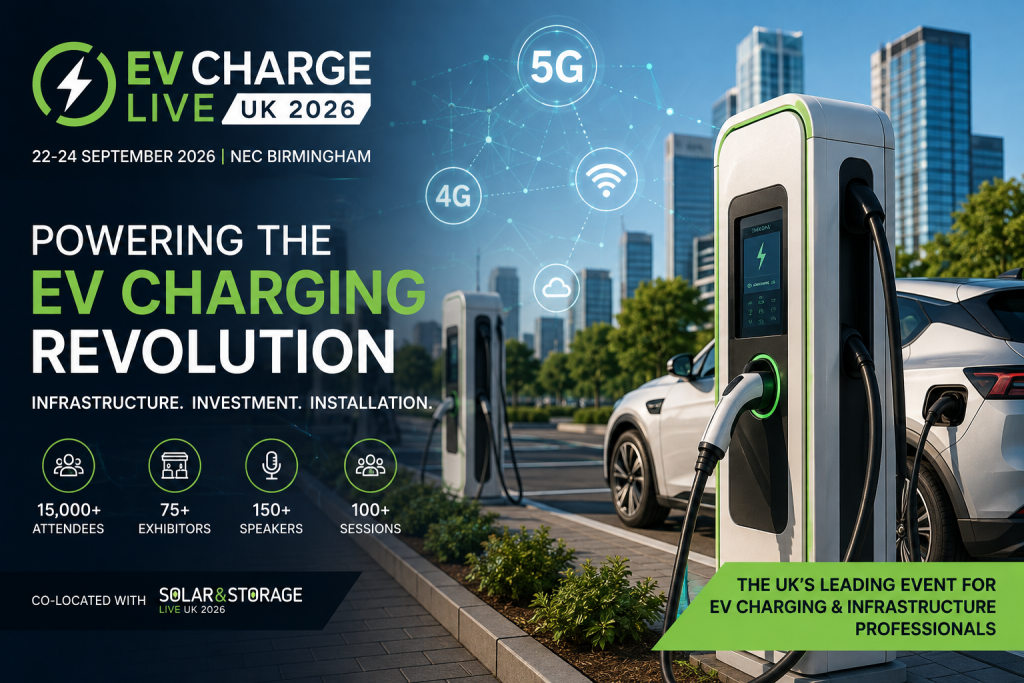
EVCharge Live UK 2026 runs 22 to 24 September at the NEC Birmingham, co-located with Solar & Storage Live UK. Beyond the chargers themselves, it is worth watching as an IoT story: every smart charge point is a connected endpoint, and reliable 4G, 5G and multi-network SIM connectivity is now part of the charging infrastructure itself.
The UK EV market is entering a different phase
The early conversation around EV charging was largely about getting enough charge points into the ground. That challenge has not gone away, but the industry has become considerably more sophisticated. Modern charging infrastructure now combines high-power electrical systems, renewable generation, battery storage, payment systems, cloud management platforms, smart charging, load balancing, data analytics and increasingly sophisticated communications.
All of that comes together at EVCharge Live UK 2026. Organised by Terrapinn and co-located with Solar & Storage Live UK, the event is aimed squarely at the organisations designing, deploying, operating and financing the next generation of charging infrastructure. For anyone working in IoT, cellular networking or remote infrastructure, though, there is another angle to the story: every smart EV charger needs to communicate. As the estate expands into motorway services, council car parks, workplaces, retail parks, hotels, fleet depots and increasingly remote sites, reliable 4G and 5G connectivity is becoming part of the charging infrastructure itself.
What is EVCharge Live UK?
EVCharge Live is a specialist business-to-business exhibition and conference dedicated to EV charging infrastructure. It is not a motor show for people choosing their next electric car. Its audience comes from the organisations that make charging work at scale: charge point operators, electrical installers, local authorities, fleet operators, property owners, energy companies, technology suppliers, consultants, infrastructure developers and investors.
The organisers frame the event around three themes: infrastructure, investment and installation. That is a fair indication of where the industry now sits. The technology largely exists; the harder questions are about deploying it reliably, economically and at sufficient scale. EVCharge Live therefore sits at the intersection of transport, energy, property and digital infrastructure.
Pairing with Solar & Storage Live UK is deliberate. A large commercial charging site might fold in solar generation, battery storage, dynamic tariffs and demand management alongside multiple high-power chargers. A fleet depot could see dozens or hundreds of vehicles arrive at roughly the same time. At that point, installing chargers is a long way from simply wiring equipment to the mains.
EVCharge Live UK 2026 at a glance
| Dates | 22 to 24 September 2026 |
| Venue | NEC Birmingham |
| Format | B2B exhibition and conference |
| Exhibitors | Over 100 |
| Speakers | More than 150 |
| Combined audience | 15,000+ (with Solar & Storage Live UK) |
| Entry | Free with registration |
| Co-located event | Solar & Storage Live UK |
Who is exhibiting?
The exhibitor list spans the full charging and energy ecosystem, with confirmed names including Tesla, Zaptec and Vestel Mobility alongside charger manufacturers, charge point operators, energy technology businesses, infrastructure companies, software specialists and communications vendors. The breadth is the point: the charging market has grown well beyond hardware.
From an IoT perspective, the presence of communications and networking vendors on an EV charging floor is quietly significant. It underlines something easy to overlook: a charging network is also a distributed communications network. A charge point physically delivers electricity, but digitally it behaves much more like an IoT endpoint.
From EV charger to intelligent energy node
Consider a typical public charging session. The driver connects the vehicle. The charger may need to identify the customer, talk to a charge point management system, authorise the transaction, determine pricing, monitor the session, record energy consumption and process payment. Meanwhile the operator wants to know the charger is healthy, and if something goes wrong the charger needs to report the fault, so the operator can restart equipment remotely, change configuration, push firmware or pull diagnostics.
At larger sites a further layer appears. The system has to work out how much power is available and distribute it intelligently between vehicles. Add solar generation and battery storage and the charging site effectively becomes a small energy management system. Connectivity is what links all of this together.
OCPP and the connected EV charger
One of the key technologies behind modern charging networks is OCPP, the Open Charge Point Protocol. OCPP provides a standardised way for charge points to communicate with central management systems. Depending on the implementation it can carry charger status, transaction information, authentication, energy metering, remote commands, smart charging and management functions. Rather than treating every charger as an isolated piece of electrical kit, an operator can manage an entire distributed estate, potentially hundreds or thousands of chargers, from a central platform.
This is classic IoT architecture: remote devices, communications networks, cloud platforms, telemetry, remote management and large volumes of operational data. And it raises the same question that faces almost every IoT deployment: how do you keep all those remote devices reliably connected?
Why 4G still matters for EV charging
For many installations, 4G LTE is an extremely practical connectivity choice. A charger does not need much bandwidth simply to talk to its management platform. OCPP messages, status updates, meter readings and authentication traffic are modest compared with something like CCTV. What matters more is availability.
A cellular connection means the charger does not have to depend on the broadband or Wi-Fi belonging to the site where it is installed. Chargers turn up in council car parks, hotels, supermarkets, railway stations, motorway services, business parks, leisure centres, residential developments, fleet depots and rural locations. Getting onto the host site's corporate network introduces technical, administrative and security complications. A dedicated cellular connection keeps the charging infrastructure separate from the customer's IT network: fit the router or embedded modem, insert the IoT SIM, configure the APN, and the charger has its own managed connection. That alone can simplify deployment considerably.
Why multi-network IoT SIMs make sense
Coverage is one of the biggest considerations when you are deploying thousands of geographically scattered devices. A network that performs perfectly at one site may be weaker at the next. This is where multi-network IoT SIMs earn their place. Rather than building the whole estate around a single mobile operator, a roaming or multi-network SIM can provide access to several available networks.
A multi-network SIM does not hop between networks every few seconds as signal strength changes. Network selection and roaming behaviour is more nuanced than that. What multiple available networks do provide is deployment flexibility and resilience across a distributed estate, which is far easier than surveying and procuring a different operator SIM for every individual site.
Public IP or private connectivity?
Not every charger needs a public IP address. Many OCPP implementations work perfectly well over standard outbound internet connectivity: the charger establishes the connection out to the cloud-based management system, rather than the platform initiating an inbound connection to the charger. In that model a standard dynamic-IP IoT SIM may be entirely suitable.
More complex installations can need additional remote access. An industrial cellular router might also serve the charger controller, payment terminal, energy meter, site controller, battery storage system, solar inverter, local monitoring equipment or a maintenance interface. In those environments, private APNs, VPN connectivity, fixed private IP addressing or secure remote-access platforms become useful. The right approach is to design connectivity around what actually needs to communicate, rather than ordering a public IP SIM for everything. We cover this trade-off in detail in our guide to private vs public IP for cellular IoT.
Industrial 4G and 5G routers for EV charging
Some chargers include cellular connectivity directly. Others use a dedicated industrial router, and at larger sites the second approach has real advantages: one router can serve multiple devices while giving the operator far more control over the network. Typical features that matter here include:
- Dual-SIM resilience – two SIMs for an added layer of redundancy.
- Automatic WAN failover – fixed Ethernet as primary with cellular as backup, or the reverse.
- VPN connectivity – secure tunnels back to central management systems.
- Firewalling – traffic restricted to the services and destinations actually required.
- Remote management – the router itself monitored and managed remotely.
- External antennas – a properly sited antenna to rescue signal from a metal cabinet, underground car park or poor-coverage location.
- Ethernet connectivity – several devices on one managed communications backbone.
This is the point where the EV charging market starts to look remarkably like industrial IoT. For a primer on the hardware tiers involved, see our explainer on cellular router classifications.
Does an EV charger actually need 5G?
Not necessarily. There is a temptation to assume every new connected product should default to 5G. For basic OCPP communication, 4G is normally more than capable; a charger does not need hundreds of megabits per second to report that vehicle 14 has drawn 32.6 kWh. 5G gets more interesting once you stop treating the charger as an isolated device.
| Scenario | Typical connectivity | Why |
|---|---|---|
| Single AC/DC charger, OCPP only | 4G LTE, dynamic IP SIM | Low bandwidth, availability matters more than speed |
| Site with meter, payment and controller | 4G router, private APN or VPN | Several devices, secure remote access needed |
| Charging hub with CCTV, ANPR, signage, storage | 5G router, possibly with failover | Multiple bandwidth-hungry systems on one site |
| Temporary or pre-fibre site | 5G primary connectivity | High-bandwidth link where fixed line is absent or delayed |
So the useful question is not really does the charger need 5G? It is could the charging site benefit from 5G? As hubs grow denser, the answer increasingly tends towards yes.
Antennas are part of the installation, not an afterthought
The SIM and router get most of the attention in cellular deployments; the antenna is too often left as an afterthought. That can be a costly mistake. EV chargers are substantial pieces of electrical equipment and frequently contain a lot of metal. Bury a cellular modem deep inside a metal enclosure and radio performance suffers. Underground car parks, remote motorway sites, rural car parks and chargers sited close to large buildings all add to the challenge.
External antennas let the radio element sit where the signal is actually usable. For harder installs, directional antennas or a proper antenna survey are worth considering. As with most IoT deployments, reliable connectivity starts with radio planning, not the SIM card. Our IoT antenna directory is a useful starting point for matching antenna type to site.
Conference highlights: Connected Infrastructure deserves attention
The conference programme runs across multiple theatres covering keynotes, connected infrastructure, charging development and power systems. Opening keynotes look at innovation and international lessons for the UK's EV future, and at the balance between central and local government in delivering charging infrastructure, which matters increasingly as local authorities shape where public charging goes and how fast networks develop. Other sessions examine what successful electrification should look like by 2030, moving the discussion beyond simply counting installed chargers towards reliability, utilisation, accessibility, grid capacity and the economics of running networks. There is also a Startups Award for early-stage companies across charging, clean mobility, solar and storage.
For IoT professionals, the Connected Infrastructure strand is arguably the most interesting. Each charging site generates operational data, each charger reports status, each payment system talks outward and each energy controller makes decisions based on demand, tariffs and available power. Connect thousands of these together and the telecommunications layer becomes critical national infrastructure in its own right.
Who should visit?
The event is aimed at industry professionals rather than the public. The obvious visitors are charger manufacturers and charge point operators, but the useful audience is far wider. Electrical contractors and EV installers can assess new hardware and installation technology. Fleet managers can look at depot charging and electrification strategy. Local authorities can meet operators, suppliers and technology providers. Property developers, landlords, hotels and retailers can explore destination charging. Energy companies can see how charging interacts with generation, storage and the grid.
And for IoT and telecommunications specialists, the draw is the connectivity requirement created by potentially hundreds of thousands of new connected charging devices. The companies building Britain's charging network are not simply installing electrical equipment. They are deploying connected infrastructure.
EV charging is becoming an IoT market
Perhaps the most interesting thing about EVCharge Live is not the chargers, but everything behind them. The physical charger is the visible part of a much larger stack: a cellular modem, IoT SIM, OCPP connection, cloud management platform, payment gateway, energy management system, smart meter, and often solar, storage and a remote maintenance platform. Multiply that across thousands of locations and EV charging becomes one of the UK's largest emerging distributed IoT environments.
That creates a hard requirement for dependable communications. For many deployments, straightforward 4G with a well-chosen IoT SIM will remain the sensible answer. Others will run fixed Ethernet with cellular failover. Larger sites will use industrial routers serving several devices, and the most sophisticated hubs may justify 5G for the whole site rather than a single charger. The communications technology does not need to be glamorous. It just needs to work, because when a driver pulls in on 8% battery, a charger that cannot reach its management or payment platform is a far more serious failure than a sensor missing a reading. That makes resilient connectivity a small but essential part of the EV transition.
Frequently asked questions
When and where is EVCharge Live UK 2026?
EVCharge Live UK 2026 takes place from 22 to 24 September 2026 at the NEC in Birmingham, co-located with Solar & Storage Live UK. Entry is free with registration.
Does an EV charger need 5G, or is 4G enough?
For basic OCPP communication, 4G LTE is normally more than adequate, since status, metering and payment traffic use little bandwidth. 5G becomes worthwhile at larger sites that combine chargers with CCTV, ANPR, signage, storage and site management, or at temporary and pre-fibre locations that need a high-bandwidth primary link.
Do EV chargers need a public IP SIM?
Usually not. Most OCPP setups work over standard outbound connectivity, with the charger connecting out to a cloud management platform, so a dynamic-IP IoT SIM is often enough. Public IP, private APNs or VPNs become relevant only where inbound remote access to multiple on-site devices is required.
Why use a multi-network IoT SIM for EV charging?
Chargers are deployed across many sites with varying coverage. A multi-network or roaming SIM can access several available networks, improving resilience and simplifying rollout compared with procuring a different operator SIM for each location. It does not switch networks second by second, but it removes the need to survey every site around one operator.


