A camera that understands what it sees, and keeps it to itself
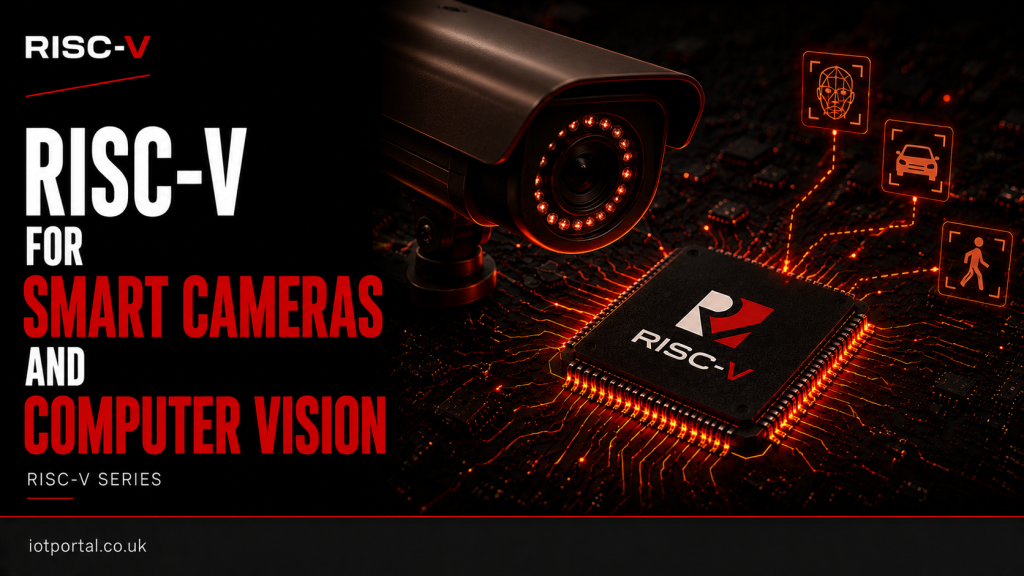
RISC-V computer vision is where all the edge-AI pieces come together in one device. A camera is a firehose of data, and the old habit of streaming every frame to the cloud is both expensive and a privacy liability. A RISC-V smart camera does the looking on the device and sends only the conclusion, and the silicon to do it is now cheap enough to put in a doorbell.
The most demanding sensor there is
Every other sensor in this series produces a trickle. A temperature reading, a vibration signature, a door state. A camera produces a torrent, thirty frames a second of millions of pixels, and that changes the maths entirely. Stream that torrent to the cloud and you are paying for the bandwidth, waiting on the round trip, and handing someone else a live video feed of wherever your camera is pointed. For a lot of applications that last part alone is a dealbreaker.
The answer is to do the seeing where the camera is. On-device computer vision means the pixels get understood on the spot, and only the meaning travels. This is the same “send only what matters” discipline from the TinyML post, but applied to the hungriest data source in the building, and it leans heavily on the vector extension, because image work is vector maths from top to bottom.
The camera pipeline, stage by stage
A smart camera is not one job but a short assembly line. First, capture: the image sensor delivers raw data, usually in a Bayer pattern that looks nothing like a photograph yet. Second, the image signal processor, the ISP, turns that raw data into a clean image, handling demosaicing, white balance, exposure and HDR. This stage is easy to overlook and it matters enormously, because doing it in dedicated hardware frees the main cores to do the clever part instead of burning cycles cleaning up pixels.
Third, inference: a vision model runs over the cleaned image and works out what is in it, a face, a number plate, three people, an empty shelf. Fourth, output: the device emits the result as metadata, and optionally encodes a clip if a human ever needs to see it. Raw frames go in one end, a short sentence comes out the other.
Why RISC-V silicon suits it
That assembly line wants a heterogeneous chip: a capture interface, a hardware ISP, an accelerator for the inference, a video codec, all on one die and talking over shared memory. That is exactly the kind of design the open ISA makes straightforward, and Espressif’s ESP32-P4 is the poster child. It carries dual RISC-V cores at 400 MHz with vector and AI extensions, a hardware ISP for the camera pipeline, a 2D pixel accelerator, an H.264 encoder and a MIPI camera interface. Earlier ESP32 parts did the ISP work in firmware and paid for it in CPU cycles; the P4 puts it in silicon.
The privacy story is the selling point. A cloud camera streams everything and asks you to trust the server. A RISC-V smart camera runs the model on the chip and sends “two people at the door,” not the footage. That is dramatically cheaper on bandwidth and a far easier conversation to have about data protection, because the sensitive part never leaves the device.
What the silicon does at each stage
| Stage | What happens | RISC-V hardware (ESP32-P4 example) |
|---|---|---|
| Capture | Sensor delivers raw Bayer frames | MIPI-CSI camera interface |
| ISP | Demosaic, white balance, exposure, HDR | Hardware image signal processor |
| Inference | Detect and classify what is in frame | Vector and AI extensions on the RISC-V cores |
| Encode | Compress a clip only if needed | Hardware H.264 encoder |
| Output | Emit the result, not the video | Metadata over the network link |
Because the P4 has no radio of its own, vision boards like the ESP32-P4-EYE pair it with an ESP32-C6 for the connection, the same split-brain arrangement covered in the ESP32 and RISC-V post. Espressif’s ESP-VISION framework ties the whole capture-to-inference flow together for developers.
Where the smart cameras go
Once vision is cheap and local, it turns up everywhere. People counting and occupancy sensing for buildings. Number-plate reading on a barrier. Defect spotting on a production line. Shelf monitoring in retail. A doorbell that tells you a parcel arrived rather than pinging you at every passing cat. In each case the device does the work a cloud service used to, without the subscription, the latency or the exposure.
Vision also rarely travels alone. The moment a machine has to see and then act on what it sees, you are into control loops and real-time response, which is the territory of the next post, RISC-V for robotics. For how vision fits the broader intelligent-edge picture, the RISC-V and IoT cornerstone holds the whole thread together.
Last updated 23 August 2026. Sources: ESP32-P4 (dual-core RISC-V up to 400 MHz, hardware ISP, vector and AI extensions, H.264 encoder, MIPI-CSI/DSI) per Espressif; ESP32-P4-EYE vision development board pairing the ESP32-P4 with an ESP32-C6 radio per Espressif, 2025; ESP-VISION edge AI and computer-vision framework per Espressif documentation, 2026.