A robot is two computers wearing one chassis
RISC-V robotics is a story about a split. A robot has to react in hard real time, where a missed deadline bends metal or hurts someone, and it has to think hard, where perception and planning chew through serious compute. Those are opposite demands, and the open ISA is unusual in being able to serve both ends of the problem.
Seeing is not the same as acting
The computer vision post ended with a machine that understands what it is looking at. A robot is what happens when that machine then has to do something about it, and that turns out to be a much harder engineering problem, because now there are motors, deadlines and consequences.
The difficulty is that a robot runs two completely different kinds of computation at once. One is deterministic control: the tight loops that drive motors and read sensors, which absolutely must finish on time, every time, because a control loop that misses its slot is not slow, it is dangerous. The other is inference: the perception, mapping and planning, which is heavy, hungry, and can afford to be a fraction of a second late now and then. Trying to run both on one undifferentiated lump of compute is how robots end up either twitchy or unsafe.
The split that keeps robots safe
The answer, learned the hard way across the industry, is to separate the two. A control plane handles the real-time work with guaranteed timing and safety checks. An inference plane handles the thinking. The inference side sends high-level intentions down, “go to that waypoint,” “pick up that object,” and the control side turns them into motion while enforcing the limits that stop the robot doing anything stupid.
The golden rule of robot compute: the AI never drives the motors directly. Perception and planning are allowed to be occasionally slow or wrong. A motor safety loop is not. So you build a deterministic control plane that always meets its deadline, put the thinking in a separate inference plane, and let the first one keep the second one honest.
Why RISC-V spans both planes
Here is where the open ISA does something few architectures can. It reaches all the way from tiny deterministic real-time cores, the sort that run bare metal or a lightweight RTOS like Zephyr with predictable timing, up to full application processors running embedded Linux and the whole robotics software stack, with vector and NPU acceleration for the inference in between. One instruction set covers the control plane, the inference plane and the accelerators, and can put them on a single heterogeneous chip with custom instructions tuned for each job.
Honesty matters here, though. Today RISC-V is genuinely strongest on the control side: motor control, safety islands, deterministic real-time loops, the cost-sensitive and safety-sensitive sockets. On high-end perception, NVIDIA’s Jetson platform and Arm still set the standard for raw inference. RISC-V is climbing that ladder from the control plane upward, not landing at the top of it. For a robotics buyer, that makes it a compelling choice for the real-time and mid-tier work now, with the AI ceiling rising steadily.
ROS 2, running on RISC-V
The framework that ties a robot’s software together is ROS, the Robot Operating System, now in its ROS 2 generation. Think of it as the robot’s nervous system: sensors, compute nodes and actuators wired into a graph, with data flowing between them deterministically. ROS 2 handles the reliable real-time execution and communication, which is exactly the discipline robotics demands.
And it runs on RISC-V today. Acceleration Robotics and Microchip published a ROS 2 release for the RISC-V-based PolarFire SoC FPGA, complete with ROS 2-compatible IP cores for robotic tasks like perception and coordinate transforms. That is a real, working robotics stack on open silicon, not a promise, and the FPGA fabric alongside the RISC-V cores is a neat fit for the custom real-time logic robots so often need.
The two planes, side by side
| Aspect | Control plane | Inference plane |
|---|---|---|
| Job | Motor loops, safety, sensor I/O | Vision, mapping, planning |
| Timing | Hard real-time, fixed deadlines | Best-effort, compute-heavy |
| Failure cost | Immediate and physical | A late or wrong decision |
| Software | Bare metal or Zephyr, ROS 2 controllers | Linux, ROS 2, AI frameworks |
| Typical RISC-V | Real-time cores, safety islands | Application cores plus vector / NPU |
The elegance of doing this on RISC-V is that both columns can be the same instruction set, which simplifies the toolchain, the debugging and the engineers you need to hire.
Where it shows up
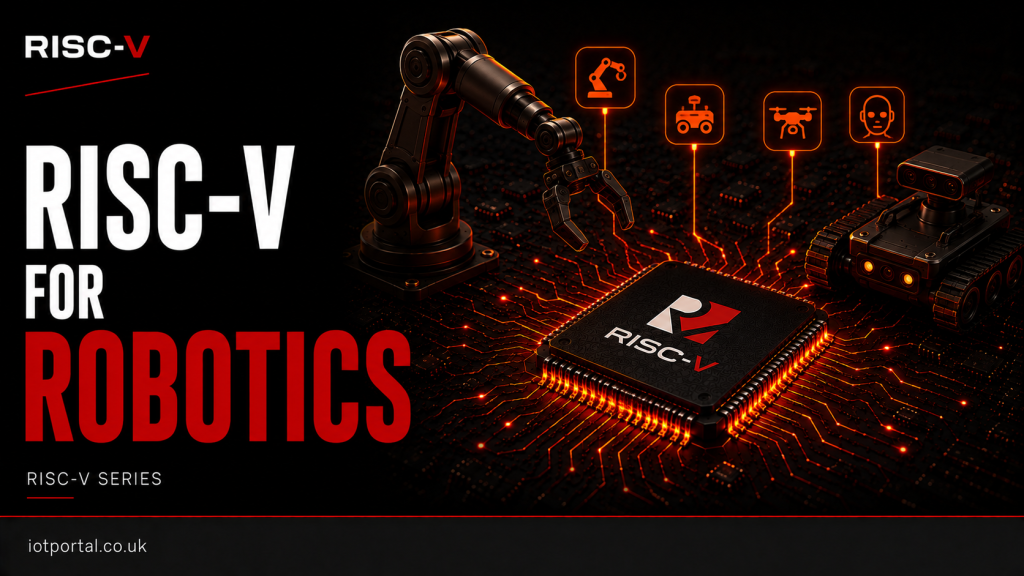
The near-term home for RISC-V in robotics is anywhere the control and cost pressures are highest: robot arms and cobots on a production line, autonomous mobile robots trundling round a warehouse, drones where every gram and milliwatt counts, and the growing category of service robots. In all of them the deterministic control layer is doing the load-bearing work, with on-device perception, drawn straight from the edge AI playbook, feeding it decisions.
It is the most physical expression yet of the thesis running through this whole series: intelligence moving into the device, right down to machines that sense and act in the world. For how that connects sensor, gateway, vision and control into one open-silicon story, the RISC-V and IoT cornerstone holds the argument together.
Last updated 23 August 2026. Sources: physical AI framing for RISC-V in robotics and autonomous systems (deterministic control, low latency, custom instructions) per Design-Reuse and Open Source For You, July 2026; ROS 2 released for the RISC-V-based Microchip PolarFire SoC FPGA with ROS 2-compatible IP cores by Acceleration Robotics and Microchip per RISC-V International; assessment that RISC-V is strongest today in deterministic control and motor control while NVIDIA and Arm lead high-end robotics inference per industry analysis, 2026.