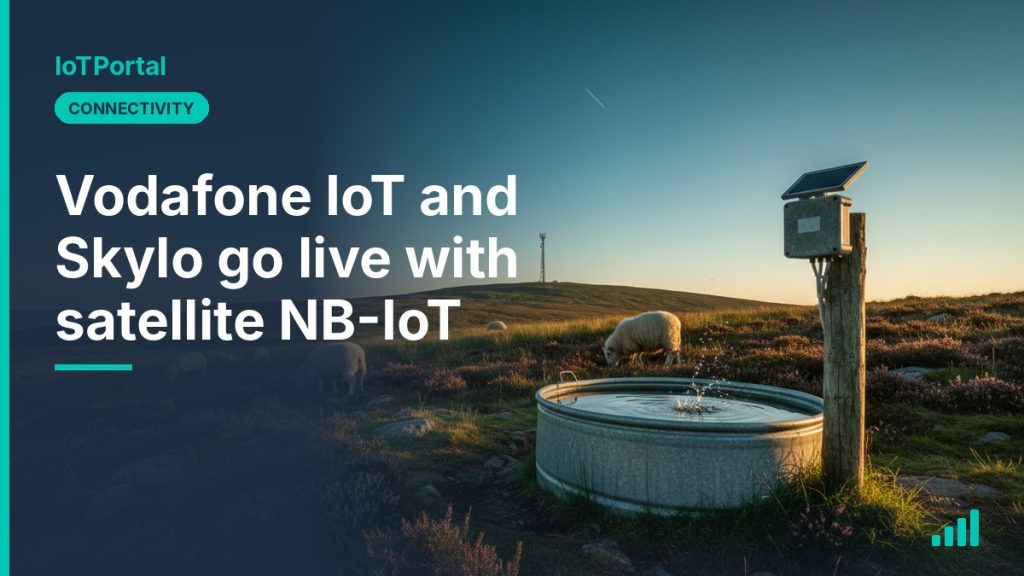
Vodafone IoT and Skylo have switched their satellite service from trial to commercial. As of this week, a device on a standard Vodafone global SIM can drop from cellular onto Skylo’s NTN NB-IoT satellite network when it runs out of signal, then hop back again, all managed from the same Vodafone IoT platform. Back in August, when I wrote up Vodafone’s NTN strategy, this was still a trial with a “commercial to follow” label on it. It’s followed. So here’s what has actually launched, what it means if you’ve got kit in the middle of nowhere, and where the rest of the NTN market has got to while we weren’t looking.
The short answer: Vodafone IoT’s hybrid cellular-satellite service with Skylo went commercial on 9 November 2026. It uses 3GPP-standard NB-IoT over satellite (NTN), works on a standard Vodafone global SIM with no separate satellite subscription or terminal, and covers Skylo’s footprint, which Skylo now puts at more than 41 countries. It’s built for small, infrequent telemetry from sensors and trackers, not for broadband or your 4G router.
What Vodafone IoT and Skylo have launched
Strip the press release language out and it comes down to four things:
- One SIM, two networks. Vodafone and Skylo have joined up their network cores, so a device on a Vodafone global SIM can move between cellular and satellite in both directions. No second SIM, no separate satellite contract.
- Standards, not a proprietary box. Skylo’s network runs to 3GPP NTN standards, which is why it slots into an existing cellular estate rather than needing its own modem and platform.
- Same platform. Satellite connections are managed from the Vodafone IoT Managed Connectivity Platform, which Vodafone says already handles over 240 million devices, up from 215 million when it signed Iridium a year ago. Your ops team doesn’t get a second dashboard to ignore.
- Bigger footprint than in January. When the partnership was announced, Skylo quoted 36 countries and around 70 million square kilometres. Skylo now says it covers more than 41 countries.
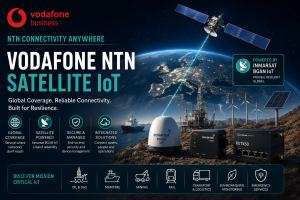
The trials that got it here were sensible, unglamorous stuff: monitoring remote storage tanks, plus micro-mobility and e-bikes, with customers in the UK, Spain, Italy and Canada. The target list for the commercial service is asset tracking, logistics, maritime, agriculture, mining and remote energy infrastructure. That’s the right list. Those are the sectors where “we lost the tank level reading for three days” actually costs somebody money.
Erik Brenneis, Vodafone IoT’s CEO, called it “only the beginning”, promising more customers, more countries and more networks. Hold that thought, because I’ll come back to the “more networks” bit.
Trial to commercial: what has changed since January
| January 2026 (announced) | November 2026 (launched) | |
|---|---|---|
| Status | Trial, commercial “in the near future” | Full commercial service |
| Skylo footprint | 36 countries, ~70 million sq km | More than 41 countries |
| SIM | Single Vodafone SIM | Standard Vodafone global SIM, existing and new customers |
| Management | Vodafone IoT Managed Connectivity Platform | Unchanged, satellite and cellular in one view |
The thing I’d underline is the “existing customers” bit. Satellite isn’t being sold as a shiny new product line you have to migrate to. If your devices are already on a Vodafone global SIM and your hardware supports NTN, this is an extension of what you’ve got. That’s how satellite should have been sold all along, and for most of the last thirty years it wasn’t.
What it means if you’ve got kit in the field
I’ve spent a long time watching people buy satellite as a magic fix and then discover what it costs per kilobyte. So, before anyone rings their account manager:
- Your device has to support NTN. A standard Vodafone SIM doesn’t turn an old NB-IoT module into a satellite modem. You need a Release 17 NTN-capable chipset with GNSS on board, because the device has to work out timing and Doppler against a satellite. If your module predates NTN, the SIM won’t save you.
- Think bytes, not megabytes. This is narrowband and delay-tolerant. Meter readings, tank levels, location pings, alarms. Design the payload for satellite from day one rather than hoping your chatty JSON will squeeze through.
- It isn’t for routers. Nobody is failing a CCTV site’s 4G router over to Skylo. If you need broadband backup at a remote site, you’re still looking at a second network, bonding or a dish. I covered the options in bonded 4G or a second router.
- Ask about the commercials. No pricing was published with the launch. Before you design around it, find out how satellite bytes are billed against terrestrial ones and whether failover traffic is capped. That’s where the business case lives or dies. Skylo’s own Vodafone IoT partner page doesn’t list covered countries or certified devices either, and warns that availability varies by country and that coverage isn’t worldwide, so run its compatibility check before you commit.
- Antenna and placement still matter. Skylo doesn’t fly its own satellites. It orchestrates capacity from partners including Viasat/Inmarsat, EchoStar, Ligado, TerreStar and Space42, and much of that is geostationary. Sky view counts. A tracker in a steel container in a ship’s hold isn’t seeing anything.
The honest pitch for NTN NB-IoT is “fewer blind spots”, which is exactly the phrase Vodafone used on LinkedIn. It’s a coverage and resilience layer for small data. Sell it as anything more and you’ll have an unhappy customer by the second invoice.
NTN market update: where everyone has got to
Vodafone going commercial is the headline, but it isn’t happening in isolation. The whole satellite IoT market has spent 2026 moving from “trial” to “launch date”, and the operators are clearly spreading their bets. Vodafone itself has Skylo live, Iridium in the pipe and AST SpaceMobile for phones.
| Player | Approach | Where it stands (November 2026) |
|---|---|---|
| Skylo | Software-led NTN across partner satellites (Viasat/Inmarsat, EchoStar, Ligado, TerreStar, Space42), 3GPP standards, no constellation of its own | Commercial with Vodafone IoT. Added Space42’s Thuraya-4 in May. Said in May it already supported 16 million devices |
| Iridium NTN Direct | Its own 66-satellite LEO network, L-band, truly global coverage | Roaming agreement with Deutsche Telekom IoT signed in September, with commercial service for DT customers scheduled for Q4 2026. Vodafone IoT integration announced in November 2025. Altair added it to the ALT1350 and ALT1550 chipsets in October |
| Sateliot | Its own LEO 5G NB-IoT constellation, sold as a roaming extension to operators | Telenor IoT partnership in May 2026. Latest launch took it to 11 satellites. UK MVNO Eseye signed up in 2024 |
| Starlink Direct to Cell | LTE from LEO on partner operators’ spectrum | Data and IoT available since 2025. Rebranded Starlink Mobile at MWC 2026. Phones first, IoT on the roadmap |
| AST SpaceMobile | Broadband direct-to-device for unmodified phones | Agreements with more than 60 operators by August 2026, including Vodafone through the SatCo joint venture |
| Amazon | Buying Globalstar for $11.6bn to build out direct-to-device | Deal announced in 2026. One to watch, given Vodafone has already lined up Amazon Leo for satellite backhaul |
Funnily enough, the post sitting under Vodafone’s announcement in my LinkedIn feed was Altair at Enlit Europe. That’s the bit of the story that gets less airtime than it should. Satellite IoT only scales when NTN is in the chipsets that end up in ordinary meters and trackers, and that’s now happening: Altair with Iridium, Nordic’s nRF9151 working with both Skylo and Iridium, and Mlink testing with Iridium since June. The networks are the press release. The silicon is the market.
The numbers
ABI Research expects satellite IoT to reach around US$1.5 billion in service revenue in 2026, and reckons standards-based NB-NTN will grow from 7.8% of satellite IoT connections in 2025 to 19.5% by 2030. Counterpoint puts satellite IoT connections above 40 million by 2030, and named Iridium and Skylo as the “Pacesetters” in its 2026 satellite IoT rankings. Different methods, same direction: proprietary satellite IoT isn’t going away, but the growth is in the standards-based stuff that looks like cellular.
My take
I like this launch, and not because it’s clever. It’s because it’s boring in the right way. A standard SIM, the same platform, the same procurement route, and satellite becomes another network the device can roam onto. That’s what 3GPP NTN was supposed to deliver, and Vodafone is one of the first big IoT operators to actually ship it commercially.
The interesting question for 2027 is what happens when Iridium goes live alongside Skylo inside the same operator. Skylo’s strength is cost and footprint in the countries it covers. Iridium’s is genuinely global, pole to pole, including the oceans, and Vodafone pitched it at the properly remote jobs: windfarms, oil pipelines, shipping and emergency services. That’s presumably what Brenneis means by “more networks”. If Vodafone ends up steering devices between the two depending on where they are, that’s multi-network satellite, and it’ll make the multi-IMSI SIM debates we have about terrestrial networks look quaint.
For UK buyers, the practical advice hasn’t changed. Most of the UK has decent terrestrial coverage, so NTN here is about the awkward edges: hill farms, reservoirs, coastal sites, anything that crosses the sea. For the bigger picture on what’s available in this country, see my UK satellite and NTN state of play.
Quick answers
What has Vodafone IoT launched with Skylo?
A commercial hybrid cellular-satellite IoT service, launched on 9 November 2026. Devices on a standard Vodafone global SIM can switch between Vodafone’s cellular networks and Skylo’s NTN NB-IoT satellite network, managed through the Vodafone IoT Managed Connectivity Platform.
Do I need a separate satellite SIM or terminal?
No separate SIM or satellite terminal is needed, but the device must have an NTN-capable NB-IoT module (3GPP Release 17 or later) with GNSS. Older NB-IoT modules without NTN support won’t connect to the satellite network.
How many countries does Skylo cover?
Skylo says its commercial NTN service now covers more than 41 countries. When the partnership was announced in January 2026, Skylo quoted 36 countries and around 70 million square kilometres.
What is NTN NB-IoT used for?
Small, infrequent data from devices outside terrestrial coverage: asset tracking, tank and meter monitoring, environmental sensors, agriculture, logistics and maritime. It is narrowband and delay-tolerant, so it isn’t suitable for video, broadband or router failover.
Is Iridium NTN Direct available on Vodafone yet?
Vodafone IoT announced its Iridium NTN Direct partnership in November 2025, with commercial service planned for 2026 after integration and testing. The first operator to confirm a commercial date is Deutsche Telekom IoT, scheduled for Q4 2026.
Sources: Vodafone IoT press releases, “Vodafone IoT and Skylo launch commercial satellite connectivity service”, 9 November 2026, and “Vodafone IoT partners with Iridium”, 4 November 2025; Skylo Vodafone IoT partner page; Vodafone IoT LinkedIn post, November 2026; Advanced Television, Telecoms.com and Mobile World Live launch coverage, November 2026; Vodafone IoT and Skylo partnership announcement, January 2026; Iridium press releases (Mlink, June 2026; Deutsche Telekom IoT and Toyota, September 2026; Altair Semiconductor, October 2026); Telenor IoT and Sateliot, May 2026; Space42 and Skylo, May 2026; Light Reading on Skylo’s FCC filing, May 2026; Starlink Direct to Cell; ABI Research satellite IoT insights, 2026; Counterpoint Research Satellite IoT Connectivity CORE Rankings 2026. Positions reflect information available in November 2026.